金融业

Search documents
GDP同比增长5.5% 上海2025年前三季度经济数据出炉
Zhong Guo Xin Wen Wang· 2025-10-22 03:50
Economic Growth - Shanghai's GDP for the first three quarters of 2025 reached 40,721.17 billion yuan, with a year-on-year growth of 5.5%, surpassing the national average by 0.3 percentage points [1][2] - The primary industry added value was 64.26 billion yuan, growing by 0.9%; the secondary industry added value was 8,448.67 billion yuan, growing by 3.9%; and the tertiary industry added value was 32,208.24 billion yuan, growing by 5.9% [1] Industrial Performance - The industrial added value in Shanghai increased by 5.2% year-on-year, with the total output value of above-scale industries growing by 5.7%, an increase of 0.1 percentage points compared to the first half of the year [1] - The three leading industries in manufacturing saw an output value growth of 8.5%, outpacing the overall growth of above-scale industrial output value by 2.8 percentage points [1] Tertiary Sector Insights - The tertiary sector's added value grew by 5.9% year-on-year, with significant contributions from the information transmission, software, and IT services sector, which saw a 15.5% increase in added value [1] - The financial sector's added value reached 6,965.27 billion yuan, growing by 9.8%, while transportation, storage, and postal services increased by 5.2% [1] Investment and Consumption - Fixed asset investment in Shanghai increased by 6.0% year-on-year, while the total retail sales of social consumer goods reached 12,302.77 billion yuan, growing by 4.3%, with an acceleration of 2.6 percentage points compared to the first half of the year [2] - The average urban survey unemployment rate in Shanghai was 4.2% [2] Financial Market and Budget - The transaction volume in major financial markets in Shanghai grew by 12.7% year-on-year [2] - Local general public budget revenue was 6,555.68 billion yuan, a 1.0% increase, while expenditures rose by 8.0% to 6,876.39 billion yuan [2]
【数据发布】2025年三季度国内生产总值初步核算结果
中汽协会数据· 2025-10-22 03:35
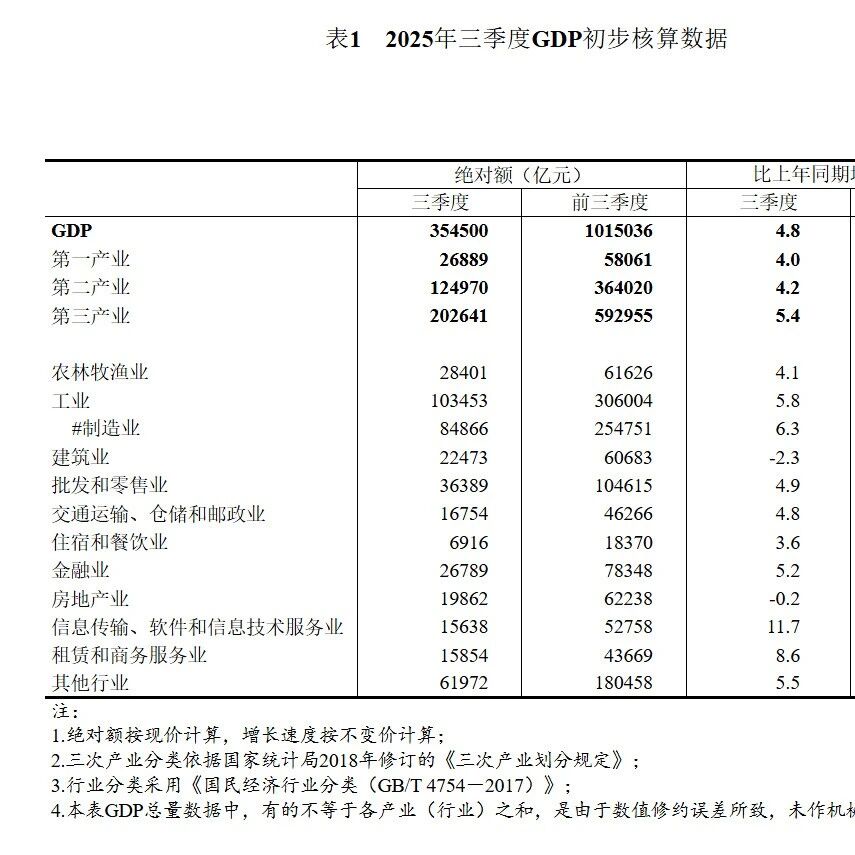
Core Viewpoint - The article provides an overview of China's GDP calculations for the third quarter of 2025, highlighting growth rates across various sectors and the overall economic performance compared to previous periods [2][4]. GDP Overview - China's GDP for Q3 2025 is estimated at 35,450 billion yuan, with a year-on-year growth of 4.8% and a growth of 5.2% for the first three quarters [2]. - The primary industry shows a growth of 4.0%, while the secondary industry grows at 4.2%, and the tertiary industry leads with a growth of 5.4% [2]. Sector Performance - The agricultural sector (including agriculture, forestry, animal husbandry, and fishery) has a GDP of 28,401 billion yuan, growing by 4.1% year-on-year [2]. - The manufacturing sector shows a robust growth of 6.3%, with a GDP of 84,866 billion yuan [2]. - The construction industry, however, faces a decline with a growth rate of -2.3% [2]. - The financial sector grows by 5.2%, contributing 26,789 billion yuan to the GDP [2]. - The information transmission, software, and IT services sector exhibits significant growth at 11.7% [2]. Historical Context - The article compares the current GDP growth rates with historical data, indicating a recovery trend from the pandemic lows in 2020, where Q1 saw a decline of -6.8% [4][6]. - The GDP growth rates for 2023 are projected to be 4.7% in Q1, 6.5% in Q2, and 5.0% in Q3, indicating a stable economic recovery [4]. Calculation Methodology - The GDP is calculated using the production method, which reflects the value added by various sectors after deducting intermediate consumption [8][9]. - The article outlines the three methods of GDP calculation: production, income, and expenditure, emphasizing the production method as the basis for the quarterly GDP data [8][9]. Data Quality and Release - The article discusses the importance of data quality in GDP calculations, ensuring that the statistics accurately reflect economic conditions [35][36]. - Quarterly GDP data is released approximately 15 days after the end of the quarter, with final revisions published in January of the following year [39][41].

北京:前三季度GDP同比增长5.6%
Yang Shi Wang· 2025-10-22 02:44
二、工业生产增势较好,高端制造引领增长 央视网消息:据北京市统计局消息,前三季度,北京全市坚决贯彻落实党中央、国务院决策部署, 坚持稳中求进工作总基调,着力落实稳经济一揽子政策措施,总体经济呈现"一季度开局良好,二、三 季度增势稳定"特征。主要领域中,工业、投资较快增长,服务业重点行业增速提高,就业物价保持稳 定,居民收入稳步增加,新质生产力不断培育壮大,高质量发展迈出坚实步伐。 根据地区生产总值统一核算结果,全市实现地区生产总值38415.9亿元,按不变价格计算,同比增 长5.6%。分产业看,第一产业实现增加值77.9亿元,下降1.1%;第二产业实现增加值5055.9亿元,增长 4.0%;第三产业实现增加值33282.0亿元,增长5.8%。 一、农业生产保持稳定,种业收入两位数增长 前三季度,全市实现农林牧渔业总产值165.7亿元,同比下降0.4%(按可比价格计算,下同)。其 中,实现农业(种植业)产值88.5亿元,受极端天气影响,下降0.8%,蔬菜(含食用菌)播种面积和产 量分别增长3.7%和4.7%;实现林业产值37.3亿元,下降13.6%;实现牧业产值30.1亿元,增长11.9%,生 猪、牛、禽出栏量 ...
中国经济顶压前行
21世纪经济报道· 2025-10-21 12:46
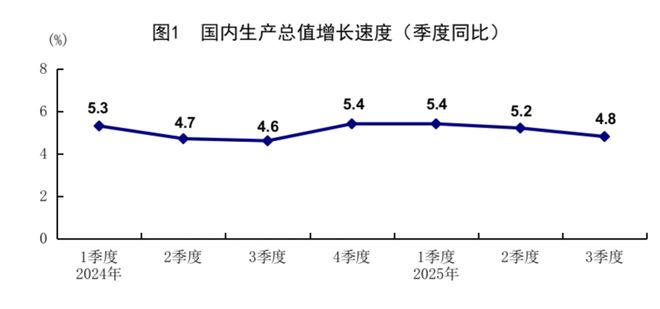
Core Viewpoint - The economic growth in the first three quarters of 2023 was 5.2%, laying a solid foundation for achieving the annual growth target of around 5% [2][10][12]. Economic Indicators - The GDP for the first three quarters reached 101.5 trillion yuan, with a year-on-year growth of 5.2%. The quarterly growth rates were 5.4% in Q1, 5.2% in Q2, and 4.8% in Q3, indicating a decline in growth [1][2]. - In Q3, industrial production maintained stability with a year-on-year increase of 6.2%, although this was a slight decrease from the first half of the year [4]. - The service sector's value added grew by 5.4% year-on-year in the first three quarters, showing overall stability [4]. - Retail sales of consumer goods increased by 4.5% year-on-year, but the growth rate fell by 0.5 percentage points compared to the first half of the year [5]. Investment Trends - Fixed asset investment (excluding rural households) decreased by 0.5% year-on-year, with infrastructure investment growing by 1.1% and real estate investment declining by 13.9% [5][11]. - The introduction of 500 billion yuan in new policy financial tools and another 500 billion yuan in local government debt limits aims to stimulate effective investment and address local fiscal challenges [1][11]. Export Performance - Exports in the first three quarters grew by 7.1%, maintaining resilience despite global uncertainties, while imports fell by 0.2% [5][6]. - The high-tech industry showed strong performance, with high-tech manufacturing value added increasing by 9.6% year-on-year [4][6]. Policy Outlook - The government is expected to implement further measures to stabilize growth, including potential interest rate cuts and support for the real estate market [2][10][12]. - The focus will be on expanding domestic demand, enhancing effective investment, and stabilizing foreign trade and investment [10][12].

日本经济走向何方?
Jin Rong Shi Bao· 2025-10-21 09:16
Group 1: Economic Overview - Japan's economy is facing complex challenges, including a depreciating yen, inflation issues, and the impact of an aging population [1][2] - The nominal GDP of Japan, when converted to USD, remains below Germany's, ranking fourth in the world economy [2] - Economic recovery is supported by improved employment conditions, increased investment demand, and growth in tourism and exports, but external pressures such as U.S. trade protectionism and global supply chain disruptions pose significant risks [2] Group 2: Industry Insights - Japan's manufacturing sector has faced disruptions due to natural disasters, leading to risks in supply chains for machinery, electronic components, and the automotive industry [3] - The service sector is showing signs of recovery, particularly in retail and dining, while the digital transformation is benefiting information and communication services [3] - The Japanese government is implementing policies to enhance economic security, promote green transformation, and accelerate digitalization in industries [3] Group 3: Sino-Japanese Economic Relations - Despite a decrease in Japan's direct investment in China, the Chinese market remains crucial for Japanese companies [4] - The RCEP framework is facilitating deeper economic cooperation between China and Japan, with opportunities for collaboration in areas like the "silver economy," carbon neutrality, and digital economy [4] - Both countries can work together to address trade protectionism and maintain regional supply chain stability [4] Group 4: AI and Technological Development - The rise of generative AI is driving global industrial transformation and altering competitive dynamics [5] - Japan is focusing on developing its generative AI capabilities, although it faces challenges in cloud services, local model competitiveness, and talent availability [5] - Future strategies should balance domestic development and international cooperation, particularly with China, to enhance Japan's international competitiveness [5]
数字化 智能化 场景化
Jin Rong Shi Bao· 2025-10-21 02:01
探索安全与效率并重的增长模式 当前,新一轮科技革命正以前所未有的广度和深度,不断影响甚至重塑全球经济和政治格局。同样,以 人工智能为代表的金融科技,不仅改变着金融服务的形态与逻辑,也在持续打破传统金融业的竞争壁 垒,推动金融业的竞争范式实现深度变革。 近日,在全球财富管理论坛·2025上海苏河湾大会上,专家学者齐聚一堂,对人工智能发展趋势及科技 赋能金融业发展等话题展开了探讨。 楼继伟举例称,以新能源汽车产业为例,其成功实践了"技术自主、供应链多元、市场全球"的立体化策 略。一方面,上半年出口量占全球市场份额的42%,动力电池国产化率超95%;另一方面,产业链中的 关键材料则通过全球化合作实现多元供应,既保障了供应链安全,又深度融入全球市场和产业生态,彰 显了中国仍是全球产业链和市场互利共赢的重要力量。 十四届全国人大常委、财经委副主任史耀斌进一步表示,中国在拥抱新技术革命的道路上凭借强大的制 造能力、超大的市场规模,推动了新技术快速产业化、加速迭代,形成了发展优势和增量财富。比如说 我们构建了全球最大、发展最快的可再生能源体系,形成了全球最大、最完整的新能源产业链,持续打 造相关数据要素的应用场景,拉动了国 ...
全年GDP增长5%左右无虞,四季度政策还会发力吗?
Sou Hu Cai Jing· 2025-10-21 01:35
Core Viewpoint - The GDP growth for Q3 2025 is reported at 4.8%, a decrease of 0.4 percentage points from the previous quarter, but the overall economic development remains stable and progressive [1] - The GDP growth for the first three quarters of the year is 5.2%, exceeding the government's target of around 5% for the year, laying a solid foundation for achieving the annual goal [1] Supply Side Analysis - Industrial production has accelerated, with the cumulative industrial added value from January to September growing by 6.2%, which is 0.4 percentage points higher than the same period last year [1] - In September, the industrial added value increased by 6.5%, up 1.3 percentage points from August [1] - The strong performance in exports and the implementation of policies to expand domestic demand, such as the "two new" policies, have contributed to the rapid growth of high-tech manufacturing and equipment manufacturing sectors [4] Demand Side Analysis - The total retail sales of consumer goods increased by 4.5% year-on-year in the first three quarters, but the growth rate in September fell to 3.0%, indicating weak recovery momentum [5][7] - Fixed asset investment decreased by 0.5% year-on-year from January to September, marking a significant slowdown [7][9] - Manufacturing investment grew by 4.0%, but this represents a decline of 1.1 percentage points compared to the previous months, continuing a six-month downward trend [9][10] Policy Measures - The government has introduced measures to stimulate investment, including the issuance of 500 billion yuan in new policy financial tools and the activation of 500 billion yuan in local government debt limits [10] - A series of consumer support policies have been rolled out, including childcare subsidies and personal consumption loans, which are expected to boost future consumption recovery [10] Economic Outlook - Analysts predict that the GDP growth rate for Q4 could reach around 4.7%, allowing for the achievement of the annual growth target of approximately 5% [11][12] - The internal driving force for economic growth is expected to strengthen, supported by structural monetary policy tools and the stabilization of the real estate market [11]
2025年三季度国内生产总值初步核算结果
Guo Jia Tong Ji Ju· 2025-10-21 01:30
Core Points - The preliminary GDP results for the third quarter of 2025 indicate a GDP of 354,500 billion with a year-on-year growth of 4.8% and a growth of 5.2% for the first three quarters [8][5][4] - The primary industry grew by 4.0%, the secondary industry by 4.2%, and the tertiary industry by 5.4% in the third quarter [8][5] - The manufacturing sector showed a robust growth of 6.3%, while the construction industry faced a decline of 2.3% [8][5] GDP Growth Rates - Year-on-year growth rates for GDP from 2020 to 2025 show fluctuations, with 2025 projected to have a growth of 5.4% in Q1, 5.2% in Q2, and 4.8% in Q3 [5][4] - The quarterly growth rates indicate a consistent recovery post-pandemic, with 2023 showing a growth of 4.7% in Q1 and 6.5% in Q2 [5][4] Industry Performance - The agricultural sector (including forestry, animal husbandry, and fishery) reported a growth of 4.1% in Q3 2025 [8] - The industrial sector, particularly manufacturing, continues to be a strong contributor to GDP, with a growth rate of 6.3% [8] - The financial sector also showed positive growth at 5.2%, while the real estate sector faced challenges with a slight decline of 0.2% [8] Data Sources and Methodology - The GDP data is calculated using the production method, which reflects the value added by various industries [12][11] - The classification of industries follows the national standards set by the National Bureau of Statistics, ensuring consistency in reporting [22][23] - The GDP figures are subject to revisions as more comprehensive data becomes available, ensuring accuracy in reflecting economic conditions [33][34]
中国经济顶压前行:前三季度增长5.2%,稳增长政策仍需加力
2 1 Shi Ji Jing Ji Bao Dao· 2025-10-20 11:24
Economic Overview - The GDP for the first three quarters of 2023 reached 101.5 trillion yuan, with a year-on-year growth of 5.2% [1][3] - The quarterly growth rates were 5.4% in Q1, 5.2% in Q2, and 4.8% in Q3, indicating a decline in growth momentum [1][3] Key Economic Indicators - Major economic indicators such as industrial output, services, retail sales, and investment showed a decline compared to the first half of the year, with Q3 GDP growth down by 0.4 percentage points from Q2 [3][4] - In September, exports increased by 8.4% year-on-year, contributing to a recovery in industrial output and service sector performance [3][4] Investment and Consumption Trends - Fixed asset investment (excluding rural households) fell by 0.5% year-on-year, with infrastructure investment growing by 1.1% and real estate investment declining by 13.9% [5][6] - Retail sales of consumer goods grew by 4.5% year-on-year, but September saw the lowest monthly growth of 3% due to factors like the timing of holidays [5][6] High-Tech Industry Performance - The industrial output value of high-tech industries grew by 6.2% year-on-year, with significant contributions from sectors like equipment manufacturing and electronics, which saw growth rates exceeding 9% [4][5] - High-tech manufacturing industries maintained a robust growth rate of 9.6%, with specific sectors like integrated circuits and biopharmaceuticals achieving double-digit growth [4][5] Policy Measures and Future Outlook - The government introduced a "two 500 billion" policy to stabilize growth, including 500 billion yuan in new policy financial tools and 500 billion yuan in local government debt limits [3][9] - Analysts expect that the implementation of these policies could significantly boost investment and support the economy in achieving the annual growth target of around 5% [9][10] Challenges and Considerations - The decline in GDP growth is attributed to weakening consumption and investment, with ongoing challenges in the real estate sector impacting consumer confidence and spending [6][7] - There is a need for continued policy support to stabilize growth, particularly in the real estate market, to enhance consumer sentiment and investment [11]
大国五年丨强国梦,从蓝图一步步走向现实
Xin Hua She· 2025-10-20 09:28
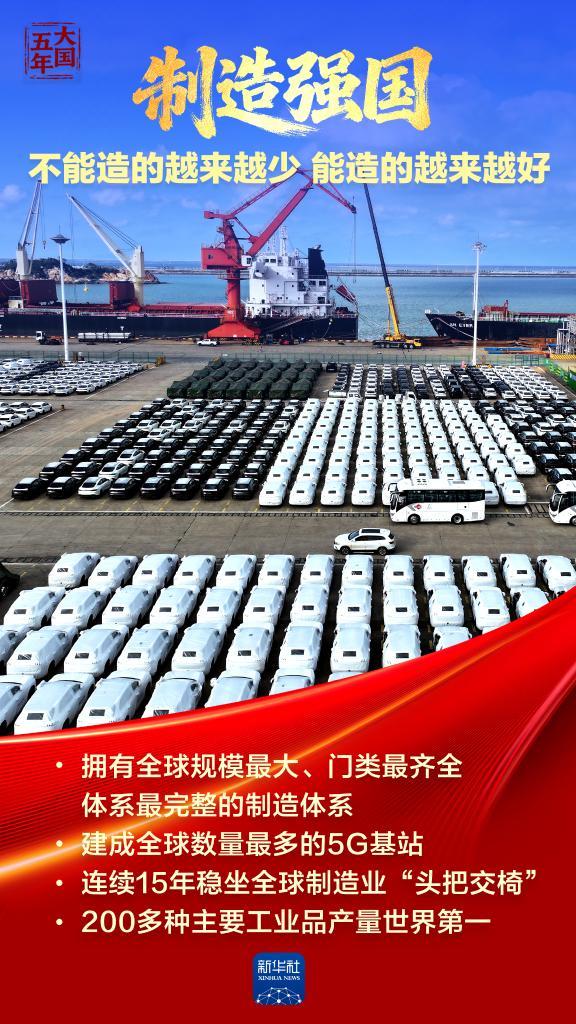
Group 1: Manufacturing Strength - China has the largest and most complete manufacturing system globally, maintaining its position as the world's leading manufacturing country for 15 consecutive years [2] - The country produces over 200 major industrial products with the highest output in the world [2] Group 2: Aerospace Achievements - The first Chinese space station "Tianhe" has been fully constructed and is operational [5] - The "Chang'e 6" mission achieved the world's first lunar sample return from the far side of the moon [5] - The "Zhurong" Mars rover successfully landed on Mars, marking multiple global firsts in manned spaceflight [5] Group 3: Transportation Infrastructure - The national comprehensive three-dimensional transportation network has a completion rate exceeding 90% [7] - China's high-speed rail operating mileage is twice that of all other countries combined [7] - The country ranks first in urban rail transit operating mileage [7] Group 4: Technological Innovation - China ranks first globally in the number of top 100 technology innovation clusters, with 26 clusters [11] - The contribution of the "new economy" to GDP has reached 18% [11] - The national comprehensive innovation capability ranking has improved to 10th place [11] Group 5: Education System - China has established the largest and highest quality education system, with a gross enrollment rate in preschool education reaching 92% [15] - The consolidation rate for compulsory education exceeds 95% [15] - The gross enrollment rate for higher education has reached 60.8% [15] Group 6: Cultural Influence - The number of registered museums in China has reached 7,046, and there are 3,248 public libraries [17] - Cultural products such as web dramas, online literature, and online games have gained significant influence overseas [17] Group 7: Maritime Economy - China's marine product output has ranked first globally for several consecutive years [19] - The national marine production value is expected to exceed 10 trillion yuan in 2024 [19] - The country accounts for approximately one-third of global shipping volume and container throughput [19] Group 8: Financial Sector - The total assets of the banking industry are nearly 470 trillion yuan, ranking first in the world [23] - China's foreign exchange reserves have maintained the world's largest scale for 20 consecutive years [23] - The stock and bond market sizes rank second globally, with advancements in green and digital finance [23]