高端装备

Search documents
基金经理投资笔记 | 2026年资产配置的基准线
Jin Rong Jie· 2025-12-24 22:37
Core Viewpoint - The article discusses the macroeconomic strategies for asset allocation in 2026, emphasizing the importance of understanding economic cycles and the need for wealth management upgrades. The proposed strategy focuses on "risk premium decline, profit increase, and structural differentiation" as a framework for investment decisions [1][2]. Growth Factors - The expected GDP growth rate for China in 2026 is projected at 4.9% for real GDP and 5.2% for nominal GDP, indicating a moderate recovery characterized by a "stable real and rising nominal" trend. This recovery is supported by proactive fiscal policies and monetary easing, which bolster infrastructure and foster new productive capacities [3]. - Corporate profitability is anticipated to improve, with industrial profit margins expected to rise to 5.8%-6.0% and return on equity (ROE) for listed companies increasing to 9.5%-10%. This improvement is driven by supply-side reforms and a recovery in pricing power [4][5]. Inflation Factors - The Consumer Price Index (CPI) is expected to rise moderately to a central value of 0.5% in 2026, while the Producer Price Index (PPI) is projected to turn positive in the third quarter, with an annual average of -0.4%. This reflects a weak recovery in consumption and a gradual alleviation of production pressures [6]. Liquidity Factors - The 10-year government bond yield is expected to remain low, with a "low first, high later" trend. The Loan Prime Rate (LPR) is likely to be reduced by 10 basis points, aligning with growth stabilization policies while avoiding excessive pressure on bank profitability [7]. - The expected range for the USD/CNY exchange rate in 2026 is between 6.80 and 7.15, indicating a "first rise, then stabilize" pattern influenced by U.S. Federal Reserve rate cuts and improved foreign exchange supply-demand dynamics [7]. Asset Allocation Recommendations - Equity assets are likely to enter a "profit-driven" golden period, with a focus on new productive capacities and cyclical goods benefiting from PPI recovery expectations. This shift represents a significant change in risk asset pricing [10]. - The bond market is expected to exhibit "low volatility and narrow fluctuations," with a balanced approach to liquidity and yield. The reduction in LPR is favorable for high-rated credit bonds [10]. - Indirect investment tools such as wealth management products and funds are expected to benefit from the "residential savings migration," serving as a transitional option for conservative investors [10]. - The attractiveness of RMB-denominated assets is expected to increase, suggesting a moderate allocation to RMB-denominated equities and bonds to mitigate single currency risks [11].


江苏新增13家省创新联合体
Xin Hua Ri Bao· 2025-12-24 22:26
Group 1 - Jiangsu Province has identified 13 innovation consortiums for 2025, involving approximately 160 innovative entities across various emerging industries such as artificial intelligence, brain-like intelligence, high-end equipment, aerospace, and biomedicine [1][2] - The 13 innovation consortiums are distributed across five cities: Nanjing, Suzhou, Wuxi, Changzhou, and Xuzhou, with 10 led by industry leaders and 3 by national innovation platforms and research institutes [1] - Notable leading units include Nanjing Lais Information Technology Co., Ltd., a pioneer in aviation transportation informatization, and Xuzhou Heavy Machinery Co., Ltd., a leader in the wheeled crane industry [1] Group 2 - The innovation consortiums focus on addressing "bottleneck" technologies that restrict industrial development, key technologies with first-mover advantages, and foundational frontier technologies, setting medium- to long-term strategic goals [2] - Since the launch of the provincial innovation consortium construction in 2022, a total of 38 provincial innovation consortiums have aggregated over 440 innovative entities, including renowned universities and leading enterprises [2]
巩固“稳”的基底 开拓“进”的新局——聚焦省委经济工作会议①
Da Zhong Ri Bao· 2025-12-24 01:15
Group 1 - The core viewpoint emphasizes the steady growth and positive trajectory of Shandong's economy, with key indicators showing resilience and improvement [1][2] - In the first eleven months, the province's industrial added value increased by 7.7%, retail sales of consumer goods grew by 5.2%, and foreign trade rose by 4.6% [1] - Shandong is set to become the third province in China and the first in the north to surpass a GDP of 10 trillion yuan, marking significant economic milestones [1] Group 2 - The "six musts" outlined in the Central Economic Work Conference are crucial for guiding Shandong's economic development, focusing on policy support, innovation, and leveraging local advantages [2][3] - The province aims to enhance its economic structure by addressing long-standing issues while also adapting to new challenges, indicating a dual focus on stability and progress [3][4] - The emphasis on "stability" includes maintaining employment, businesses, markets, and expectations, while "progress" involves implementing key industrial projects and fostering new growth drivers [4][5] Group 3 - The service sector is identified as a key engine for economic growth and job creation, with a reported 5.3% increase in revenue from the service industry in the first ten months of the year [5][6] - Despite the growth in the service sector, challenges remain regarding its overall size and quality, prompting calls for targeted strategies to enhance its development [6] - The focus on specific industries, such as wholesale and retail, finance, and transportation, highlights the need for tailored policies to boost service sector performance [6]
总体看 长期向好支撑条件没有变
Si Chuan Ri Bao· 2025-12-24 00:14
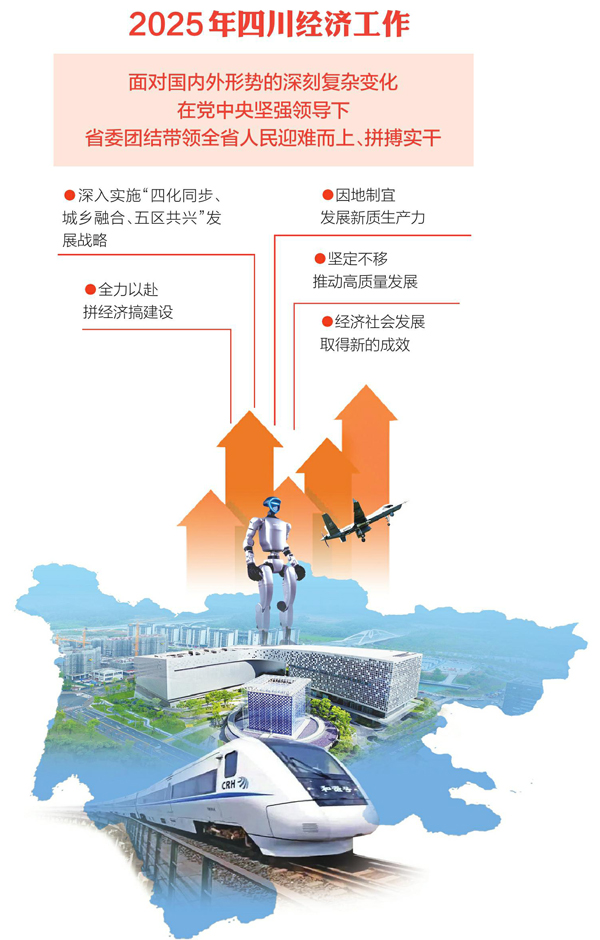
Core Viewpoint - The article emphasizes the strong resilience, vitality, and potential of Sichuan's economy, highlighting the need for continued efforts to achieve high-quality development and address various challenges as the province enters the "15th Five-Year Plan" period [3][9]. Economic Performance - In 2025, Sichuan's economy showed a positive recovery trend, with GDP growth rates of 5.5% in Q1, 5.6% in H1, and 5.5% in the first three quarters, improving its ranking among the top ten economic provinces from seventh to fifth [5]. - The province faced challenges such as international trade friction and insufficient domestic demand while undergoing structural adjustments and transformation [5]. Technological and Industrial Development - Sichuan is advancing new productive forces, exemplified by the successful operation of the world's first commercial supercritical carbon dioxide power generation unit [5]. - The province is focusing on technological innovation to drive industrial innovation, implementing the "15+N" key industrial chain strategy and promoting future industry development through major technological projects [6]. Reform and Opening Up - Significant progress has been made in reform and opening up, with 314 reform measures being advanced and notable achievements in state-owned enterprise reforms [6]. - Major events such as the Western China International Fair and the "Belt and Road" technology exchange conference have enhanced Sichuan's openness and international cooperation [6]. Regional Development - The Chengdu-Chongqing economic circle is being strengthened, with improvements in Chengdu's core functions and regional economic support [6]. - Industrial growth has been robust, with 23 consecutive months of double-digit growth in the industrial sector and a steady recovery in the service sector [6]. Social Welfare and Employment - Sichuan has made strides in social welfare, addressing employment for over 2,000 college graduates and improving the living standards of 42,000 disadvantaged individuals [7]. - The province's economic resilience and vitality are reflected in its ability to navigate challenges and achieve significant milestones during the "14th Five-Year Plan" period [7]. Future Opportunities - The "15th Five-Year Plan" period presents new opportunities for Sichuan, with a focus on enhancing its role as a key driver of western development and improving the Chengdu-Chongqing economic circle [9][10]. - The province is expected to benefit from supportive national macroeconomic policies and strategic missions assigned to it, which will facilitate further development [9][10].
德阳经开区:一座产业新城的五年答卷
Si Chuan Ri Bao· 2025-12-23 21:47
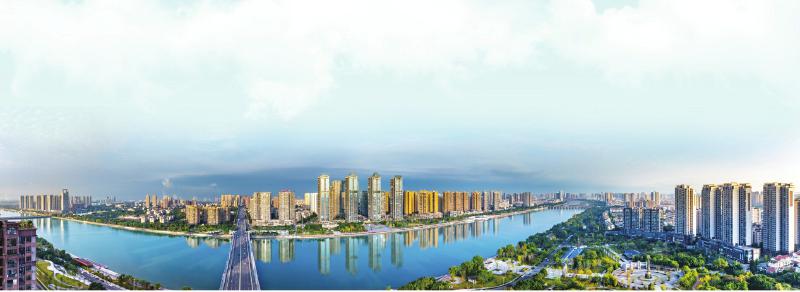
Core Insights - The Deyang Economic and Technological Development Zone has significantly contributed to the local economy, with a projected GDP of 46.5 billion yuan by 2025, representing over 68% growth compared to the end of the 13th Five-Year Plan [6] - The region has transformed its industrial structure from a focus on mechanical equipment to a dual-driven model of high-end equipment and electronic information, with over 31,000 market entities established [6][7] - The Deyang University Science and Technology Park has become a hub for innovation, signing 20 innovation projects and forming a fund matrix worth 3 billion yuan within a year [7][8] Economic Growth - The Deyang Economic Zone is expected to achieve a total industrial output value exceeding 110 billion yuan, with fiscal revenue and tax growth rates projected to exceed 70% and 50%, respectively [6] - The zone has attracted 78 quality industrial projects, contributing over 36 billion yuan in output value, with a high occupancy rate of 86.4% in standardized factories [8] - R&D investment has reached 3.8% of the total social expenditure, with a cumulative R&D expenditure of 3.54 billion yuan, marking a 94.6% increase since the end of the 13th Five-Year Plan [8][9] Innovation and Technology - The number of national high-tech enterprises has reached 85, with significant market shares in various sectors, such as over 55% for a key ceramic substrate manufacturer [9] - The region has established 141 high-level innovation platforms, achieving breakthroughs in 378 key technologies, with 68 reaching international standards [8][9] Infrastructure and Logistics - The Deyang International Railway Logistics Port has enhanced the region's connectivity, with over 440 international trains operated in the past five years, and a projected import-export total of 5.5 billion yuan by 2025 [10][11] - The logistics infrastructure includes a comprehensive road network and standardized warehouses, facilitating efficient trade and transport [10] Urban Development and Quality of Life - The urban area has expanded to 47.12 square kilometers, with a resident population of 301,000 and an urbanization rate of 97.7% [12] - Significant improvements in public amenities and environmental quality have been made, including the construction of parks and the reduction of PM2.5 levels by 31.2% over five years [6][12][14] - The region has focused on enhancing living conditions, with over 4,248 households receiving new property certificates and substantial upgrades to educational and healthcare facilities [14][15] Future Outlook - The Deyang Economic Zone aims to continue its trajectory of high-quality development, targeting a "first-class park" status with a commitment to innovation and openness [15]
今年湖南有891家上市后备企业 科创板后备军占近三成
Xin Lang Cai Jing· 2025-12-23 17:02
分行业来看,制造业仍是湖南省上市后备企业的核心支柱,共有180家,占比约两成。新材料、生物医 药、新一代信息技术、高端装备等战略性新兴产业占比高,显示湖南省在产业升级与科技创新方面的布 局。另外,人工智能领域也有多家后备军,如湖南中车智行科技有限公司、希迪智驾科技股份有限公司 等。 值得注意的是,此次科创板后备库中通过的企业,共有257家,占比约28.8%,多集中在生物医药、新 一代信息技术、高端装备、新材料、新能源等领域。 ■文/视频 全媒体记者 仝若楠 三湘都市报12月23日讯 22日,湖南省委金融办公示了2025年湖南省上市后备企业资源库入库企业名 单,共有891家企业入库,较去年增加了19家。 从地区上来看,长沙市以256家入库企业位居首位,占比约30%;株洲市、郴州市紧随其后,分别有86 家、72家;衡阳市、邵阳市、娄底市、岳阳市的上市后备企业数量超过50家;益阳市、永州市、湘潭市 的上市后备企业数量均突破40家。 ...
外资研发中心落户,深圳将给百万级奖励
2 1 Shi Ji Jing Ji Bao Dao· 2025-12-23 14:32
Group 1 - Shenzhen has introduced new measures to attract foreign investment, focusing on five key areas: promoting high-level opening-up in key sectors, optimizing the business environment, enhancing investment operation convenience, increasing financial support, and improving foreign investment promotion mechanisms [1] - The new implementation measures include 22 specific initiatives, with two new reward measures added, effective from January 1, 2026, for a duration of three years [1][2] - The measures aim to support the establishment of foreign multinational company headquarters and R&D centers, offering significant financial incentives for qualifying entities [2] Group 2 - The new policy provides a one-time reward of up to 8 million yuan for recognized foreign multinational company headquarters that achieve a minimum of 10 million USD in actual foreign investment [2] - For foreign R&D centers, a maximum one-time reward of 1 million yuan is available, with an additional 5 million yuan for those that meet specific investment criteria [2] - The trend indicates a shift in foreign investment towards high-tech sectors such as electronics, communications, and artificial intelligence, while traditional manufacturing sectors are seeing decreased interest [2][3] Group 3 - Since the beginning of the 14th Five-Year Plan, Shenzhen has established 41,000 new foreign-invested enterprises, accounting for 15.7% of the national total, with actual foreign investment nearing 300 billion yuan [3] - In the first ten months of this year, Shenzhen's actual foreign investment reached 29.7 billion yuan, an increase of 8.4% year-on-year, with high-tech industries attracting over 10 billion yuan, representing more than one-third of the total [3] - The growth rate for high-tech manufacturing investment has reached 52.7%, indicating a robust interest in advanced technology sectors [3]
智者勇进 接续奋进新江苏| 太仓擘画现代化新蓝图 在机遇叠加中锻造县域发展标杆
Yang Zi Wan Bao Wang· 2025-12-23 07:40
锚定"现代田园城、幸福金太仓"的城市总定位,太仓坚持一张蓝图绘到底。未来五年,太仓将聚焦"提速扩量、提质增效"两个导向,坚定不移做深做 实"四篇文章":更高水平打造融入上海桥头堡、以港强市枢纽城、对德合作示范区、城乡和美幸福地。这幅宏图,建立在"十四五"期间打下的坚实产业基 础和取得的卓越发展成就之上。 初冬时节,长江之畔的江苏省太仓市,处处涌动着发展的活力与丰收的喜悦。从机声隆隆的智能制造车间,到星罗棋布的德企园区;从集装箱穿梭如织 的"万里长江第一港",到诗意栖居的现代田园乡村;从直冲云霄的航空航天产业梦想,到赋能千行百业的人工智能新场景……这座以"天下粮仓"为历史底 蕴的城市,正以奋进之姿,全力冲刺"十四五"收官,并擘画着"十五五"高质量发展的崭新蓝图。 "3+3+X"体系蓬勃,锻造经济增长"关键担当" 产业体系的现代化是中国式现代化的核心。作为构建现代化产业体系的"主心骨","十四五"以来,太仓精心培育的"3+3+X"产业体系蓬勃发展,成为经济 保持高速增长的"关键担当"。 制造业是压舱石。"十四五"期间,太仓全市规上工业总产值年均增长率达9%。在这片热土上,传统产业、新兴产业、未来产业协同共进。全球 ...

上海交大未来产业母基金二期启动
FOFWEEKLY· 2025-12-23 04:20
Group 1 - The "Shanghai Jiao Tong University Future Industry Science and Technology Innovation Conference" was successfully held, co-hosted by Shanghai State-owned Capital Investment Co., Ltd. and Shanghai Jiao Tong University [2] - The Shanghai Jiao Tong University Dazero Bay Technology Innovation Fund will officially commence investment operations on December 27, 2024, leveraging the academic strengths of the university and the industrial resources of the state investment [2] - The fund has already successfully invested in 10 high-quality projects led by top scholars, covering cutting-edge fields such as integrated circuits, biomedicine, artificial intelligence, high-end equipment, and advanced materials [2] Group 2 - The "Science and Technology Innovation Rainforest Ecosystem Plan" and the "Shanghai Jiao Tong University Future Industry Mother Fund Phase II" were launched, aiming to enhance the activity of technology transfer and create a comprehensive entrepreneurial innovation atmosphere [2] - The collaboration among Shanghai Jiao Tong University, Shanghai State Investment Company, and Bank of China Shanghai Branch is expected to accelerate the transformation of scientific and technological achievements [2]


【广发宏观王丹】12月EPMI量回落、价企稳
郭磊宏观茶座· 2025-12-23 03:31
Core Viewpoint - The Strategic Emerging Industries PMI (EPMI) for December 2025 decreased by 3.6 points to 49.1, which is higher than the levels in December 2022 and 2023 but lower than the levels in other years since 2014 [1][4][7]. Summary by Sections Overall EPMI Performance - The EPMI's absolute level of 49.1 is the third lowest since data collection began in 2014, indicating a relative decline compared to historical averages [7][8]. - Among seven major sub-industries, three are above the expansion threshold of 50, while four are below, consistent with November's performance [4][8]. Key Sub-Indicators - Production volume, product orders, and export orders fell by 3.5, 5.4, and 3.0 points respectively in December [9]. - The demand decline was faster than production, leading to a significant increase in the production-to-order ratio, which reached 4.8 in December, compared to average values from 2021 to 2025 [9][10]. - The sales price index rose by 0.2 points, with notable increases in the new energy and new energy vehicle sectors, which saw price increases of 3.6 and 1.8 points respectively [9][11]. - The difficulty of obtaining loans increased by 2.9 points, indicating a slightly tighter credit environment for emerging industries compared to November [9]. Sector Performance - The biotechnology, new energy vehicles, and next-generation information technology sectors maintained high levels of prosperity, with biotechnology seeing a 2.7-point increase in its prosperity index in December [14]. - The new energy and new energy vehicle sectors experienced a decline in prosperity compared to October, but remained among the top three sectors [14]. - Other sectors such as high-end equipment, new materials, and energy conservation and environmental protection are in a contraction phase [14][15]. Future Outlook - The EPMI is expected to continue reflecting seasonal trends, with a slight decline anticipated in the manufacturing PMI for December, as historical data shows a tendency for decreases during this period [18]. - The overall economic environment remains subdued, with nominal growth stabilizing due to supply-side policies, while actual growth remains to be validated in the context of investment recovery [21].