智能硬件

Search documents
科技周报|国内最大DRAM存储芯片厂商冲刺科创板;智能眼镜首次进入国补范围
Di Yi Cai Jing· 2026-01-04 03:39
Group 1: Fire Engine as AI Cloud Partner - Fire Engine has officially become the exclusive AI cloud partner for the 2026 Spring Festival Gala of the Central Radio and Television Station [2] - The partnership will leverage cutting-edge multimodal large models and cloud computing technology to enhance the Gala's programs, online interactions, and video live streaming [2] - Fire Engine has provided technical support for Douyin's Spring Festival Gala live broadcasts over the past five years, demonstrating high concurrency capacity and stability [2] Group 2: Changxin Technology's IPO - Changxin Technology's IPO application has been accepted, aiming to raise 29.5 billion yuan [3] - The company has experienced continuous revenue growth over the past three years, but it is projected to incur significant losses exceeding 30 billion yuan from 2022 to 2024 [3] - As the largest DRAM manufacturer in China, Changxin holds a 3.97% global market share, but it still lags behind major international competitors [3] Group 3: Blue Arrow Aerospace's IPO - Blue Arrow Aerospace's IPO application has been accepted, with plans to raise 7.5 billion yuan [4] - The funds will be allocated for enhancing reusable rocket capacity and technology [4] - The company has reported increasing revenues but also significant net losses from 2022 to 2025 [4] Group 4: National Subsidy Policy for Smart Glasses - The 2026 national subsidy policy includes smart glasses for the first time, aiming to promote product innovation and market growth [7] - The subsidy for digital and smart products is set at 15% of the product price, with a cap of 500 yuan per item [7] - The inclusion of smart glasses is expected to lower consumer barriers and stimulate short-term sales, with projected significant growth in AR and AI glasses sales by 2025 [8] Group 5: Launch of 2026 National Subsidy - The 2026 national subsidy program officially commenced on January 1, with the first order successfully placed by a consumer in Guangzhou [9] - The program aims to enhance consumption convenience in rural areas and promote economic growth [9] - JD.com has committed to investing nearly 30 billion yuan to support the national subsidy initiative in rural areas [9]
李泽湘、甘洁和金沙江投了一家空间智能硬件公司,港科大系出身|硬氪首发
3 6 Ke· 2026-01-04 01:37
作者|黄楠 编辑|袁斯来 硬氪获悉,深圳市无穹创新科技有限公司(以下简称"无穹创新")近期连续完成三轮融资,累计金额达数千万元,Maple Pledge枫承资本长期出任独家私募 融资顾问。我们总结了本轮融资信息和该公司几大亮点: 融资轮次:天使+轮、Pre-A及Pre-A+轮 融资规模:数千万元 投资方:李泽湘教授旗下的XBOTPARK基金、零以创投、元禾原点广州基金、元禾原点杭州基金、金沙江联合、晨晖创投及甘洁教授旗下的知行基金 资金用途:将主要用于技术研发投入、核心团队人才扩充与全球商业化拓展 融资金额及投资机构 公司基本信息 成立时间:2020年12月 注册地址:深圳市南山区 企业定位:无穹创新是一家聚焦空间智能基础设施的硬科技企业,聚焦全自研跨本体空间智能通用硬件MetaCam,为人、机器人及智能系统提供与空间深度 交互的感知与理解能力。 技术亮点:基于"通用硬件+整机产品"的双业务布局,无穹创新构建了从算法层、硬件层到整机层的完整空间智能体系。 算法层面,公司自研并开源了一套多传感器融合算法,覆盖空间定位、环境感知、语义理解、决策规划与自主控制等环节。通过海量真实场景数据的持续训 练与优化,其跨场景 ...


AI浪潮下,支付催生新消费场景
Mei Ri Shang Bao· 2026-01-04 00:52
Core Insights - The rapid evolution of AI technology is significantly transforming the payment landscape, moving from cash payments to various advanced methods like "tap" and "AI payment" [1][2][3] Group 1: Payment Innovations - The introduction of "AI payment" by Alipay in September 2025 marks a significant milestone, enabling seamless ordering and payment through voice commands [2] - Meituan's AI Agent product "Xiao Mei" integrates AI payment with local services, attracting a large user base [2] - Rokid's smart glasses extend "AI payment" capabilities, allowing users to complete orders through voice commands while on the move [2] Group 2: Consumer Experience - In Hangzhou, the "tap" payment method has become ubiquitous, simplifying transactions across various locations, including convenience stores and street vendors [3] - The integration of "AI payment" enhances consumer experiences, allowing users to place orders without needing to interact with their phones [3] - The evolution of payment methods is shifting towards a more "invisible" experience, redefining the relationship between consumers and spending [3][4] Group 3: Future Outlook - "AI payment" is seen as a starting point for the industry's intelligent transformation, promoting smarter and more efficient consumer interactions [4] - The ongoing technological advancements and ecosystem improvements suggest that payments will evolve into a smart hub connecting people and goods, heralding a new era of consumption [4]
北京推动科技创新和产业创新深度融合 在发展新质生产力上奋勇争先
Ren Min Ri Bao· 2026-01-03 23:57
Group 1 - The core viewpoint emphasizes the importance of technological and industrial innovation in enhancing productivity and economic growth in Beijing, with a focus on building a modern industrial system aligned with new productivity standards [1][2] - Beijing's high-tech industries contribute over 40% to economic growth, with plans to establish three trillion-yuan industrial clusters and seven hundred-billion-yuan clusters during the 14th Five-Year Plan [1] - The city aims to accelerate the construction of an international technology innovation center and deepen the integration of technological and industrial innovation during the 15th Five-Year Plan [1] Group 2 - Beijing hosts four out of 21 national-level manufacturing pilot platforms, which are crucial for the transition of new products from trial to production [2] - The city plans to strengthen its pilot platform capabilities by 2027, focusing on enhancing public service functions and establishing clear development paths [2] - Companies like Beijing Yuli Technology Co., Ltd. are providing comprehensive services from research and design to mass production through their pilot platforms [2] Group 3 - Over 1,000 national-level specialized and innovative "little giant" enterprises exist in Beijing, with a strong demand for technology and innovation [3] - The city utilizes a joint funding model involving enterprises and research institutions to drive technological solutions [3] - A "pay after use" model is being explored to support the high-quality development of small and micro enterprises, allowing them to access over 440 technology achievements from universities [3] Group 4 - Beijing is fostering a competitive open innovation ecosystem with vibrant science parks and industrial bases [4] - The city encourages cross-field collaboration and the formation of innovation alliances to target future industrial directions [4] - The Changping Laboratory is making significant progress in life sciences, with research on Parkinson's disease expected to be published in top journals and applied in clinical trials [5]
YU7续航为什么好?雷军:不仅仅是电池大,是在每一个角度都进行了大规模的提升
Xin Lang Cai Jing· 2026-01-03 13:29
Core Viewpoint - Xiaomi's CEO Lei Jun highlighted the impressive battery life of the YU7 model during the first live stream of 2026, attributing it to advancements in battery size, operational efficiency, and energy conversion technology [1][4]. Group 1: Battery Technology - The YU7's strong battery life is not solely due to a larger battery but also improvements in the V6s plus operational efficiency compared to the previous generation [1][4]. - The use of silicon carbide technology enhances energy conversion efficiency, contributing to better overall performance [1][4]. Group 2: Energy Optimization - Xiaomi has implemented extensive energy optimization across various aspects, leading to unprecedented reductions in energy consumption [1][4]. - The YU7 model demonstrates exceptional performance in low-temperature conditions, showcasing the effectiveness of the energy optimization strategies [1][4].

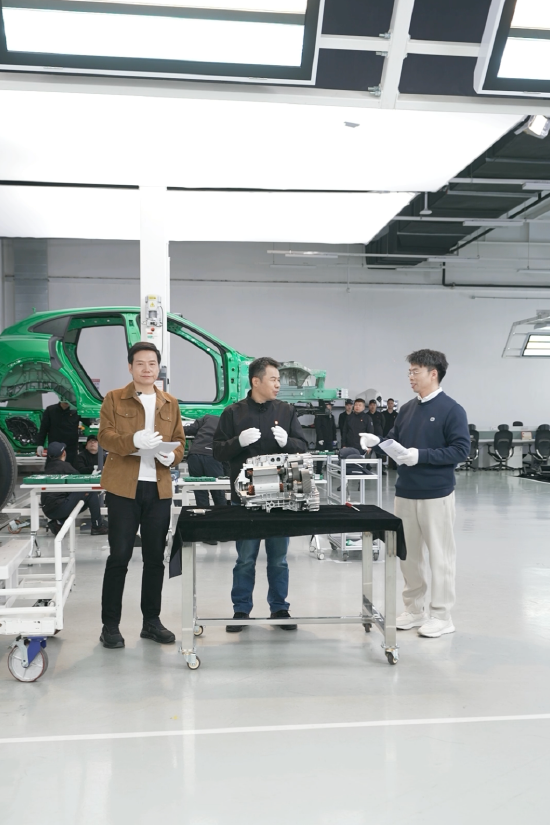
雷军:小米的空气滤网比N95口罩要强很多
Xin Lang Cai Jing· 2026-01-03 12:40
专题:雷军2026年首场直播,现场拆车 新浪科技讯 1月3日晚间消息,小米集团创始人、董事长、CEO雷军今日举行2026年第一场直播,雷军 表示,小米的空气滤网比N95口罩要强很多,N95口罩能够将颗粒物过滤到95%,我们这个可以过滤到 99.95%。 雷军还表示,因为大家买YU7多半是家庭,特别担心小朋友的健康,YU7在设计的时候就考虑了家庭的 需求。所以在健康这一点上,考虑了父母的想法,考虑到孩子的需求。他表示,小米获得了五星健康车 的荣誉,在清新空气、健康防护、绿色出行方面都获得了五星标准。(罗宁) 新浪科技讯 1月3日晚间消息,小米集团创始人、董事长、CEO雷军今日举行2026年第一场直播,雷军 表示,小米的空气滤网比N95口罩要强很多,N95口罩能够将颗粒物过滤到95%,我们这个可以过滤到 99.95%。 雷军还表示,因为大家买YU7多半是家庭,特别担心小朋友的健康,YU7在设计的时候就考虑了家庭的 需求。所以在健康这一点上,考虑了父母的想法,考虑到孩子的需求。他表示,小米获得了五星健康车 的荣誉,在清新空气、健康防护、绿色出行方面都获得了五星标准。(罗宁) 责任编辑:李铁民 责任编辑:李铁民 专题 ...

“百镜大战”2025年全面打响 AI眼镜距离“随身终端”还有多远?
Shen Zhen Shang Bao· 2026-01-01 21:54
Core Insights - The article discusses the rising trend of AI glasses, which are expected to become a significant consumer product by 2026, transitioning from concept to practical demand in 2025 [2][3] - The competition in the AI glasses market, referred to as the "Hundred Glasses War," involves major tech companies and startups, indicating a robust ecosystem development [2][9] Industry Overview - The AI glasses market is experiencing rapid growth, with a 110% year-on-year increase in global shipments in the first half of 2025 [5] - Major players include tech giants like Meta, Samsung, Xiaomi, and Alibaba, as well as specialized XR companies, all launching various AI glasses products [3][4] Technological Advancements - Significant improvements in display technology are noted, with many AI glasses featuring high-resolution and high-refresh-rate displays to enhance user experience [6] - Innovations in interaction methods, such as Meta's "Neural Band" for gesture control and various voice and touch interfaces, are transforming user engagement [7] Market Dynamics - The demand for AI glasses is driven by advancements in AI capabilities and consumer needs for hands-free information access, including real-time translation and health monitoring [4][10] - The competitive landscape is not only about hardware but also about creating a cohesive ecosystem that integrates AI glasses with other devices and services [9][10] User Experience - Comfort and weight are critical factors for user acceptance, with many companies striving to make their products lightweight and comfortable to wear [7][8] - The core positioning of AI glasses is as a "wearable service entry point," which directly influences user adoption [8] Ecosystem Development - The integration of AI glasses with various services, such as navigation and payment systems, is essential for creating a seamless user experience [10][11] - Establishing standardized communication protocols and security measures is crucial for ensuring interoperability and data safety within the AI glasses ecosystem [9]


刚刚,雷军宣布!网友:太给力了,2026年第一天就放大招
Zhong Guo Ji Jin Bao· 2026-01-01 02:07
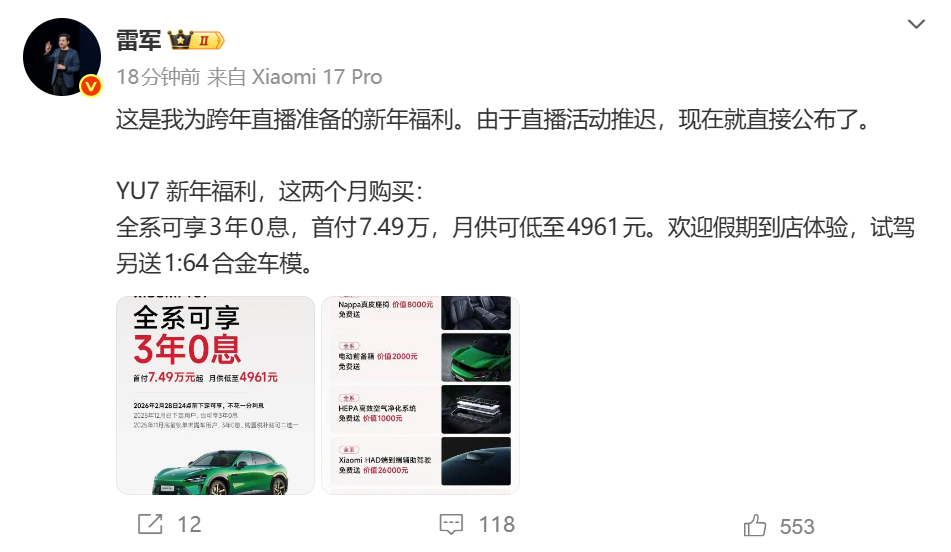
Group 1 - Xiaomi announced a New Year promotion for its YU7 model, offering a 3-year interest-free financing option with a down payment of ¥74,900 and monthly payments starting at ¥4,961 [1][3] - Customers who place an order by February 28, 2026, can enjoy up to ¥48,000 in purchase benefits, including features like Nappa leather seats and advanced air purification systems [3] - The interest-free financing is equivalent to a subsidy of approximately ¥19,125 for the YU7 Max model, enhancing the perceived value for customers [4] Group 2 - Xiaomi's YU7 model has achieved significant sales milestones, ranking first in the SUV category for four consecutive months as of November 2025 [9] - In the third quarter of 2025, Xiaomi reported a revenue of ¥1,131.2 billion, a year-on-year increase of 22.3%, with the smart electric vehicle segment generating ¥283 billion [9] - The company has expanded its retail presence, with 477 stores across 138 cities by the end of December 2025, and plans to open additional locations in January 2026 [10]
弱复苏低通胀强补贴下的内需主线
2025-12-31 16:02
Summary of Key Points from Conference Call Records Industry Overview - The focus is on the domestic consumption sector, with policies aimed at boosting consumer spending through increased household income, including minimum wage hikes and corporate salary increases [1][4][5] - The service consumption sector is expected to benefit from reforms in pricing mechanisms, particularly in healthcare, transportation, and public utilities [1][6] - The retail sector, especially offline retail, is seen as a crucial driver for domestic demand, supported by policies for updating commercial facilities [1][12] Core Insights and Arguments - **Consumer Policy Effectiveness**: The effectiveness of consumer promotion policies is anticipated to exceed market expectations, with significant increases in minimum wage across provinces, averaging over 8% [4][5] - **Service Sector Reforms**: Reforms in service pricing, particularly in healthcare, are expected to enhance the income of service providers while controlling costs for consumers [6] - **Product Innovation**: In the goods consumption sector, companies that excel in innovation and new supply offerings are likely to thrive, moving away from traditional consumer upgrade logic [7] - **Tourism and Local Policies**: Local government competition is expected to stimulate tourism, benefiting cultural and agricultural sectors [1][7] Important but Overlooked Content - **Retail Performance**: The first quarter of 2026 is projected to be crucial for leading regional retail companies, with expectations of strong performance during the extended Spring Festival [12] - **Cross-Border E-commerce**: Currency fluctuations have a limited impact on leading cross-border e-commerce companies, with exchange rate losses being a minor portion of profits [13] - **Household Appliances and Smart Hardware**: The government has initiated a subsidy plan for key household appliance categories, with a total subsidy of approximately 250 billion for 2026, focusing on six core categories [19][20] - **Food and Beverage Sector**: The food and beverage sector is expected to hit a performance bottom in Q1 2026, with a gradual recovery anticipated in Q2 [22] Future Outlook - **Economic Rebalancing**: The macroeconomic narrative is shifting towards economic rebalancing, with a cautious optimism for 2026 as supply-demand dynamics are expected to improve [8][9] - **Investment Opportunities**: Key investment opportunities are identified in sectors benefiting from government support, particularly in smart home and wearable technology, with a focus on companies like Midea, Haier, and TCL [20][21] - **Pork Market Expectations**: The pork market is showing signs of recovery, with prices expected to stabilize and improve, leading to a more optimistic outlook for the industry [16] This summary encapsulates the essential insights and projections from the conference call records, highlighting the key themes and potential investment opportunities across various sectors.
后关税时代,智能硬件创业者的下一站在哪?|2025 T-EDGE全球对话
Sou Hu Cai Jing· 2025-12-31 12:52
Core Insights - The article discusses the impact of the U.S. tariff policy on global trade, particularly how it affects Chinese companies' overseas strategies and the emergence of new players in the AI-driven hardware sector [3] - The global AI edge hardware market is projected to grow from 321.9 billion yuan to 1.22 trillion yuan from 2025 to 2029, with a compound annual growth rate (CAGR) of 40%, significantly outpacing traditional consumer electronics [3] - The shift towards AI hardware represents a new competitive landscape, where hardware is evolving from a passive tool to an active service provider that understands user needs [4][5] Group 1: Market Dynamics - The U.S. tariff changes have led to a reassessment of overseas markets, with many companies considering alternatives to the U.S. market while still recognizing its significance due to high consumer willingness to pay [6] - Despite tariff fluctuations, Chinese companies maintain profitability due to advantages in supply chains, talent pools, and rapid product iteration compared to Silicon Valley [4][6] - The AI hardware sector is characterized by challenges such as data scarcity and the need for significant computational power, which can increase costs and limit product usability [5][34] Group 2: Entrepreneurial Challenges and Opportunities - Entrepreneurs in the AI hardware space face hurdles related to proprietary data availability and the complexity of enhancing user experience through AI [5][35] - The need for collaboration with medical professionals and data experts is emphasized as a strategy to overcome challenges in product development and user engagement [5][35] - The article highlights that addressing these challenges can lead to unique value propositions that differentiate products in the market [35] Group 3: Innovation and Product Development - The article outlines a shift in product development strategies, where crowdfunding platforms like Kickstarter are utilized for market validation and user feedback [7][12] - Companies are encouraged to adopt a direct-to-consumer (DTC) approach, leveraging community engagement and social media to enhance product visibility and user interaction [13][14] - The importance of understanding local market dynamics and consumer behavior is stressed, particularly in the context of product localization and cultural adaptation [18][25] Group 4: Future Directions and Strategic Insights - The establishment of innovation centers, such as the one in Silicon Valley, aims to facilitate connections between entrepreneurs and overseas resources, enhancing market entry strategies [28] - The integration of AI into hardware is seen as a critical factor for future success, with a focus on creating seamless user experiences that address real-world problems [33][36] - The article concludes with a call for entrepreneurs to navigate the complexities of AI and hardware integration while ensuring compliance with varying international regulations [36]