
石化化工

Search documents
洋浦经开区近零碳园区建设方案征求意见
Zhong Guo Hua Gong Bao· 2025-08-18 13:33
Core Viewpoint - The Hainan Province Danzhou City Ecological Environment Bureau has released a draft plan for creating a near-zero carbon park in the Yangpu Economic Development Zone, aiming for low carbon peak by 2030 and near-zero carbon by 2060 [1] Short-term Goals (2025-2027) - The plan encourages new data centers to increase the proportion of green electricity and aims to enhance green electricity consumption in key new projects [2] - It promotes the construction of wind and solar power projects, accelerates the commissioning of existing wind power projects, and pushes for new project development [2] - The plan includes the initiation of green hydrogen energy demonstration projects and aims to cleanly and efficiently utilize fossil energy while gradually reducing coal consumption [2] - It explores hydrogen energy applications, including the entire hydrogen production, storage, transportation, and utilization chain, and promotes offshore wind power hydrogen production [2] - The establishment of a carbon emission management system in the park and the implementation of carbon budget management mechanisms are also highlighted [2] Medium-term Goals (2028-2030) - The city plans to steadily advance offshore wind power development and integrate planning, construction, and grid connection [3] - It aims to build a comprehensive energy supply system based on the green development needs of the petrochemical industry and establish a regional hydrogen pipeline [3] - The plan focuses on low-carbon transformation of the park and the cultivation of benchmark enterprises for collaborative transformation [3] - It emphasizes the development of low-energy, low-pollution, and high-value-added emerging industries, particularly in new energy and digital economy sectors [3] - The Danzhou City Ecological Environment Bureau will implement coordinated control of carbon dioxide and pollutants while promoting energy conservation, pollution reduction, carbon reduction, and green growth [3]
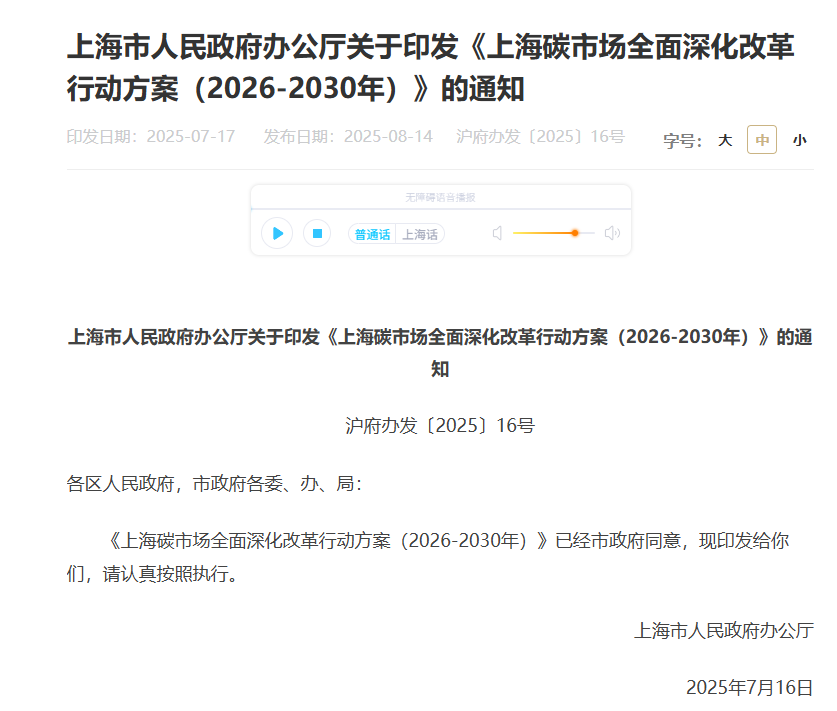
上海:丰富碳金融产品和服务体系
Zhong Guo Zheng Quan Bao· 2025-08-14 20:16
Core Viewpoint - The Shanghai Municipal Government has issued the "Action Plan for Comprehensive Deepening Reform of the Shanghai Carbon Market (2026-2030)" aimed at establishing a carbon pricing mechanism centered around the carbon market, with the goal of making Shanghai a significant international hub for carbon trading, finance, pricing, and innovation [1] Group 1: Carbon Market Development - The action plan emphasizes the enhancement of the carbon emission trading market, including the establishment of a total quota management system and a reserve quota adjustment mechanism [1] - It proposes a dual control system for carbon emissions, linking total emissions and intensity, and aims to reserve development space for strategic emerging industries [1] - The market coverage will be gradually expanded, with reduced thresholds for high-energy industries and public institutions starting from 2026 and 2028 respectively [1] Group 2: Voluntary Emission Reduction Initiatives - The plan encourages enterprises to establish product carbon footprint management systems and set greenhouse gas emission control targets to achieve net-zero emissions [2] - It aims to create a sustainable management mechanism for carbon inclusivity, focusing on areas like green travel and resource recycling [2] - The action plan also seeks to innovate carbon inclusivity incentive mechanisms, including the development of a personal carbon credit assessment system [2]
上海:自2026年起,石化等高载能行业、数据中心的纳管门槛降至年排放1万吨二氧化碳当量
Xin Hua Cai Jing· 2025-08-14 05:18
Core Viewpoint - Shanghai has issued the "Action Plan for Comprehensive Deepening Reform of the Shanghai Carbon Market (2026-2030)", focusing on enhancing the carbon emission trading market and promoting voluntary greenhouse gas reduction initiatives [1][2]. Group 1: Key Actions - The Action Plan emphasizes three main actions: improving the carbon emission trading market, promoting voluntary greenhouse gas reduction, and enhancing innovation capabilities within the carbon market [1]. - It outlines 16 key reform tasks, including establishing a total quota management system, gradually expanding market coverage, optimizing greenhouse gas emission accounting and reporting methodologies, and increasing the proportion of paid allocation [1][2]. Group 2: Market Coverage Expansion - The plan aims to lower the entry threshold for high-energy-consuming industries, such as petrochemicals and data centers, to an annual emission of 10,000 tons of CO2 equivalent starting in 2026 [2]. - By 2028, public institutions like universities and hospitals with emissions of 10,000 tons or more will be included in the market management and gradually implement carbon emission quota management [2].

石化产业开启“反内卷”模式,聚焦石化ETF(159731)低位布局机遇
Sou Hu Cai Jing· 2025-08-12 02:46
Core Viewpoint - The petrochemical industry is facing significant challenges due to intense competition, leading to a situation where increased production does not translate into higher profits. The central government has proposed measures to address these issues and promote sustainable development in the sector [1]. Industry Summary - The petrochemical sector is experiencing "involution" competition, characterized by low-quality and homogeneous products, which has resulted in a widespread profit squeeze among companies [1]. - The central government has outlined comprehensive rectification requirements to combat this issue, emphasizing self-regulation, the role of industry associations, and the leadership of major enterprises in standardizing operations [1]. - Key strategies for improvement include enhancing innovation to achieve product differentiation, focusing on high-end technology, and phasing out non-compliant production capacities based on energy efficiency and environmental standards [1]. Company Summary - As of August 12, 2025, the top ten weighted stocks in the CSI Petrochemical Industry Index (H11057) include Wanhua Chemical, China Petroleum, Sinopec, and others, collectively accounting for 56.18% of the index [1]. - The petrochemical ETF (159731) closely tracks the CSI Petrochemical Industry Index and has shown an upward trend, reflecting the value proposition in the sector [1].
五部门:推进化工园区规范建设和高质量发展
Di Yi Cai Jing· 2025-08-08 02:04
《通知》称,有关省级化工园区认定管理机构要组织竞争力三级、智慧化初始级化工园区诊断剖析短板 弱项问题,于2025年底前制定专业化改造方案。 8月8日,工业和信息化部办公厅、自然资源部办公厅、生态环境部办公厅、交通运输部办公厅、应急管 理部办公厅发布《关于推进化工园区规范建设和高质量发展有关工作的通知》(以下简称《通知》)。 《通知》提出,严格化工园区认定管理。有关省级化工园区认定管理机构要按照工业和信息化部反馈的 整改意见,于10月30日前修订完善省级细则。修订工作完成前,暂停认定化工园区;对已认定的化工园 区,要按照修订后的省级细则,于2025年底前完成复核。 《通知》称,有关省级化工园区认定管理机构要组织竞争力三级、智慧化初始级化工园区诊断剖析短板 弱项问题,于2025年底前制定专业化改造方案,督促指导有关化工园区对标改造、提级进步;支持竞争 力二级、智慧化提升级化工园区在创新驱动、绿色低碳、可持续发展、智慧化转型等方面进一步完善提 升。 工业和信息化部办公厅 自然资源部办公厅 生态环境部办公厅 交通运输部办公厅 应急管理部办公厅 关于推进化工园区规范建设和高质量发展有关工作的通知 有关省、自治区、直辖市 ...
工信部等五部门发布《关于推进化工园区规范建设和高质量发展有关工作的通知》
智通财经网· 2025-08-08 01:46
Core Viewpoint - The notice issued by multiple government departments aims to promote the standardized construction and high-quality development of chemical parks, emphasizing the need for provincial management bodies to identify shortcomings and develop specialized transformation plans by the end of 2025 [1][2]. Group 1: Standardization and Management - Provincial management bodies are required to review and submit their local chemical park recognition management implementation details by August 15, 2025, to ensure compliance with the national standards [2]. - Strict management of chemical park recognition is mandated, with a deadline of October 30 for revisions based on feedback from the Ministry of Industry and Information Technology [3]. - A rectification work ledger must be established for issues identified during the recognition and review processes, with a clear timeline and responsible parties [3]. Group 2: Evaluation and Transformation - Provincial management bodies are tasked with conducting a competitive and smart evaluation of recognized chemical parks by October 31, using the newly established evaluation guidelines [4]. - A specialized transformation plan must be developed for lower-tier chemical parks by the end of 2025, focusing on innovation, green development, and smart transformation [4]. Group 3: Support Measures - Local authorities are encouraged to prioritize policy support for high-quality chemical parks, including land use, funding, and infrastructure development [5]. - Industry associations and third-party organizations are to enhance the promotion of evaluation guidelines and provide public services for chemical parks, including problem diagnosis and improvement consulting [5].
“反内卷”背景下的石化化工行业展望
2025-08-05 03:15
Summary of Petrochemical Industry Outlook and Key Points Industry Overview - The petrochemical industry is undergoing a new round of supply-side reform focused on controlling new capacity, optimizing resource allocation, and transitioning towards high-value-added products in response to demand changes and challenges from renewable energy development [1][3][4]. Core Insights and Arguments - The Ministry of Industry and Information Technology (MIIT) is expected to release a petrochemical growth stabilization plan that includes strict control over new capacity, project approvals, and the elimination of outdated facilities [1][9]. - The refining capacity is nearing the 1 billion tons threshold, leading to increased scrutiny on new projects, particularly in ethylene, ethylene glycol, and polyethylene sectors [1][4]. - Old petrochemical facilities face dual challenges of environmental compliance and energy efficiency, with a deadline for upgrades or market exit set for 2026 [1][11]. - The Chinese ethylene industry has approximately 8 million tons of outdated capacity that must be rectified or phased out, impacting downstream industries [1][12]. Additional Important Content - The current "anti-involution" policy aims to optimize supply by controlling new capacity, which is more stringent than previous reforms [2][3]. - The refining sector is experiencing a peak in demand, with some local refineries operating at less than 50% capacity, prompting a shift towards integrated refining and chemical projects [4][16]. - The MIIT's upcoming policies will enforce stricter project approvals, requiring the elimination of older, high-energy-consuming facilities [9][10]. - The coal chemical sector has seen numerous projects approved, particularly coal-to-ethylene projects, but profitability remains a significant issue, leading to many projects being halted due to funding shortages [6][16]. - The propylene industry is projected to face a surplus of 21 million tons by 2023, indicating a potential for widespread losses if no corrective measures are taken [7][16]. - The government is pushing for technological innovation and higher environmental standards, which may benefit larger, well-capitalized firms while smaller operations may struggle to comply [11][13]. Conclusion - The petrochemical industry is at a critical juncture, with significant regulatory changes on the horizon that will reshape the competitive landscape. Companies must adapt to stricter environmental standards and optimize their operations to remain viable in a rapidly evolving market.
国信证券:化工行业“内卷式”竞争问题突出 关注同质化领域供给侧变革机遇
智通财经网· 2025-08-03 06:37
Core Viewpoint - The petrochemical industry is currently facing significant "involution" competition, leading to a widespread dilemma of increasing production without increasing profits, with the industry's operating revenue profit margin declining from 8.03% in 2021 to 4.85% in 2024, and remaining low in the first half of 2025 [1] Group 1: Industry Challenges - The low-quality and homogeneous competition is primarily due to excessive investment and repeated construction, resulting in product homogenization, along with local governments' blind investment promotion exacerbating overcapacity [1] - The central government has proposed comprehensive rectification requirements to address these issues, including strengthening self-discipline, promoting innovation, and eliminating non-compliant capacity based on energy efficiency and environmental standards [2] Group 2: Policy Developments - The chemical industry has seen a gradual deepening of anti-involution policies this year, with significant measures introduced such as the "National Unified Market Construction Guidelines" aimed at curbing repeated construction and market segmentation [2] - In June, a joint notice was issued by five ministries to assess old facilities in the refining and fertilizer sectors, focusing on safety, environmental protection, and energy efficiency to promote the exit of inefficient capacity [2] Group 3: Market Outlook - The industry is expected to see opportunities for supply-side reforms in areas with significant homogeneous competition, such as refining and certain pesticide varieties, as state-owned enterprises control capacity and new project approvals are restricted [3] - By August 2025, a recovery in overseas demand for certain chemical products and further domestic demand growth is anticipated, with a focus on investment in sectors with improved supply-demand dynamics and scarce resource attributes, particularly electronic resins [4] Group 4: Price Trends - As of July 2025, the China Chemical Product Price Index (CCPI) reported a decline of 5.6% from the beginning of the year, indicating a slight decrease in the prices of major chemical products [3] - International crude oil prices showed an upward trend in July, with Brent crude rising from $67.11 to $73.24 per barrel, influenced by geopolitical tensions and seasonal fuel consumption [4] Group 5: Sector-Specific Insights - The electronic resin sector is poised for growth due to increasing demand for high-frequency and high-speed copper-clad laminates, with a projected compound annual growth rate of 26% from 2024 to 2026 [5] - The phosphate fertilizer market is experiencing price increases driven by overseas agricultural recovery and supply disruptions, while the pesticide sector is expected to see price recovery due to increased demand and limited supply growth [5][6]

江苏出台专项行动方案护航新型工业化网络和数据安全
Xin Hua Ri Bao· 2025-08-01 21:57
Group 1 - The Jiangsu Provincial Department of Industry and Information Technology and the Provincial Communications Administration have launched a special action plan for network and data security to support new industrialization by 2025 [1][2] - By the end of 2025, a list of key enterprises for network security protection will be established, with at least 300 enterprises conducting self-classification and verification, and at least 50 enterprises participating in network security standard compliance trials [1][2] - The action plan emphasizes the importance of managing key industries within the province's "1650" industrial system, including raw materials, consumer goods, and electronic information sectors [2] Group 2 - The plan includes regular risk assessments, remote monitoring, and on-site diagnostics for key enterprises in the "Build Peak and Strengthen Chain" initiative, aimed at enhancing network security services in the industrial sector [2] - Focus will be placed on industries such as petrochemicals, non-ferrous metals, and intelligent connected vehicles, with ongoing special actions to strengthen data security risk prevention [2] - The initiative will also involve the classification and grading of data security, identifying enterprises that possess critical core technologies and are vital for the stability of the industrial chain [2]
国信证券:石化化工业“内卷式”竞争问题突出 供给端重构下产能优化与价格生态重塑
智通财经网· 2025-08-01 07:25
Core Viewpoint - The petrochemical industry is facing significant "involution" competition, leading to a decline in profit margins, with the industry's operating revenue profit margin expected to drop from 8.03% in 2021 to 4.85% in 2024, and remaining low in the first half of 2025 [1] Group 1: Industry Challenges and Policy Responses - The current phase of the petrochemical industry is characterized by chaotic competition, resulting in a situation where increased production does not lead to increased profits [1] - The central government has proposed comprehensive rectification measures to address these issues, including enhancing self-discipline, promoting innovation, and eliminating non-compliant production capacity based on energy efficiency and environmental standards [1] - Recent policies have shifted from institutional construction to special rectification, with measures such as the introduction of the "National Unified Market Construction Guidelines" aimed at curbing repeated construction and market segmentation [1][2] Group 2: Supply-Side Opportunities - The report highlights potential supply-side transformation opportunities in sectors with significant homogeneous competition, such as refining, olefins, and certain pesticide varieties facing potential overcapacity [2] - The expected exit of inefficient production capacity due to state-owned enterprise capacity control and project approval restrictions may lead to an improvement in the supply-demand structure and a recovery in industry profitability [2] Group 3: Macro and Chemical Product Prices - As of July 2025, the comprehensive PMI output index was 50.2%, indicating a slight decline in manufacturing activity [3] - The China Chemical Product Price Index (CCPI) reported a decrease of 5.6% from the beginning of the year, with 48 out of 279 petrochemical products experiencing price increases year-on-year [3] Group 4: Oil Prices - International crude oil prices showed an upward trend in July, with Brent crude rising from $67.11 to $73.24 per barrel, and WTI from $65.45 to $70.00 per barrel [4] - The report anticipates that Brent crude prices will stabilize between $65 and $70 per barrel, while WTI will range from $60 to $65 per barrel, influenced by geopolitical risks and OPEC+ policies [4] Group 5: Future Outlook for Chemical Products - The report recommends investment in chemical products with improving supply-demand dynamics and scarce resource attributes, focusing on electronic resins, phosphate fertilizers, pesticides, and refining [5][6] - The electronic resin sector is expected to grow significantly due to increasing demand for high-frequency and high-speed copper-clad laminates used in AI servers, with a projected compound annual growth rate of 26% from 2024 to 2026 [5] - The phosphate fertilizer market is anticipated to see price increases due to overseas agricultural recovery and supply disruptions, while the pesticide sector is expected to rebound as demand rises and capital expenditure declines [6]