铝业

Search documents
长江有色:24日铸造铝期价上涨0.88% 今日市场呈现“有价无市”
Xin Lang Cai Jing· 2026-02-24 10:03
Group 1 - The core viewpoint of the articles indicates that the aluminum alloy market is experiencing a bullish sentiment, driven by rising prices in the futures market and strong performance in the spot market despite some short-term fluctuations in demand [1][2]. Group 2 - The main aluminum alloy futures contract (2603) opened higher and maintained a strong performance, closing at 22,320 yuan, an increase of 195 yuan or 0.88%, with a trading volume of 5,471 lots, down by 3,929 lots, and an open interest of 11,540 lots, down by 415 lots [1]. - On February 24, the average price of aluminum alloy ADC12 was reported at 23,500 yuan per ton, up by 100 yuan; A356.2 alloy was at 25,700 yuan per ton, up by 200 yuan; A380 alloy was at 25,000 yuan per ton, up by 100 yuan; ZL102 alloy was at 25,100 yuan per ton, up by 200 yuan; and ZLD104 alloy was at 25,000 yuan per ton, up by 200 yuan [1]. - The supply of scrap aluminum remains tight, providing support for high aluminum alloy prices, while demand is weakening due to many downstream enterprises shutting down for the Spring Festival, leading to reduced purchasing intentions [2].


铁山港的“零碳”之路——零碳园区破局供给侧改革 广西蹚出产业升级新路径
Zhong Guo Fa Zhan Wang· 2026-02-24 08:54
Core Viewpoint - The exploration and practice of "zero carbon" at Tieshan Port represents a successful supply-side structural reform that revitalizes high-energy-consuming industries through the introduction of "green electricity," ultimately fostering a new growth pole for Guangxi's industrial future [1] Group 1: Structural Challenges and Solutions - Guangxi's industrial parks face a "dual paradox," with abundant renewable energy resources but insufficient grid capacity leading to "abandoned wind and solar" energy, while simultaneously hosting high-energy-consuming industries that rely heavily on traditional power sources [2] - The Tieshan Port Industrial Zone has proposed a new solution by shifting from "factor-driven" to "institutional innovation-driven," aiming to restructure energy supply to better fit industrial needs through direct connections to renewable energy sources [2][3] - The innovative "190MW offshore wind power green electricity direct connection" model allows for a direct link between a nearby offshore wind farm and the industrial zone, achieving over 98.6% green electricity usage [2][3] Group 2: Economic Impact and Industrial Upgrading - The new model reduces electricity costs for enterprises by 20% and creates a "zero-carbon ID" for products, transforming green electricity into a "green premium" and shifting competition from price to value [3] - The Tieshan Port Industrial Zone has established a dual threshold for project admission, rejecting high-carbon projects and focusing on industries that can deeply integrate with green electricity, such as marine equipment manufacturing and ecological aluminum [4] - The industrial chain for marine equipment has been developed with a full lifecycle approach, achieving an annual production capacity of 500 offshore wind turbines and a 40% increase in production efficiency through digitalization [4] Group 3: Future Prospects and Challenges - The Tieshan Port Industrial Zone has planned 39 key projects with a total investment exceeding 27.5 billion, expecting the marine equipment industry to generate over 30 billion annually and ecological aluminum to exceed 5 billion [5] - Challenges remain, including the need for central approval for offshore wind farms, complex multi-party interests in green electricity direct supply, and insufficient social capital participation in zero-carbon infrastructure investments [6] - The exploration at Tieshan Port serves as a valuable reference for industrial park transformation in western regions, demonstrating how local green electricity resources can be converted into high-value industrial output [6][7]
国泰海通:2026年铝市场仍趋紧 上调中国宏桥(01378)目标价至43.2港元
智通财经网· 2026-02-24 05:51
Core Viewpoint - Cathay Securities maintains a "Buy" rating for China Hongqiao (01378) and raises the target price to HKD 43.2, citing a continued tight supply in the aluminum market through 2026, which has led to upward revisions in profit expectations [1] Group 1: Supply Factors - Domestic aluminum production capacity is nearing regulatory limits, with an expected capacity of 44.59 million tons by the end of 2025, close to the 45 million tons cap [2] - Significant disruptions are anticipated in overseas supply, such as the planned closure of the Mozal aluminum smelter in Africa due to rising electricity costs, which poses long-term risks to global aluminum production [2] - The demand for aluminum is expected to increase as the trend of substituting aluminum for copper accelerates, with the copper-aluminum price ratio reaching 4.2, significantly above the historical reasonable level of 3.5 [2] Group 2: Demand Factors - The demand from the renewable energy sector is on the rise, particularly from electric vehicles and energy storage devices, which are consuming increasing amounts of aluminum [2] Group 3: Company Strategy and Financial Outlook - China Hongqiao plans to implement a high dividend strategy, benefiting from reduced future capital expenditures, with 2.17 million tons of capacity already transferred to Yunnan and 830,000 tons remaining in its 3 million tons transfer plan [3] - The company is expected to gradually implement its transfer plan starting in 2026, leading to a decrease in capital expenditure compared to previous high levels, which will enhance its dividend payment capacity [3] - The dividend payout ratio is projected to reach a maximum of 64% in 2024, making the company an attractive high-dividend stock in the Hong Kong market [3]

国泰海通:2026年铝市场仍趋紧 上调中国宏桥目标价至43.2港元
Zhi Tong Cai Jing· 2026-02-24 05:50
Core Viewpoint - Cathay Securities maintains a "Buy" rating for China Hongqiao (01378) and raises the target price to HKD 43.2, citing a continued tight supply in the aluminum market through 2026, which has led to upward revisions in profit expectations [1] Group 1: Supply Dynamics - Domestic aluminum production capacity is nearing regulatory limits, with an expected capacity of 44.59 million tons by the end of 2025, close to the 45 million tons cap [2] - Significant disruptions are anticipated in overseas supply, such as the planned closure of the Mozal aluminum smelter in Africa due to rising electricity costs, which poses long-term risks to global aluminum production [2] - The demand for aluminum is accelerating as it increasingly substitutes copper, with the copper-aluminum price ratio reaching 4.2, significantly above the historical reasonable level of 3.5 [2] Group 2: Demand Trends - The demand from the renewable energy sector is on the rise, with increasing consumption of aluminum in electric vehicles and energy storage devices [2] Group 3: Company Strategy and Financial Outlook - China Hongqiao plans to implement a high dividend strategy, benefiting from reduced future capital expenditures, with 2.17 million tons of capacity already relocated to Yunnan [3] - The company is expected to gradually execute its relocation plan based on policy requirements and market conditions, leading to a decrease in capital expenditure compared to previous high levels [3] - With improved profitability and reduced capital expenditure needs, the company's dividend payout capacity is projected to enhance, with a maximum dividend payout ratio of 64% anticipated in 2024 [3]
最高法院一锤定音,特朗普关税遭重击,千亿美元退税大战马上开打
Sou Hu Cai Jing· 2026-02-24 04:26
有学者指出,虽然最高法院的判决在一定程度上遏制了特朗普个人权力的过度扩张,保住了国会的征税权,但它并未能阻止美国继续转向对等贸易的保护主 义道路。从特朗普推出的B计划来看,美国仍然在寻求以关税手段来保护自己的经济利益,这也意味着尽管法律层面受阻,特朗普在国际贸易中的保护主义 立场依然坚定。 美国最高法院近日作出了一项震撼性的判决,裁定特朗普援引国际紧急经济权力法加征的全球关税违宪。这一判决不仅让特朗普在去年重返白宫后的第一次 法律较量中遭遇失败,更引发了涉及至少1700亿美元退税的争议。如今,许多进口商已准备好积极争取退税,以弥补自己因高关税遭受的经济损失,而特朗 普也迅速启动了B计划,准备反击这一局面。 过去一年里,特朗普一直试图通过加征关税的手段,迫使全球屈服,从而重塑全球贸易格局。然而,在2月20日,美国最高法院明确划定了红线,宣布总统 的权力并非无限,不能单凭行政命令就绕过国会的征税权。法院的这一判决以6比3的结果作出,不仅是特朗普遭遇的法律败北,更是对他一贯法律当参考的 治国风格投下了反对票。首席大法官罗伯兹在多数意见书中强调,国会授权必须是明确且受限的。简单来说,1977年通过的《国际紧急经济权力 ...

期货市场交易指引2026年02月24日-20260224
Chang Jiang Qi Huo· 2026-02-24 03:54
Report Industry Investment Ratings - **Macro Finance**: Long - term bullish on stock indices, suggesting buying on dips; government bonds to trade in a range [1][5] - **Black Building Materials**: Short - term trading for coking coal; range trading for rebar; glass to trade weakly in a range [1][7][8][9] - **Non - ferrous Metals**: Suggest buying copper on dips; strengthening observation for aluminum; waiting and seeing for nickel; range trading for tin, gold, silver; range - bound oscillation for lithium carbonate [1][10][11][13][14][16] - **Energy and Chemicals**: Range trading for PVC; low - level rebound for caustic soda; selling short on rallies for soda ash; strong - biased oscillation for styrene; range trading for rubber, urea, methanol; weak - biased oscillation for polyolefins [1][16][18][19][20][21][22][23][24] - **Cotton and Textile Industry Chain**: Strong - biased oscillation for cotton and cotton yarn; oscillation for apples and jujubes [1][24][26] - **Agriculture and Animal Husbandry**: Cautious about short - selling the May contract of live pigs, selling short on rallies; selling short on rallies for near - month egg contracts if culling does not accelerate; range trading for corn; short - selling on rallies for soybean meal; buying on dips for oils [1][28][29][30] Core Views - The report provides trading suggestions for various futures products based on their market fundamentals, supply - demand relationships, and macro - economic factors. It also analyzes the impacts of policies, geopolitical events, and seasonal factors on different futures markets [1][5][8][10] Summary by Category Macro Finance - **Stock Indices**: Short - term oscillation, long - term bullish, buy on dips. AI concerns boost precious metals, and the market may be strong before the Two Sessions [5] - **Government Bonds**: Oscillation. Despite supply pressure, the bond market may continue the bull market if the pressure can be digested [5] Black Building Materials - **Coking Coal**: Short - term trading. After the Spring Festival, the coking coal market is weak and stable, with slow demand recovery [7][8] - **Rebar**: Range trading. The tariff game continues, and the steel price is expected to be weak in the short - term due to low valuation and weak driving forces [8] - **Glass**: Weak - biased oscillation. Supply reduction and demand weakness coexist, and there are potential risks and uncertainties [9] Non - ferrous Metals - **Copper**: Suggest buying on dips. Supply is tight, demand is resilient, and copper remains a strategic resource [10][11] - **Aluminum**: Strengthen observation. Supply is expected to improve, but the bullish sentiment in the non - ferrous market remains [11] - **Nickel**: Suggest buying on dips moderately. The reduction of nickel ore quotas in Indonesia supports the price [13] - **Tin**: Range trading. Supply is tight, and downstream demand is in a recovery trend [13] - **Silver and Gold**: Range trading. Geopolitical events and economic data affect the prices, and the mid - term price centers are rising [14] - **Lithium Carbonate**: Range - bound oscillation. Supply and demand factors coexist, and attention should be paid to the disturbances in Yichun's mining end [16] Energy and Chemicals - **PVC**: Range trading. Low valuation, weak domestic demand, and high inventory, but there are potential opportunities from policies and exports [16][18] - **Caustic Soda**: Low - level rebound. Supply pressure is large, and the price may be supported if the market atmosphere of related commodities improves [18] - **Soda Ash**: Selling short on rallies. Supply is excessive, and the price may be under pressure in the short - term [24] - **Styrene**: Strong - biased oscillation. Low inventory during the Spring Festival and export support the price, but supply may increase in March [19][20] - **Rubber**: Range trading. Supply is in the off - season, and demand is expected to support the price [20] - **Urea**: Range trading. Supply increases, and demand is supported by agricultural and industrial needs, with stable prices [21] - **Methanol**: Range trading. Supply decreases, demand is weak, and the market is weak [22][23] - **Polyolefins**: Weak - biased oscillation. Supply is high, demand is weak during the Spring Festival, and inventory accumulates [23] Cotton and Textile Industry Chain - **Cotton and Cotton Yarn**: Strong - biased oscillation. Global cotton supply and demand change, and the price is expected to be strong after the festival [24] - **Apples**: Oscillation. The trading volume of different grades of apples varies in different regions [26] - **Jujubes**: Oscillation. The purchase price of Xinjiang gray jujubes varies by region [26] Agriculture and Animal Husbandry - **Live Pigs**: Cautious about short - selling the May contract, selling short on rallies. Short - term price is under pressure, and long - term price depends on capacity reduction [28] - **Eggs**: Selling short on rallies for near - month contracts if culling does not accelerate. Supply is sufficient, and demand is weak after the festival [28] - **Corn**: Range trading. Short - term supply - demand game is intense, and long - term supply is relatively loose [29] - **Soybean Meal**: Short - selling on rallies. Global supply is abundant, and domestic supply is loose from March to June [29][30] - **Oils**: Buying on dips. After the Spring Festival, domestic oils are expected to follow the external market higher, with different performances among varieties [30][31][32][33][34][35]
铝周报:沪铝或以震荡偏强运行-20260224
Hua Long Qi Huo· 2026-02-24 03:01
Group 1: Investment Rating - No specific investment rating for the industry is provided in the report. Group 2: Core Views - Aluminum prices are likely to show a mainly fluctuating and strengthening trend, with limited arbitrage opportunities. It is recommended to mainly wait and see for options contracts [7][41] Group 3: Summary by Directory 1. Market Review - Before the Spring Festival, the price of the main contract AL2603 of Shanghai aluminum futures mainly fluctuated, ranging from around 23,080 yuan/ton to a maximum of about 23,800 yuan/ton [9] 2. Macroeconomic Aspect - In January 2026, the national consumer price index rose 0.2% year - on - year and 0.2% month - on - month. The industrial producer price index decreased 1.4% year - on - year with the decline narrowing by 0.5 percentage points, and rose 0.4% month - on - month with the increase expanding by 0.2 percentage points. The industrial producer purchase price index decreased 1.4% year - on - year with the decline narrowing by 0.7 percentage points, and rose 0.5% month - on - month with the increase expanding by 0.1 percentage points [6][13][14] 3. Supply and Demand Situation 3.1 Alumina - As of December 2025, domestic alumina production was 8.0108 million tons, a decrease of 127,200 tons from the previous month and a 6.7% year - on - year increase. As of February 12, 2026, the domestic alumina inventory totaled 98,000 tons [19] 3.2 Aluminum Products and Alloys - As of December 2025, the monthly production of aluminum products was 6.1356 million tons, an increase of 204,600 tons from the previous month with no year - on - year change. The monthly production of aluminum alloys was 1.825 million tons, an increase of 86,000 tons from the previous month and a 13.7% year - on - year increase [25] 4. Inventory Situation 4.1 Global Visible Inventory - As of February 13, 2026, the electrolytic aluminum inventory on the Shanghai Futures Exchange was 297,340 tons, an increase of 52,200 tons from the previous week. As of February 23, 2026, the LME aluminum inventory was 473,550 tons, a decrease of 2,000 tons from the previous trading day, and the proportion of cancelled warrants was 10.79% [31] 4.2 Domestic Invisible Market Inventory - As of February 12, 2026, the total social inventory of electrolytic aluminum was 861,100 tons, an increase of 37,900 tons from the previous day. The breakdown by region is provided in the report [31]
美大法官“大战”总统,6:3裁定特朗普关税违法:1.4万亿美元收入“落空”,或撕开美国财政千亿黑洞!
Mei Ri Jing Ji Xin Wen· 2026-02-21 09:09
Core Points - The U.S. Supreme Court ruled 6-3 that the tariffs imposed by the Trump administration under the International Emergency Economic Powers Act (IEEPA) were illegal, resulting in a loss of over $1.4 trillion in expected revenue over the next decade [1][2][6] - The ruling also leaves a potential $175 billion in tax refunds unresolved, creating a significant fiscal gap that may require the U.S. Treasury to issue more bonds, potentially increasing U.S. debt yields [2][41] Group 1: Legal and Fiscal Implications - The Supreme Court's decision halts multiple tariff increases, leading to a substantial loss in federal revenue projections [2][6] - The ruling has triggered concerns about short-term liquidity risks, prompting the Treasury to consider issuing more bonds to cover the fiscal shortfall [2][41] - The ruling does not affect tariffs imposed under Section 232 of the Trade Expansion Act, which are expected to generate $635 billion in revenue over the next decade [12][13] Group 2: Business and Trade Impact - The ruling opens the door for U.S. importers to seek refunds for tariffs deemed illegal, with estimates suggesting up to $175 billion in potential refunds [14][18] - Retail and apparel companies, particularly those sourcing from countries like China and Vietnam, are particularly anxious due to increased tariff costs impacting profit margins [19][21] - The legal battle over refunds may lead to prolonged litigation, with companies already filing lawsuits to reclaim tariffs [18][24] Group 3: Future Trade Policies - In response to the ruling, the Trump administration has invoked a 52-year-old legal provision to impose a temporary 10% global import tariff for 150 days [4][25][29] - Analysts suggest that the new tariff framework could potentially be more stringent than the previous one, with the possibility of rates rising to 15% [34][36] - The Supreme Court's ruling may not end the trend of trade protectionism, as the administration seeks to implement new tariffs under different legal frameworks [44]
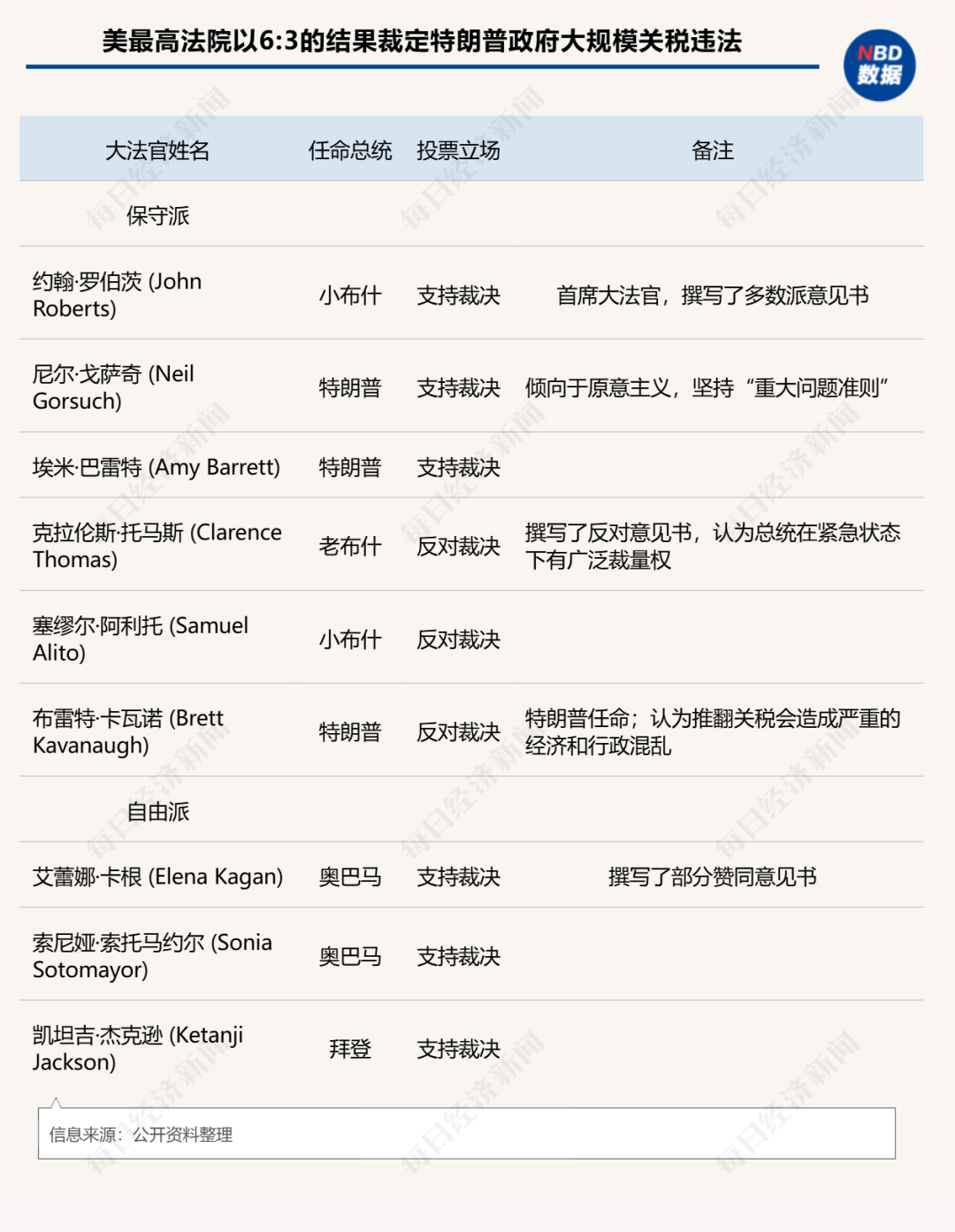
美大法官“大战”总统,6:3裁定特朗普关税违法:1.4万亿美元收入“落空”,或撕开美国财政千亿黑洞!特朗普闪电反击
Mei Ri Jing Ji Xin Wen· 2026-02-21 09:06
Core Points - The U.S. Supreme Court ruled 6-3 that the tariffs imposed by the Trump administration under the International Emergency Economic Powers Act (IEEPA) were illegal, resulting in a loss of over $1.4 trillion in expected tariff revenue over the next decade and leaving a $175 billion refund issue unresolved [1][3][33] - In response to the ruling, the Trump administration invoked a dormant legal provision to impose a 10% global import tariff, which could potentially escalate to 15% [24][27][38] Group 1: Legal and Financial Implications - The Supreme Court's decision effectively dismantled a broad tariff system, which was expected to generate significant federal revenue, and raised concerns about a fiscal shortfall that may require the issuance of more government bonds, thereby increasing U.S. Treasury yields [1][33][35] - The ruling has created uncertainty regarding the refund of previously collected tariffs, with estimates suggesting that up to $175 billion could be refunded to importers [13][17][33] Group 2: Industry Impact - Various industries, particularly retail and manufacturing, are facing increased costs due to tariffs, with companies like Costco and Alcoa already filing lawsuits to reclaim tariffs deemed illegal [18][21][24] - The new global 10% tariff could lead to higher average tariffs than those previously in place, potentially affecting consumer prices and business operations across multiple sectors [33][34][38] Group 3: Future Trade Policy - The revival of the 1974 Trade Act's Section 122 allows for the imposition of tariffs without extensive investigation, indicating a shift towards more aggressive trade measures [24][27][38] - Analysts suggest that the new tariff regime may be more stringent than the previous one, with potential long-term implications for U.S. trade relations and economic stability [33][34]

都认为中国会赢:美国以为手中的牌比中国多,但它错了
Sou Hu Cai Jing· 2026-02-21 08:52
Group 1 - The trade friction between the US and China, which began in 2018, has led to significant global attention, with many experts suggesting that the US underestimated China's economic resilience and supply chain strength [1][3] - The US initially imposed tariffs on steel and aluminum, followed by additional tariffs on Chinese goods, but these measures resulted in increased costs for American consumers and farmers, while China successfully found alternative markets [3][4] - China's trade surplus with the US is projected to reach a new high of $1 trillion by 2025, indicating that the US's strategy to reshape its manufacturing base through tariffs has not been effective [4][6] Group 2 - Experts argue that the US's inconsistent policies have led to a perception that China is a more reliable partner, causing other countries to shift their trade relationships towards China [6][9] - The trade war has prompted China to enhance its technological self-sufficiency, particularly in sectors like semiconductors, as the US's restrictions have spurred increased domestic investment [3][11] - The global trade landscape has shifted, with countries initially aligning with the US now adopting a more cautious approach, recognizing China's strength and resilience in the face of trade pressures [9][11] Group 3 - The US's talent outflow, particularly in fields like artificial intelligence, has been exacerbated by policies that inadvertently push skilled professionals back to China [7] - China's strategic response to the trade war includes diversifying its markets and strengthening economic ties with emerging markets, which enhances its global influence [11] - The ongoing trade tensions have highlighted the vulnerabilities in the US economy, particularly its reliance on Chinese manufacturing, as the US struggles to find alternatives for many Chinese imports [6][11]