
新能源汽车制造

Search documents
北汽蓝谷新能源科技股份有限公司十一届十五次董事会决议公告
Shang Hai Zheng Quan Bao· 2026-01-23 18:44
Core Viewpoint - The company has approved an investment of RMB 199,100 million for the construction of the Xiangjie Super Factory, focusing on the industrialization of high-end platform models and the digitalization of production lines [2][7][10]. Group 1: Investment Overview - The investment project aims to enhance production efficiency and support the introduction of new models, specifically targeting the BE22 3.0 platform [11][16]. - The project will cover key processes including stamping, welding, painting, and assembly, with the goal of improving flexibility, efficiency, quality, and intelligence in manufacturing [11][18]. - The investment has been approved by the board of directors and does not require shareholder approval as it does not meet the threshold for such a review [10][20]. Group 2: Strategic Importance - The project aligns with the company's overall strategic development plan and is expected to enrich the product lineup, facilitating rapid technological upgrades and enhancing core competitiveness [20]. - The Chinese electric vehicle industry is experiencing significant growth, with opportunities in high-end MPV, sedan, and SUV markets, which the company aims to capitalize on through this investment [16]. Group 3: Expected Benefits - The project is anticipated to quickly introduce new models, enhance the high-end product matrix, and strengthen the brand's market position [18]. - Financially, the project is expected to impact the company's cash flow in 2026 but will not significantly affect the operating performance for that year [22].

销量增速放缓 理想汽车被传将关闭低效门店
Xi Niu Cai Jing· 2026-01-23 10:21
Core Insights - Li Auto is planning to close a number of underperforming retail stores, primarily those opened during its rapid expansion phase, although the exact number of closures is still under evaluation [2] - The company has not yet made an official response to this news [2] Delivery Performance - In 2021, Li Auto delivered 90,500 vehicles, a year-on-year increase of 177.4% - In 2022, the total delivery volume reached 133,200 units, growing by 47.2% - In 2023, deliveries surged to 376,000 units, marking a 182.2% year-on-year growth - For 2024, the expected delivery volume is projected to grow by 33.1% to 500,500 units - However, in 2025, the retail volumes for the Li L7 and L8 models are expected to drop significantly, with year-on-year declines of 66% and 79% respectively, leading to an overall delivery volume of 406,000 units, a decrease of approximately 19% from the previous year [2] Retail Expansion - Li Auto has rapidly expanded its retail channels, adding 179 new retail centers in 2023 alone, reaching a peak expansion rate - By the end of 2025, the company plans to have over 540 retail centers across nearly 160 cities in China [2] Strategic Initiatives - In mid-2025, Li Auto will launch the "Hundred Cities Star Plan," aimed at penetrating lower-tier markets through a light-asset model by recruiting partners [3] - Founded in 2015, Li Auto is recognized as a new force in China's new energy vehicle market, having been listed on NASDAQ and the Hong Kong Stock Exchange in 2010 and 2021 respectively [3] - The company focuses on range-extended electric vehicle technology, targeting the mid-to-large family vehicle segment with the brand philosophy of "creating a mobile home, creating a happy home" [3]



北汽蓝谷的“翻身”困局
Hua Er Jie Jian Wen· 2026-01-20 11:43
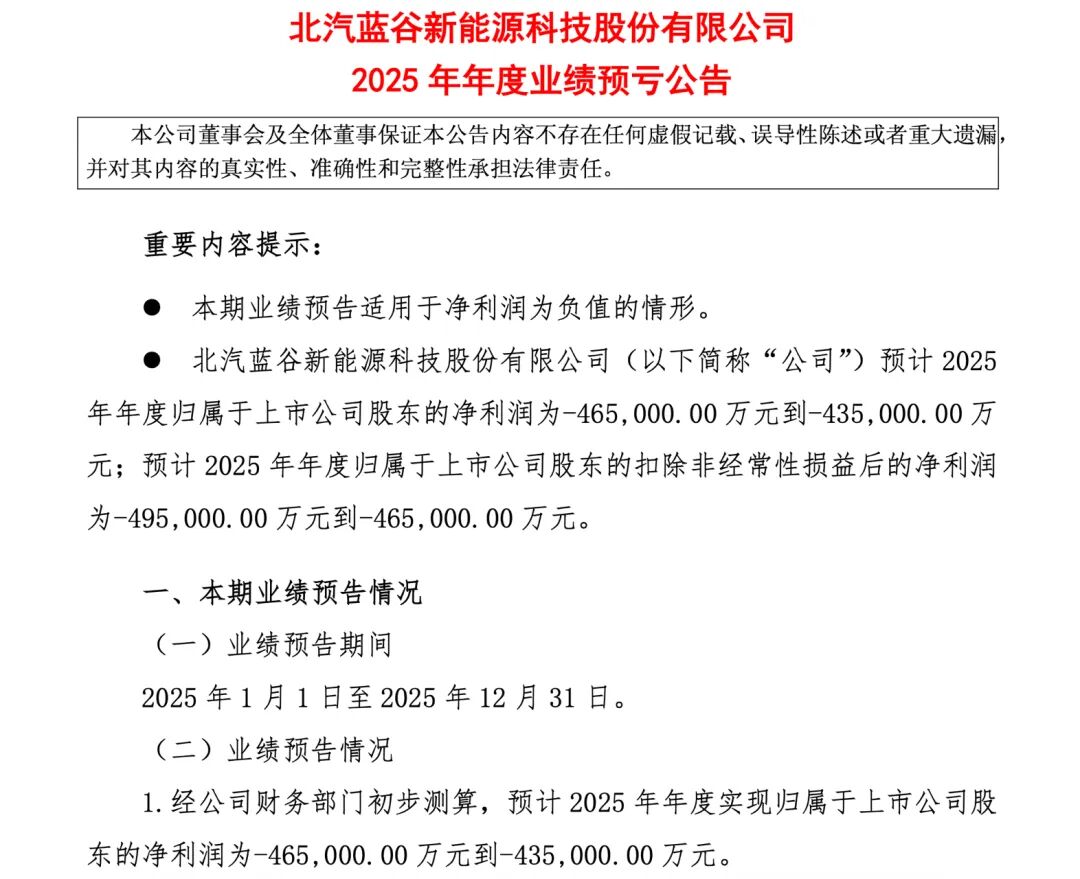
Core Viewpoint - Beiqi Blue Valley's 2025 performance report reveals a complex picture of "growth and losses coexisting," with an expected net loss of 4.35 billion to 4.65 billion yuan, despite a significant reduction from the previous year's loss of 6.948 billion yuan [2] Group 1: Financial Performance - The company's net loss for 2025 is projected to be between 4.35 billion and 4.65 billion yuan, a notable decrease from the 6.948 billion yuan loss in 2024, yet still at a high level [2] - Sales volume reached 209,600 units in 2025, marking an 84.06% year-on-year increase, but this growth has not translated into improved profitability [2][3] - Historical losses from 2020 to 2024 were 6.482 billion yuan, 5.244 billion yuan, 5.465 billion yuan, 5.400 billion yuan, and 6.948 billion yuan respectively, indicating a persistent trend of financial challenges [2] Group 2: Strategic Investments and Challenges - The paradox of increasing sales but ongoing losses stems from substantial strategic investments, particularly in R&D, which rose to 1.573 billion yuan in the first three quarters of 2025, a 43.26% increase from the previous year [3] - The company's traditional B-end market, primarily the EU series, which contributed 70%-80% of sales, is being disrupted, leading to a shift in brand perception [4] - The transition to new high-end brands, such as Arcfox and Xiangjie, is ongoing, but the sales from these new models have not yet compensated for the decline in sales from older models [5] Group 3: Partnerships and Technological Advancements - A significant focus is on the collaboration with Huawei, which has resulted in the high-end brand "Xiangjie" becoming a new growth engine, raising the average selling price by 8,000 yuan [7] - The partnership has evolved into a "strategic community," with plans for a 20 billion yuan investment over three years to establish dedicated departments and supply chains [8] - The company has also achieved a milestone by obtaining the first batch of L3 conditional autonomous driving permits for its Arcfox Alpha S model, positioning itself at the forefront of autonomous driving commercialization in China [10] Group 4: Future Outlook and Market Position - Despite ongoing losses, the increase in sales has instilled some confidence among analysts, with expectations for continued growth in 2026 due to new model launches [13] - The current focus on L3 technology is seen as a long-term investment, requiring sustained R&D and market development, with limited immediate financial impact [12] - The company faces the challenge of transforming its brand perception and market recognition while relying on Huawei's support to establish a solid high-end market presence [13]
北汽蓝谷预告,2025年净亏损超43.5亿元
Guo Ji Jin Rong Bao· 2026-01-19 14:00
Core Viewpoint - The company, Beiqi Blue Valley, is expected to significantly reduce its net profit loss for the year, with projections indicating a loss between 4.35 billion to 4.65 billion yuan, a notable improvement from the previous year's loss of 6.948 billion yuan, representing a reduction of 2.298 billion to 2.598 billion yuan, or a decrease of 33.09% to 37.41% [3] Group 1 - The primary reason for the anticipated loss is the company's commitment to its "three-year leap" strategy, which involves ongoing investments in product development and channel construction, impacting short-term performance [3] - In 2025, the company aims to achieve sales of 209,600 vehicles, reflecting a year-on-year growth of 84.06%, although it remains in a loss phase due to the lack of scale benefits [3] - Beiqi Blue Valley operates three main vehicle brands: Arcfox, Xiangjie, and Beijing Automotive, with Arcfox expected to be the main contributor to sales growth in 2025 [3] Group 2 - Arcfox's total sales reached 160,000 units, accounting for 76% of total sales, with the Arcfox T1 being the best-seller at 56,500 units, representing 35.3% of Arcfox's total sales [3] - The higher-priced Xiangjie brand has not yet achieved scale, with total sales of 35,800 units, and its two models, Xiangjie S9 and S9T, showing similar sales figures [4] - The company has recently gained attention for its advancements in smart technology, with the Arcfox Alpha S receiving L3 conditional autonomous driving approval, making it one of only two companies to achieve this [4]
碳中和50ETF(159861)涨超1.1%,电力设备出海迎超级景气周期
Mei Ri Jing Ji Xin Wen· 2026-01-19 06:39
Group 1 - The Carbon Neutral 50 ETF (159861) rose over 1.1%, indicating a super boom cycle for the export of electrical equipment [1] - By 2025, the sales of new energy vehicles are expected to grow by 28% year-on-year, with a penetration rate reaching 47.9% [1] - Short-term demand is anticipated to be driven by domestic policies such as trade-in programs, while long-term growth is supported by ongoing technological and cost optimizations [1] Group 2 - The global demand for energy storage batteries is entering a high prosperity phase, with expected rapid growth in shipments due to the maturation of the domestic storage market and increased overseas penetration [1] - The construction of a unified national electricity market is expected to boost demand for ultra-high voltage and smart grid infrastructure, further enhancing investment in the power grid [1] - TSMC's increased capital expenditure reflects strong demand for AI, and the construction of AIDC both domestically and internationally is expected to maintain rapid growth [1]
小群的思想政治课——A股一周走势研判及事件提醒
Datayes· 2026-01-18 15:25
Core Viewpoint - The article discusses the current state of the A-share market, highlighting the volatility and the significant net redemption of stock ETFs, indicating a shift in investor sentiment and market dynamics [14][44]. Market Overview - A-share market experienced a significant net redemption of stock ETFs amounting to 114.83 billion yuan, the largest in 13 months, contrasting with the previous week's net subscription of 17.145 billion yuan [14]. - The market sentiment has shown signs of overheating, with the Morgan Stanley A-share sentiment index surpassing the 78 threshold, reaching 93% on January 12, 2026 [17]. - The article notes that the market is expected to remain volatile in the coming week, reflecting the previous structural overheating [17]. Investment Strategies - Analysts suggest that despite short-term regulatory impacts, the overall market trend remains upward, with a focus on sectors expected to perform well during the upcoming earnings season [18]. - The article emphasizes the importance of focusing on companies with strong earnings growth potential, particularly in technology and advanced manufacturing sectors [23]. Sector Performance - The article highlights that the computer sector attracted the most capital inflow, with a net inflow of 36.184 billion yuan, followed by electronics and media sectors [47]. - Conversely, the defense, non-bank financials, and banking sectors experienced significant net outflows [44]. Industry Insights - The semiconductor sector is noted for its positive outlook, with expectations of continued price increases in memory chips, projected to rise by 55%-60% in Q1 2026 [29]. - The article also mentions the ongoing developments in the aerospace sector, with companies like China Aerospace Technology Group making progress in commercial rocket launches [24]. Economic Indicators - The article reports that China's total electricity consumption is expected to exceed 10 trillion kilowatt-hours by 2025, marking a significant milestone in global energy consumption [36]. - The article also discusses the anticipated increase in prices for various materials, including passive components and refrigerants, driven by rising demand and supply constraints [30][31].

主播说联播丨10万亿度电的“新”意与“绿”意
Yang Shi Xin Wen Ke Hu Duan· 2026-01-18 08:34
Core Insights - China's total electricity consumption is projected to exceed 10 trillion kilowatt-hours by 2025, maintaining its position as the world's largest electricity consumer [1][3] Group 1: Total Electricity Consumption - China's annual electricity consumption is more than double that of the United States and surpasses the combined total of the EU, Russia, India, and Japan for 2024 [3] - The 10 trillion kilowatt-hours mark represents approximately double the total electricity consumption of China in 2015, indicating a strong economic growth trajectory [3] Group 2: Structural Changes in Consumption - High-end manufacturing, particularly in the electric vehicle sector, is emerging as a significant driver of electricity demand, with a year-on-year growth rate exceeding 20% [3] - The tertiary sector and residential electricity consumption are also rapidly increasing, especially in the internet and related services industries, which have seen a year-on-year growth rate exceeding 30% [3] - The proliferation of electric vehicles is driving a nearly 50% year-on-year increase in electricity consumption in the charging and swapping industry [3] Group 3: Supply and Green Energy - By 2025, over 60% of China's installed power generation capacity will come from non-fossil energy sources, making green energy the dominant force in electricity generation [3] - One-third of the total electricity consumed in China will be green electricity, reflecting a significant shift towards sustainable energy sources [3] - The country is intensifying the construction of ultra-high voltage projects to deliver more clean electricity across regions [3]
10万亿度电的“新”意与“绿”意
Yang Shi Xin Wen Ke Hu Duan· 2026-01-18 08:11
Core Insights - China's total electricity consumption is projected to exceed 10 trillion kilowatt-hours by 2025, maintaining its position as the world's largest electricity consumer [1] Consumption Overview - China's annual electricity consumption is more than double that of the United States and surpasses the combined total of the EU, Russia, India, and Japan for 2024 [1] - The 10 trillion kilowatt-hours mark represents approximately double China's total electricity consumption in 2015, indicating a strong economic growth trajectory [1] Structural Changes - High-end manufacturing, particularly in the electric vehicle sector, is emerging as a significant driver of electricity demand, with a year-on-year growth rate exceeding 20% [1] - The tertiary sector and urban-rural residential electricity consumption are also rapidly increasing, especially in the internet and related services industries, which have seen a year-on-year growth rate exceeding 30% [1] - The proliferation of electric vehicles is driving a nearly 50% year-on-year increase in electricity consumption in the charging and battery swap industry [1] Supply Dynamics - By 2025, non-fossil energy sources are expected to account for over 60% of installed power generation capacity, becoming the dominant source of electricity [1] - One-third of the total electricity consumed in China will be green electricity, reflecting a significant shift towards sustainable energy sources [1] - The country is intensifying the construction of ultra-high voltage projects to deliver more clean electricity across regions [1]
2025年全社会用电量突破10万亿千瓦时
Yang Shi Wang· 2026-01-17 12:08
Group 1 - The core viewpoint of the news is that China's total electricity consumption is projected to exceed 10 trillion kilowatt-hours in 2025, maintaining its position as the world's largest electricity consumer [1] - In 2025, China's total electricity consumption is expected to reach 10,368.2 billion kilowatt-hours, representing a year-on-year growth of 5.0% [1] - China's annual electricity consumption is more than double that of the United States and exceeds the combined total of the EU, Russia, India, and Japan's 2024 consumption [1] - The electricity consumption of 10 trillion kilowatt-hours is approximately double that of China's total consumption in 2015 [1] Group 2 - The secondary industry is the main electricity consumer, accounting for 64% of total consumption, with high-end manufacturing becoming a new growth point [1] - The electricity consumption in the new energy vehicle and wind power equipment manufacturing sectors has seen year-on-year growth rates exceeding 20% and 30%, respectively [1] - The tertiary industry and urban-rural residential electricity consumption are expected to grow rapidly, contributing 50% to the overall electricity consumption growth [1] - The electricity consumption in the internet and related services sector is projected to grow by over 30%, while the charging and swapping industry is expected to see nearly 50% growth [1] Group 3 - The increase in electricity consumption is supported by a clean and efficient energy supply system, with non-fossil energy accounting for over 60% of installed capacity by 2025 [2] - China is accelerating the construction of nine major clean energy bases and plans to complete four ultra-high voltage transmission lines, enhancing cross-regional and cross-provincial transmission capacity to 370 million kilowatts [2] - The national energy transmission network is being further strengthened with initiatives like "West-to-East Power Transmission" and "North-to-South Power Supply" [2]
质量责任如何科学界定?困扰欣旺达等企业的电池安全归因话题受关注
Zhong Guo Jin Rong Xin Xi Wang· 2026-01-16 09:27
Core Viewpoint - A lawsuit involving the quality of battery cells supplied by Xinwanda Power to Geely's subsidiary, Weirui Electric, has raised concerns about the long-standing issue of defining quality responsibility within the electric vehicle supply chain [1][2]. Group 1: Lawsuit Details - Xinwanda announced that it is being sued for 2.314 billion yuan due to alleged quality issues with battery cells delivered between June 2021 and December 2023 [2]. - Weirui Electric, a subsidiary of Geely, is involved in the lawsuit and is a key player in the high-end electric vehicle market [2]. - The lawsuit highlights the complexity of battery safety, which cannot be solely attributed to the battery cells, as it involves multiple components and systems [3]. Group 2: Quality Responsibility - The safety of power batteries is recognized as a complex system that includes battery pack design, battery management systems, and vehicle integration [3]. - Xinwanda asserts that similar battery cells supplied to other clients have not experienced quality issues, suggesting that the problem may not lie solely with the battery cells [3]. - The industry is urged to avoid one-sided blame and to analyze the complexities of automotive batteries to foster healthy development [3]. Group 3: Supply Chain and Responsibility - The recall of Volvo's EX30 vehicles, which reportedly used battery cells from Xinwanda, has further complicated the situation, with Xinwanda clarifying that it is not directly involved in the battery system sold to Volvo [4]. - The incidents are seen as critical examples for examining quality, responsibility, and risk within the electric vehicle supply chain, impacting corporate survival and industry ecology [4]. - There is a call for establishing a fair responsibility-sharing mechanism within the supply chain to enhance resilience and competitiveness in the global market [4][5].

