
新能源汽车等

Search documents
利好来了!上海,重磅发布!事关商业航天、机器人……
Zheng Quan Shi Bao Wang· 2026-01-10 07:17
关于商业航天、人形机器人等热门赛道,《行动方案》提出,积极引导企业投资布局低空经济、商业航天、具身智能、生物制造、智能终端等新 兴领域,加速电动垂直起降飞行器(eVTOL)、商业火箭、人形机器人等创新产品突破产业规模化发展瓶颈。 上海最新发布 (原标题:利好来了!上海,重磅发布!事关商业航天、机器人……) 超级赛道迎来重磅利好政策。 1月9日,据上海市人民政府网站,上海市人民政府办公厅印发《上海市支持先进制造业转型升级三年行动方案(2026—2028年)》(以下简称 《行动方案》),其中明确,实施结构调优升级、创新攻关强基、能级质效跃升、资源要素支撑四大行动,并提出了17条具体举措,本方案自 2026年1月1日起实施,有效期至2028年12月31日。 1月9日消息,上海市人民政府办公厅近日印发《上海市支持先进制造业转型升级三年行动方案(2026—2028年)》,其中提出,到2028年,新增 年产值10亿元以上制造业企业100家,累计超过600家,带动产业链新增规上工业企业500家,规上制造业企业研发费用占营收比重显著提升。 在实施结构调优升级行动方面,《行动方案》提出,推动重点产业和新兴产业壮大发展。大力发展 ...


高盛调了几家公司评级,我用大数据看出了门道
Sou Hu Cai Jing· 2026-01-07 00:04
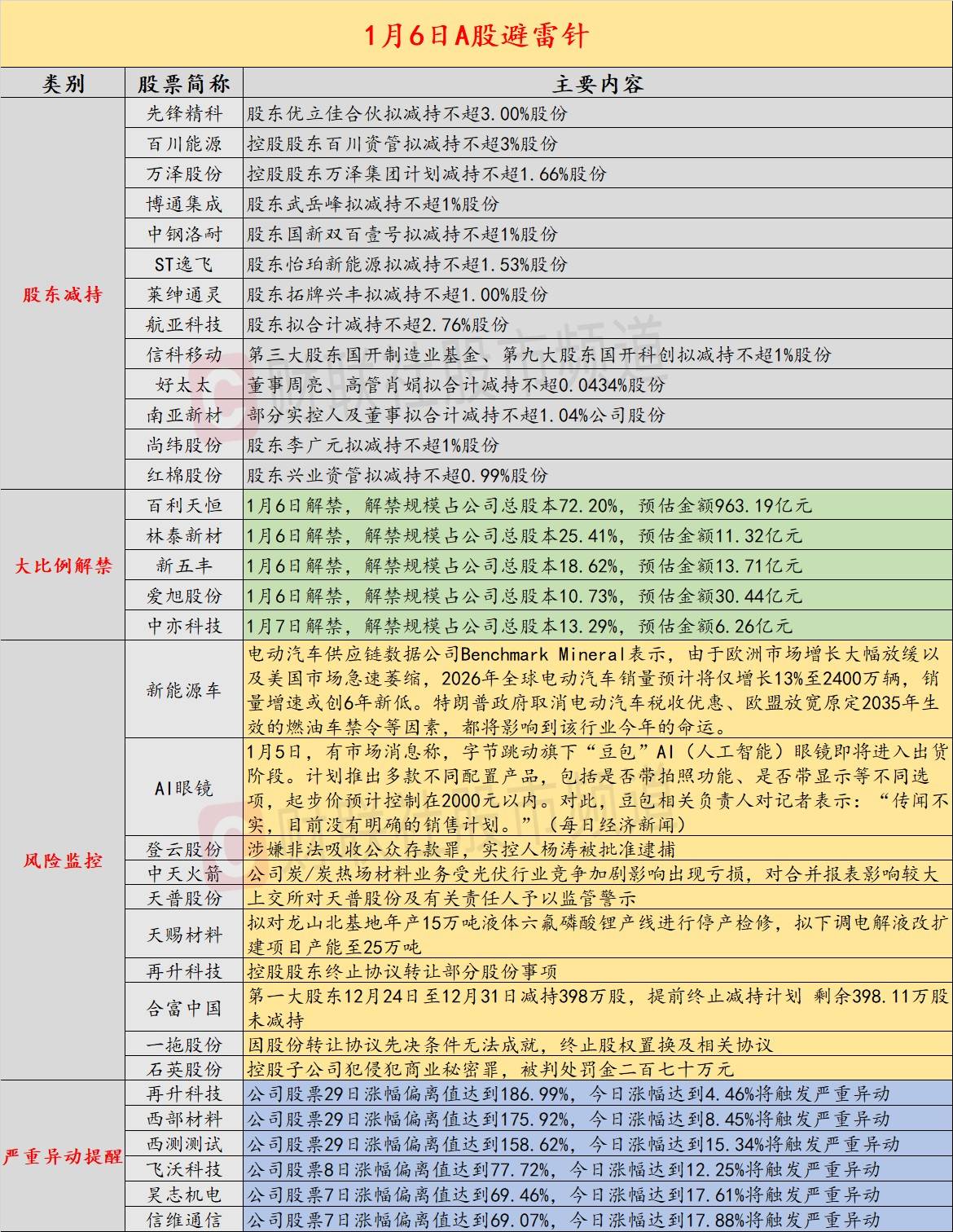
Group 1 - Goldman Sachs downgraded Baosteel and China Aluminum while upgrading Yanzhou Coal and China Coal Energy [1] - ByteDance's "Doubao" AI glasses are rumored to be released, but the company clarified there are no concrete sales plans [1][3] - The market's reaction to news is often driven by underlying capital movements rather than the news itself [1][4] Group 2 - Shareholders of various companies, including Pioneer Technology and Baichuan Energy, plan to reduce their holdings by up to 3% [3] - Significant share unlocks are occurring, with Baichuan Energy's unlock amount estimated at 96.319 billion yuan, accounting for 72.20% of total shares [3] - The electric vehicle market is expected to see only a 13% growth in global sales by 2026, influenced by various regulatory changes [3] Group 3 - The perception of stock price movements can be misleading; declines may indicate institutional accumulation rather than weakness [4][9] - Data analysis reveals that stocks experiencing "capital grabbing" often show signs of future price increases [5][6] - Institutions may use price declines as opportunities to accumulate shares, contrary to public sentiment [8][10]




第十届中国制造强国年会成功在京召开
Feng Huang Wang Cai Jing· 2025-12-29 05:36
Core Insights - The 10th China Manufacturing Power Conference was held in Beijing, focusing on the theme "Rooted in the Real Economy, Moving Towards New Directions" and discussing the high-quality development path of China's manufacturing industry during the 14th and 15th Five-Year Plans [1][15] - The conference gathered over 400 guests from various sectors, including government, industry, academia, and research, to explore key topics such as strengthening the foundation of the real economy and developing new productive forces [1][2] Group 1: Key Themes and Discussions - The conference emphasized the importance of high-end, specialized, market-oriented, refined, and effective approaches to empower the real economy [2] - Li Yizhong, former Minister of Industry and Information Technology, highlighted the need for intelligent, green, and integrated development in building a modern industrial system, focusing on AI applications, low-carbon transitions, and the fusion of manufacturing and services [3][4] - Su Bo, former Deputy Minister of Industry and Information Technology, stated that China has reached a manufacturing power development index of 128.85, narrowing the gap with Germany and Japan, and emphasized the need for a three-step strategy for manufacturing power construction during the 15th Five-Year Plan [4][5] Group 2: Strategic Recommendations - Six key tasks were proposed for the 15th Five-Year Plan, including enhancing technological innovation, advancing digital economy, fostering new productive forces, promoting green growth, and strengthening the resilience of industrial supply chains [5][6] - Liu Lihua, former Deputy Minister of Industry and Information Technology, discussed the importance of consolidating the foundation of the real economy and leading the development of new productive forces, reflecting on the achievements of the manufacturing industry during the 14th Five-Year Plan [6][8] Group 3: Innovations and Future Directions - The conference introduced the "Innovation Development Index for Small and Medium-Sized Enterprises" to evaluate and support local industrial clusters, aiming to enhance the innovation capabilities of SMEs [10][11] - The "Two-Innovation Integration" public service platform was launched to assist in the development of industrial clusters, providing data-driven insights and support for local industries [11][12] - Liu Fei, Deputy Secretary-General of the China Manufacturing Power Research Institute, presented the "Invisible Champion Growth Path" report, outlining the characteristics of successful small and medium-sized enterprises in China [13][14] Group 4: Historical Context and Future Outlook - The conference marked a significant milestone, coinciding with the conclusion of the "Made in China 2025" initiative and the beginning of the 15th Five-Year Plan, reinforcing the commitment to building a modern industrial system [15][16] - The event has evolved into a major platform for discussing the future of China's manufacturing industry, aiming to continue contributing to the construction of a manufacturing power [15][16]

工信部最新发文,事关航空航天、人工智能
21世纪经济报道· 2025-12-26 07:30
Core Viewpoint - The national industrial and information technology work conference emphasized the importance of implementing the new development philosophy and accelerating the construction of a modern industrial system, aiming for high-quality development and a strong industrial economy in the upcoming "15th Five-Year Plan" period [1][7]. Summary by Sections Industrial Economic Performance - In 2025, the industrial economy is expected to show steady progress, with telecommunications business volume and software business revenue projected to grow by approximately 9% and 12% year-on-year, respectively. The digital industry revenue is also anticipated to increase by around 9% [3]. - From January to November, the added value of high-tech manufacturing and equipment manufacturing industries grew by 9.2% and 9.3% year-on-year, respectively. The core AI industry surpassed 1 trillion yuan, and exports of new energy vehicles exceeded 2 million units [3]. Key Tasks for 2026 - The conference outlined ten key areas of focus for 2026, including: 1. Consolidating the positive trend of the industrial economy and supporting major industrial provinces [8]. 2. Enhancing the resilience and safety of industrial supply chains [8]. 3. Accelerating the improvement of industrial technological innovation capabilities [8]. 4. Optimizing traditional industries through standards and technological upgrades [8]. 5. Cultivating emerging and future industries, including integrated circuits and biomedicine [8]. 6. Promoting deep integration of information technology and industrialization [9]. 7. Advancing green and low-carbon development in industries [9]. 8. Supporting high-quality development in the information and communication sector [9]. 9. Fostering high-quality enterprises and addressing overdue payments [10]. 10. Improving industry governance effectiveness [10]. Governance and Leadership - The conference stressed the importance of the Party's leadership in ensuring the success of various initiatives and called for strengthening political construction and enhancing the capabilities of the workforce [11][12]. Conclusion - The conference concluded with a call for unity around the central leadership and a commitment to achieving the goals set for the upcoming year, contributing to the modernization of China [12].

上海市经信委:7个国家重点专项申报启动
Xin Hua Cai Jing· 2025-12-23 05:48
重点专项申报指南涉及的项目均采用一轮申报程序。项目申报单位根据指南相关申报要求,通过重点专 项平台填写并提交项目申报书。项目申报单位网上填报申报书的受理时间为:2026年1月4日8:00至2月5 日16:00。 各区政府、在沪高校、科研机构、重点企业要高度重视重点专项组织申报工作,把此项工作与壮大新兴 产业、培育未来产业、发展新质生产力等协同推进,切实提升科研投入绩效、强化重大创新成果的"实 战性",在项目组织实施中一体化推动重大科技成果产出和落地转化。 (文章来源:新华财经) 新华财经上海12月23日电 据上海市经信委消息,根据《工业和信息化部关于发布国家重点研发计划"工 业软件"等7个重点专项2025年度项目申报指南的通知》,扎实推动科技创新和产业创新深度融合,助力 发展新质生产力,推进上海市新兴产业和未来产业发展,现启动7个国家重点专项申报工作。 本年度涉及申报的7个国家重点专项,分别是"工业软件""智能机器人""增材制造与激光制造""新能源汽 车""基础科研条件与重大科学仪器设备研发""信息光子技术""先进计算与新兴软件"。 各单位可通过重点专项平台(http://service.most.gov.c ...
科学仪器设备研发再登榜:科技部发布7个重点专项项目申报指南
仪器信息网· 2025-12-17 09:08
Core Viewpoint - The Ministry of Industry and Information Technology has released the 2025 project application guidelines for seven key special projects under the national key R&D plan, focusing on the localization of high-end scientific instruments and key component breakthroughs [1][2]. Group 1: Key Special Projects - The seven key special projects include "Industrial Software," "Intelligent Robots," "Additive Manufacturing and Laser Manufacturing," "New Energy Vehicles," and "Research Conditions and Major Scientific Instrument Development," aiming to promote industrial innovation and technological upgrades [2][4]. - The "Research Conditions and Major Scientific Instrument Development" project specifically targets the localization of high-end instruments to overcome bottlenecks in core technologies [2][3]. Group 2: Focus Areas for 2025 - The focus areas for 2025 are expected to include the engineering and application development of high-end general scientific instruments, such as high-throughput nucleic acid mass spectrometers and high-sensitivity online ion chromatography analyzers, aimed at achieving domestic substitution in fields like medical research and food safety [3]. - Development of core key components will concentrate on items like focused argon ion sources and gamma-ray time-of-flight array detectors to enhance the self-control capabilities of instrument components [3]. Group 3: Application Process - The application process for the projects will be organized by the applicant units according to the guidelines, requiring a comprehensive project submission that covers all research content and assessment indicators [5]. - The guidelines encourage the integration of innovative teams and the participation of young and female researchers, emphasizing collaboration in basic research and key technology development [5].

中信证券:亚洲股市更需聚焦基本面线索变化带来的结构性配置机会
Xin Lang Cai Jing· 2025-12-05 00:22
Core Viewpoint - Asian stock markets should focus on fundamentals due to improved liquidity, geopolitical disturbances, and short-term AI bubble concerns [1] Group 1: A-shares - A-shares require a fundamental breakthrough beyond expectations, with recommendations to focus on resource and traditional manufacturing sectors for pricing power reassessment and companies going abroad, while paying attention to less crowded and dividend-paying stocks [1] Group 2: Hong Kong Stocks - Hong Kong stocks are expected to benefit from both internal and external catalysts, with suggestions to emphasize five major directions: technology, healthcare, and resource products [1] Group 3: South Korean Stocks - South Korean stocks are driven by fundamentals, policies, and liquidity, with a focus on semiconductor and AI industries for reassessment opportunities [1] Group 4: Indian Stocks - Indian stocks have potential for catch-up growth, with recommendations to prioritize interest rate-sensitive companies and consumer sectors under a backdrop of loose monetary policy, while taking a contrarian view on IT services [1] Group 5: Japanese Stocks - Japanese stocks are benefiting from governance dividends and increased foreign investment, with a focus on industry consolidation and asset reassessment [1] Group 6: Southeast Asian Stocks - Southeast Asian markets are showing signs of recovery, with specific recommendations for Malaysia to focus on AI and data center supply chains, Indonesia on consumption and new energy vehicles, and Thailand on consumer and tourism sectors, while closely monitoring macro variables and policy trends [1]

全球贸易新引擎:2026世界自贸港加工增值展览会将于海南盛大启幕
Sou Hu Cai Jing· 2025-12-03 04:20
Core Insights - The 2026 World Free Trade Port Processing and Value-Added Exhibition will take place from April 26 to April 28, 2026, in Hainan, China, focusing on the theme "New Horizons of Free Trade, New Future of Value-Added" [2] - The exhibition aims to create a world-class platform for communication and trade in the processing and value-added sector, highlighting the significant business opportunities arising from policy dividends in free trade ports [4] Industry Highlights - The exhibition will showcase advanced industries, including high-end food processing, biomedicine, medical devices, aerospace components, new energy vehicles, green low-carbon products, luxury goods, and consumer products, demonstrating how companies can leverage free trade port policies to enhance product value [6] - A policy interpretation area will be established to analyze successful case studies from major global free trade ports, illustrating the cost advantages and market competitiveness gained through policies such as "zero tariff on imported materials" and "over 30% value-added processing" [6] - The event will feature a focus on smart supply chain and logistics solutions, showcasing how IoT, blockchain, and big data technologies can create efficient, transparent, and secure modern supply chain systems within free trade ports [6] Investment Opportunities - The exhibition will host multiple investment forums and one-on-one matching sessions to facilitate direct dialogue between global capital and quality projects, promoting deep integration between industry and capital [6] Development Trends - A high-level forum will be held during the exhibition, inviting government representatives, international organization leaders, Nobel laureates, CEOs of Fortune 500 companies, and renowned scholars to discuss key topics such as global free trade port policy innovation, industry chain optimization, and the future of digital and green trade [8][9] - The chairman of the organizing committee emphasized that Hainan Free Trade Port is an ideal location for this event, aiming to create a continuous exchange of ideas and business opportunities to unlock the potential of processing and value-added sectors [8] Exhibition Overview - The 2026 World Free Trade Port Processing and Value-Added Exhibition is the first and largest international exhibition focused on the processing and value-added sector within free trade ports, aiming to connect policies, industries, and markets to drive global trade towards higher efficiency and added value [10]
【图解】推动新兴产业、未来产业发展 12月起一批国家标准将实施
Zhong Guo Jing Ji Wang· 2025-12-02 08:06
Group 1 - A series of important national standards will be implemented starting in December, aimed at promoting the healthy development of emerging and future industries, creating a favorable consumer environment, and ensuring the safety of people's lives and property [3][4][5][6][7][8][9][10][11][12][13][14][15][16][17][18][19][20]. Group 2 - The standard for sensitive personal information processing (GB/T 45574-2025) establishes general and specific security requirements, further regulating the handling of sensitive personal information and protecting the rights of individuals [5]. - The e-commerce platform service quality evaluation standard (GB/T 31526-2025) introduces an evaluation index system to enhance service quality and optimize user experience on e-commerce platforms [6]. - The green packaging technical specifications for toys and children's products (GB/T 44869-2024) set basic requirements for packaging, aiming to reduce plastic waste and promote green development in the sector [7][8]. - The industrial instrument intelligence level requirements (GB/T 45727-2025) will drive technological innovation and industry upgrades in instrument manufacturing [9]. - The national standards for urban furniture (GB/T 45793-2025 and GB/T 45794-2025) will improve the performance and quality of public facilities, enhancing urban living environments [10][12]. - The ceramic tile quality grading standard (GB/T 45817-2025) aims to elevate product quality and promote the transformation of the ceramic tile industry towards mid-to-high-end development [13]. - The furniture recycling transaction technical specifications (GB/T 45697-2025) will standardize recycling practices, improving efficiency and transparency in the furniture industry [14]. - The guidelines for classifying and grading agricultural product wholesale markets (GB/T 46118-2025) will enhance management practices and support high-quality development in the sector [15]. - Standards related to business entity credit will improve credit levels and provide technical support for the construction of a social credit system [16][17]. - The technical guidelines for in-depth investigation of traffic accidents (GB/T 45645.1-2025) will support scientific determination of accident causes and enhance traffic safety management [18]. - The dynamic monitoring and early warning requirements for the safety performance of new energy vehicles (GB/T 45688-2025) will help standardize safety monitoring platforms [19]. - The technical specifications for remote service and management systems for electric vehicles (GB/T 32960.1-2025 and GB/T 32960.4-2025) will ensure safe and reliable operation of electric vehicles, promoting healthy development in the new energy vehicle industry [20].

杭州打造全球视觉智能产业标杆,请看《浪尖周报》第51期
Xin Lang Cai Jing· 2025-11-30 05:21
Core Insights - The "Wave Plan" aims to promote industrial collaboration and technological innovation in the Yangtze River Delta region [1] - The "Wave Weekly: Yangtze River Delta Industrial Dynamics" focuses on the latest industrial developments in nine trillion GDP cities, highlighting key news and leadership activities [1] Industry Highlights - Hangzhou's visual intelligence industry reported a revenue of 710.4 billion yuan in the first three quarters [2] - Shanghai's Xuhui district is developing a "Blockchain + AI" industrial cluster [2] - Nanjing is collaborating with Baiyun Electric to enhance the capabilities of the smart grid industry [2] - Hefei's major scientific facilities, including EAST, CRAFT, and BEST, are now open to global access [2] - Suzhou's Taicang is building a modern port to promote the integration of industry and city [2] - Ningbo's Qianwan New Area is strengthening its dual industrial clusters in biomedicine and new energy vehicles [2] - Wuxi is advancing the expansion of the 465 cluster in coordination with the new energy chain [2] - Nantong is deepening its layout in the new tracks of artificial intelligence and integrated circuits [2] - Changzhou's Nine Company ecological chain project has settled in the high-tech zone [2]