
焦炭

Search documents
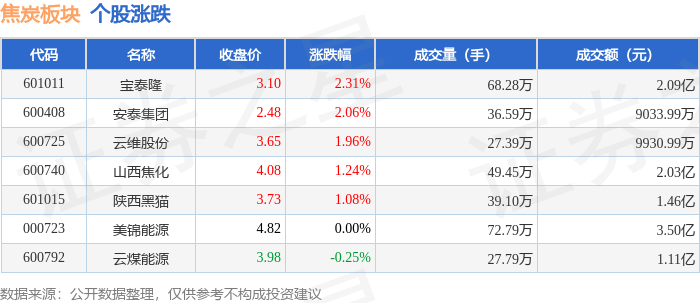
焦炭板块9月16日涨0.84%,宝泰隆领涨,主力资金净流出5997.25万元
Zheng Xing Xing Ye Ri Bao· 2025-09-16 08:52
Core Viewpoint - The coking coal sector experienced a 0.84% increase on September 16, with Baotailong leading the gains, while the overall market indices showed modest increases [1] Group 1: Market Performance - The Shanghai Composite Index closed at 3861.87, up 0.04% [1] - The Shenzhen Component Index closed at 13063.97, up 0.45% [1] - The coking coal sector's individual stock performance is detailed in a table, showing various closing prices and percentage changes [1] Group 2: Stock Performance - Baotailong (601011) closed at 3.10 with a 2.31% increase and a trading volume of 682,800 shares, amounting to 209 million yuan [1] - Antai Group (600408) closed at 2.48, up 2.06%, with a trading volume of 365,900 shares, totaling 90.34 million yuan [1] - Yunwei Co. (600725) closed at 3.65, up 1.96%, with a trading volume of 273,900 shares, totaling 99.31 million yuan [1] - Shanxi Coking Coal (600740) closed at 4.08, up 1.24%, with a trading volume of 494,500 shares, totaling 203 million yuan [1] - Shaanxi Black Cat (601015) closed at 3.73, up 1.08%, with a trading volume of 391,000 shares, totaling 146 million yuan [1] - Meijin Energy (000723) remained unchanged at 4.82, with a trading volume of 727,900 shares, totaling 350 million yuan [1] - Yunmei Energy (600792) closed at 3.98, down 0.25%, with a trading volume of 277,900 shares, totaling 111 million yuan [1] Group 3: Capital Flow - The coking coal sector saw a net outflow of 59.97 million yuan from main funds, while retail investors contributed a net inflow of 65.13 million yuan [1] - Detailed capital flow for individual stocks shows varying levels of net inflow and outflow among main funds, retail investors, and speculative funds [2]


云维股份涨2.23%,成交额7693.74万元,主力资金净流入116.36万元
Xin Lang Cai Jing· 2025-09-16 06:03
Group 1 - The core viewpoint of the news is that Yunwei Co., Ltd. has shown a positive stock performance with a 2.23% increase on September 16, reaching a price of 3.66 CNY per share, and a total market capitalization of 4.511 billion CNY [1] - The company has experienced a year-to-date stock price increase of 8.28%, with a 5-day increase of 5.17%, a 20-day increase of 8.93%, and a 60-day increase of 15.09% [1] - The main business revenue composition of Yunwei Co., Ltd. is 95.38% from coal product sales and 4.62% from sales of other products like coking coal [1] Group 2 - As of September 10, the number of shareholders for Yunwei Co., Ltd. is 35,600, which is a decrease of 2.84% from the previous period, while the average circulating shares per person increased by 2.92% to 34,619 shares [2] - For the first half of 2025, Yunwei Co., Ltd. reported an operating income of 327 million CNY, a year-on-year decrease of 17.28%, and a net profit attributable to shareholders of -14.53 million CNY, a significant year-on-year decrease of 362.53% [2] Group 3 - Since its A-share listing, Yunwei Co., Ltd. has distributed a total of 350 million CNY in dividends, but there have been no dividend distributions in the past three years [3]
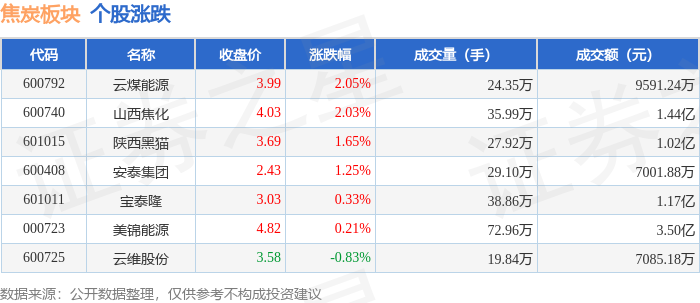
焦炭板块9月15日涨0.84%,云煤能源领涨,主力资金净流出1778.76万元
Zheng Xing Xing Ye Ri Bao· 2025-09-15 08:49
Market Overview - The coke sector increased by 0.84% on September 15, with Yunmei Energy leading the gains [1] - The Shanghai Composite Index closed at 3860.5, down 0.26%, while the Shenzhen Component Index closed at 13005.77, up 0.63% [1] Individual Stock Performance - Yunmei Energy (600792) closed at 66.5, up 2.05% with a trading volume of 243,500 shares and a turnover of 95.91 million yuan [1] - Shanxi Coking Coal (600740) closed at 4.03, up 2.03% with a trading volume of 359,900 shares and a turnover of 144 million yuan [1] - Shaanxi Black Cat (601015) closed at 3.69, up 1.65% with a trading volume of 279,200 shares and a turnover of 102 million yuan [1] - Antai Group (600408) closed at 2.43, up 1.25% with a trading volume of 291,000 shares and a turnover of 70.02 million yuan [1] - Baotailong (601011) closed at 3.03, up 0.33% with a trading volume of 388,600 shares and a turnover of 117 million yuan [1] - Meijin Energy (000723) closed at 4.82, up 0.21% with a trading volume of 729,600 shares and a turnover of 350 million yuan [1] - Yunwei Co. (600725) closed at 3.58, down 0.83% with a trading volume of 198,400 shares and a turnover of 70.85 million yuan [1] Fund Flow Analysis - The coke sector experienced a net outflow of 17.78 million yuan from main funds, while retail funds saw a net inflow of 8.80 million yuan and 8.98 million yuan respectively [1] - Shanxi Coking Coal had a main fund net inflow of 10.80 million yuan, but retail funds saw a net outflow of 9.19 million yuan [2] - Yunmei Energy had a main fund net inflow of 10.02 million yuan, with retail funds also experiencing a net outflow of 7.49 million yuan [2] - Shaanxi Black Cat had a main fund net inflow of 7.54 million yuan, while retail funds saw a net outflow of 6.93 million yuan [2] - Antai Group had a main fund net outflow of 5.03 million yuan, but retail funds had a net inflow of 709,230 yuan [2] - Meijin Energy experienced a significant main fund net outflow of 35.07 million yuan, while retail funds had a net inflow of 1.69 million yuan [2]

广发期货日评-20250912
Guang Fa Qi Huo· 2025-09-12 06:44
1. Report Industry Investment Ratings No specific industry investment ratings are provided in the report. 2. Core Views - In September, the direction of the second - half monetary policy is crucial for the equity market. A - shares may enter a high - level shock pattern after a large increase, and the risk has been largely released [2]. - The 10 - year Treasury bond interest rate has strong gaming power around 1.8%, and an incremental drive is needed to choose a direction. The bond market shows a differentiated trend with the long - end being weak and the short - end being strong [2]. - The U.S. employment market continues to weaken, the ECB keeps policy unchanged, and gold shows a sideways consolidation. Silver is in the $40 - 42 range for short - term trading [2]. - The shipping index (European line) is in a weak shock, and a 12 - 10 spread arbitrage can be considered [2]. - Steel prices are suppressed by factors such as falling apparent demand and coking coal resumption. Iron ore prices are strong, while coking coal and coke prices are weak [2]. - The U.S. core CPI meets expectations, and the expectation of interest rate cuts heats up again. The prices of base metals such as copper, aluminum, and zinc are affected by different factors [2]. - The oil market is worried about marginal supply increments, dragging oil prices down. The chemical products market has different supply - demand situations and price trends [2]. - The agricultural products market is affected by factors such as production expectations and supply - demand contradictions, with different price trends for different varieties [2]. - Special commodities like soda ash, glass, and rubber have different market performances and trading suggestions [2]. - In the new energy sector, polysilicon has a rising price due to increasing production cut expectations, and lithium carbonate maintains a tight balance [2]. 3. Summary by Related Catalogs Financial - **Stock Index**: After a large increase, A - shares may enter a high - level shock. Sell near - month put options at support levels to collect premiums [2]. - **Treasury Bond**: The 10 - year Treasury bond interest rate is at a critical point. Adopt a wait - and - see strategy and focus on changes in the capital market, equity market, and fundamentals in the short term [2]. - **Precious Metals**: For gold, buy cautiously at low prices or sell out - of - the - money options. For silver, conduct short - term band trading in the $40 - 42 range and sell out - of - the - money options at high volatility [2]. Black - **Steel**: Steel prices are suppressed. Adopt a wait - and - see strategy [2]. - **Iron Ore**: Buy iron ore 2601 contracts at low prices in the range of 780 - 830 and consider an iron ore - coking coal long - short strategy [2]. - **Coking Coal**: Sell coking coal 2601 contracts at high prices in the range of 1070 - 1170, and the iron ore - coking coal long - short strategy is favorable [2]. - **Coke**: Sell coke 2601 contracts at high prices in the range of 1550 - 1650, and the iron ore - coke long - short strategy is favorable [2]. Non - ferrous Metals - **Copper**: The futures price is close to the mainstream cost range, and the short - term downward space is limited. The main contract reference range is 79500 - 81500 [2]. - **Aluminum and Related Alloys**: Aluminum prices are affected by macro - factors and cost support, with different reference ranges for different contracts [2]. - **Zinc**: The expectation of interest rate cuts improves, boosting zinc prices. The main contract reference range is 21500 - 23000 [2]. - **Tin**: The fundamentals remain strong, and the tin price is in a high - level shock. The operating range is 285000 - 265000 [2]. Energy and Chemicals - **Crude Oil**: Concerns about marginal supply increments drag oil prices down. Adopt a short - side strategy and pay attention to support levels [2]. - **Urea**: High short - term supply pressure drags down the price. Adopt a wait - and - see strategy and pay attention to the support level of 1630 - 1650 yuan/ton [2]. - **PX and PTA**: The supply - demand expectations in September are different, and the prices are in a shock range. For PTA, consider a TA1 - 5 rolling reverse spread strategy [2]. - **Other Chemical Products**: Each chemical product has different supply - demand situations and trading suggestions, such as short - fiber, bottle - grade polyester, ethylene glycol, etc. [2] Agricultural Products - **Grains and Oils**: Different grains and oils are affected by factors such as production expectations and supply - demand contradictions, with different price trends and trading suggestions [2]. - **Sugar and Cotton**: Sugar prices are affected by overseas supply prospects, and cotton has low old - crop inventories, with different trading suggestions [2]. - **Livestock and Poultry Products**: The livestock and poultry products market is affected by factors such as supply - demand contradictions and sales rhythms, with different price trends [2]. Special Commodities - **Soda Ash**: The market lacks a main trading logic and is in a narrow - range shock. Adopt a short - selling strategy on rebounds [2]. - **Glass**: The market is affected by production lines and spot market sentiment. Adopt a wait - and - see strategy [2]. - **Rubber**: The macro - sentiment fades, and rubber prices are in a shock - down trend. Adopt a wait - and - see strategy [2]. New Energy - **Polysilicon**: Due to increasing production cut expectations, the price is rising. Adopt a wait - and - see strategy [2]. - **Lithium Carbonate**: The market maintains a tight balance. Adopt a wait - and - see strategy, and the main contract reference range is 70000 - 72000 yuan [2].
中信期货晨报:商品期货多数上涨,中小盘股指涨幅较好-20250912
Zhong Xin Qi Huo· 2025-09-12 05:11
1. Report Industry Investment Rating - No relevant content provided. 2. Core Viewpoints of the Report - The report notes that most commodity futures rose, and small - and mid - cap stock index futures had good gains. In the overseas market, the US labor market shows a clear slowdown trend, and the weak non - farm data increases the probability of a September interest rate cut. In the domestic market, the PPI is expected to see a slight increase in the central value, while the CPI may be slightly lower than the first - half level. Short - term domestic assets present mainly structural opportunities, with a higher probability of incremental policies in the fourth quarter. Overseas, the situation is generally favorable for gold. Long - term US fundamentals are fair, and a weak US dollar pattern continues [6]. 3. Summary by Related Catalogs 3.1 Market Performance - **Stock Index Futures**: The CSI 300 futures closed at 4562, up 2.92% daily, 2.37% weekly, 1.24% monthly, 17.40% quarterly, and 16.35% year - to - date. The SSE 50 futures closed at 2990.2, up 1.78% daily, 1.68% weekly, 0.34% monthly, 11.20% quarterly, and 11.66% year - to - date. The CSI 500 futures closed at 7124.6, up 3.81% daily, 3.28% weekly, 1.83% monthly, 21.52% quarterly, and 25.11% year - to - date. The CSI 1000 futures closed at 7387.8, up 3.31% daily, 2.24% weekly, 0.29% monthly, 20.15% quarterly, and 26.32% year - to - date [3]. - **Treasury Bond Futures**: The 2 - year Treasury bond futures closed at 102.41, up 0.06% daily, 0.02% weekly, - 0.01% monthly, - 0.22% quarterly, and - 0.55% year - to - date. The 5 - year Treasury bond futures closed at 105.59, up 0.16% daily, 0.00% weekly, 0.07% monthly, - 0.63% quarterly, and - 0.89% year - to - date. The 10 - year Treasury bond futures closed at 107.58, up 0.08% daily, - 0.34% weekly, - 0.21% monthly, - 1.24% quarterly, and - 1.23% year - to - date. The 30 - year Treasury bond futures closed at 114.74, down 0.02% daily, - 1.38% weekly, - 1.55% monthly, - 4.61% quarterly, and - 3.44% year - to - date [3]. - **Foreign Exchange**: The US dollar index was at 97.8433, unchanged daily, up 0.11% weekly, unchanged monthly, up 1.11% quarterly, and down 9.81% year - to - date. The euro - US dollar exchange rate was 1.1695, with 0 pips change daily, - 24 pips weekly, 9 pips monthly, - 93 pips quarterly, and 1342 pips year - to - date. The US dollar - yen exchange rate was 147.46, with 0 pips change daily, up 0.03% weekly, up 0.28% monthly, up 2.40% quarterly, and down 6.20% year - to - date [3]. - **Overseas Commodities**: NYMEX WTI crude oil was at $63.75, up 1.56% daily, 2.87% weekly, - 0.41% monthly, - 1.88% quarterly, and - 11.30% year - to - date. ICE Brent crude oil was at $67.6, up 1.61% daily, 2.94% weekly, 0.21% monthly, 1.46% quarterly, and - 9.66% year - to - date. COMEX gold was at $3680.4, up 0.45% daily, 1.12% weekly, 4.67% monthly, 11.02% quarterly, and 39.45% year - to - date [3]. 3.2 Macro Situation - **Overseas Macro**: The US released August non - farm data, with only 22,000 new jobs, lower than the previous value and expectations. The labor market's downward risk has increased, and wage growth has slowed. The number of initial and continued unemployment claims shows that the labor market slowdown is becoming more obvious [6]. - **Domestic Macro**: In August, the PPI rebounded from - 3.6% to - 2.9% year - on - year, while the CPI dropped from 0% to - 0.4% year - on - year. The tail - wagging effect had a large impact, and food prices dragged down the CPI. The PPI's month - on - month rebound to 0 and the core CPI's rise to 0.9% indicate that domestic policies are starting to take effect. The PPI central value is expected to rise slightly, and the CPI may be slightly lower than the first - half level [6]. 3.3 Asset Views - **Short - term**: Domestic assets mainly present structural opportunities. The market sentiment has cooled down after important domestic events this week. In the overseas market, the weak US non - farm data increases the probability of a September interest rate cut, which is favorable for gold. - **Long - term**: The US fundamentals are fair, and interest rate cuts are expected to boost the fundamentals. The weak US dollar pattern continues, and investors should be vigilant about volatility spikes and focus on non - US dollar assets [6]. 3.4 Viewpoint Highlights - **Financial Sector**: Stock index futures should adopt a dumbbell structure to deal with market differences; stock index options should continue the hedging and defensive strategy; the stock - bond seesaw may continue in the short term for Treasury bond futures. All are expected to be in a volatile state [7]. - **Precious Metals**: Driven by dovish expectations, the prices of gold and silver are expected to rise in a volatile manner, as the probability of a September interest rate cut in the US increases, and the risk of the Fed's loss of independence expands [7]. - **Shipping Sector**: For the container shipping to Europe route, attention should be paid to the game between peak - season expectations and price - increase implementation. Steel and iron ore are expected to be volatile, with the impact of production restrictions on steel weakening and iron ore showing an unexpected decline in molten iron production and a slight increase in port inventories [7]. - **Black Building Materials**: Despite the "anti - involution" impact, the prices of varieties in this sector are still supported during the peak season. However, most varieties are expected to be in a volatile state, such as coke starting the first - round price cut after the end of military parade - related production restrictions, and the supply of coking coal significantly decreasing [7]. - **Non - ferrous Metals and New Materials**: Affected by the better - than - expected July China's import and export data, non - ferrous metals were initially boosted. However, most varieties are expected to be volatile, with some facing downward pressure, such as copper due to the rising risk of overseas recession [7]. - **Energy and Chemicals**: The supply - demand situation of crude oil has weakened significantly, and coking coal's decline has dragged down the chemical industry. Most varieties in this sector are expected to be volatile, with some facing downward pressure, such as PP due to the increasing pressure of new production capacity [9]. - **Agricultural Sector**: The agricultural market is in a narrow - range volatile state, waiting for the results of field inspections. Most agricultural products are expected to be volatile, such as livestock products facing a supply - demand imbalance and rubber facing pressure from previous highs [9].
日评-20250912
Guang Fa Qi Huo· 2025-09-12 03:40
Report Summary 1. Report Industry Investment Ratings No specific industry investment ratings are provided in the report. 2. Core Views - In September, the direction of the second - half monetary policy is crucial for the equity market. After A - shares have accumulated significant gains, they may enter a high - level shock pattern, and the risk has been largely released [2]. - The 10 - year Treasury bond interest rate has strong gaming power around 1.8%, and an incremental driver is needed to choose a direction. The long - end of Treasury bonds is weak while the short - end is strong [2]. - The U.S. employment market continues to weaken, the ECB keeps policy unchanged, and gold shows a sideways consolidation [2]. - The container shipping index (European line) main contract is weakly volatile [2]. - Steel prices are suppressed by factors such as declining apparent demand and coking coal复产 [2]. - The U.S. core CPI meets expectations, and the expectation of interest rate cuts has heated up again [2]. - There is a high supply pressure in the short - term for some energy and chemical products, and the market needs to pay attention to industrial demand rhythm [2]. - For agricultural products, there are different supply - demand situations, such as the abundant supply expectation for sugar and the low inventory of old - crop cotton [2]. 3. Summary by Categories Financial - **Stock Index**: The stock index has a volume - increasing rise with the resonance of technology and finance. It is recommended to sell near - month put options at the support level to collect premiums [2]. - **Treasury Bond**: Uncertain about the direction, investors are advised to wait and see in the short - term, and pay attention to the capital market, equity market, and fundamentals [2]. - **Precious Metals**: Gold should be bought cautiously at low prices or sell out - of - the - money gold options. Silver should be traded in the range of 40 - 42 dollars and sell out - of - the money options at high volatility [2]. - **Container Shipping Index (European Line)**: Consider the 12 - 10 spread arbitrage as the main contract is weakly volatile [2]. Black - **Steel**: It is recommended to wait and see due to factors suppressing steel prices [2]. - **Iron Ore**: Buy the iron ore 2601 contract at low prices in the range of 780 - 830 and go long on iron ore and short on coking coal [2]. - **Coking Coal**: Short the coking coal 2601 contract at high prices in the range of 1070 - 1170 [2]. - **Coke**: Short the coke 2601 contract at high prices in the range of 1550 - 1650 [2]. Energy and Chemical - **Crude Oil**: Adopt a short - side thinking, with support levels for WTI at [61, 62], Brent at [64, 65], and SC at [465, 475] [2]. - **Urea**: Wait and see as the short - term high - supply pressure drags down the market [2]. - **PX**: Treat the short - term oscillation in the range of 6600 - 6900 [2]. - **PTA**: Oscillate in the range of 4600 - 4800 in the short - term and conduct TA1 - 5 rolling reverse arbitrage [2]. - **Short - fiber**: Follow the raw materials, with the processing fee oscillating in the range of 800 - 1100 [2]. - **Bottle Chip**: The supply and demand may both decline in September, and the processing fee fluctuates in the range of 350 - 500 yuan/ton [2]. - **Ethylene Glycol**: Look for EG1 - 5 reverse arbitrage opportunities [2]. - **Caustic Soda**: Wait and see [2]. - **PVC**: Hold short positions [2]. - **Pure Benzene**: Follow styrene and oil prices in the short - term [2]. - **Styrene**: Do low - buying operations on EB10 and expand the EB11 - BZ11 spread at a low level [2]. - **Synthetic Rubber**: The price fluctuates in the range of 11400 - 12500 [2]. - **LLDPE**: Oscillate in the short - term [2]. - **PP**: Stop profit on short positions at 6950 - 7000 [2]. - **Methanol**: Conduct range operations in the range of 2350 - 2550 [2]. Agricultural - **Soybean Meal**: Operate in the range of 3050 - 3150 for the 01 contract [2]. - **Hog**: The market has limited supply - demand contradictions, and pay attention to the subsequent slaughter rhythm [2]. - **Corn**: Short at high prices [2]. - **Oil**: The short - term P main contract may test the 9000 support [2]. - **Sugar**: Pay attention to the support at around 5500 [2]. - **Cotton**: Wait and see on a single - side basis [2]. - **Egg**: Control the position of previous short positions as the market rebounds [2]. - **Apple**: The main contract runs around 8100 [2]. - **Jujube**: The main contract fluctuates around 11000 [2]. Special Commodities - **Soda Ash**: Short on rebounds [2]. - **Glass**: Wait and see and pay attention to the spot market sentiment during the peak season [2]. - **Rubber**: Wait and see [2]. - **Industrial Silicon**: The price may fluctuate in the range of 8000 - 9500 yuan/ton, and pay attention to the silicon industry conference [2]. New Energy - **Polysilicon**: Wait and see as the production cut expectation rises and the price increases [2]. - **Lithium Carbonate**: Wait and see mainly, with the main contract running around 7 - 7.2 million [2].
广发期货《黑色》日报-20250912
Guang Fa Qi Huo· 2025-09-12 01:14
1. Report Industry Investment Ratings - No industry investment ratings are provided in the reports. 2. Core Views Steel Industry - The steel price is in a weak downward trend, with the decline already factoring in the decrease in apparent demand. Further decline is subject to policy interference on the raw material supply side. It is recommended to wait and see for now [1]. Iron Ore Industry - The iron ore market is currently in a balanced and slightly tight pattern. The 2601 contract showed an oscillating downward trend. It is advisable to go long on the Iron Ore 2601 contract at low prices and recommend the arbitrage strategy of going long on iron ore and short on coking coal [3]. Coke and Coking Coal Industry - For coke, the market anticipates 2 - 3 rounds of price cuts. It is recommended to go short on the Coke 2601 contract at high prices and use the arbitrage strategy of going long on iron ore and short on coke. For coking coal, the price may continue to decline in September. It is recommended to go short on the Coking Coal 2601 contract at high prices and use the arbitrage strategy of going long on iron ore and short on coking coal [5]. 3. Summary by Directory Steel Industry Steel Prices and Spreads - The spot prices of most steel products declined slightly. For example, the spot price of threaded steel in the East China region dropped by 10 yuan/ton, and the 05 contract price dropped by 11 yuan/ton [1]. Cost and Profit - The cost of Jiangsu electric - furnace threaded steel increased by 3 yuan/ton, while the cost of Jiangsu converter threaded steel decreased by 8 yuan/ton. The profit of East China hot - rolled coils remained unchanged, and the profit of South China threaded steel increased by 14 yuan/ton [1]. Production and Inventory - The daily average pig iron output increased by 11.6 to 240.6, a rise of 5.1%. The output of five major steel products decreased by 3.4 to 857.2, a decrease of 0.4%. The inventory of five major steel products increased by 13.9 to 1514.6, an increase of 0.9% [1]. Iron Ore Industry Prices and Spreads - The warehouse receipt costs of various iron ore types declined. For example, the warehouse receipt cost of PB powder dropped by 9.9 to 838.1, a decrease of 1.2%. The 01 contract basis of various iron ore types increased significantly [3]. Supply and Demand - The global iron ore shipment volume decreased by 800.6 to 2756.2, a decrease of 22.5%. The 247 - steel - mill daily average pig iron output increased by 11.8 to 240.6, a rise of 5.1%. The national crude steel monthly output decreased by 352.6 to 7965.8, a decrease of 4.2% [3]. Inventory - The 45 - port inventory increased by 24.3 to 13849.65, an increase of 0.2%. The 247 - steel - mill imported ore inventory decreased by 67.3 to 6636.8, a decrease of 0.7% [3]. Coke and Coking Coal Industry Prices and Spreads - The prices of coke and coking coal futures contracts increased. For example, the Coke 01 contract increased by 27 to 1630, a rise of 1.7%. The Coking Coal 01 contract increased by 25 to 1142, a rise of 2.2% [5]. Supply and Demand - The weekly coke production of all - sample coking plants increased by 2.4 to 66.8, a rise of 3.8%. The 247 - steel - mill daily average pig iron output increased by 11.8 to 240.6, a rise of 5.1% [5]. Inventory - The total coke inventory increased by 11.0 to 906.2, an increase of 1.2%. The total coking coal inventory decreased slightly. For example, the all - sample coking plant coking coal inventory decreased by 36.5 to 883.5, a decrease of 4.0% [5].
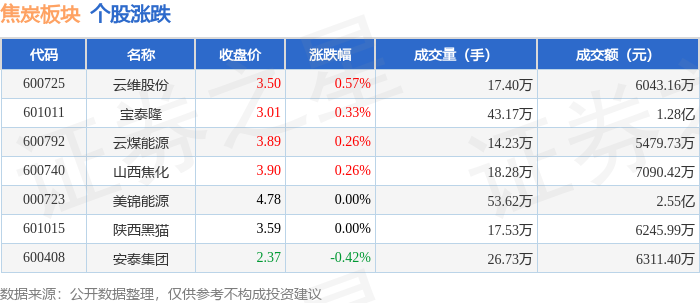
焦炭板块9月11日涨0.13%,云维股份领涨,主力资金净流出3053.7万元
Zheng Xing Xing Ye Ri Bao· 2025-09-11 08:58
Group 1 - The coke sector experienced a slight increase of 0.13% on September 11, with Yunwei Co., Ltd. leading the gains [1] - The Shanghai Composite Index closed at 3875.31, up 1.65%, while the Shenzhen Component Index closed at 12979.89, up 3.36% [1] - The trading volume and turnover for key coke stocks were reported, with Yunwei Co., Ltd. closing at 3.50 and a trading volume of 174,000 shares [1] Group 2 - The net capital flow in the coke sector showed a net outflow of 30.537 million yuan from main funds, while retail investors contributed a net inflow of 27.677 million yuan [1] - Individual stock capital flows indicated that Baotailong had a net inflow of 4.3111 million yuan from main funds, while An Tai Group experienced a significant net outflow of 14.4761 million yuan [2] - The overall sentiment in the coke sector appears mixed, with some stocks like Yunwei Co., Ltd. seeing retail inflows despite main fund outflows [2]
《黑色》日报-20250911
Guang Fa Qi Huo· 2025-09-11 01:38
Group 1: Report Industry Investment Rating - No relevant content provided Group 2: Core Views Steel - Steel maintains a weak trend, with iron ore and coking coal showing divergent trends. Steel apparent demand remains at a low level in the off - season and has not recovered. There is an expectation of inventory accumulation at low prices from August to September, and the apparent demand is expected to pick up in the peak season, with slower inventory accumulation. The steel supply - demand situation has not deteriorated to the negative feedback stage. Future steel prices will more likely follow the supply - side expectations of coking coal. For the January contract, pay attention to the support levels of 3100 for rebar and 3300 for hot - rolled coils [1] Iron Ore - As of the previous afternoon's close, the iron ore 2601 contract showed a stable oscillating trend. On the supply side, the global shipment volume of iron ore has dropped significantly from its annual high, and the arrival volume at 45 ports has decreased. It is estimated that the subsequent average arrival volume will first increase and then decrease. On the demand side, the steel mill profit margin has slightly declined, and after major events, the hot - metal production will significantly rebound this week, increasing the steel mills' restocking demand. It is expected that supply and demand will recover simultaneously this week. In terms of inventory, port inventory has slightly increased, the port clearance volume has decreased month - on - month, and the steel mills' equity iron ore inventory has decreased month - on - month. Looking ahead, due to the still high profit margin of steel mills, hot - metal production will remain at a relatively high level in September, and the low port inventory year - on - year provides support for iron ore. The iron ore market is currently in a slightly tight balance, and it is recommended to take a long position on dips for the iron ore 2601 contract and reduce the position of the long - iron - ore short - coking - coal arbitrage [3] Coking Coal and Coke - As of the previous afternoon's close, coking coal futures showed an oscillating downward trend, with sharp price fluctuations recently. The spot auction price was stable with a weak trend, and the Mongolian coal quotation was weak. For coke, futures showed an oscillating rebound trend, with sharp price fluctuations recently. After the first round of price cuts in the coke spot market, it has temporarily stabilized, and the port trade quotation follows the futures. On the supply side of coking coal, due to the shutdown of main - producing area coal mines last week, coal mine production decreased significantly month - on - month, but after the end of the parade, production restrictions were lifted, and the main - producing areas gradually resumed production. For coke, due to the previous consecutive price increases, coking profits improved, and northern coking enterprises quickly resumed production after being restricted by major events. On the demand side, the hot - metal production of blast furnaces dropped significantly last week, and steel mills will resume production this week, leading to a rapid rebound in hot - metal production. In terms of inventory, coking plant and steel mill inventories have slightly increased, and port inventories have decreased for coke; for coking coal, last week, coal mines, coal preparation plants, coking plants, and steel mills reduced their inventories, while ports and border crossings slightly increased their inventories. The overall inventory is at a medium - low level. It is recommended to take profit on short positions, treat the market with an oscillating view, and reduce the position of the long - iron - ore short - coking - coal/coke arbitrage [5] Group 3: Summary by Directory Steel Steel Prices and Spreads - Rebar and hot - rolled coil spot and futures prices in different regions have generally declined. For example, rebar spot prices in East China, North China, and South China decreased by 10 yuan/ton each, and most rebar and hot - rolled coil futures contracts also declined [1] Cost and Profit - The billet price decreased by 10 yuan/ton, while the slab price remained unchanged. The cost of Jiangsu electric - furnace rebar increased by 1 yuan, and the cost of Jiangsu converter rebar remained unchanged. The profit of East China hot - rolled coils remained unchanged, while the profit of North China hot - rolled coils increased by 20 yuan, and the profit of South China hot - rolled coils increased by 10 yuan. The profit of rebar in different regions showed different changes, with North China's rebar profit decreasing by 10 yuan [1] Production - The daily average hot - metal production decreased by 11.1 to 229.0, a decrease of 4.6%. The production of five major steel products decreased by 24.0 to 860.7, a decrease of 2.7%. The production of rebar and hot - rolled coils also decreased, with rebar production dropping by 1.9 to 218.7 (a decrease of 0.9%) and hot - rolled coil production dropping by 10.5 to 314.2 (a decrease of 3.2%) [1] Inventory - The inventory of five major steel products increased by 32.8 to 1500.7, an increase of 2.2%. The rebar inventory increased by 16.6 to 640.0, an increase of 2.7%, and the hot - rolled coil inventory increased by 8.9 to 374.3, an increase of 2.4% [1] Transaction and Demand - The daily average building materials trading volume decreased by 0.8 to 9.3, a decrease of 8.3%. The apparent demand for five major steel products decreased by 29.9 to 827.8, a decrease of 3.5%. The apparent demand for rebar and hot - rolled coils also decreased, with rebar's apparent demand dropping by 2.1 to 202.1 (a decrease of 1.0%) and hot - rolled coil's apparent demand dropping by 15.4 to 305.4 (a decrease of 4.8%) [1] Iron Ore Iron Ore - Related Prices and Spreads - The warehouse - receipt costs of various iron ore powders decreased slightly, with a decrease of about 0.4%. The basis of the 01 contract for various iron ore powders increased significantly, for example, the basis of the 01 contract for PB powder increased by 41.7 to 39.7, a significant increase of 2108.3%. The 5 - 9 spread increased by 2.5 to - 66.5 (an increase of 3.6%), the 9 - 1 spread decreased by 2.5 to 42.5 (a decrease of 5.6%), and the 1 - 5 spread remained unchanged [3] Spot Prices and Price Indexes - The spot prices of various iron ore powders at Rizhao Port decreased slightly, with a decrease of about 0.3% - 0.4%. The Singapore Exchange 62% Fe swap price increased by 1.5 to 106.8 (an increase of 1.4%), and the Jinshi 62% Fe price increased by 2.0 to 107.7 (an increase of 1.8%) [3] Supply - The 45 - port arrival volume decreased by 78.0 to 2448.0, a decrease of 3.1%. The global shipment volume decreased by 800.6 to 2756.2, a significant decrease of 22.5%. The national monthly import volume decreased by 131.5 to 10462.3, a decrease of 1.2% [3] Demand - The daily average hot - metal production of 247 steel mills decreased by 11.3 to 228.8, a decrease of 4.7%. The 45 - port daily average port clearance volume decreased by 0.9 to 317.8, a decrease of 0.3%. The national monthly pig - iron production decreased by 110.8 to 7079.7, a decrease of 1.5%, and the national monthly crude - steel production decreased by 352.6 to 7965.8, a decrease of 4.2% [3] Inventory Changes - The 45 - port inventory increased by 24.3 to 13849.65, an increase of 0.2%. The import iron ore inventory of 247 steel mills decreased by 67.3 to 9007.2, a decrease of 0.7%. The inventory available days of 64 steel mills increased by 1.0 to 21.0, an increase of 5.0% [3] Coking Coal and Coke Prices and Spreads - For coking coal, the 01 contract price decreased by 7 to 1124, a decrease of 0.6%, and the 05 contract price decreased by 10 to 1205, a decrease of 0.8%. For coke, the 01 contract price increased by 6 to 1603, an increase of 0.3%, and the 05 contract price increased by 7 to 1733, an increase of 0.4% [5] Supply - The weekly coke production of the full - sample coking plants decreased by 0.2 to 64.3, a decrease of 0.34%. The daily average production of 247 steel mills decreased by 11.3 to 228.8, a decrease of 4.7%. The raw coal production of Fenwei sample coal mines decreased by 43.1 to 860.5, a decrease of 5.0%, and the clean coal production decreased by 25.4 to 444.5, a decrease of 5.74% [5] Demand - The weekly hot - metal production of 247 steel mills decreased by 11.2 to 228.8, a decrease of 4.74%. The weekly coke production demand also decreased, with the full - sample coking plant daily average production decreasing by 0.2 to 64.3, a decrease of 0.34% [5] Inventory Changes - For coke, the total inventory increased by 7.8 to 895.3, an increase of 0.9%. The coking plant inventory increased by 1.2 to 66.5, an increase of 1.8%, and the 247 - steel - mill inventory increased by 13.6 to 623.7, an increase of 2.2%. For coking coal, the Fenwei coal mine clean coal inventory increased by 6.8 to 116.7, an increase of 5.8%, while the full - sample coking plant inventory decreased by 41.2 to 967.3, a decrease of 4.34%, and the 247 - steel - mill inventory decreased by 16.1 to 811.9, a decrease of 2.04% [5] Supply - Demand Gap - The calculated coke supply - demand gap increased by 4.9 to - 0.8, indicating a slight improvement in the supply - demand situation [5]
中国旭阳(1907.HK):周期低点仍实现盈利
Ge Long Hui· 2025-09-10 20:08
Core Viewpoint - The company experienced a significant decline in revenue and profit in the first half of 2025, primarily due to falling coke prices, but still managed to maintain profitability through cost control measures [1][3]. Financial Performance - Total operating revenue for the first half of 2025 was 20.549 billion RMB, a year-on-year decrease of 18.5% [1]. - Net profit for the same period was 87 million RMB, down 34% year-on-year, impacted by lower coke prices [1]. - The gross profit margin improved to 11.9%, an increase of 4.4 percentage points, attributed to effective cost-saving measures and a reduction in depreciation expenses [2]. Coke Business - Revenue from coke and coking operations was 6.36 billion RMB, a decrease of 35.2% year-on-year [1]. - The average price of coke fell to approximately 1,400 RMB per ton (excluding tax), a decline of about 30% year-on-year, but rebounded to around 1,500 RMB per ton by the end of July 2025 [1]. - The volume of coke produced increased by 330,000 tons year-on-year, totaling 10.88 million tons [1]. Chemical Business - Revenue from the chemical business was 9.1 billion RMB, down 12.6% year-on-year, primarily due to lower average prices for key products [2]. - The gross profit margin for the chemical segment was 8.3%, a decrease of 0.2 percentage points, with a tax-prepared profit of 190 million RMB, down 44.9% year-on-year [2]. Hydrogen Energy Business - Hydrogen sales reached 1,114 million cubic meters, a year-on-year increase of 20%, with hydrogen revenue of 56 million RMB, up 47% [2]. Operational Management and Trade - Revenue from operational management was 1.275 billion RMB, a decrease of 47% year-on-year, with a tax-prepared profit of 34 million RMB, down 41.2% [3]. - Trade business revenue increased by 53% to 3.73 billion RMB, although it incurred a tax-prepared loss of 184 million RMB, which widened by 8.2% year-on-year [3]. Future Outlook - The company has adjusted its net profit forecasts for 2025, 2026, and 2027 to 170 million, 480 million, and 1.06 billion RMB respectively, reflecting the impact of declining coke prices [1][3]. - The target price remains at 4.2 HKD, indicating a potential upside of 68% from the current stock price [1][3].