茶饮

Search documents
看2026|柠季汪洁:产品组织供应链全面升级,加速走向全球
Bei Ke Cai Jing· 2026-01-01 09:48
Core Viewpoint - The article discusses the strategic initiatives and goals of the company, Ningji, in response to the central economic work conference's emphasis on expanding domestic demand and optimizing supply in 2026. Group 1: Strategic Initiatives - Ningji aims to empower existing operations through "digital intelligence" to achieve lean growth, enhancing operational efficiency via a self-developed intelligent management system that has improved the operational capabilities of 90% of its stores [6]. - The company focuses on "standardization" to optimize supply and support agricultural modernization, having established over 1,000 acres of perfume lemon plantations in Guangdong and Guangxi, ensuring product quality and driving local industry upgrades [6]. - To stimulate domestic demand, Ningji plans to innovate marketing strategies, exemplified by the "Lemon Treasure Festival," which led to a 30.2% year-on-year increase in GMV during the event, contributing to offline consumption [7]. Group 2: Strategic Development Goals for 2026 - In 2025, despite market pressures, Ningji achieved a 20% year-on-year growth in overall GMV and a 12% increase in average daily store revenue, with a remarkable 63% growth in monthly delivery revenue [8]. - For 2026, the company will shift from "rapid expansion" to "high-quality development," focusing on "quality profitability" and prioritizing "single-store profitability" as a key performance indicator [8]. - The company plans to enhance its research and development capabilities, establishing a scientific-driven R&D matrix and a quality control system, while continuing to innovate and develop differentiated products [9]. - Ningji aims to deepen its "globalization" and "supply chain enhancement," with plans to open new storage centers in regions like Urumqi and accelerate international expansion, having already signed contracts for 40 stores in Southeast Asia and Oceania [9].


喜茶、古茗押注“液体咸蛋糕”,下一个爆点是提拉米苏!
东京烘焙职业人· 2026-01-01 08:33
以下文章来源于饮力实验室 ,作者梦婕 饮力实验室 . 离产品更近一步。 12月22日,喜茶又刷屏了: 喜茶 联名泡泡玛特旗下人气IP"星星人" ,推出提拉米苏风味的奶茶新品,门店迅速迎来爆单,多个周边套餐几乎秒售罄,多位网友称"排队一小 时以上"。 这让我发现,甜品化趋势下,头部品牌似乎更偏爱提拉米苏产品,这是为什么? 被形容为 " 液体咸蛋糕 " 这款风味喜茶、古茗、瑞幸都在上 喜茶这次联名,不仅又一次切中了流量爆点,还 被很多业内人评价 " 特别好喝 " : 这款新品叫 "提拉米苏·英红" ,是围绕联名活动研发定制的饮品,饮品中用到马斯卡彭乳酪、可可粉等元素,还原提拉米苏的风味和层次感。同时,喜茶 还在售挞类产品的门店中推出了星星人联名"AOP提拉米苏可颂挞"。 这不是"提拉米苏"第一次被看见,实际上,它一直是茶饮品牌青睐的热门甜品元素: 古茗、 Manner等品牌推出 "提拉米苏拿铁" , 将拿铁咖啡搭配可可粉和奶盖,被网友评价为"一口惊艳,2025年最爱的一杯。" 瑞幸上架提拉米苏系列,将其分别搭配美式、拿铁等咖啡,近期还推出了 "提拉米苏杯子蛋糕"、"提拉米苏大福" 等甜品,不少网友甚至为了甜品才去 ...
搜狐酒馆第49期|朱毅:奶茶含咖啡因和苹果果酸一样不用恐慌,极端言论就是为了博流量
Sou Hu Cai Jing· 2025-12-31 07:04
以下是直播全文摘要,供行业人士参考。 毕然:这次事件被网络发酵,甚至有人说咖啡因超标如准毒品,您怎么看这种说法? 2025年,新茶饮行业已从早期的品类扩张与口味创新阶段,迈入以"健康认知"与"价值共识"为核心的新阶段。奶茶产品引发的公众讨论不再局限于口味与营 销,而是深入至成分安全、科学沟通与品牌信任的层面,这对茶饮品牌的风险沟通与综合知识运营能力提出了更高要求。 12月30日,搜狐酒业主播毕然连线中国农业大学食品科学与营养工程学院教授朱毅,开启搜狐酒馆第49期节目,共同探讨新阶段下茶饮行业如何应对成分焦 虑、构建科学认知,直播热度超30万+。 本次对话中,朱毅指出,当前围绕奶茶咖啡因的争议,标志着行业进入了深度认知竞争阶段,其破局关键在于:以科学沟通扭转公众对咖啡因的片面恐慌, 阐明咖啡因是茶的天然固有成分,且因茶多酚、茶氨酸的缓冲作用,其释放比咖啡更温和;推动建立更清晰、易懂的成分标注体系,如红绿灯警示、生活化 类比,保障消费者知情权,将恐慌性关注转化为理性关注。品牌需坚守并传达茶饮的本真价值——此次争议本质是消费者对产品天然属性与真实品质的关注 升级,是行业回归"真茶"本味的积极信号。 朱毅:这显然是过 ...

外媒热议中国2025年经济亮点
Huan Qiu Shi Bao· 2025-12-31 05:13
Group 1: Economic Resilience and Trade - In 2025, China's goods trade maintained growth for ten consecutive months despite high tariffs imposed by the US, with a predicted export growth rate of 8% for the year [1][2] - China achieved a record annual trade surplus of $1 trillion in November 2025, offsetting declines in exports to specific markets by expanding into Europe, Latin America, and Africa [1] - China's export products have become more innovative, enhancing its role in stabilizing global supply chains amid rising protectionism [2] Group 2: Artificial Intelligence and Technological Advancements - 2025 marked a pivotal year for artificial intelligence, with China's DeepSeek releasing the R1 model, challenging the dominance of US AI companies [3][4] - China is recognized as a leader in the open-source AI sector, with its models gaining traction globally, significantly impacting the competitive landscape [4] - The advancements in AI are part of a broader trend of China's technological capabilities extending into robotics and deep-sea science [3] Group 3: Stock Market Performance - The total market capitalization of A-shares surpassed 100 trillion yuan for the first time in 2025, with significant returns exceeding initial predictions [5][6] - High expectations for the Chinese stock market are driven by a slow bull market and increased foreign investment interest, particularly following the emergence of DeepSeek [5][6] - Analysts predict a 38% increase in the Chinese stock market by the end of 2027, reflecting strong investor confidence [5] Group 4: Soft Power and Global Influence - China ranked second in the global soft power index, surpassing the UK, with cultural products like the toy brand Labubu gaining international popularity [7][8] - The success of Chinese lifestyle brands and cultural products in global markets indicates a shift towards China leading global trends rather than merely following them [7][8] - The rise of Chinese media and entertainment on international platforms showcases the growing influence of Chinese culture [7] Group 5: Consumer Spending and Economic Growth - International organizations have raised China's GDP growth forecast for 2025 to 5%, highlighting its role as a key contributor to global economic growth [9] - Consumer spending's contribution to economic growth significantly increased from 29.7% at the end of 2024 to 56.6% by the third quarter of 2025, driven by both durable goods and service consumption [9] - The outlook for 2026 remains positive, with expectations that consumer spending will continue to support economic growth [9]
巅峰时估值600亿的喜茶,如今大量关店,到底发生了什么?
Sou Hu Cai Jing· 2025-12-31 02:49
Core Insights - The tea beverage market, particularly the new tea brands, is facing significant challenges as economic downturns and market contractions lead to strategic shifts and store closures among previously high-flying companies like Heytea [2][5][12] Group 1: Market Dynamics - The period from 2012 to 2023 marked a rapid growth phase for Heytea, characterized by high demand and long queues for its products, with peak valuations reaching 60 billion [4][5] - In 2023, Heytea faced increased competition from brands like Mixue Ice Cream and Bawang Tea, which adopted different strategies, leading to a stagnation in growth for Heytea [4][5] - The overall market is experiencing a decline in consumer spending power, prompting a shift in purchasing behavior among young consumers who are now more cautious about their spending [10][12] Group 2: Strategic Shifts - Heytea has begun to implement strategic contractions, including halting new franchise applications and avoiding price wars, indicating a transition from aggressive growth to a more stable growth model [7][12] - The company has reduced its price range from 20-40 yuan to 15-19 yuan, and even introduced items below 10 yuan to retain customers, but this has diminished its brand differentiation and high-end appeal [12][14] - The industry is moving away from reckless expansion towards a focus on avoiding homogenization and ensuring sustainability, as many franchisees face financial difficulties [12][14]
扩张集体放缓,新茶饮第一梯队踩下急刹车
3 6 Ke· 2025-12-31 00:49
Core Insights - The leading new tea beverage brands, represented by Heytea, are experiencing a significant slowdown in expansion, with a notable decrease in the number of stores from 4,610 in October 2024 to 3,930 by October 2025, resulting in a net closure of 680 stores within a year [2] - The challenges faced by franchisees include high operational costs, particularly due to the expensive raw materials and short shelf life of fresh ingredients, which contribute to profitability pressures [8][9] - The competitive landscape is shifting, with brands like Bawang Chaji rapidly expanding through a "big single product" strategy, yet also facing challenges related to market saturation and product innovation [9][10] Group 1: Expansion Trends - Heytea's franchise model, which previously allowed for rapid expansion, has now hit a brake, with the company halting new franchise applications as of February 2023 [4] - The number of operational stores for Heytea as of December 29, 2023, is reported at 3,883, consistent with the previous year's figures, indicating a plateau in growth [2] - Naixue's Tea is also seeing a reduction in store numbers, with operational stores at 1,570, down from 1,798 at the end of 2024 [2] Group 2: Franchisee Challenges - Franchisees are facing tough decisions regarding store renewals, with additional renovation costs required for upgrades, leading to closures due to performance pressures [3] - High raw material costs are a significant burden, with reports indicating that material costs for Naixue's Tea reached approximately 740 million yuan, accounting for 34.1% of total revenue [8] - Franchisees have reported that the cost of materials supplied by brands like Heytea can increase by as much as 40%, further straining profitability [8] Group 3: Product Strategy and Market Positioning - The new product launch frequency has increased significantly for Heytea, with new offerings introduced weekly, but this has led to inventory pressures for franchisees [5] - The pricing strategy is shifting back to the 20-30 yuan range for new products, as brands aim to regain high-end market positioning after a period of aggressive discounting during the delivery wars [11] - The competitive dynamics are evolving, with brands like Bawang Chaji focusing on product innovation while also managing the challenges of high store density in key markets [9][10]
张红超兄弟靠6元奶茶赢得千亿财富 蜜雪冰城低价盈利模式面临可持续性考验
Chang Jiang Shang Bao· 2025-12-30 23:21
Core Insights - UBS released its 11th "Billionaire Report," featuring Zhang Hongchao and Zhang Hongfu, the founders of Mixue Ice City, who became billionaires with a net worth of 117.9 billion yuan, making them the richest in Henan [1][11] - Mixue Ice City went public on the Hong Kong Stock Exchange on March 3, 2025, with its stock price reaching 618.50 HKD per share, significantly contributing to the Zhang brothers' wealth [1][11] - The company has expanded rapidly, with over 53,000 stores globally by June 2025, and reported a profit of 2.693 billion yuan in the first half of 2025 [1][11] Company Background - Zhang Hongchao and Zhang Hongfu started their entrepreneurial journey with a mere 3,000 yuan, selling ice cream and milk tea, and have built a successful business over 28 years [1][2] - The brothers' contrasting personalities and skills have complemented each other, with Zhang Hongchao focusing on product quality and Zhang Hongfu on marketing and expansion [5][6] Business Model and Strategy - Mixue Ice City's success is attributed to its low-price strategy combined with a self-built supply chain, allowing it to maintain profitability while offering affordable products [15][7] - The company has established five production bases across China, with an annual capacity of 1.65 million tons, ensuring over 70% of its core raw materials are self-sourced [15][7] Financial Performance - The company reported net profits of 3.137 billion yuan and 4.437 billion yuan for 2023 and 2024, respectively, with a year-on-year growth of 57.13% and 41.41% [15][7] - In the first half of 2025, Mixue Ice City achieved a net profit of 2.693 billion yuan, reflecting a 42.90% increase compared to the previous year [15][7] Challenges and Risks - The sustainability of the low-price model is under scrutiny, especially in a competitive market where product quality has been questioned due to complaints about hygiene and service [17][13] - The company faced challenges with rapid expansion, leading to issues such as supply shortages and management difficulties, prompting a strategic shift towards standardization and supply chain improvement [9][10] Market Position - Despite its challenges, Mixue Ice City has established a strong brand presence, particularly in lower-tier markets, and has been able to maintain a competitive edge through its pricing strategy [13][7] - The company has expanded internationally, with stores in countries like Indonesia, Vietnam, and South Korea, but faces uncertainties related to market adaptation and regulatory differences [17][13]
河南,正为全球做奶茶
Xin Lang Cai Jing· 2025-12-30 06:40
Core Insights - The global expansion of "Mixue" has reached 13 countries with approximately 4,700 overseas stores, marking a significant milestone in the international beverage market [1][4] - The trend of new tea beverage brands from Henan province, such as Mixue, Ice Pure Tea, and others, is reshaping the global beverage landscape [1][4] Group 1: Expansion and Market Presence - Mixue opened two new stores in Hollywood, Los Angeles, and Broadway, New York, showcasing its high-quality and affordable products, such as ice cream priced at $1.19 and lemon water at $1.99 [4][13] - Ice Pure Tea has achieved a record by covering 20 countries with over 1,000 signed overseas stores, becoming the leading Chinese tea brand in terms of international presence [5] - Other brands like Junchai and Slow Tea are also expanding into Southeast Asia, with Junchai opening three stores in Malaysia [7] Group 2: Market Strategy and Consumer Engagement - Mixue's strategy includes adapting to local consumer preferences by offering various toppings and sweetness options, which has resonated well with American consumers [4][12] - The brands are leveraging cultural elements and local partnerships to enhance their market entry strategies, ensuring a smooth operational setup in foreign markets [15] - The focus on Southeast Asia is driven by the region's young population and high demand for new beverage experiences, aligning well with the product offerings of these brands [11] Group 3: Supply Chain and Operational Efficiency - Mixue has established a robust supply chain network, including a digital procurement system across 38 countries and local warehousing in four countries to support its overseas operations [12] - The company has invested in multiple production bases in China, ensuring a steady supply of products to meet international demand [12] - Ice Pure Tea emphasizes local partnerships for market entry, ensuring that operations are tailored to local conditions and consumer preferences [15] Group 4: Competitive Landscape and Future Challenges - The competitive landscape in overseas markets is intensifying, with a need for brands to refine their supply chains and establish strong brand recognition to succeed [16][17] - Industry experts highlight the importance of integrating local cultural elements and consumer habits into business strategies for successful market penetration [17]

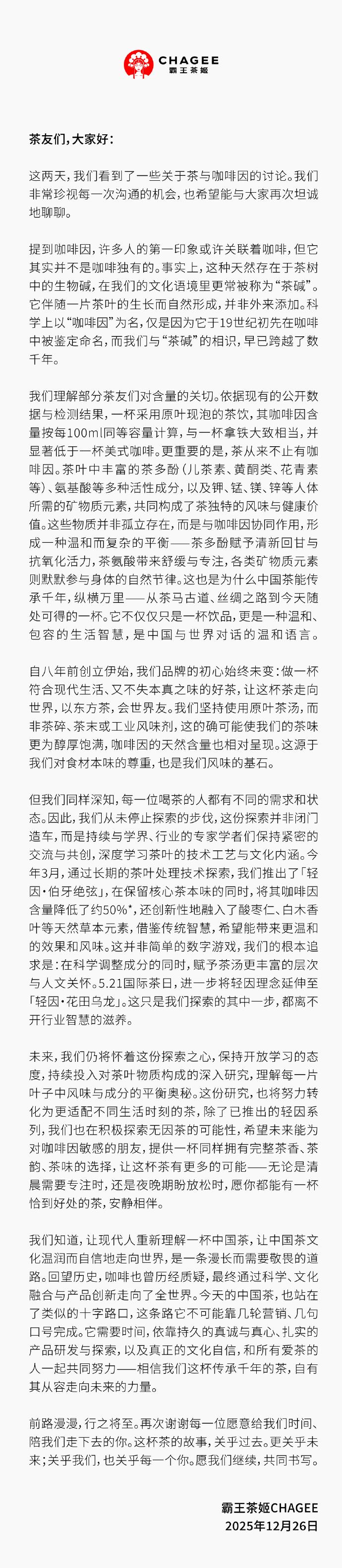
喝奶茶,更易“咖啡因”过量?
3 6 Ke· 2025-12-30 02:09
Core Viewpoint - The controversy surrounding BaWang Tea Ji's high caffeine content in its beverages has sparked significant public discussion, leading to a notable drop in its stock price. The company clarified that caffeine is naturally present in tea, similar to coffee, and provided data to support its claims about caffeine levels in its drinks [1][4]. Group 1: Company Response and Market Reaction - BaWang Tea Ji's stock fell over 14% following public concerns about its caffeine content [1]. - The company issued a statement emphasizing that caffeine is not exclusive to coffee and is naturally occurring in tea, which is often referred to as "theine" in cultural contexts [1]. - BaWang Tea Ji introduced a new product with approximately 50% less caffeine, named "Light Caffeine · Bo Ya Jue Xuan" [1]. Group 2: Caffeine Content in Tea Beverages - Caffeine in tea is not a new concept, and many brands, including BaWang Tea Ji, openly disclose the caffeine content in their products [4]. - BaWang Tea Ji's drinks have caffeine levels ranging from 89.2 mg to 241.3 mg per cup, depending on the product [4][5]. - Other brands, such as Heytea, have implemented a "Caffeine Traffic Light" system to categorize their drinks based on caffeine content, with red indicating over 100 mg, yellow between 50 mg and 100 mg, and green below 50 mg [7][9]. Group 3: Caffeine in Tea and Its Sources - Caffeine is a natural compound found in about 100 plant species, including coffee and tea, and is chemically identical in both [18]. - Research indicates that tea leaves can contain higher caffeine levels than coffee beans, with the order of caffeine content being tea leaves > coffee leaves > coffee beans [18]. - Factors such as tea variety, harvesting time, and environmental conditions significantly influence the caffeine content in tea leaves [20]. Group 4: Consumer Awareness and Recommendations - BaWang Tea Ji's app provides information on caffeine content and advises consumers to manage their intake based on personal sensitivity [5]. - Other brands also provide caffeine content labels and recommendations for consumption timing to help consumers make informed choices [9][11]. - It is suggested that individuals sensitive to caffeine should limit their intake, especially close to bedtime, to avoid potential negative effects [25].
早报 | 贵金属大跳水;乌91架无人机袭击普京官邸?特朗普很生气;解放军无人机俯瞰台北101大厦;王忠磊、王忠军被限高
虎嗅APP· 2025-12-29 23:59
Group 1 - Precious metals, led by silver, experienced significant price corrections after a recent surge, with silver dropping over 8% and gold falling nearly $200 in a single day [2] - The Chicago Mercantile Exchange raised margin requirements for several popular futures contracts, including silver and gold, to mitigate market volatility [2] - The price of platinum and palladium also saw substantial declines, with platinum down nearly 13% and palladium over 15% [2] Group 2 - Labubu blind box prices have drastically decreased from previous highs, with the second-hand market seeing prices drop from over 4,600 yuan to around 260 yuan [5][7] - Morgan Stanley reported that Pop Mart is transitioning from explosive growth to sustainable growth, predicting a slowdown in revenue growth for Labubu by 2026 [7] Group 3 - Huayi Brothers and its founders are facing legal and financial issues, with a court restricting high consumption due to a 74.73 million yuan enforcement case [8] - The company has been involved in multiple legal disputes, indicating potential financial instability [8] Group 4 - SoftBank is in talks to acquire DigitalBridge Group, which manages over $100 billion in data center assets, as part of its strategy to enhance its data infrastructure [9] - DigitalBridge's stock surged by 45% in pre-market trading following news of the potential acquisition [9] Group 5 - The People's Bank of China announced a new action plan for digital yuan management, set to be implemented on January 1, 2026, with significant transaction volumes already recorded [10][11] - By November 2025, digital yuan transactions reached 34.8 billion, totaling 16.7 trillion yuan, indicating strong adoption [11][12] Group 6 - Zero Run Auto announced a 3.744 billion yuan investment from FAW Group, which will help enhance the company's stability and risk management capabilities [32] - The investment agreement ensures that the founding team retains control, reflecting a strategic partnership for future growth [32]