
非银金融

Search documents
开年首周 两融资金持续入场!
Zheng Quan Shi Bao· 2026-01-12 07:52
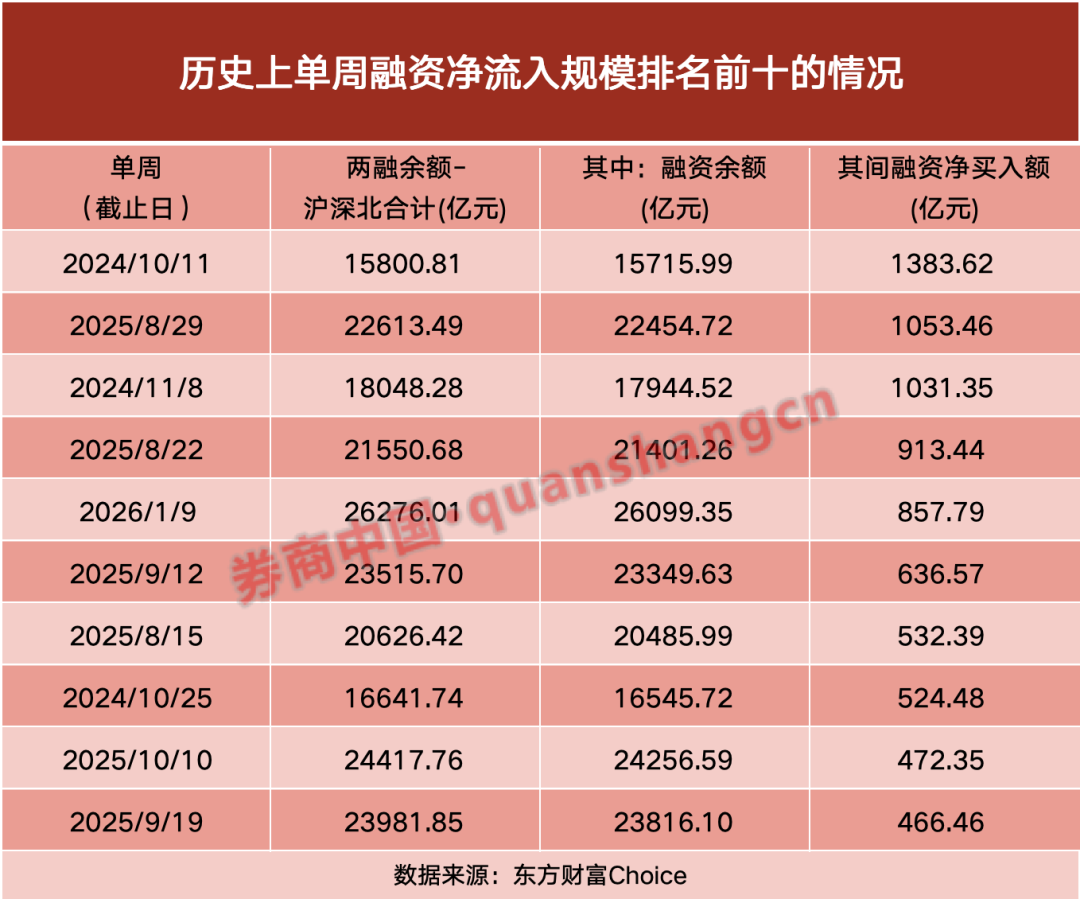
Core Viewpoint - The A-share market experienced a strong start in the first week of 2026, with significant inflows of leveraged funds, indicating a positive market sentiment and potential for continued investment activity [1][3]. Group 1: Market Performance - In the first week of 2026, the A-share market saw a net inflow of financing funds amounting to 857.79 billion yuan, ranking as the fifth largest weekly net inflow in A-share history [1][3]. - The total trading volume in the A-share market exceeded 30 trillion yuan on January 9, 2026, reflecting heightened market activity and investor interest [3]. Group 2: Fund Inflows - The first four days of the week recorded daily net inflows exceeding 100 billion yuan, with figures of 192.66 billion yuan, 188.87 billion yuan, 249.02 billion yuan, and 159.44 billion yuan, indicating a strong acceleration of fund entry [3]. - The electronic sector attracted the most attention from financing clients, with a net inflow of 158.12 billion yuan, significantly higher than other sectors [8]. - Non-bank financials and the computer sector also received substantial net inflows, each exceeding 60 billion yuan [9]. Group 3: Investor Behavior - Many existing clients increased their positions, primarily focusing on short-term operations and chasing market hotspots, while new account openings were not yet evident [6]. - Over 70% of the stocks saw net buying from financing clients, with seven stocks exceeding 1 billion yuan in net buying, including XW Communication and China Ping An [10]. Group 4: Future Market Outlook - Analysts suggest that the current market momentum is supported by multiple liquidity factors, including significant inflows into A500 ETF and a strengthening yuan, which reflects international confidence in China [12]. - The spring market is expected to have further room for growth, with technology sectors likely to remain a long-term focus, while value sectors may also present opportunities [12][13].

开年首周,两融资金持续入场!
Zheng Quan Shi Bao· 2026-01-12 07:30
Group 1 - The A-share market experienced a strong start in the first week of 2026, with a net inflow of margin financing reaching 857.79 billion yuan, ranking fifth in A-share history for single-week net inflows [1][2] - The first four days of the week saw daily net inflows exceeding 100 billion yuan, indicating a rapid influx of funds, although the fifth day showed a significant slowdown with a net inflow of only 67.81 billion yuan [2] - The electronic industry was particularly favored by margin investors, attracting a net inflow of 158.12 billion yuan, significantly higher than other sectors [5][6] Group 2 - Other sectors that received notable net inflows included non-bank financials and computers, each exceeding 60 billion yuan in net buying [6] - Over 70% of margin trading stocks experienced net buying, with seven stocks seeing net inflows exceeding 10 billion yuan, including XW Communication and China Ping An [7] - Analysts suggest that the strong performance in the A-share market is driven by multiple liquidity factors, including abnormal inflows into A500 ETF and the continuous appreciation of the yuan, reflecting international capital's restored confidence in China [8][9]
开年首周,两融资金持续入场!
证券时报· 2026-01-12 07:27
Core Viewpoint - The A-share market experienced a strong start in the first week of 2026, with significant inflows of leveraged funds, indicating a positive market sentiment and potential investment opportunities [2][5][18]. Group 1: Market Performance - The first week of 2026 saw a net inflow of financing funds reaching 857.79 billion yuan, ranking fifth in A-share history for single-week net inflows [2][5]. - The total trading volume in the A-share market exceeded 30 trillion yuan on January 9, reflecting heightened market activity and investor interest [4]. - Daily net inflows for the first four days of the week were substantial, exceeding 100 billion yuan each day, with figures of 192.66 billion, 188.87 billion, 249.02 billion, and 159.44 billion yuan respectively [6]. Group 2: Sector Focus - The electronic sector attracted the most attention from financing clients, with a net inflow of 158.12 billion yuan, significantly higher than other sectors [12]. - The non-ferrous metals sector followed with a net inflow of 95.62 billion yuan, while the defense and military industry saw an increase of 91.73 billion yuan, indicating growing interest in these areas [13]. - Other sectors such as non-bank financials and computers also received over 60 billion yuan in net financing [14]. Group 3: Investor Behavior - Investors showed a strong inclination towards short-term operations, primarily chasing hot themes, with many existing clients increasing their positions rather than new account openings [3][9]. - Over 70% of the stocks in the financing market experienced net buying, with seven stocks exceeding 1 billion yuan in net inflows, including significant contributions from XW Communication and China Ping An [15][16]. Group 4: Future Outlook - Analysts suggest that the current market momentum is supported by multiple liquidity factors, including abnormal inflows into A500 ETF and the continuous appreciation of the yuan, which reflects international confidence in China [18][19]. - The spring market is expected to have further room for growth, with technology sectors likely to remain a long-term focus, while value sectors may also present opportunities [20][21]. - Short-term market dynamics may shift, with potential changes in sentiment and policy risks to be monitored, but overall risks are considered manageable [22].

资金跟踪系列之二十八:市场交易热度加速上升,两融与北上大幅回流
SINOLINK SECURITIES· 2026-01-12 07:04
Macro Liquidity - The US dollar index continued to rise, and the degree of "inversion" in the China-US interest rate spread has narrowed. The nominal and real yields of 10Y US Treasuries both fell, indicating a rebound in inflation expectations [1][13][19]. Market Trading Activity, Volatility, and Liquidity - Market trading activity has continued to rise, with most industry trading heat above the 90th percentile. Specifically, sectors such as military, light industry, chemicals, media, and textiles are all above this threshold [2][25]. - The volatility of major indices has also increased, with the communication sector's volatility remaining above the 80th historical percentile [2][31]. - Market liquidity indicators have improved, although all sectors remain below the 60th historical percentile [2][35]. Institutional Research - The electronic, pharmaceutical, computer, machinery, and electric new energy sectors have seen high research activity, while sectors like oil and petrochemicals, agriculture, military, and automotive have also experienced rising research interest [3][41]. Analyst Forecasts - The net profit forecast for the entire A-share market in 2026 has been downgraded. However, the profit forecasts for sectors such as non-ferrous metals, chemicals, transportation, consumer services, and textiles have been upgraded. The net profit forecasts for the Shanghai 50 and CSI 300 indices have also been raised, while those for the ChiNext and CSI 500 indices have been lowered [3][4][4.1][4.2][4.3][4.4]. Northbound Trading Activity - Northbound trading activity has continued to rise, with significant net purchases of A-shares. The trading volume ratio in sectors like home appliances, media, and non-bank financials has increased, while it has decreased in communication, electronics, and banking [4][5][5.1][5.2]. Margin Financing Activity - Margin financing activity has reached its highest point since November 2025, with a net purchase of 857.75 billion yuan last week. Key sectors for net purchases include electronics, military, and non-ferrous metals, while net sales were seen in food and beverage, consumer services, and utilities [6][6.1][6.2][6.3]. Active Equity Funds and ETFs - The positions of actively managed equity funds have decreased, while ETFs have seen renewed net subscriptions, primarily driven by institutional ETFs. The main net purchases in ETFs were in sectors like non-ferrous metals, military, and chemicals, while electronics, electric new energy, and banking saw net sales [8][8.1][8.4][8.5].
A股开年首周融资净流入857.79亿元,电子行业获158亿元加仓居首
Sou Hu Cai Jing· 2026-01-12 06:28
Core Insights - The A-share market experienced a significant inflow of financing funds during the first trading week of 2026, with a net buying amount of 857.79 billion yuan, ranking fifth in the historical records of A-share weekly net inflows [1] Group 1: Market Trends - The first four trading days of the week saw particularly notable inflows, with daily net inflows exceeding 100 billion yuan, specifically 192.66 billion yuan, 188.87 billion yuan, 249.02 billion yuan, and 159.44 billion yuan, while the last trading day saw a slowdown with a net inflow of 67.81 billion yuan [3] - The electronic industry emerged as the primary focus for financing clients, receiving a net inflow of 158.12 billion yuan, the highest among all sectors, followed by non-ferrous metals and defense industries with net inflows of 95.62 billion yuan and 91.73 billion yuan respectively [3] Group 2: Individual Stocks - Over 70% of margin trading targets achieved net buying, with notable stocks including XW Communication and China Ping An, each exceeding 18 billion yuan in net buying, while Goldwind Technology and CITIC Securities received net buys of 16.24 billion yuan and 14.53 billion yuan respectively [3] Group 3: Investor Behavior - A medium-sized brokerage in Shenzhen reported that the incremental margin trading funds primarily came from existing clients, focusing on chasing hot stocks and short-term operations, with new account openings not yet showing significant activity [3] - A two-margin investor from East China indicated that they had preemptively increased their positions in brokerage stocks in December 2025 and made minor adjustments in the first week of 2026, primarily in the energy storage sector [4]

证券ETF(512880)盘中涨超1.3%,连续3日净流入超22亿元,市场关注非银金融双轮驱动
Mei Ri Jing Ji Xin Wen· 2026-01-12 06:16
1月12日,证券ETF(512880)盘中涨超1.3%,资金面看,连续3日净流入超22亿元,市场关注非银 金融双轮驱动。 西部证券指出,保险板块本周表现强劲,开门红业绩高增长成为核心催化因素,负债端和资产端形 成共振,推动行业基本面持续改善。分红险凭借收益优势契合居民"挪储"需求,头部险企凭借产品力和 渠道优势实现集中度提升。券商板块当前盈利与估值存在错配,国际业务成为头部券商重要角逐领域, 广发证券通过H股融资支持境外子公司发展,行业集中度变化下选股重要性提升。非银金融整体受益于 AUM扩容与利差率修复双轮驱动,叠加机构低配格局下的补仓动能,估值修复空间有望进一步打开。 证券ETF(512880)跟踪的是证券公司指数(399975),该指数从A股市场中选取具有代表性的上 市证券公司证券作为指数样本,以反映证券行业相关上市公司证券的整体表现。证券公司指数覆盖了证 券行业的主要企业,能够较好地体现证券行业的周期性特征和市场走势。 每日经济新闻 (责任编辑:董萍萍 ) 【免责声明】本文仅代表作者本人观点,与和讯网无关。和讯网站对文中陈述、观点判断保持中立,不对所包含内容 的准确性、可靠性或完整性提供任何明示或暗示 ...
“扫货”逾800亿!开年首周,两融资金加速涌入!
券商中国· 2026-01-12 04:21
Core Viewpoint - The A-share market experienced a strong start in the first week of 2026, with significant inflows of leveraged funds, indicating a positive market sentiment and potential for continued investment activity [1][4]. Group 1: Market Performance - In the first week of 2026, the A-share market saw a net inflow of financing funds amounting to 857.79 billion yuan, ranking as the fifth largest single-week inflow in A-share history [1][4]. - The total trading volume on January 9, 2026, exceeded 30 trillion yuan, reflecting heightened market activity and investor interest [3]. - Daily net inflows during the first four days of the week were robust, exceeding 100 billion yuan each day, with figures of 192.66 billion, 188.87 billion, 249.02 billion, and 159.44 billion yuan respectively [4]. Group 2: Sector Analysis - The electronic sector attracted the most attention from financing clients, with a net inflow of 158.12 billion yuan, significantly higher than other sectors [8]. - The non-ferrous metals sector followed with a net inflow of 95.62 billion yuan, while the defense and military industry saw an increase of 91.73 billion yuan in financing balance [8]. - Other sectors such as non-bank financials and computers also received over 60 billion yuan in net financing purchases [8]. Group 3: Investor Behavior - Investors showed a preference for short-term operations, primarily focusing on chasing hot themes, with many existing clients returning to the market rather than new account openings [6]. - Over 70% of stocks recorded net financing purchases, with seven individual stocks exceeding 1 billion yuan in net purchases, including significant inflows for XW Communication and China Ping An [8]. Group 4: Future Market Outlook - Analysts suggest that the current market momentum is supported by multiple liquidity factors, including abnormal inflows into A500 ETF and the appreciation of the RMB, which reflects international confidence in China [10]. - The spring market is expected to continue evolving, with opportunities in technology sectors and potential value plays in traditional consumer goods and real estate [11]. - Short-term market dynamics may be influenced by emotional shifts and potential policy changes, but overall risks are considered manageable [11].

策略周报:1月第1周全球外资周观察:灵活型外资或明显参与开门红行情-20260112
Guoxin Securities· 2026-01-12 03:30
Group 1: A-Share Market - The estimated net inflow of northbound funds for the week from January 5 to January 9, 2026, is 9.6 billion yuan, compared to a net outflow of 3.1 billion yuan in the previous week [10] - The estimated net inflow of flexible foreign capital during the same week is 3.2 billion yuan, up from 1.7 billion yuan the previous week [10] - The top active stocks in the northbound trading include Ningde Times with a total transaction amount of 22.5 billion yuan, accounting for 20% of the stock's weekly trading volume [10] Group 2: Hong Kong Market - A total of 16.7 billion Hong Kong dollars flowed into the Hong Kong stock market during the week from December 29, 2025, to January 6, 2026, with flexible foreign capital inflowing 36.5 billion Hong Kong dollars [14] - Stable foreign capital saw an outflow of 21.6 billion Hong Kong dollars, while local funds from Hong Kong or mainland China experienced an outflow of 12.7 billion Hong Kong dollars [14] - The sectors attracting foreign capital include software services, non-ferrous metals, and pharmaceutical biology, with significant inflows into ETFs, banks, and non-bank financials [14] Group 3: Asia-Pacific Market - In the Asia-Pacific market, there was a net outflow of 2 billion yen from the Japanese stock market for the week ending December 29, 2025, following a larger outflow of 37.5 billion yen the previous week [17] - In December, overseas institutional investors withdrew 2.52 billion dollars from the Indian stock market, compared to an outflow of 430 million dollars the previous month [17] Group 4: US and European Markets - In November, global mutual funds saw a net inflow of 9.2 billion dollars into the US equity market, up from 3.8 billion dollars in the previous month [20] - European equity markets also experienced net inflows, with the UK, Germany, and France receiving 0.55 billion dollars, 1.17 billion dollars, and 1.4 billion dollars respectively [20]
资金风向标 | 两融余额较上一日增加69.91亿元 68股获融资净买入额超1亿元
Sou Hu Cai Jing· 2026-01-12 01:55
| 序号 | | | | | --- | --- | --- | --- | | | 证券代码 ◆ | 证券简称 ◆ | 交易日期⇒ | | 1 | 601318.SH | 中国部安 | 2026-01-09 | | 2 | 002202.SZ | 金风科技 | 2026-01-09 | | ന | 300308.SZ | 中际旭创 | 2026-01-09 | | ব | 300418.SZ | 昆仑万维 | 2026-01-09 | | 5 | 600030.SH | 中信证券 | 2026-01-09 | | 6 | 300136.SZ | 信维通信 | 2026-01-09 | | 7 | 300450.SZ | 先导智能 | 2026-01-09 | | 8 | 002173.SZ | 创新医疗 | 2026-01-09 | | ರಿ | 603179.SH | 新泉股份 | 2026-01-09 | | 10 | 300750.SZ | 宁德时代 | 2026-01-09 | 中泰证券研报表示,中国商业航天正从"探索验证"阶段向"成长爆发"期过渡,行业迎来关键发展拐点。预计在"十五五"期间,随着政 ...






68股受融资客青睐,净买入超亿元
Zheng Quan Shi Bao Wang· 2026-01-12 01:53
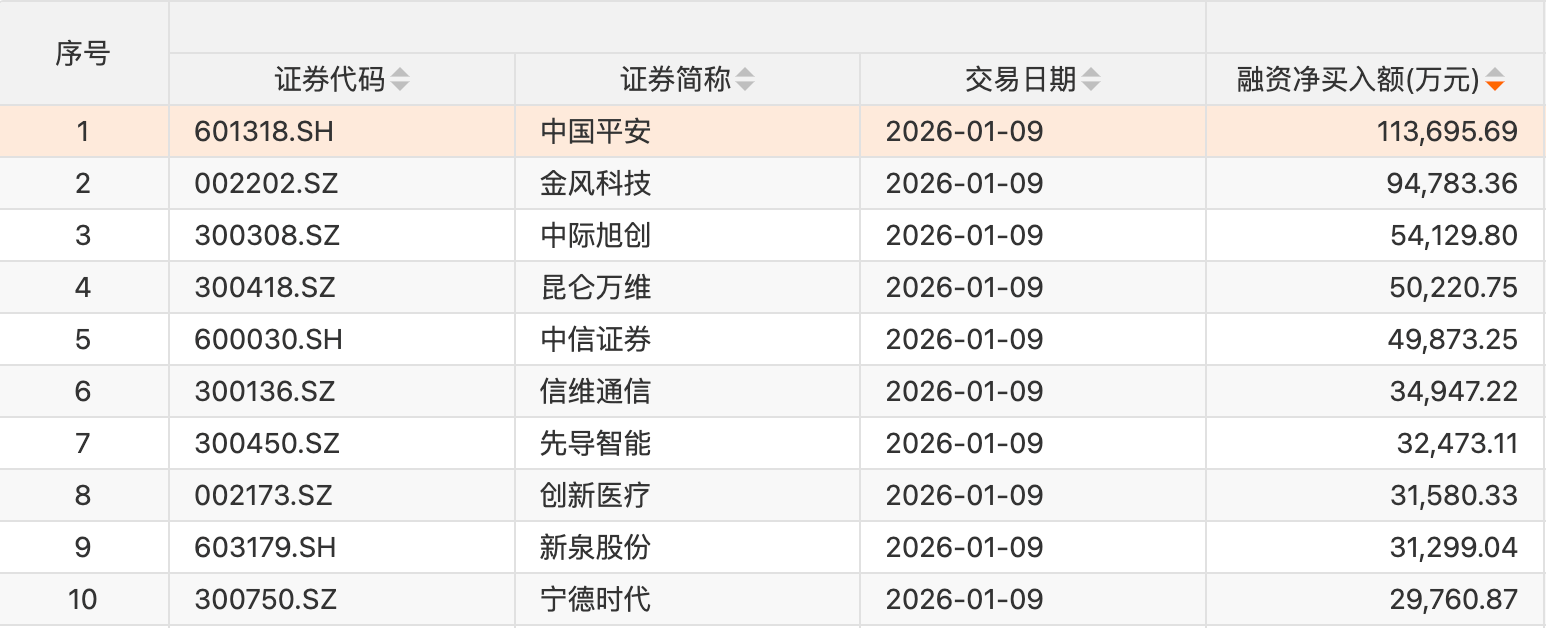
截至1月9日,市场融资余额合计2.61万亿元,较前一交易日增加67.81亿元,这已经是融资余额连续5个 交易日持续增加,其中,沪市融资余额13093.33亿元,较前一交易日增加33.27亿元;深市融资余额 12921.54亿元,较前一交易日增加33.93亿元;北交所融资余额84.48亿元,较前一交易日增加6105.40万 元。 证券时报·数据宝统计显示,具体到个股,1月9日共有1778只股获融资净买入,净买入金额在千万元以 上的有643只,其中68只融资净买入额超亿元。中国平安融资净买入额居首,当日净买入11.37亿元,其 次是金风科技、中际旭创,融资净买入金额分别为9.48亿元、5.41亿元,融资净买入金额居前的还有昆 仑万维、中信证券、信维通信等。 通信 | 002324 | 普利特 | -2.65 | 27114.34 | 76249.99 | 4.31 | 基础化 | | --- | --- | --- | --- | --- | --- | --- | | | | | | | | 工 | | 600118 | 中国卫 | 3.97 | 27033.13 | 385753.14 | 3.08 | 国防 ...