
半导体制造

Search documents
港股大涨超700点,百度涨超9%,壁仞科技最高涨120%
2 1 Shi Ji Jing Ji Bao Dao· 2026-01-02 09:28
Market Overview - On the first trading day of 2026, Hong Kong stocks experienced a strong opening, with the Hang Seng Index rising over 700 points, an increase of 2.76%, and the Hang Seng Tech Index up by 4% [1] - The total net inflow into Hong Kong stocks through the Stock Connect in 2025 reached 1.406 trillion HKD, a year-on-year increase of 74%, indicating that domestic capital has become a stabilizing force in the market [5] Stock Performance - The debut of Wallen Technology, the first GPU stock in Hong Kong, saw its share price surge nearly 120% at one point, closing with a gain of over 75%, bringing its total market capitalization to 82.6 billion HKD [2] - Semiconductor stocks led the gains, with Hua Hong Semiconductor rising over 9% and SMIC increasing more than 5% [2] - Baidu Group saw a significant increase of over 9%, New Oriental rose over 7%, and NetEase increased by over 6%, while Alibaba and Tencent both gained over 4% [2][3] Sector Highlights - The photovoltaic solar sector saw widespread gains, with GCL-Poly Energy rising nearly 21% and GCL-Technology increasing by nearly 5% [4] - Precious metals continued to rise, with spot silver and New York silver both increasing by 4%, and spot gold rising by 1.5% [7] Future Outlook - According to Industrial Securities, the Hong Kong stock market is expected to continue its bullish trend in 2026, with a focus on "growth momentum and value reconstruction dividends" [5] - The Hang Seng Tech Index's price-to-earnings ratio stands at 24 times, significantly lower than the Nasdaq 100's 46 times, indicating a valuation gap [5]


港股大涨超700点,百度涨超9%,壁仞科技最高涨120%,机构:2026年港股牛市延续
2 1 Shi Ji Jing Ji Bao Dao· 2026-01-02 08:54
Market Overview - The Hong Kong stock market opened positively on January 2, 2026, with the Hang Seng Index rising over 700 points, a gain of 2.76%, and the Hang Seng Tech Index increasing by 4% [1] - The first trading day of the "GPU first stock" Wallen Technology saw its share price surge nearly 120% at one point, closing with a gain of over 75%, resulting in a total market capitalization of HKD 82.6 billion [2] Sector Performance - The semiconductor sector performed well, with Hua Hong Semiconductor rising over 9% and SMIC increasing by over 5% [2] - Tech stocks showed strong performance in the afternoon, with Baidu Group up over 9%, New Oriental up over 7%, and NetEase up over 6% [2][3] - Solar energy stocks also saw significant gains, with GCL-Poly Energy rising nearly 21% and GCL-Technology increasing by nearly 5% [4] Investment Trends - In 2025, the cumulative net inflow into Hong Kong stocks through the Stock Connect reached HKD 1.406 trillion, a year-on-year increase of 74%, indicating that domestic capital has become a stabilizing force in the market [6] - The Hang Seng Tech Index's price-to-earnings ratio stood at 24 times, significantly lower than the Nasdaq 100's 46 times and its historical average of 35 times, highlighting a valuation gap [6] - Investment focus for 2026 is expected to be on "growth momentum and value reconstruction dividends," with a bullish market outlook [6] Precious Metals - Precious metals experienced a significant rise, with spot silver and New York silver both increasing by 4%, and spot gold rising by 1.5% [9] - The price of aluminum on the LME reached USD 3,000 per ton for the first time since 2022 [9] - Long-term outlook for gold remains positive due to factors such as a weak dollar and a declining interest rate cycle, with no current reasons to be bearish on gold assets [10]

港股收评:恒生科技指数收涨4%,壁仞科技首日大涨超75%,科技股集体上涨,半导体板块涨幅居前
Jin Rong Jie· 2026-01-02 08:33
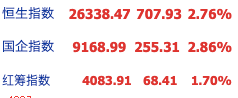
Market Performance - The Hong Kong stock market opened strong on the first trading day of 2026, with the Hang Seng Index rising by 2.76% to 26,338.47 points, the Hang Seng Tech Index increasing by 4% to 5,736.44 points, and the National Enterprises Index up by 2.86% to 9,168.99 points [1] Technology Sector - Major tech stocks performed well, with Alibaba-W up by 4.34%, Tencent Holdings rising by 4.01%, and JD Group-SW increasing by 3.14%. Notably, Baidu's stock surged over 9% following the announcement of its subsidiary Kunlun Chip's application for a mainboard listing on the Hong Kong Stock Exchange [2] - The semiconductor sector showed strength, with Hua Hong Semiconductor rising over 9% after announcing plans to acquire a 97.4988% stake in Huali Micro for a transaction price of 8.268 billion RMB and to raise 7.556 billion RMB through a stock issuance [2] Electric Vehicle Sector - XPeng Motors-W delivered 37,500 smart electric vehicles in December 2025, a 2% year-on-year increase, with total deliveries for 2025 reaching 429,400 units, up 126% from the previous year [4] - Geely Automobile's total sales in December 2025 were 236,817 units, a 13% year-on-year increase, with total sales for the year reaching 3,024,567 units, up 39% [4] - NIO-SW delivered 48,100 vehicles in December 2025, marking a 54.6% year-on-year increase, with cumulative deliveries reaching 997,600 units [4] - BYD's new energy vehicle sales in December 2025 were 420,398 units, down approximately 18.2% year-on-year, while total sales for the year reached 4,602,436 units, up 7.73% [4] Institutional Insights - Everbright Securities noted that the overall profitability of the Hong Kong stock market is relatively strong, with sectors like internet, new consumption, and innovative pharmaceuticals being relatively scarce. Despite recent gains, valuations remain low, suggesting long-term investment opportunities [5] - CITIC Securities highlighted that the Hong Kong market is expected to experience a second round of valuation recovery and performance revival in 2026, driven by internal and external economic factors [5] - Guolian Minsheng Securities indicated that the first half of 2026 will benefit from a weak domestic economic recovery and continued monetary easing from the Federal Reserve, with significant inflows of southbound capital expected [6]
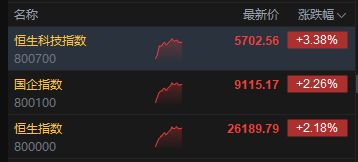
港股午评:恒指涨2.18%,恒生科指飙升3.38%,百度涨7.45%,华虹半导体涨9.89%
Jin Rong Jie· 2026-01-02 04:19
Market Performance - The Hang Seng Index rose by 2.18% to 26,189.79 points, while the Hang Seng Tech Index increased by 3.38% to 5,702.56 points [1] - The China Enterprises Index gained 2.26% to 9,115.17 points, and the Red Chip Index was up by 1.04% to 4,057.23 points [1] Major Technology Stocks - Alibaba-W increased by 3.15%, Tencent Holdings rose by 3.01%, JD Group-SW went up by 2.69%, and Xiaomi Group-W gained 2.44% [3] - NetEase-S surged by 5.87%, Meituan-W rose by 1.55%, Kuaishou-W increased by 3.13%, and Bilibili-W gained 2.64% [3] - Baidu Group-SW saw a significant increase of 7.45%, with its subsidiary Kunlun Chip submitting a listing application to the Hong Kong Stock Exchange [3] Semiconductor Sector - Hua Hong Semiconductor experienced a strong performance, rising by 9.89% [3] - The company announced plans to acquire 97.4988% of Huali Micro's shares for a transaction value of 8.268 billion RMB, with a fundraising target of 7.556 billion RMB [3] Power Equipment Sector - Goldwind Technology saw a substantial increase of over 17% [3] - Blue Arrow Aerospace's IPO application was accepted by the Shanghai Stock Exchange, aiming to become the first commercial rocket company listed on the Sci-Tech Innovation Board [3] Wall Street Technology - Wall Street Technology's first-day listing saw a surge of over 72% [4] - The public offering phase received a staggering 2,347.53 times subscription, with 49.5386 million shares allocated, representing approximately 17.39% of the total shares offered [4] - The international placement phase also saw significant interest, with 23.5308 million shares allocated, equivalent to 82.61% of the total shares offered [4]
特朗普搬石头砸脚,稀土价格暴涨6000%,美国全球抢购,八万零件遭断供
Sou Hu Cai Jing· 2026-01-02 02:07
Group 1 - The "Pax Silica Declaration" alliance aims to end China's dominance in the global rare earth supply chain, particularly in heavy rare earths like yttrium, samarium, and dysprosium [1][2] - The U.S. is attempting to bypass market dependencies through a political alliance, creating a "de-China" rare earth pathway with partners like Australia, Japan, and South Korea [2][3] - Despite these efforts, the U.S. Geological Survey reported that the U.S. still relies on China for 93% of its yttrium supply, highlighting the structural issues in the industry [4][6] Group 2 - The U.S. lacks industrial-scale rare earth separation and refining capabilities, with two-thirds of its raw ore still needing to be processed in China [10][12] - The construction of a new rare earth refinery in the U.S. could take 7 to 10 years, with costs significantly higher than those in China [12][38] - The U.S. Department of Defense's investment in MP Materials does not address the fundamental issue of lacking refining capabilities [12][48] Group 3 - China's export controls on heavy rare earths, including yttrium and samarium, are a strategic response to U.S. actions, impacting critical industries like defense and automotive [14][41] - The price of yttrium skyrocketed from $6 to $320 per kilogram, a 53-fold increase, due to supply shortages, affecting global manufacturing [21][32] - Major automotive companies and defense contractors are facing production disruptions due to reliance on Chinese rare earths, with significant implications for supply chains [24][27] Group 4 - The crisis reveals the limitations of political solutions in addressing complex supply chain issues, as the U.S. attempts to restructure its rare earth supply without the necessary industrial foundation [33][55] - The rare earth industry is characterized by high technical barriers and geopolitical significance, with China controlling a significant portion of the global supply chain [23][34] - The U.S. is now exploring legislative measures to prioritize non-Chinese rare earths for defense projects, but the market lacks sufficient alternatives [50][52] Group 5 - The ongoing crisis emphasizes the need for a multi-faceted approach to resource management, as countries reassess their resource potentials and supply chain dependencies [53][55] - The rare earth market is being redefined as a strategic asset rather than a mere commodity, with geopolitical implications influencing supply and pricing [55][55] - The long-term solution may lie in accepting a diversified supply chain rather than attempting to politically sever ties with China [55][55]
重庆半导体崛起:230亿元的项目,多款产品进入风险量产阶段
Xin Lang Cai Jing· 2025-12-31 15:54
Core Insights - Sanan Optoelectronics has announced that its joint venture with STMicroelectronics, Anifa Semiconductor, has completed validation of several products and entered the risk mass production phase as of December 29, 2025 [2][11] - The establishment of Anifa Semiconductor in August 2023, with a registered capital of $612 million, aims to produce 8-inch silicon carbide wafers for automotive-grade control chips, with a total investment of 23 billion yuan [4][13] - The rapid progress of Anifa Semiconductor, achieving risk mass production within two years, is noted as highly efficient in the global semiconductor industry [5][13] Company Developments - Anifa Semiconductor is currently constructing a production line with an annual capacity of approximately 480,000 wafers, focusing on automotive applications [4][13] - Chongqing Chip Alliance has also completed the installation and debugging of a 12-inch integrated circuit production line, expected to enter risk mass production by June 2026, with a total investment of 14.5 billion yuan [14] - The 12-inch line will produce high-end chips, including automotive MCU chips and RF-SOI chips, with a monthly output of 20,000 wafers [14] Industry Context - The semiconductor industry in Chongqing is projected to exceed 100 billion yuan if both major projects reach full production [15] - The local automotive industry, particularly in smart connected vehicles, is a significant driver for semiconductor demand, with each vehicle requiring up to 3,000 chips [16] - Chongqing's semiconductor ecosystem is supported by over 50 companies, forming a complete industry chain from chip design to manufacturing [17] Innovation and Infrastructure - The Western (Chongqing) Science City has established a robust innovation system, including large scientific facilities and partnerships with local universities, to support the semiconductor industry's growth [18] - This innovation framework is seen as a model for other cities aiming for industrial upgrades, positioning Chongqing as a global semiconductor innovation hub [18]

“你必须足够果敢”:华尔街回首动荡的2025年
Xin Lang Cai Jing· 2025-12-31 12:16
杰德・埃勒布鲁克几乎彻夜未眠。 那是 4 月 2 日周三晚间,特朗普总统刚刚现身白宫玫瑰园,手持一块大幅公告牌,上面赫然写着他将对 全球多国征收的惩罚性关祱税率。华尔街迅速意识到,特朗普此次是动真格的 —— 他要打破这个他口 中对美国不公的全球贸易体系。 来源:环球市场播报 当晚与家人用餐时,乃至整夜,埃勒布鲁克都在琢磨后续走势。当时亚洲市场暴跌,一场全球范围的股 市崩盘就此拉开序幕。作为银资本管理公司的投资组合经理,埃勒布鲁克与团队次日一早便在圣路易斯 的办公室紧急集结,着手分析关祱政策对持仓股票的影响。当天股市抛售潮愈演愈烈,其持仓占比最大 的亚马逊股价暴跌近 10%。 和从东京到纽约的全球投资者一样,埃勒布鲁克在这场罕见的市场波动中,仓促地完成了一场 "动荡应 对速成课"。标普 500 指数一度逼近熊市边缘,随后市场情绪却迅速反转,触发了数十年来最快的股市 反弹之一,最终推动这一基准指数创下历史新高。市场给出的核心启示是:保持冷静、敢于逢低买入, 终有回报。 美国经济的起伏与人工智能热潮固然对市场影响深远,但 2025 年的诸多市场波动,根源大多指向白 宫。 加拿大银行信贷分析公司首席美国股票策略师艾琳 ...

东芯股份:拟用不超9.7亿元闲置超募资金及利息现金管理
Xin Lang Cai Jing· 2025-12-31 10:34
Core Viewpoint - The company has completed all fundraising projects and has permanently supplemented its working capital with surplus funds [1] Group 1: Fundraising and Financial Management - In the past 12 months, the company has invested a total of 3.226 billion yuan in cash management, yielding a total return of 50.335 million yuan, with 151 million yuan of unused quota remaining [1] - As of December 31, 2025, the cumulative use of over-raised funds amounts to 1.493 billion yuan, which includes two instances of permanent working capital supplementation and two share buybacks [1] - The company plans to utilize no more than 970 million yuan of temporarily idle over-raised funds and their interest for cash management within 12 months starting from January 3, 2026, by purchasing capital-preserving products to increase returns [1]

长鑫科技科创板IPO火速受理 上峰水泥半导体投资迎快速回报期
Zheng Quan Shi Bao Wang· 2025-12-31 08:03
Group 1 - The core event is the acceptance of Changxin Technology's IPO application by the Shanghai Stock Exchange, marking a significant milestone for the domestic DRAM sector and indicating that the strategic investment by Shangfeng Cement in the semiconductor field is entering a phase of intensive returns [1] - Changxin Technology is recognized as the largest and most advanced DRAM manufacturer in China, achieving a breakthrough in the critical storage sector [1] - The IPO sets a record on the Sci-Tech Innovation Board as the first project accepted under the "pre-review" model, significantly shortening the listing cycle and laying a foundation for rapid access to the capital market [1] Group 2 - Shangfeng Cement has been implementing a "main business + investment" dual-drive strategy over the past five years, focusing on semiconductor investments while maintaining cash flow advantages from its cement operations [2] - The company has completed a full industry chain layout in key areas such as integrated circuit design, manufacturing, equipment, and materials, with investments in several companies like Shanghai Chao Silicon and Shenghe Jingwei, which have either gone public or are in the process of doing so [2] - Future plans for Shangfeng Cement include leveraging its cement business to empower new material ventures, gradually forming a development pattern of "cement main business + new economy investment + new material" [2]

A股2025年收官:沪指全年上涨18.41%,创指暴涨49.57%
Xin Lang Cai Jing· 2025-12-31 07:22
Market Performance - The three major A-share indices opened higher on December 31, but experienced fluctuations, with the ChiNext Index dropping over 1% [1] - By the close, the Shanghai Composite Index rose 0.09% to 3968.84 points, while the ChiNext Index fell 1.23% to 3203.17 points [1][2] Stock Movement - A total of 2470 stocks rose, while 2768 stocks fell, with 221 stocks remaining flat [3] - The total trading volume in the Shanghai and Shenzhen markets was 20,451 billion yuan, a decrease of 972 billion yuan from the previous trading day [3] Sector Performance - The defense and military sector continued to rise significantly, with multiple stocks hitting the daily limit or increasing over 10% [5] - The real estate sector also performed well, with several stocks reaching the daily limit and others increasing over 5% [5] - AI application concept stocks surged, with notable gains in media stocks, indicating a strong market interest in AI-related investments [5] Market Outlook - Dongguan Securities suggests that the A-share market is entering a slow bull phase, driven by improved liquidity expectations and institutional support [7] - Debon Securities maintains that the slow bull market remains intact, with the Shanghai Composite Index approaching 4000 points and a stable trading volume around 20 trillion yuan [8] - Zheshang Securities anticipates that the focus will shift to policy expectations and industry trends in early 2026, with a potential active performance in small and mid-cap growth stocks [9]