新茶饮

Search documents
特朗普对巴西关税新政引发连锁反应:美国农产品期货市场受冲击
Guan Cha Zhe Wang· 2025-08-01 15:38
Group 1: Agricultural Market Impact - The U.S. government has imposed a 40% tariff on Brazilian products, raising the total tariff to 50%, which includes orange juice [1] - This tariff has led to a significant drop in orange juice futures prices, while coffee futures prices surged by 3.5% [1] - As of July 29, Brazil's coffee exports for the month were only 2.4 million bags, compared to 3.8 million bags in July 2024, indicating a potential supply issue [1] Group 2: Coffee Market Dynamics - The U.S. coffee industry relies heavily on imports, with domestic production accounting for only about 1% of consumption, making Brazilian coffee crucial due to its affordability and variety [2] - The U.S. is the largest market for Brazilian coffee, accounting for approximately 16% of exports, and also the largest market for Brazilian orange juice, making up about 40% of exports [2] - Analysts suggest that there is a possibility of coffee being included in the tariff exemption list, which could alleviate market anxiety [2][3] Group 3: Corporate Governance Changes - Zhang Rui was removed from her position as an independent non-executive director at Nayuki Tea due to concerns about her ability to dedicate sufficient time and attention to her role [3] - Zhang Rui has also been serving as an independent director at Guosen Securities, where she attended all meetings in 2024, but failed to attend two consecutive meetings in 2025 [4] - Guosen Securities announced her removal as an independent director following her absence from meetings, as per company regulations [4] Group 4: New Product Launches - The new tea brand Tianlala has launched a Lychee series of drinks, featuring four new products that combine lychee with various flavors to cater to diverse consumer preferences [5] - The visual design of the Lychee series emphasizes a light pink color scheme, reflecting a blend of traditional Eastern aesthetics and modern beverage trends [5] - The brand aims to create an immersive consumer experience by integrating cultural elements and interactive features into the product launch [5] Group 5: Corporate Leadership Changes - Starbucks Coffee Shanghai has undergone a leadership change, with Tan Buay Beng stepping down as chairman and being succeeded by Shen Can [6] - The company, established in March 2000, is fully owned by Starbucks Coffee Holdings and engages in various business activities including restaurant management [6]



茶咖日报|特朗普对巴西关税新政引发连锁反应:美国农产品期货市场受冲击
Guan Cha Zhe Wang· 2025-08-01 15:22
Group 1: Agricultural Market Impact - The U.S. government has imposed a 40% tariff on Brazilian products, raising the total tariff to 50%, which includes orange juice [1] - This tariff has led to a significant drop in orange juice futures prices and a rise in coffee prices, with orange juice futures hitting a limit down and coffee futures increasing by 3.5% [1] - As of July 29, Brazil's coffee exports for the month were only 2.4 million bags, compared to 3.8 million bags in July 2024, indicating a potential supply issue [1] Group 2: Coffee Market Dynamics - The U.S. coffee industry relies heavily on imports, with domestic production accounting for only about 1% of consumption, making Brazilian coffee crucial due to its affordability and variety [2] - The U.S. is the largest market for Brazilian coffee, accounting for approximately 16% of exports, and also the largest market for Brazilian orange juice, making up about 40% of exports [2] - Analysts suggest that coffee may eventually be included in the tariff exemption list, as there is ongoing lobbying from Brazilian coffee exporters [2][3] Group 3: Corporate Governance Changes - Zhang Rui has been removed from her position as an independent non-executive director of Nayuki Tea due to concerns about her ability to dedicate sufficient time and attention to her role [3] - Zhang Rui has also been dismissed from her role at Guosen Securities after missing multiple board meetings, which is against the company's regulations [4] Group 4: New Product Launches - The new tea brand Tienlala has launched a lychee series of drinks, featuring four new products that combine lychee with various flavors to cater to diverse consumer preferences [5] - The visual design of the lychee series emphasizes a light pink color scheme, reflecting a blend of traditional Eastern aesthetics and modern beverage trends [5] Group 5: Corporate Leadership Changes - Starbucks Coffee Shanghai has undergone a leadership change, with Tan Buay Beng stepping down as chairman and being succeeded by Shen Can [6]

穷鬼赛道,捧出了2个河南首富 || 深度
Sou Hu Cai Jing· 2025-08-01 11:03
Core Insights - The article discusses the rise of Mixue Ice City, founded by Zhang Hongchao and Zhang Hongfu, who recently became the richest individuals in Henan with a net worth of 117.9 billion yuan [2][3] - The company has successfully positioned itself in the low-price beverage market, with over 46,000 stores globally and a significant increase in stock price since its IPO [3][4][54] - Despite facing challenges, including a food safety incident, the brand's strong public image and low pricing strategy have contributed to its resilience and growth [5][8][59] Company Overview - Mixue Ice City was founded 28 years ago and has grown to become the largest chain fast-food restaurant globally, selling 9 billion cups of beverages in 2024 [3][8][54] - The company has maintained a pricing strategy that keeps most products under 10 yuan, with the most popular lemon water only increasing from 3 yuan to 4 yuan since its launch in 2013 [5][8][39] - The brand has avoided celebrity endorsements, instead creating its own mascot, "Xue Wang," which has become a significant part of its marketing strategy [7][50] Financial Performance - Following its IPO in March, Mixue Ice City saw its market value exceed 100 billion HKD, with a stock price increase from 202.5 yuan to 494 yuan per share [4][54] - The company reported total revenue of 24.8 billion yuan in 2024, with a consistent annual growth rate of over 30% in the past four years [55][61] Market Position - Mixue Ice City has established itself as a leader in the tea beverage market, competing effectively against brands like Nayuki and Heytea, which were founded later [8][54] - The company has also expanded into the coffee market with its brand "Lucky Coffee," which has over 6,000 stores, ranking fourth in the domestic coffee market [56] Challenges and Future Outlook - The company faces challenges such as rising lemon prices due to extreme weather, which could impact profit margins [60] - Despite ongoing growth, there are signs of slowing revenue growth and increasing store closures, indicating a potential market shake-up [61] - The future balance between the conservative approach of Zhang Hongchao and the aggressive expansion strategy of Zhang Hongfu will be crucial for sustaining the company's market position [61][62]

新茶饮六小龙:2025 上半年,谁赢麻了?
Sou Hu Cai Jing· 2025-08-01 10:26
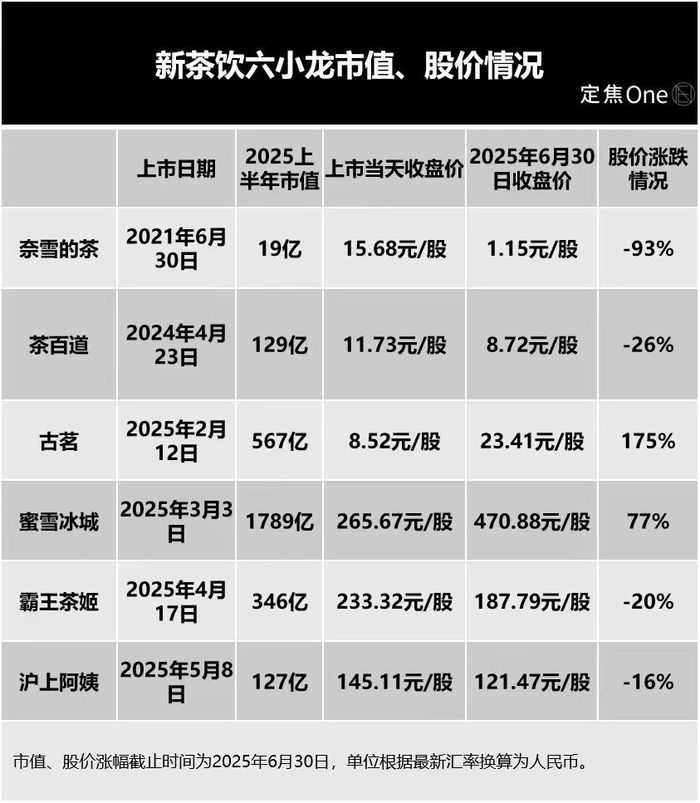
Core Insights - The new tea beverage industry is experiencing a significant transformation, with a focus on profitability and market differentiation as it shifts from incremental competition to stock competition [3][26] - The "New Tea Beverage Six Dragons" are highlighted, with distinct performance metrics among them, particularly in terms of sales volume, revenue, and market capitalization [3][4] Group 1: Market Performance - Mixue Ice City leads the market with an annual sales volume of 9 billion cups and revenue of 24.829 billion, establishing itself as the "scale king" [3][14] - Bawang Chaji has the highest gross and net profit margins among the brands, indicating superior profitability efficiency [3][17] - Nayuki Tea, once a high-end representative, is struggling with continuous losses due to its direct sales model [3][14] Group 2: IPO and Stock Performance - Mixue Ice City achieved a record IPO in Hong Kong, raising approximately 4 billion HKD and reaching a market capitalization of over 100 billion HKD [4][8] - The stock price changes from IPO to June 30, 2025, show significant disparities, with Guming up 175% and Nayuki down 93% [6][8] - As of June 30, 2025, the market capitalizations are: Mixue Ice City (178.9 billion), Guming (56.7 billion), Bawang Chaji (34.6 billion), and Nayuki Tea (1.9 billion) [8][14] Group 3: Financial Metrics - In terms of revenue, Mixue Ice City leads with 24.829 billion, followed by Bawang Chaji (12.406 billion) and Guming (8.791 billion) [14][17] - Mixue Ice City has the highest number of stores at 46,479, significantly more than its competitors combined [15][17] - Bawang Chaji, while not leading in revenue, has the highest gross margin at 47.76% and net margin at 20.27%, indicating strong profitability [17][18] Group 4: Strategic Focus - The industry is moving towards refined operations, emphasizing supply chain efficiency, differentiated positioning, and global expansion [26][28] - Mixue Ice City has the largest self-built supply chain, with over 60% of its ingredients sourced internally, which helps reduce costs [28][30] - Bawang Chaji focuses on a limited product range, with 91% of its GMV coming from "original leaf fresh milk tea," allowing for precise procurement and lower inventory costs [19][24] Group 5: Expansion and Challenges - Bawang Chaji plans to open 1,000 to 1,500 new stores in 2025 to address its current store count deficit [25][30] - The new tea beverage market is seeing a saturation point, with a growth rate slowing to 6.4% in 2024, indicating a shift to competition based on existing market share [26][28] - International expansion is becoming a key strategy, with brands like Mixue Ice City and Bawang Chaji actively pursuing markets in Southeast Asia and Europe [30][33]
新茶饮六小龙:2025上半年,谁赢麻了?
Xin Lang Cai Jing· 2025-08-01 01:40
Core Viewpoint - The new tea beverage industry is experiencing a significant transformation with the emergence of the "New Tea Six Dragons," which includes brands like Mixue Ice City, Bawang Chaji, and others, marking a shift from growth competition to stock competition as the market matures [1][17]. Group 1: Market Performance - Mixue Ice City leads the market with an annual sales volume of 9 billion cups and revenue of 24.829 billion, establishing itself as the "scale king" [1][10]. - Bawang Chaji has the highest profitability metrics, with a gross margin of 47.76% and a net margin of 20.27%, outperforming other brands in terms of efficiency [11]. - The market capitalization of the "New Tea Six Dragons" as of June 30, 2025, is led by Mixue Ice City at 178.9 billion, followed by Guming at 56.7 billion, and others trailing significantly [5][6]. Group 2: Stock Performance - Stock price changes from listing to mid-2025 show significant divergence, with Guming increasing by 175% and Mixue Ice City by 77%, while Nayuki Tea plummeted by 93% [4][5]. - The stock performance reflects market sentiment, with some brands experiencing initial gains followed by declines, indicating volatility in investor confidence [2][8]. Group 3: Financial Metrics - In terms of revenue, Mixue Ice City leads with 24.829 billion, nearly double that of Bawang Chaji at 12.406 billion, with other brands trailing behind [10]. - The majority of Mixue Ice City's revenue comes from franchise operations, with 99.96% of its stores being franchises, which significantly boosts its revenue [10][11]. - Bawang Chaji's profitability is notable despite its smaller scale, indicating a focus on high-margin products and efficient operations [11][12]. Group 4: Strategic Directions - The industry is shifting towards supply chain efficiency, differentiated positioning, and global expansion as the market becomes saturated [17][19]. - Mixue Ice City has the largest and most mature supply chain, with over 60% of its ingredients sourced in-house, allowing for cost control and stable supply [17]. - Brands are increasingly looking to expand internationally, with Mixue Ice City planning to open 300-500 new stores abroad, particularly in Southeast Asia and Europe [19][21].
《洞见ESG》7月刊 :全国碳市场开启四周年
21世纪经济报道· 2025-07-31 13:26
Regulatory Insights - The national carbon market has seen a significant increase in both volume and price, with a transaction value exceeding 46.6 billion yuan [2] - The Ministry of Ecology and Environment highlighted the need for clearer pathways for the steel industry's green and low-carbon transition as it was included in the national carbon market this year [2] Policy Updates - Three major economic provinces are piloting the issuance of distributed green certificates, which are crucial for promoting green consumption and production [2] - The development of zero-carbon parks is accelerating, with renewable energy and digitalization companies benefiting from this trend [3] - The People's Bank of China and other regulatory bodies have included green trade and consumption in the support scope of the new green finance project directory, effective from October 1, 2025 [3] - The National Energy Administration has set mandatory consumption targets for renewable electricity, particularly for the electrolytic aluminum industry [3] Cover Article - The national carbon market has expanded to include the steel, cement, and aluminum smelting industries, covering approximately 8 billion tons of emissions, with around 3,700 key emission units expected to participate [3] Industry Insights - China's new climate goals aim to cover the entire economy and all greenhouse gases by 2035, as stated in a joint declaration with the EU [4] - The installed capacity of renewable energy in China has surpassed that of coal power, marking a significant milestone in the country's energy development [4] - 90% of large banks in China have fully disclosed their operational carbon emissions, while smaller banks are lagging behind [4] - New tea beverage companies face challenges in food safety and compliance, necessitating the integration of ESG into their strategies for long-term growth [5] - The white wine industry is increasingly looking to overseas markets for growth amid intensified domestic competition, with a reported decline in the wine index since May [6] ESG Discussions - The national carbon market's expansion is expected to add 1,500 key emission units, covering over 60% of national CO2 emissions [7] - The global focus on transition finance is growing, as traditional high-carbon industries face financing challenges while green investment continues to rise [7]

全国42万家新茶饮门店!哪个省份数量最多?
Sou Hu Cai Jing· 2025-07-31 07:15
Core Insights - The new tea beverage market in China is entering a phase of intense competition, with a total of 426,313 stores expected by July 15, 2025, and a market size projected to reach 3,547.2 billion yuan by 2024, potentially exceeding 4,000 billion yuan by 2028 [3][6][12] Market Overview - The new tea beverage market is becoming saturated, leading brands to compete for existing market share rather than expanding into new markets [3][12] - The distribution of new tea beverage stores shows a trend of "dense in the east, sparse in the west, strong in the south, and weak in the north" [12][17] Regional Distribution - Guangdong province leads with 81,637 stores, accounting for 19.15% of the national total, followed by Jiangsu with 27,923 and Guangxi with 24,244 [8][9] - The top three provinces for new tea beverage stores are influenced by local consumption culture, economic conditions, and market environments [9][12] Brand Strategies - Different brands exhibit unique regional layout strategies, often concentrating in their origin provinces, such as Mixue Ice City in Henan and Gu Ming in Zhejiang [13][14] - Key factors influencing brand regional layouts include consumer market characteristics, commercial environment, and competitive differentiation [14][15][16]

出海速递 | 中国工业机器人:从Made in China到Made for Global/上半年新茶饮:门店增长停滞,集体看向美国
3 6 Ke· 2025-07-30 10:54
Group 1 - The core viewpoint of the news highlights the significant growth and international expansion of Chinese industries, particularly in robotics and gaming, indicating a shift from "Made in China" to "Made for Global" [2][6] - Chinese industrial robots are entering a new era of global expansion, showcasing the country's advancements in technology and manufacturing capabilities [2] - The new tea beverage market in China is experiencing stagnation in store growth, prompting brands to innovate their business models to adapt to the U.S. market [3] Group 2 - The U.S.-China economic talks held in Stockholm focused on trade relations and macroeconomic policies, with both sides agreeing to extend certain tariffs and countermeasures for an additional 90 days [4] - OpenAI launched the ChatGPT Study learning mode aimed at the education sector, providing interactive and personalized learning tools [5] - Anthropic is negotiating a new funding round that could raise its valuation to $170 billion, reflecting strong investor interest in AI companies [5] - WeRide is expanding its Robotaxi service in Abu Dhabi in collaboration with Uber, expecting to double its order volume as it covers nearly half of the core areas of the city [5]


新茶饮黑马“爷爷不泡茶”,能否跑赢质疑?
东京烘焙职业人· 2025-07-30 08:33
Core Viewpoint - The article discusses the rapid expansion and challenges faced by the new tea brand "爷爷不泡茶" (Grandpa Doesn't Brew Tea), highlighting its impressive growth in the competitive tea beverage market while also addressing issues related to customer complaints and market saturation [3][4][30]. Group 1: Company Overview - "爷爷不泡茶" has expanded to over 1,200 stores across 24 provinces and 163 cities within a year, achieving a growth rate of over 400% [5][6]. - The brand was founded in 2018 in Wuhan and initially named "爷爷泡的茶" (Grandpa Brews Tea), inspired by the founder's admiration for Jay Chou [10][11]. - The brand underwent a strategic rebranding in 2022, focusing on innovative tea products that reflect Hubei's tea culture [13][18]. Group 2: Market Position and Competition - The new tea beverage market is highly competitive, with many brands experiencing slow expansion, while "爷爷不泡茶" has managed to grow rapidly [6][30]. - The brand's products incorporate local Hubei flavors, such as the "恩施玉露" (Enshi Yulu) tea, but faces challenges of product homogeneity in a crowded market [20][21][22]. - The brand's recent product launch, "空山栀子" (Empty Mountain Gardenia), aims to capture market attention but is not unique to the brand, as competitors also offer similar products [21][22]. Group 3: Expansion Strategy - The brand's rapid growth is attributed to its franchise model, allowing for quicker market penetration compared to traditional direct store openings [30][31]. - "爷爷不泡茶" offers a lower entry cost for franchisees, making it an attractive option compared to competitors like "霸王茶姬" (Bawang Chaji) [34]. - The brand plans to reach 4,500 stores by the end of 2025, with ambitions to challenge the 5,000-store mark [39]. Group 4: Challenges and Consumer Feedback - Despite rapid growth, the brand faces significant challenges, including customer complaints about product quality and service, such as the "half cup" issue [35][41]. - Franchisees express concerns about profitability, citing high operational costs and low revenue due to aggressive promotional strategies [41][42]. - The brand's decentralized store distribution complicates supply chain management and quality control, which could hinder future growth [36][37].

上半年新茶饮:门店增长停滞,集体看向美国
3 6 Ke· 2025-07-29 10:59
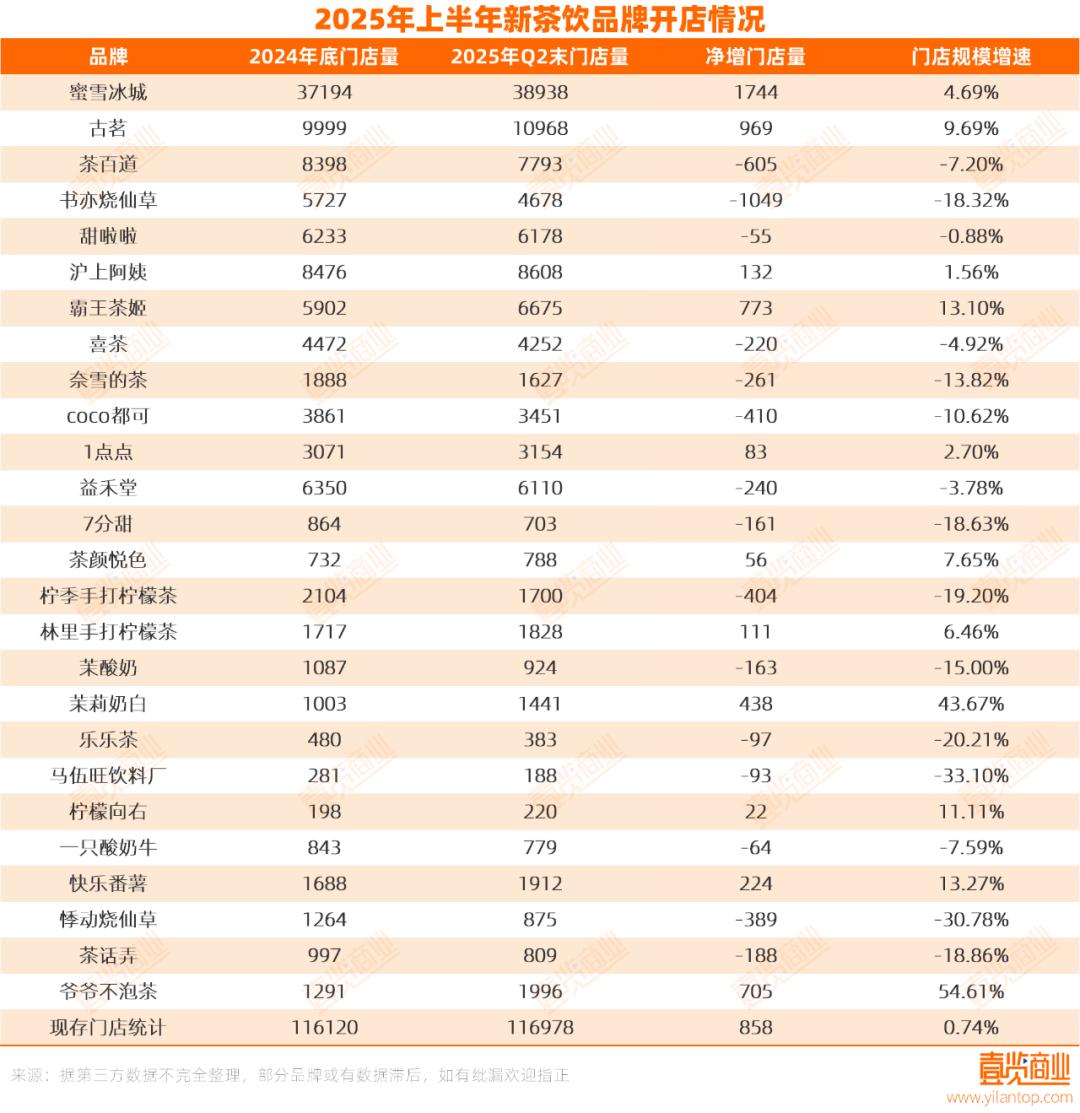
Core Insights - The new tea beverage industry is experiencing a slowdown in store opening speed, with a total of 116,978 stores as of June 2025, reflecting a growth of only 0.74% compared to the end of 2024 [1][2] - The brand landscape is undergoing significant changes, with leading brands expanding steadily while many mid-tier brands face closures, indicating an accelerated process of "survival of the fittest" [1][3] Brand Expansion and Performance - Among the 26 tracked brands, 11 showed positive growth in store numbers, with leading brands like Mixue Ice City and Gu Ming showing robust expansion rates of 4.69% and 9.69% respectively [2][3] - Notable closures were observed in mid-tier brands, with Shuyi Burned Grass experiencing the highest net loss of 1,049 stores, a decline of 18.32% [3][4] - The overall trend indicates that the industry is shifting from quantity-focused expansion to quality-driven strategies, with brands like Mixue Ice City and Gu Ming emphasizing deeper market penetration and operational efficiency [6][8] Market Dynamics and Strategy Adjustments - The number of new cities entered by brands has decreased compared to the previous year, with only 11 brands expanding their city presence while 14 brands exited certain cities [6][8] - Brands are increasingly focusing on optimizing their business models, with stricter franchise management and a shift towards enhancing product offerings and customer experiences [7][8] - The industry is moving towards a "tea + " model, integrating elements like baking, light meals, and retail into their store concepts to meet evolving consumer demands [11][12] International Expansion - The U.S. has become a primary target for international expansion, with brands adapting their business models to fit local markets rather than replicating domestic success [14][21] - Key brands like Heytea and Bawang Chaji are establishing a presence in major U.S. cities, focusing on high-end positioning and localized product offerings [18][19] - The U.S. market for ready-to-drink tea is projected to grow significantly, with a potential market size increase of 5 to 10 times by 2030, driven by favorable consumer preferences [21]