
煤炭

Search documents
战争形势复杂,建议谨慎观望
Dong Zheng Qi Huo· 2026-03-23 05:14
Report Industry Investment Rating No relevant content provided. Core Viewpoints of the Report - This week, the macro - logic continued to dominate the market. With the war escalating and the Fed remaining hawkish, most commodities except a few energy - chemical products declined. Next week, the war situation will still significantly impact the market. The performance of commodities is expected to be energy and chemicals > agricultural products > ferrous metals > precious metals and non - ferrous metals. Given the high volatility of commodities, it is recommended to wait and see until the situation becomes clear [2][18][19]. Summary According to the Directory 1. One - Week Review and Views 1.1 One - Week Review: Commodity Trends Diverged, Only Some Energy - Chemical Products Performed Strongly - From March 16th to 22nd, commodity trends diverged. Only some energy - chemical products were strong. In terms of sectors: coal chemical industry > energy > oil chemical industry > ferrous metals > agricultural products > non - ferrous metals > precious metals. In the first half of the week, the market fluctuated narrowly. In the second half, the Fed remained unchanged, and Powell's hawkish statement led to a downward revision of interest - rate cut expectations. The attack on Iranian oil and gas facilities by Israel on Thursday caused oil and chemical prices to rise, but they slightly declined on Friday [1][11]. 1.2 Next - Week Outlook: The War Situation is Complex, It is Recommended to Wait and See Cautiously - The war shows an escalating trend, with the Fed remaining hawkish. Most commodities except energy - chemical products declined. Next week, the arrival of the US amphibious landing force in the Middle East may lead to further war escalation, but there are also signs of "peace talks". As long as the strait is not unsealed, there will be a supply - demand gap in the energy market, and energy - chemical products have a basis for price increase. However, due to high volatility, it is recommended to wait and see [2][18][19]. 2. Exchange Rate and Interest Rate Data Tracking - The US dollar index weakened, and the 10 - year US Treasury yield rose. As of March 20th, the US dollar index fell 0.99% to 99.5100, and the 10 - year US Treasury yield rose 11BP to 4.39%. The attack on Iranian oil and gas facilities and high US PPI have raised inflation concerns. The Fed remained unchanged, with some hawkish statements. The weakening of the US dollar index may be due to concerns about the US getting into a war quagmire and future stagflation [26][27]. 3. Upstream Raw Material Prices - The Iran - US war continues, and with the attack on Iranian energy facilities, the shipping in the Strait of Hormuz has not been substantially restored, causing oil prices to rise. The increase in oil prices and downstream restocking demand are positive for coking coal, but due to loose domestic supply and weak terminal demand, coking coal prices are generally fluctuating [30]. 4. High - Frequency Production - End Data - Most commodity production - end data improved this week, except for the slight decline in PE capacity utilization, and production indicators of glass and soda ash. The year - on - year growth rate of industrial added value from January to February was 6.3%, exceeding market expectations [33]. 5. High - Frequency Inventory - End Data - Gold and silver inventories continued to decline slightly. Most industrial product inventories decreased, but the inventories of copper, aluminum, PTA, etc. continued to accumulate, and the inventory pressure of live pigs was relatively high [53]. 6. High - Frequency Demand - End Data - Most real - estate high - frequency indicators improved this week, such as the increase in the sales area of second - hand houses in 16 cities and the sales area of commercial housing in 30 large and medium - sized cities. The government bond issuance and net financing scale increased significantly. Terminal demand, including subway passenger volume, flight execution rate, apparent consumption of rebar, and power consumption of 25 provinces' power plants, is improving [75][76]. 7. Key Commodity Basis - The report provides data on the basis of key commodities such as gold, copper, aluminum, rebar, etc., but specific analysis is not detailed in the provided text [90]. 8. Commodity Price Ratios - The report presents various commodity price ratios, including the gold - silver ratio, gold - copper ratio, etc., but no in - depth analysis is provided [101]. 9. Summary and Outlook - The performance of commodities is expected to be energy and chemicals > agricultural products > ferrous metals > non - ferrous metals and precious metals. Due to the unpredictable war situation, it is recommended to wait and see [3][110].
跌差不多了吧
猛兽派选股· 2026-03-23 04:10
Group 1 - The market has returned to the upper boundary of the previous consolidation structure, showing a gap down long bearish candle, similar to the situation when the trade war was initiated by Huang Mao [1] - Long-term momentum SSV has returned to zero [1] - Sentiment indicators are in a frozen state [1] Group 2 - Defensive sectors include wind power storage, oil and gas, and coal, all of which belong to the energy category [2] - Theoretically, the market should have reached a bottom, with a potential to fill a gap and touch the 200-day volume-weighted moving average [2] - Strategy suggests selecting inverse defensive stocks [2]


黑色:焦点移至煤炭黑色震荡偏强
Chang Jiang Qi Huo· 2026-03-23 04:06
1. Report Industry Investment Rating - Not provided in the report 2. Core Viewpoints of the Report - Last week, the black sector fluctuated within a narrow range, with small price changes in both raw materials and finished products. The steel demand continued to recover, and the steel inventory reached its peak and started to decline last week. The coking coal production rebounded to a normal to high level since last year, and the market began to trade the substitution effect of coal due to the impact on crude oil and liquefied gas supply. Overall, the black sector is expected to fluctuate with an upward bias [4][5]. 3. Summary According to Relevant Catalogs 01 Black Sector Trend Comparison: Narrow - range Fluctuation - The black sector showed a narrow - range fluctuation last week. The price trends of different black commodities such as rebar, hot - rolled coil, iron ore, coke, and coking coal are presented in the graph [6][7] 02 Futures Market Rise and Fall Comparison: Non - ferrous Metals Decline, Energy and Chemicals Continue to Strengthen - In the futures market, the non - ferrous metals sector had a significant decline, while the energy and chemicals sector continued to strengthen. The five - day percentage changes of various futures indexes are shown in the graph [9][10] 03 Spot Prices: Slight Decline in Rebar and Iron Ore, Coking Coal Begins to Strengthen - The spot prices of rebar and iron ore slightly declined, while coking coal started to strengthen. The five - day price changes and percentage changes of different commodities are presented in the graph [11][12] 04 Profit and Valuation: Improvement in Steel Mill Profits, Low Valuation of Rebar Futures - The profitability of steel mills has improved. The rebar futures price is below the valley - electricity cost of electric furnaces, indicating a relatively low static valuation. Graphs show the profitability of steel mills, different types of profits (valley - electricity, flat - electricity, peak - electricity, and long - process profits), and the comparison between futures prices and different cost levels [13][14] 05 Steel Supply and Demand: Demand Continues to Rise, Inventory Starts to Decrease - The steel demand continued to recover, and the steel inventory reached its peak and started to decline. Graphs present the total inventory, weekly production, and weekly apparent consumption of five major steel products, as well as the corresponding data for rebar [16][17] 06 Iron Ore Supply and Demand: Steel Mill Restart, Significant Increase in Hot Metal Production - Affected by the restart of steel mills, the hot metal production increased significantly last week. Currently, the hot metal production is still lower than the same period last year, with room for further increase. The steel mills started to replenish inventory, leading to an increase in steel mill iron ore inventory and a decline in port inventory. The graphs show the production of iron concentrate, global iron ore shipments, port and steel mill iron ore inventories, and the daily average hot metal production [25][26] 07 Coking Coal Supply and Demand: Increase in Raw Coal Production, Inventory Transfer to Downstream - The raw coal production of coking coal increased, and the inventory transferred to the downstream. The graphs show the daily average production of raw coal and clean coal of 523 mines, the inventory of clean coal and raw coal of 523 sample mines, the 16 - port coking coal inventory, and the coking coal inventory of 247 steel mills and all coking plants [28][29] 08 Coke Supply and Demand: Production Rebounds from a Low Level, Inventory Increases Slightly - The coke production rebounded from a low level, and the inventory increased slightly. The graphs show the daily coke production of 247 steel mills and all coking plants, the inventory of independent coking enterprises, 18 - port coke inventory, and the inventory of 247 steel mill sample coking plants [30][31] 09 Variety Spreads: Decline in Steel Mill's Disk Profit, Expansion of Hot - rolled and Rebar Spread - The steel mill's disk profit declined, and the spread between hot - rolled coil and rebar expanded. Graphs show the steel mill's disk profit of rebar, the ratio of coke to coking coal, the ratio of rebar to iron ore and rebar to coke, and the spread between hot - rolled coil and rebar [32][33] 10 Key Data/Policy/Information - The draft report of the 2026 national economic and social development plan aims to balance supply and demand in key industries such as steel, and reduce energy consumption and carbon emissions. International events include measures to ensure the safety of the Strait of Hormuz, the release of strategic oil reserves, and geopolitical conflicts in the Middle East. Domestic economic data shows that the national fixed - asset investment increased by 1.8% year - on - year from January to February, and 5.2% after excluding real estate development investment [38]
基本面与能源危机共振,短期偏强运行:中辉期货双焦周报-20260323
Zhong Hui Qi Huo· 2026-03-23 04:06
中辉期货双焦周报 基本面与能源危机共振,短期偏强运行 中辉黑色研究团队 中辉期货有限公司 交易咨询业务资格 证监许可[2015]75号 陈为昌 Z0019850 李海蓉 Z0015849 报告日期:2026/03/20 双焦观点摘要 【后市展望】:综合来看,能源供应链重塑过程中,国内煤炭(尤其是焦煤)的估值中枢有望上移,主要风 险在于地缘政治局势的反复。若冲突意外迅速缓和,全球能源溢价回落,可能削弱成本支撑逻辑。同时,需警 惕国内保供稳价政策的潜在调控,以及下游钢铁需求若持续疲弱对价格的最终压制,预计短期偏强运行。 【风险与关注】:地缘冲突、国内煤矿安全检查、能源保供、焦炭提涨、铁水产量下行等。 2 【市场概况】:本周黑色系商品波动较小,原料与成材价格整体维持区间运行。从供需层面来看,国内煤矿 维持正常生产,日均产量环比继续增加。近期线上竞拍成交率维持高位,下游补库及投机性需求均有所增加。 • 进口方面,蒙煤通关量维持前期高位水平,库存压力依然较大,现货报价跟随盘面波动为主。目前蒙5原煤 报价在1080-1100元/吨,蒙煤、山西主流仓单成本在1150-1200元/吨。 • 截至3月20日,独立焦企吨焦平均利 ...
价量一致性、RSI等指标快速下降——量化择时周报20260322
申万宏源金工· 2026-03-23 04:01
Market Sentiment Overview - As of March 20, the market sentiment indicator is at 1.7, up from 1.55 the previous week, indicating a neutral sentiment despite fluctuations throughout the week [1][4] - Multiple sub-indicators have shown a decline compared to the previous week, influenced by ongoing external political risks, suggesting a potential further drop in market sentiment [1][4] Sub-indicator Analysis - The price-volume consistency indicator has rapidly declined, reflecting a weaker correlation between price increases and market attention, indicating an overall bearish sentiment [7][9] - Total trading volume for the A-share market decreased by 12.49% week-on-week, with an average daily trading volume of 14,098.98 billion, further indicating reduced market activity [11] - The proportion of the STAR 50 index relative to the total A-share trading volume has consistently decreased, suggesting a decline in risk appetite [15] - The inter-industry trading volatility has been on the rise, reaching historical highs for 2023, indicating increased activity in switching funds between different sectors [16] - The industry trend indicator initially rose but later showed a downward trend, indicating a reduction in divergence among industry views and a slight increase in consensus on short-term value judgments [18] - The financing balance ratio has slightly decreased, indicating a reduction in market leverage and a decline in investor risk appetite [19] - The RSI indicator has penetrated the lower boundary, suggesting increased downward momentum and reduced buying power, reflecting an overall decline in market sentiment [20] - The net inflow of main funds has shown a downward trend, indicating weakened buying power and reduced enthusiasm from institutional investors [24] Industry Crowding and Trading Heat - The highest average crowding levels as of March 20 are in the utilities, basic chemicals, electrical equipment, construction decoration, and environmental protection sectors, while the lowest are in automotive, defense, social services, retail, and textiles [30][31] - The correlation between crowding and weekly price changes is near zero, indicating that high crowding does not necessarily lead to price increases, with sectors like construction decoration and environmental protection showing low price changes despite high crowding [32] Trend Scoring Model Insights - The short-term scoring model indicates that sectors such as coal, utilities, electrical equipment, communication, and construction decoration are leading in trend scores, with coal having the highest score of 93.22 [25][28] - The model suggests a preference for growth and large-cap styles, with the current signals indicating a strong preference for large-cap stocks [35]

A股三大指数跌超2%,寒武纪股价跌破1000元,比亚迪市值重回万亿元
2 1 Shi Ji Jing Ji Bao Dao· 2026-03-23 04:01
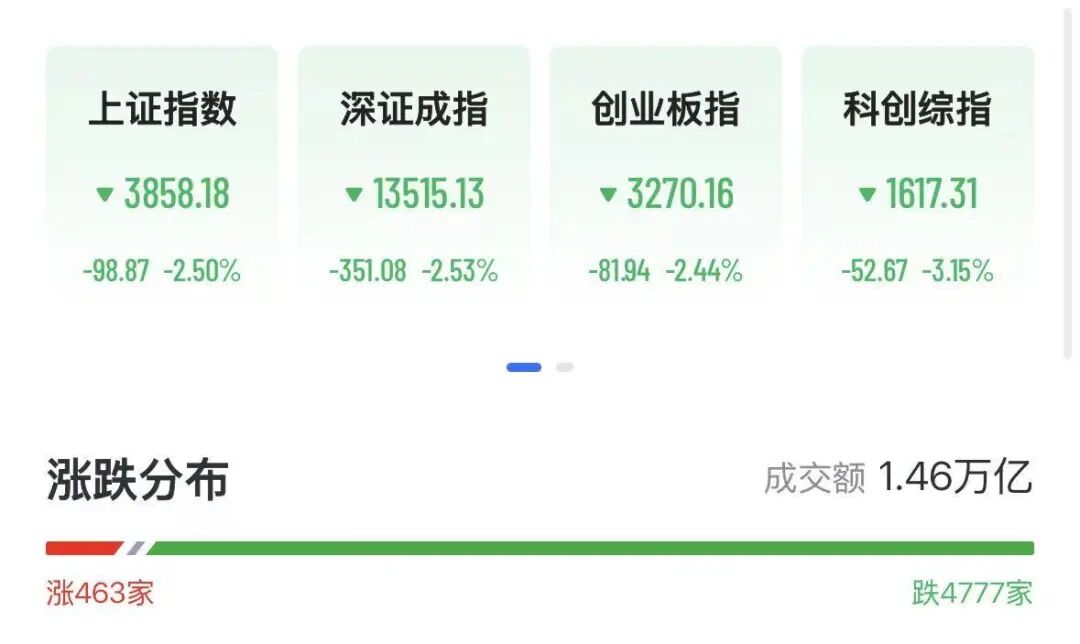
Market Overview - The A-share market opened lower on March 23, with all three major indices dropping over 2%, and the Shanghai Composite Index falling below the 3900-point mark [1] - By midday, the Shanghai Composite Index was down 2.5%, the Shenzhen Component Index down 2.53%, and the ChiNext Index down 2.44%, while the Sci-Tech Innovation Index fell over 3% [1][2] - The total trading volume in the Shanghai and Shenzhen markets reached 1.46 trillion yuan, an increase of 15.5 billion yuan compared to the previous trading day [1] Sector Performance - The green electricity concept showed resilience, with Huadian Liao Energy (600396) achieving six consecutive trading limits, and Dongfang New Energy (002310) hitting four trading limits in six days [5] - The robotics sector also performed well, with multiple stocks including Zhongdali De (002896) and Jinfatech (600143) reaching trading limits [5] - The coal sector saw significant gains, with Liaoning Energy (600758) hitting a trading limit and a buy order exceeding 1.24 million hands [5] Declining Sectors - Precious metals and pork sectors faced significant declines, with stocks like Muyuan Foods (002714) and Jinxinnong (002548) experiencing substantial drops [6] Individual Stock Movements - Domestic AI chip leader Cambricon Technologies saw its stock price drop over 3%, falling below the 1000 yuan mark, amid intensifying competition in the domestic AI chip market [7] - Chifeng Gold (600988) faced a trading halt, with its stock price hitting the limit down due to ongoing pressure in the international gold market, which saw prices drop below 4400 USD per ounce [7] - BYD (002594) experienced a counter-trend increase, with its stock price rising 5.69% to 108.89 yuan, bringing its market capitalization back to 1 trillion yuan [8] Industry Insights - The geopolitical situation in the Middle East is driving up refined oil prices, with predictions of a price increase in the domestic market [9] - The Chinese new energy vehicle market has surpassed a 50% penetration rate, shifting competition from price wars to core technology and supply chain resilience [9]



A股三大指数跌超2%,寒武纪股价跌破1000元,比亚迪市值重回万亿元
21世纪经济报道· 2026-03-23 03:58
Market Overview - The A-share market opened lower on March 23, with all three major indices dropping over 2%, and the Shanghai Composite Index falling below the 3900-point mark [1] - By midday, the Shanghai Composite Index was down 2.5%, the Shenzhen Component Index down 2.53%, the ChiNext Index down 2.44%, and the Sci-Tech Innovation Index down over 3% [1][2] - The trading volume in the Shanghai and Shenzhen markets reached 1.46 trillion yuan, an increase of 155 billion yuan compared to the previous trading day [1] Sector Performance - The green energy sector showed resilience, with Huadian Liaoning Energy achieving six consecutive trading limits, and Dongfang New Energy hitting four trading limits in six days [5] - The coal sector also performed well, with companies like Liaoning Energy and Shanxi Coking Coal reaching their daily limits [5] - Conversely, the precious metals sector saw significant declines, particularly in the pork sector, with companies like Muyuan Foods and Jin Xin Nong experiencing substantial drops [6] Individual Stock Movements - The domestic AI chip leader, Cambricon, saw its stock price drop over 3%, falling below 1000 yuan per share, amid intensifying competition in the AI chip market [7] - Chifeng Gold hit a trading limit down, attributed to ongoing pressure in the international gold market, with prices falling below 4400 USD per ounce [7] - BYD's stock price rose against the market trend, reaching 108.89 yuan per share, with a market capitalization exceeding 1 trillion yuan, and a monthly increase of over 20% [7] Industry Insights - The geopolitical situation in the Middle East is driving up refined oil prices, with predictions of a price increase in domestic oil by March 23 [8] - The penetration rate of new energy vehicles in China has surpassed 50%, shifting industry competition from price wars to core technology and supply chain resilience [8]

煤焦:市场情绪再度发酵,盘面跟随走强
Hua Bao Qi Huo· 2026-03-23 03:25
Group 1: Report's Industry Investment Rating - Not provided Group 2: Report's Core View - Market sentiment has fermented again, stimulating a sharp rise in coking coal prices. Short - term volatility has intensified, and it is recommended to focus on risk control and adopt a wait - and - see approach [3] Group 3: Summary by Related Content Market Performance - Last week, coking coal futures prices oscillated weakly, but on Friday night, prices increased with rising volume, with a gain of over 8%, showing relatively sharp fluctuations [2] - Some regional coking plants have started to raise coke prices, and the acceptance of downstream buyers should be monitored; the price of coking coal at the origin has continued a slight recovery [2] Driving Factors - The upward drive mainly comes from the further fermentation of energy concerns caused by the geopolitical conflict in the Middle East. The continuous strengthening of the energy and chemical sector has led to a compensatory rise in coking coal, while the upward drive from its own fundamentals is relatively limited [2] - The turmoil in the Middle East has little direct impact on China's coking coal imports but has an indirect impact on prices. The shipping disruption in the Strait of Hormuz has triggered market concerns about crude oil supply. Rising oil prices will generally increase corporate transportation and production costs. The increase in chemical product prices has provided some upward drive for the coal sector [2] Fundamental Situation - In terms of coking coal fundamentals, coal mine production has recovered to a high level, and the increase rate slowed down last week [2] - At the import end, the daily customs clearance volume at the Ganqimaodu Port for Mongolian coal has remained at a relatively high level, and the inventory in the port supervision area has continued to increase [2] - At the demand end, with the lifting of phased emission reduction restrictions, the hot metal output rebounded to 2.282 million tons last week, and there is still room for production resumption in the near future. The purchasing sentiment of coking and steel enterprises for raw materials has improved [2] Future Focus - Pay attention to changes in spot prices and the resumption of production at steel mills [3]
动力煤:枪已上膛,择时而发
Wu Kuang Qi Huo· 2026-03-23 03:06
Group 1: Report Industry Investment Rating - No information provided Group 2: Core Viewpoints of the Report - In early 2026, the coal market faces external disturbances such as tightened supply - side policies in Indonesia and the release of coal's energy attribute due to the Middle - East conflict. Currently, the impact on domestic coal prices is limited because of stable domestic supply and the off - season. It's expected that from the end of the second quarter to the beginning of the third quarter, coal prices are more likely to rise due to factors like downstream replenishment, peak summer demand, and supply - side safety production. However, factors like the duration of the Middle - East conflict and the persistence of Indonesia's supply - side policies need to be continuously tracked [2] Group 3: Summary by Relevant Catalogs Global Coal Supply - Side Changes - Indonesia, the world's largest exporter of thermal coal, significantly tightens its coal supply - side policies. In 2026, the proposed coal production quota (RKAB) is about 6 billion tons, a year - on - year decrease of 18.37% compared to 2025, and a 24% decrease compared to the actual 2025 production. It's estimated that coal exports may decrease by 120 - 150 million tons (30% - 40% decline). Also, Indonesia started levying a 1% - 5% stepped export tax on coal exports from January 1, 2026 [6][7][11] - The impact of Indonesia's export tightening is initially evident. China's coal imports in February 2026 were 30.94 million tons, a 33% month - on - month and 10% year - on - year decrease. The import volume in March is expected to remain low, mainly due to the slow RKAB approval process, the Ramadan, and continuous rainfall in some areas in Indonesia. Additionally, the sharp rise in international shipping costs due to the Middle - East conflict has increased the cost of imported coal [14] Impact of the Middle - East Conflict on Coal - The Middle - East conflict between the US, Israel, and Iran has led to a sharp increase in international oil and gas prices. Brent crude oil once approached $120 per barrel, and the European TTF natural gas price doubled. This has activated the energy attribute of coal, and coal can replace oil and gas in the power and chemical industries. The substitution logic has been transmitted to the overseas spot market, and the Newcastle thermal coal price is strengthening [15][18] Domestic Coal Market Situation - Thanks to China's efforts in energy security, domestic coal supply is relatively stable. In January - February 2026, China's cumulative coal production was 763 million tons, with a daily average output of 1.293 million tons, a year - on - year increase of about 2.37%. As of the reporting date, the capacity utilization rate of sample mines has recovered to 91% and is still rising [27] - Currently, the domestic coal market is in the seasonal off - season. With stable supply and low demand, factors such as Indonesia's supply tightening and the rise of overseas coal prices have not affected the domestic spot coal market. The price of thermal coal at northern ports shows seasonal fluctuations [30] Future Price Outlook - In the traditional off - season from March to May, objective factors are not conducive to price increases. Historically, there were only three years (2016, 2021, 2022) with significant off - season price increases under specific circumstances. From the end of the second quarter to the beginning of the third quarter, due to downstream replenishment, peak summer demand, and supply - side safety production, coal prices are more likely to rise, especially this year with the supply contraction of major coal - exporting countries and high oil and gas prices [36]
国泰海通晨报-20260323
国泰海通· 2026-03-23 03:04
Macroeconomic Research - Geopolitical factors are driving stronger imported inflation, with external demand showing resilience while internal demand remains to be boosted, leading to a persistent divergence [1][2] - The policy focus is on long-term special government bond issuance and the construction of a unified national market to promote high-quality economic recovery through precise investment and institutional optimization [2][18] Strategy Research - The mid-level economic landscape shows differentiation, with increased disruptions in oil supply leading to a continuous rise in prices along the oil and chemical chain; emerging technologies are seeing an upward shift in their economic center [1][4] - The first quarter saw bright growth in travel and consumer goods consumption, indicating a potential recovery in these sectors [4][24] Banking Research - The commercial banking sector is exhibiting a clear trend of "leading banks," with state-owned banks acting as a credit stabilizer; regional city commercial banks are achieving differentiated breakthroughs, particularly in economically strong provinces like Jiangsu, Zhejiang, Sichuan, and Shandong [1][7] - The market share of state-owned banks is expected to increase, with their asset proportion rising to 43.3% by the end of 2025, while city commercial banks are also gaining market share due to regional economic resilience [8][10] Transportation Research - The demand for highway passage is resilient, with stable dividends and cash flow expected; the revision of the highway management regulations is anticipated to optimize policies [1][12] - The highway sector is expected to see steady growth in traffic volume in 2026, supported by favorable location advantages and ongoing expansion projects [12][25]