食品

Search documents
广东江门“十四五”GDP突破4200亿元 年均增长5.2%
Zhong Guo Fa Zhan Wang· 2026-01-09 08:00
Core Viewpoint - The report highlights the achievements of Jiangmen City during the "14th Five-Year Plan" period, emphasizing economic growth, infrastructure development, and social progress, with a focus on high-quality development and regional coordination. Economic Development - Jiangmen's GDP exceeded 420 billion yuan, with an average annual growth rate of 5.2% over the past four years, ranking fourth in Guangdong Province [1] - The city has attracted investments totaling 800 billion yuan and has seen a 40% increase in operating entities, surpassing 800,000 [1] - Industrial investment reached 450 billion yuan, making Jiangmen the sixth city in the province to exceed 100 billion yuan in industrial investment [1] Infrastructure and Connectivity - Major infrastructure projects include the full operation of the Zhongkai Expressway and the completion of the Huangmaohai Cross-Sea Channel, enhancing connectivity with Hong Kong and Macau [1] - Jiangmen has implemented over 500 cross-border administrative services for Hong Kong and Macau residents, facilitating investment and residency [1] Industrial Development - The city has established 15 key industrial chains, with five chains (food, metal products, home appliances, petrochemical materials, and new-generation electronic information) each generating over 50 billion yuan [3] - Jiangmen's industrial added value has grown at an average annual rate of 7.6%, ranking second in the province [3] Regional Coordination - The "Hundred Thousand Project" aims to enhance the development capabilities of counties, towns, and villages, with New Hui District's GDP surpassing 100 billion yuan [4] - The "Eight Towns Linkage" initiative has led to an average annual growth of 11.4% in economic output across the eight pilot towns [5] Environmental Sustainability - Jiangmen has made significant strides in environmental protection, achieving the best air quality in a decade and maintaining a 100% quality rate for drinking water sources [5] - The city has increased its waste incineration capacity ninefold and achieved "zero landfill" for primary household waste [5] Social Progress - Over 75% of fiscal resources have been allocated to social welfare, resulting in the creation of 250,000 new jobs and a 27% increase in the total talent pool [6] - The city has added 67,000 public school places and four new universities, with a total higher education enrollment exceeding 100,000 [6]
《公司舆情哨》2025盘点:十大事件、四类危机、四种趋势!
Sou Hu Cai Jing· 2026-01-09 05:48
Core Insights - The article discusses the significant public relations challenges faced by major brands in 2025, highlighting the crisis management issues and the evolving consumer expectations in various industries [1][2][5] Group 1: Key Events and Trends - In 2025, over 20 well-known brands were monitored for public sentiment, with Sam's Club and Moutai being among the most frequently mentioned due to crises such as trust issues and leadership changes [2][4] - Major public sentiment events included Sam's Club's trust crisis, Moutai's leadership change, and controversies surrounding brands like Nestlé and West Bay [2][4] - The food, new tea drinks, and dairy industries were particularly scrutinized, reflecting their close ties to consumer daily life [2][4] Group 2: Types of Crises - The public relations crises identified can be categorized into four main types: food safety issues, marketing and advertising controversies, personnel changes and strategic adjustments, and incidents related to live streaming and new media [4][6][10] - Food safety issues were the most significant, with incidents like a food poisoning case involving Yunhai Yao leading to severe penalties [6][8] - Marketing controversies included misleading advertising practices, such as the "half bag" marketing by White Elephant, which misled consumers about product quantity [11][12] Group 3: Leadership Changes - 2025 saw numerous leadership changes in major consumer brands, particularly in the alcohol and dairy sectors, reflecting pressures for strategic transformation and performance improvement [15][17] - Notable changes included Moutai's leadership transition and significant shifts within Nestlé's executive team, which could impact existing strategies [18][19] Group 4: New Media and Crisis Management - The rise of live streaming and short videos has led to an increase in real-time public relations crises, exemplified by the incident involving Pop Mart during a live stream [20][21] - Companies are urged to adapt their crisis management strategies to address the rapid dissemination of information and the emotional responses of consumers [22][23] Group 5: Evolving Consumer Expectations - Consumer scrutiny has shifted from product safety to emotional and value-based considerations, indicating a deeper examination of brand integrity and marketing practices [24][25] - Companies are encouraged to embrace constructive criticism as an opportunity for improvement rather than adopting a victim mentality [30][31] Group 6: Future Challenges - The consumer goods industry is expected to remain a hotspot for public relations challenges, with increasing demands for product safety, marketing honesty, and price transparency [28][29] - The integration of AI technology in reputation management presents both opportunities and risks, necessitating a balance between efficiency and ethical considerations [32]


广西做优做强工业经济
Jing Ji Ri Bao· 2026-01-09 03:01
经济日报南宁1月8日讯(记者童政、臧潇)近年来,广西坚定不移实施工业强桂战略,着力扩投 资、调结构、增效益,做优做强工业经济,在工业经济总量提升、产业结构优化、数智化与绿色化转型 方面成效显著,构建起体现广西特色与优势的现代化产业体系。 "十四五"期间,广西工业经济实现跨越式增长。2025年,广西规模以上工业总产值预计达2.7万亿 元,5年增长9000亿元;工业增加值占地区生产总值比重超27%,5年提升近4个百分点,工业成为全区 经济发展的"压舱石"。 目前,广西已形成十大千亿元级支柱产业。其中,有色金属产业产值5年实现翻番,2025年预计突 破4500亿元;钢铁、食品2个产业产值超3000亿元,造纸与木材加工、石化化工、机械、电力4个产业产 值超2000亿元,汽车、电子信息、建材3个产业产值超1000亿元。 在数智化与绿色化转型方面,广西实施"智改数转""人工智能+制造"行动。"十四五"期间,全区累 计推动5000多家企业实施"智改数转"、近万家企业完成数字化诊断,新增国家级绿色工厂105家、绿色 园区11个,3个园区入选首批国家级零碳园区建设名单。 广西壮族自治区工业和信息化厅党组书记、厅长袁煌说,广西将 ...
同比上涨0.8%
Zhong Guo Ji Jin Bao· 2026-01-09 02:33
Core Viewpoint - In December 2025, the national consumer price index (CPI) increased by 0.8% year-on-year, with urban areas rising by 0.9% and rural areas by 0.6% [1][7]. Group 1: Year-on-Year Price Changes - The CPI for December 2025 showed a year-on-year increase of 0.8%, with food prices rising by 1.1% and non-food prices by 0.8% [1][7]. - Among food items, fresh vegetable prices surged by 18.2%, contributing approximately 0.39 percentage points to the CPI, while pork prices fell by 14.6%, reducing the CPI by about 0.20 percentage points [3][7]. - Other categories showed mixed results, with healthcare prices increasing by 1.8% and transportation costs decreasing by 2.6% [3][7]. Group 2: Month-on-Month Price Changes - In December, the CPI increased by 0.2% month-on-month, with food prices rising by 0.3% and non-food prices by 0.1% [1][5]. - Fresh fruit prices rose by 2.6% month-on-month, contributing approximately 0.05 percentage points to the CPI, while meat prices, including pork, saw a decline [5][7]. - Other categories experienced varied changes, with other goods and services prices increasing by 2.8% and housing costs decreasing by 0.1% [5][7]. Group 3: Annual Overview - For the entire year of 2025, the national consumer price index remained unchanged compared to the previous year [1][7]. - Food prices overall decreased by 1.5% year-on-year, while non-food prices increased by 0.4% [7][8]. - The overall inflationary pressure was relatively stable, with significant fluctuations observed in specific categories such as fresh vegetables and pork [3][7].
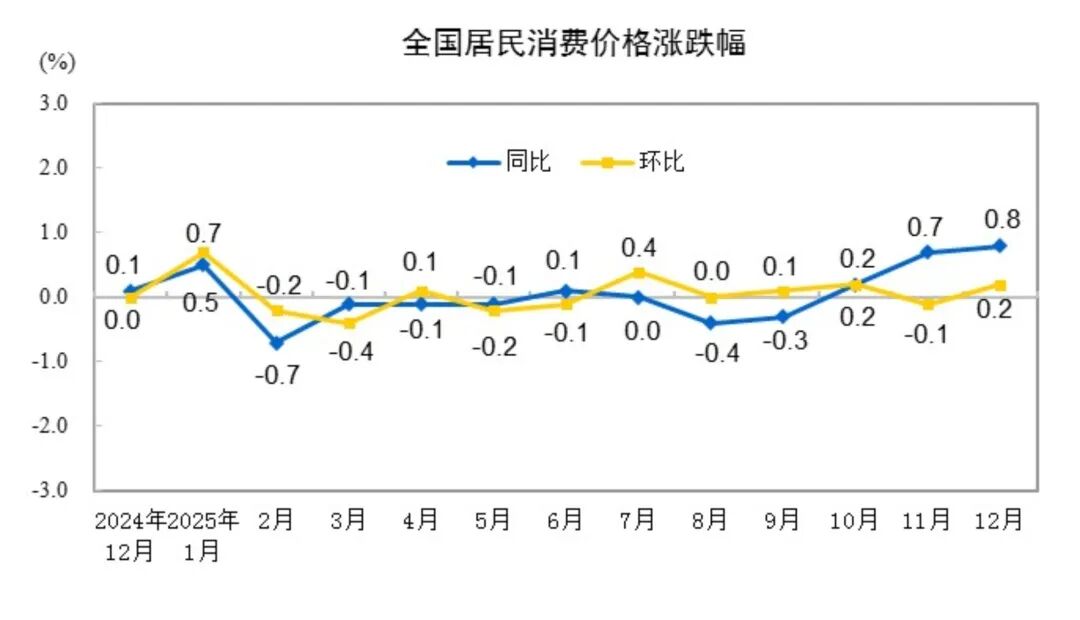
CPI同比回升至2023年3月以来最高
Di Yi Cai Jing· 2026-01-09 02:08
Group 1 - The core CPI has maintained a growth rate of over 1% for four consecutive months, driven by increased consumer demand and effective policies to boost consumption [1][4] - In December, the CPI rose by 0.8% year-on-year, with food prices contributing significantly to this increase, particularly fresh vegetables and fruits [4] - The core CPI, excluding food and energy, rose by 1.2%, indicating stable inflationary pressures in the economy [1][4] Group 2 - The PPI increased by 0.2% month-on-month, marking a continuous rise for three months, while the year-on-year decline narrowed to 1.9% [3][9] - Positive changes in PPI are attributed to ongoing macroeconomic policies and improvements in market competition, with certain industries experiencing reduced price declines [7][8] - The prices of key industries such as coal mining and lithium-ion battery manufacturing have shown signs of recovery, with price declines narrowing over several months [7][8] Group 3 - Economic experts predict that with the implementation of demand expansion policies, prices are expected to recover moderately, potentially returning to positive growth by 2026 [5] - The development of the digital economy and new materials is driving price increases in related sectors, indicating a shift towards a more dynamic economic environment [7]
国家统计局:12月国内金饰品价格上涨5.6%
Xin Lang Cai Jing· 2026-01-09 02:01
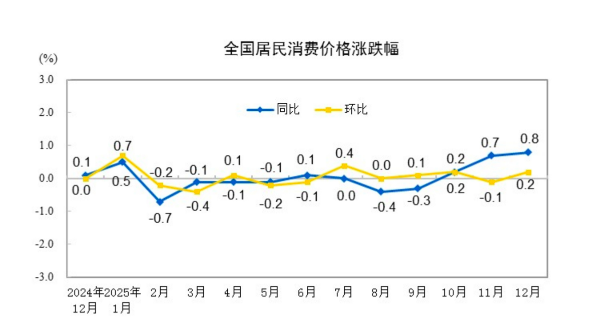
12月份,扩内需促消费政策措施继续显效,叠加元旦临近,居民消费需求增加,居民消费价格指数 (CPI)环比上涨0.2%,同比上涨0.8%,扣除食品和能源价格的核心CPI同比上涨1.2%。受国际大宗商 品价格传导拉动以及国内重点行业产能治理相关政策持续显效等因素影响,工业生产者出厂价格指数 (PPI)环比上涨0.2%,同比下降1.9%。 一、CPI环比由降转涨,同比涨幅继续扩大,核心CPI上涨1.2% CPI环比由上月下降0.1%转为上涨0.2%,环比上涨主要受除能源外的工业消费品价格上涨影响。扣除能 源的工业消费品价格上涨0.6%,影响CPI环比上涨约0.16个百分点。 其中,提振消费政策效果持续显现,叠加元旦临近,居民购物娱乐需求增加,通信工具、母婴用品、文 娱耐用消费品、家用器具价格均有上涨,涨幅在1.4%-3.0%之间;受国际金价上行影响,国内金饰品价 格上涨5.6%。能源价格下降0.5%,其中受国际油价变动影响,国内汽油价格下降1.2%,影响CPI环比下 降约0.04个百分点。食品价格上涨0.3%,影响CPI环比上涨约0.05个百分点。其中,节前消费需求增 加,鲜果和虾蟹类价格分别上涨2.6%和2.5% ...
国家统计局:12月国内金饰品价格上涨5.6%
21世纪经济报道· 2026-01-09 01:56
Group 1 - The consumer price index (CPI) increased by 0.2% month-on-month and 0.8% year-on-year, with core CPI rising by 1.2% year-on-year, indicating a recovery in consumer demand as the New Year approaches [1][3] - The increase in CPI was primarily driven by rising prices in non-energy industrial consumer goods, which rose by 0.6%, contributing approximately 0.16 percentage points to the month-on-month CPI increase [1] - Food prices rose by 1.1% year-on-year, with significant increases in fresh vegetables (18.2%) and fresh fruits (4.4%), contributing to the overall CPI increase [3] Group 2 - The producer price index (PPI) rose by 0.2% month-on-month, marking the third consecutive month of increases, with the growth rate expanding by 0.1 percentage points compared to the previous month [4] - Key industries such as coal mining and lithium-ion battery manufacturing saw price increases due to improved supply-demand dynamics, with coal prices rising for five consecutive months [4] - Year-on-year, PPI decreased by 1.9%, but the decline rate narrowed by 0.3 percentage points, indicating positive changes in certain sectors due to ongoing macroeconomic policies [5]
经济大市挑大梁,“两个万亿”引领临沂冲刺万亿城市
Feng Huang Wang Cai Jing· 2026-01-09 00:28
Core Viewpoint - Shandong Province has entered the 10 trillion yuan economy club, with a focus on high-quality development and the strategic goal of building Linyi into a trillion-yuan city as part of its "14th Five-Year Plan" [1][2][3] Economic Development - Linyi is positioned as a key economic city in Shandong, aiming to accelerate its growth towards becoming a trillion-yuan city [2] - In 2024, Linyi's GDP reached 655.58 billion yuan, with a year-on-year growth of 5.7% [3] - By the end of 2025, Linyi's GDP is projected to approach 700 billion yuan, maintaining a steady growth trend [3] Trade and Logistics - Linyi's commerce and logistics sector is crucial for its economic growth, with a market transaction volume of 645.61 billion yuan and a logistics total of 1.01196 trillion yuan in 2025 [4][5] - The city aims to enhance its logistics capabilities, targeting a market transaction volume of over 1 trillion yuan and logistics total exceeding 1.5 trillion yuan by 2030 [5] Industrial Development - Linyi is focusing on building a modern industrial system, with significant investments in eight key industries including food, wood, metallurgy, and chemicals [6] - By the end of 2025, Linyi's industrial output value is expected to exceed 1 trillion yuan, supported by the development of 13 key industrial chains [6] Cultural and Tourism Sector - The cultural and tourism industry has become a pillar of Linyi's economy, with tourism revenue reaching 870.84 billion yuan in 2024, marking a 13.88% increase [8][9] - Linyi's tourism strategy includes integrating cultural resources with consumption to stimulate economic growth [9][11] Strategic Goals - Linyi aims to become a regional center with a strong economy, vibrant culture, and a high quality of life, as outlined in its "14th Five-Year Plan" [12][13] - The city is committed to rural revitalization and enhancing its agricultural sector, with over 190 rural revitalization demonstration areas established [14][15] Implementation and Future Outlook - Linyi plans to implement twelve major projects to enhance industrial capacity, innovation, and domestic demand, ensuring sustainable economic growth [15][16] - The city is focused on practical actions and a spirit of innovation to achieve its trillion-yuan city goal [16]
广西做优做强工业经济 形成十大千亿元级支柱产业
Jing Ji Ri Bao· 2026-01-08 21:43
Group 1 - The core viewpoint of the articles highlights Guangxi's commitment to implementing the "Industrial Strong Guangxi" strategy, focusing on expanding investment, optimizing structure, and enhancing efficiency in the industrial economy [1][2] - During the "14th Five-Year Plan" period, Guangxi's industrial economy is expected to achieve significant growth, with the total industrial output value projected to reach 2.7 trillion yuan by 2025, an increase of 900 billion yuan over five years [1] - The industrial added value is anticipated to account for over 27% of the regional GDP, marking an increase of nearly 4 percentage points over five years, establishing the industrial sector as a cornerstone of economic development in the region [1] Group 2 - Guangxi has established ten pillar industries, with the non-ferrous metal industry expected to double its output value to over 450 billion yuan by 2025, while the steel and food industries are projected to exceed 300 billion yuan [1] - The region is also focusing on digital and green transformation, with over 5,000 enterprises implementing smart upgrades and nearly 10,000 completing digital diagnostics during the "14th Five-Year Plan" [1] - Guangxi aims to enhance high-quality industrial development by integrating artificial intelligence with manufacturing, promoting technological and industrial innovation, and improving the green low-carbon development system [2]
New Dietary Guidelines Are Out. Food Stocks Lose; Alcohol Shares Gain.
Barrons· 2026-01-08 16:06
Core Insights - The article emphasizes the importance of federal guidelines that prioritize nutrient-dense foods, which include protein, dairy, healthy fats, whole grains, and fruits and vegetables [1] Summary by Categories - **Nutrient-Dense Foods**: Federal guidelines focus on promoting foods that are rich in nutrients, highlighting the significance of including protein, dairy, healthy fats, whole grains, and a variety of fruits and vegetables in diets [1]