建筑

Search documents
2026年智利建筑业或迎复苏
Shang Wu Bu Wang Zhan· 2025-12-30 17:25
智利《信使报》12月23日报道,智利建筑业协会(CChC)发布最新报告,预测行业投 资在经历两年负增长后,2025年将增长2.2%,2026年4.8%。2025年复苏力度低于预 期,主要受部分项目延期、年底公共预算削减以及部分地方违约影响。报告显示, 2025年基础设施投资预计增长3.3%,其中生产性基础设施增长5.5%,公共基础设施仅 微增0.6%。住房投资总体持平,公共住房投资增长5.7%,但私人住房投资下降2.3%, 不过全国住房销量受益于利率补贴政策,大幅增长19%。对于2026年,协会预期生产性 基础设施投资将强劲增长13.6%,公共住房投资增长11%,私人住房投资收缩幅度收窄 至0.1%,住房销量预计再增30%。然而,受财政紧缩影响,公共基础设施投资预计将下 降5.1%。整体复苏仍显脆弱,主要风险包括政府可能出现的付款延迟、违约以及预算 执行不力。CChC呼吁政府短期内采取多项措施,包括加快项目审批、简化过度监管、 优化补贴政策、延长建筑许可期限,并为住房改善计划注入更多资源。 (原标题:2026年智利建筑业或迎复苏) ...
东证指数创36年来年终新高!年末行情显韧性 企业治理改革推动下明年或跑赢日经225
智通财经网· 2025-12-30 09:08
Core Viewpoint - The Japanese stock market, represented by the TOPIX and Nikkei 225 indices, has shown significant growth in 2025, with the TOPIX closing at 3408.97 points, surpassing its previous high in 1989, and the Nikkei 225 reaching 50339.48 points, marking a new annual high for the second consecutive year. Both indices have recorded substantial year-to-date gains of 22% and 26% respectively, indicating a robust recovery and investor interest in Japanese equities [1][4]. Group 1 - The TOPIX index experienced a notable rebound after a sharp decline in April due to trade war concerns, driven by improved corporate earnings, government fiscal stimulus, and a favorable global liquidity environment [4]. - The interest in Japanese stocks has expanded to include small-cap stocks, with mid-cap and small-cap segments of the TOPIX rising by 27% and 26% respectively, outperforming large-cap stocks which gained 21% since 2022 [4]. - The chief strategist at Nomura Asset Management highlighted that the new high for the TOPIX indicates an expanding buying base in the Japanese stock market, with a trend of valuation recovery across various sectors [4]. Group 2 - Key drivers of the 2025 market growth include companies like Advantest and SoftBank Group, with Advantest's market capitalization surpassing 10 trillion yen and a year-to-date increase of approximately 114%, benefiting from sustained AI spending [5]. - SoftBank Group has also seen its stock price rise over 90% this year, as its investments in OpenAI have positioned it as a critical indicator of market confidence in the non-public company [6]. - Despite the Nikkei 225's long-term outperformance, the recent resilience of the TOPIX suggests it may outperform the Nikkei 225 in 2026, driven by planned revisions to corporate governance guidelines that encourage companies to utilize cash and improve price-to-book ratios [6].

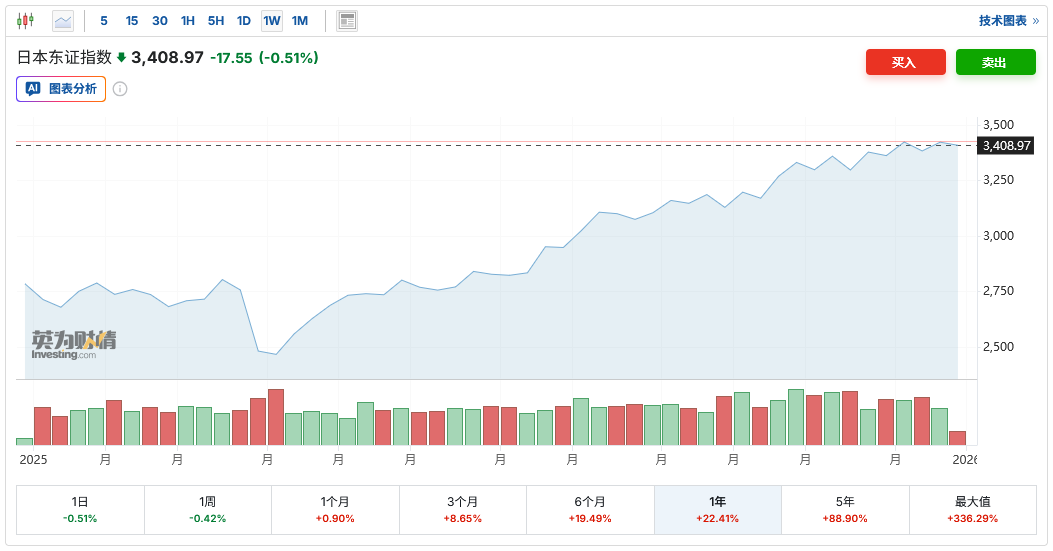
日本东证指数今年收于历史新高 盖过泡沫时期的1989年
Jin Rong Jie· 2025-12-30 08:21
Group 1 - The Tokyo Stock Exchange index (TSE) closed at a historical high of 3,408.97 points at the end of 2025, surpassing the previous peak of 2,881.37 points from 1989 during the bubble economy period [1] - The TSE index increased by 22% in 2025, marking the third consecutive year of gains [1] - Factors contributing to the rise include improved corporate earnings expectations, favorable government policies, and global excess liquidity [1] Group 2 - The Nikkei 225 index closed at 50,339.48 points, achieving a year-end high for the second consecutive year, with a 26% annual increase [2] - The Nikkei index has outperformed the TSE index for the third consecutive year [2] - The planned revisions to corporate governance laws are expected to encourage companies to utilize cash, potentially leading to improved price-to-book ratios and increased buying across various stocks [2]
肯尼亚投资:税务及法律合规指引
Sou Hu Cai Jing· 2025-12-30 04:01
Group 1: Foreign Direct Investment in Kenya - Kenya is one of the leading African countries attracting Foreign Direct Investment (FDI), with an estimated FDI inflow of approximately $1.503 billion by 2024, indicating a stable trend over the past five years [2] - Key sectors for FDI in Kenya include infrastructure, information and communication technology, banking, tourism, and mining, with major investors being China, the UK, the Netherlands, Belgium, and South Africa [2] - The Kenyan government has implemented various measures and reforms to encourage foreign investment, including public-private partnership programs aimed at attracting foreign capital in infrastructure and the establishment of the Kenya Investment Policy to create a conducive environment for sustainable investment growth [2] Group 2: Trade Relations with China - Trade between Kenya and China grew by 6.1% in 2024, with China reaffirming its commitment to enhancing trade relations with the African continent [2] - In the first quarter of 2025, exports from China to Kenya increased by 11.8%, while imports from Kenya to China rose by 13.2%, reflecting ongoing growth in bilateral trade [3] - The signing of over twenty bilateral agreements in April 2025 covering various sectors such as trade, digital innovation, health, education, agriculture, and infrastructure has laid the foundation for a comprehensive strategic partnership between the two countries [3] Group 3: Business Registration and Structure - Businesses in Kenya must register with the Companies Registry, and the registration process can be completed online, allowing foreign investors to establish companies without being physically present in Kenya [4] - Foreign entities can operate in Kenya through various structures, including setting up a company, registering a foreign branch, or forming a partnership, each with different legal implications and operational requirements [5] - The 2015 Companies Act outlines various company types, including private companies, public companies, and guarantee companies, protecting personal assets from corporate debts [6] Group 4: Taxation and Incentives - The Kenyan tax system includes corporate tax, personal income tax, value-added tax, and various other taxes, with specific incentives for businesses in export processing zones and special economic zones [13][18] - Companies in Kenya are subject to a corporate tax rate of 30% for non-resident companies on income sourced from Kenya, with certain industries enjoying reduced rates or exemptions [13] - The Kenya Investment Authority facilitates investment by providing certificates for foreign investors with investments of at least $100,000, expediting the issuance of additional operational permits [12]

12月30日热门路演速递丨前瞻2026:宏观、行业与策略的年度对话
Wind万得· 2025-12-29 22:50
核心看点: 01 迎创未来 向新而立 - 东海证券2026年度投资策略会(资产配置专场) 13:30-16:30 2026年资产配置迎来新机遇!东海证券资深分析师团队重磅解读:宏观经济"宏图新启,升维致 远",银行业在红利韧性中捕捉周期弹性,证券行业掘金财富管理与国际业务,能源及有色行业看好 商品顺周期与科技主线需求共振。四大核心板块深度剖析,把握2026年投资主线。 嘉宾: 刘思佳丨东海证券宏观策略资深高级分析师 扫码预约 02 ESG研究丨国信王开:重塑ESG投资新范式【首席开麦2025】 15:00-16:00 王鸿行丨东海证券银行业资深高级分析师 陶圣禹丨东海证券非银金融行业首席分析师 张季恺丨东海证券周期行业资深高级分析师 核心看点: 嘉宾: 王开丨国信证券首席资产配置研究员 扫码预约 03 【热点聚焦】长江建筑张弛:攻守之道——建筑行业2026年度投资策略 15:30-16:30 核心看点: 回顾2025,固投全面回落,基建投资承压;展望2026,关注积极财政带动投资止跌回稳,重视建 筑板块的结构性机会,关注三条投资主线:西部基建、工程出海、科技基建。此外,传统需求层面 关注顺周期龙头经营拐点,以 ...

涉及多个行业,数量增长明显,美国“分散性”破产潮冲击就业
Huan Qiu Shi Bao· 2025-12-29 22:49
Group 1 - A widespread bankruptcy wave is affecting various sectors in the U.S., from large corporations to small businesses and households, marking an unusual and shocking trend in American history [1][2] - As of November 2025, at least 717 large companies have filed for bankruptcy, a 14% increase compared to the same period in 2024, the highest level since 2010 [2] - The industrial sector is the most impacted, with 110 large companies in manufacturing, construction, and transportation filing for bankruptcy in the first 11 months of 2025 [2] Group 2 - High inflation, elevated interest rates, and current trade policies are cited as primary reasons for the bankruptcies, particularly affecting companies reliant on overseas materials [3][6] - Consumer-facing businesses offering non-essential services or products, such as home goods and fashion, represent the second-largest group of bankruptcies, driven by reduced consumer spending due to inflation and cost-of-living pressures [4][6] - Small businesses are increasingly filing for bankruptcy, with over 2,300 applications submitted by mid-December 2025, reflecting a nearly 10% year-over-year increase [6] Group 3 - Despite a reported 4.3% annualized GDP growth in Q3 2025, this economic growth is not evenly benefiting all sectors, highlighting structural contradictions in the U.S. economy [7] - Experts warn of potential future bankruptcies if trade policies remain volatile, interest rates stay high, and geopolitical uncertainties persist, with predictions of no employment growth in 2026 [7]

以“立园满园”司法新范式 擦亮法治“锦”色
Xin Lang Cai Jing· 2025-12-29 19:18
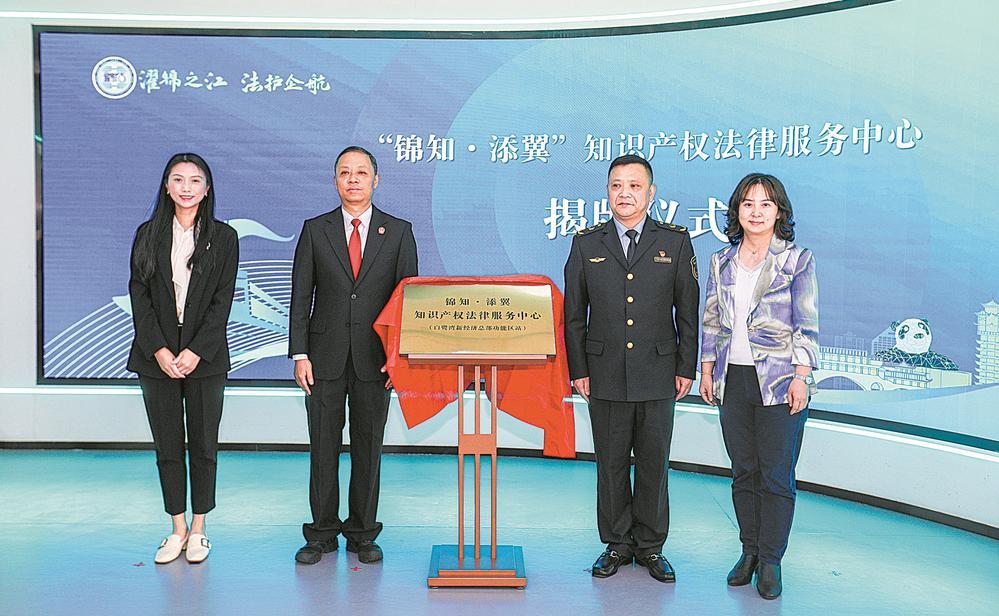
登录新浪财经APP 搜索【信披】查看更多考评等级 转自:成都日报锦观 锦江法院 行动并未止步。法院持续深化"濯锦·企航"品牌内涵,构建起"一链两端N翼"的立体化护企体系。以《促进企业发展十一条举措》为核心政策主 线,精准切入劳动雇佣、金融创新等企业关切领域;通过联合发布《政法机关与工商联沟通联系工作意见》,创新"法院+工商联+工会"多元 协同解纷模式;出台《信用修复实施办法(试行)》及配套指南,全程激励企业守信履约;更推出"一园一方"策略,为不同产业园区提供定制 化法律服务。 由此,一条以专项行动为起点、以核心政策为主线,辐射多领域的"一点一线全周期"司法护企链条清晰形成,实现了司法供给与产业需求的精 准匹配。 以"立园满园"司法新范式 擦亮法治"锦"色 锦江法院"锦知·添翼"知识产权法律服务中心揭牌。 在"十四五"收官与"十五五"谋篇布局的历史交汇点,如何以高质量司法服务赋能区域经济高质量发展,是摆在基层法院面前的时代命题。五年 来,锦江法院以"扎根园区、服务企业"为实践主轴,积极探索司法助力"立园满园"的新路径、新机制,将法治保障深度融入产业肌理。从宏观 的战略引领到微观的诉求响应、从机制的协同创新到服务 ...
美企破产“日常化”
Guo Ji Jin Rong Bao· 2025-12-29 12:08
Group 1 - The number of bankruptcy filings in the U.S. has risen to its highest level in nearly 15 years, affecting both businesses and individuals under increasing financial pressure [1][3] - Small businesses are particularly hard-hit, facing rising costs, a tight financing environment, and weakened consumer demand, leading to systemic issues across multiple industries [2][4] - The industrial sector, including manufacturing, construction, and transportation, has experienced the most significant impact, with over 70,000 jobs lost in manufacturing alone within a year [4][5] Group 2 - The non-essential consumer goods sector, such as clothing and furniture, has seen a higher number of bankruptcies compared to other industries, reflecting changes in consumer spending patterns [5] - Over 4,100 retail and dining establishments have closed in 2025, indicating a decline in industry capacity and consumer confidence [5] - The current wave of bankruptcies is becoming a normalized economic adjustment mechanism rather than a crisis event, subtly undermining the resilience of the U.S. economy through impacts on employment stability and community business vitality [5]
12.29犀牛财经晚报:金价跌破4500美元
Xi Niu Cai Jing· 2025-12-29 11:51
Group 1: Metal Futures and Market Impact - Recent rapid increases in precious and industrial metal futures prices have led to heightened volatility risks, prompting the CME Group to raise margin requirements for trading metals including gold, silver, palladium, and lithium [1] - The new margin requirements, effective after the close of trading on the upcoming Monday, include a 10% increase for gold futures, approximately 13.6% for silver, and 23% for platinum [1] - Following the announcement, international metal futures prices experienced multiple rounds of declines, with gold prices falling below the $4500 per ounce mark, closing at $4497.9 per ounce, a decrease of 1.20% [1] Group 2: AI and Investment Insights - Jinglin Asset Management, a major private equity firm, has indicated that 2026 may mark the true beginning of the widespread adoption of AI Agents [1] Group 3: Fund and Market Adjustments - Guotou Silver LOF announced a temporary suspension of trading on December 30, 2025, to protect investor interests, with the possibility of extending the suspension if market price premiums do not decrease [2] Group 4: Airline Fuel Charges - Starting January 5, 2026, domestic airlines in China will reduce the fuel surcharge for passenger transport, with fees decreasing by 10 yuan for flights under 800 kilometers and 20 yuan for longer flights [3] Group 5: Energy and Technology Developments - The first 30MW pure hydrogen gas turbine has successfully achieved stable operation, marking a significant advancement in hydrogen power generation technology [3] - The Chinese government has confirmed the continuation of the "national subsidy" for consumer goods, which has significantly boosted the sales of mid-to-high-end products in recent years [4] Group 6: Corporate Changes and Developments - Financial adjustments include the appointment of Bi Chunhui as the deputy director of the research institute at Zheshang Securities [5] - Zero Run Technology's CEO confirmed that the company will maintain control by the founding team despite the investment from FAW [6] - China Software plans to sell 555 X86 servers and two properties to optimize idle assets [7] Group 7: Market Transactions and Contracts - Financial services firm Caitong Securities has received approval from the China Securities Regulatory Commission to publicly issue bonds totaling up to 150 billion yuan [8] - Southeast Network Frame has won an EPC project worth 8.87 billion yuan [11] - Shanxi Expressway intends to acquire a 15% stake in Shanxi Transportation Development Group for 74.8 million yuan [12] - Rima Precision's subsidiary has been designated as a supplier for a new energy vehicle project, with expected sales of approximately 1.342 billion yuan over its lifecycle [13] - Nankuang Group signed a 3 billion yuan equipment procurement contract for iron ore processing [14] - Guangdong Yuedian A's Dapu Power Plant's second phase has successfully commenced commercial operations [15] - China Energy Construction's subsidiary has won an EPC project worth approximately 6.864 billion yuan [16] Group 8: Stock Market Updates - ST Dongtong's stock will resume trading on December 30, 2025, entering a delisting preparation period [17] - The Shanghai Composite Index recorded a slight increase, marking a nine-day rise, while the Shenzhen Component Index experienced a decline [18][19]



前11月进出口超1.4万亿,新动能投资双位数增长|东莞经济一线周报
Sou Hu Cai Jing· 2025-12-29 05:10
Economic Overview - Dongguan's economic performance from January to November shows a stable development trend, with total imports and exports exceeding 1.4 trillion yuan [4][2] - New investment in emerging sectors has seen double-digit growth, indicating a shift towards new economic drivers [4] AI Development - The "AI Terminal, Co-creating the Future" conference was held, attracting around 400 guests from government, research institutions, and leading AI companies like Huawei and Alibaba Cloud [6] - This event highlights Dongguan's commitment to becoming a hub for artificial intelligence and innovation [6] Infrastructure Development - Dongguan's first hydrogen refueling station has officially commenced operations, marking a significant step in establishing infrastructure for hydrogen fuel cell vehicles [8] - This initiative is part of Dongguan's broader strategy to promote green energy and sustainable transportation [8] Corporate Financing - Dongguan Securities successfully underwrote the first issuance of corporate bonds by Dongguan Houjie Holding Group, amounting to 450 million yuan with a 5-year term and a 2.40% interest rate [10] - This bond issuance represents a breakthrough in enhancing the market-oriented financing capabilities of local state-owned enterprises [10] Quality Recognition - The Dongguan Government Quality Award has opened for applications, aiming to recognize outstanding local enterprises and promote quality improvement [16] - The awards include a main prize and a nomination prize, with a limited number of recipients to ensure high standards [16] Logistics Innovation - The Dongguan Port Logistics Collaborative Public Service Platform has been launched to improve the electronic flow of logistics at the port, addressing existing challenges [18] - This platform is part of the national and provincial initiatives to advance smart port construction [18] AI Experience Center - The construction of the AI Experience Center on Lingxi Island in Dongguan has begun, aimed at creating a multifunctional innovation platform [20] - The project covers an area of approximately 48,000 square meters and is expected to enhance the local AI ecosystem [20]