
纺织服装

Search documents
文化融入智造 广货风行全球
Guang Zhou Ri Bao· 2026-01-16 02:37
Core Insights - The article emphasizes the integration of Lingnan characteristics into the global market, showcasing Guangzhou's rich cultural heritage and its evolution as a commercial hub, particularly through the "Guangdong Goods Going Global" initiative [2] Group 1: Open Innovation - Guangzhou's ability to lead in intelligent manufacturing is attributed to its spirit of "open innovation and continuous change," which has historical roots in craftsmanship and modern technological advancements [5] - The city has positioned itself as a hub for global technology resources, particularly in the smart connected electric vehicle sector, which is seen as a new engine for Guangdong goods to enter international markets [5][7] Group 2: Cultural Integration - The article highlights the importance of cultural integration in the textile and apparel industry, with products from various regions in Guangdong gaining global recognition, thus establishing the province's "global voice" in these sectors [8][9] - The upcoming "Please Come to Guangdong for the New Year" cultural tourism initiative aims to promote local customs and attract international visitors, enhancing the global appeal of Guangdong's lifestyle [9] Group 3: Consumer Experience - The launch of the Haixinsha Technology Island aims to bridge the gap between technological achievements and consumer experiences, showcasing "Guangdong Goods Manufacturing" as a market favorite [7] - Innovative marketing strategies, such as the "Sui Nong Ji" agricultural consumption map and themed community group buying, are being employed to enhance the visibility and sales of local agricultural products [10][11]


光大证券晨会速递-20260116
EBSCN· 2026-01-16 02:17
Group 1: Macro Insights - The financial data for December shows stable performance, with a notable acceleration in corporate credit growth, although sustainability is a concern due to the timing of the Spring Festival [2] - The appreciation of the RMB has led to a significant increase in household deposits, while an active stock market is expected to boost M2 growth [2] - Structural interest rate cuts and the expansion of structural tools are likely to enhance risk appetite, maintaining a short-term trend of strong equities and weak bonds [2] Group 2: Industry Research - Leading photovoltaic component companies are rapidly entering the energy storage sector, leveraging channel and scenario advantages to unlock new growth opportunities [4] - Key companies to watch include Canadian Solar, Trina Solar, JinkoSolar, JA Solar, and LONGi Green Energy, which are expected to see significant profit contributions and rapid growth in energy storage shipments [4] Group 3: Company Research - CITIC Bank reported a stable net profit growth of 3% year-on-year, with operating income at 212.5 billion, a slight decline of 0.5% [6] - The bank's expansion speed remains steady, and the approval of a new investment entity is expected to enhance its comprehensive operational capabilities [6] - EPS forecasts for CITIC Bank for 2025-2027 are set at 1.25, 1.29, and 1.33 RMB, with corresponding PB valuations of 0.57, 0.53, and 0.50 times [6] Group 4: Market Performance - The A-share market showed mixed performance, with the Shanghai Composite Index closing at 4112.6, down 0.33%, while the Shenzhen Component Index rose by 0.41% [7] - In the commodity market, nickel prices increased by 4.12%, while copper prices fell by 1.26% [7] - The foreign exchange market saw the USD/CNY exchange rate at 7.0064, a decrease of 0.08% [7]
联发股份:2025年度业绩预告
Zheng Quan Ri Bao· 2026-01-15 12:12
Core Viewpoint - The company, Lianfa Co., expects a significant increase in net profit for the fiscal year 2025, projecting a range of 28 million to 32 million yuan, which represents a growth of 38.92% to 58.77% compared to the previous year [2] Financial Performance - The projected net profit for 2025 is estimated to be between 28 million yuan and 32 million yuan [2] - This forecast indicates a year-over-year growth rate of 38.92% to 58.77% [2]

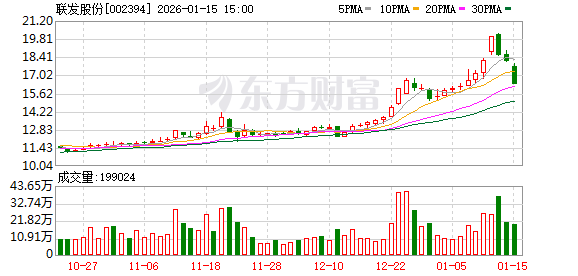
梦洁股份:公司2025年12月31日股东人数会在《2025年年度报告》中披露
Zheng Quan Ri Bao Wang· 2026-01-15 08:43
证券日报网讯1月15日,梦洁股份(002397)在互动平台回答投资者提问时表示,公司2025年12月31日 股东人数会在《2025年年度报告》中披露,请关注公司的相关定期报告。 ...

广东制造爆款频出,董明珠们点赞“广货行天下”
Sou Hu Cai Jing· 2026-01-15 04:43
Core Viewpoint - The article emphasizes the importance of quality in both consumer and corporate life, highlighting the robust quality awareness ingrained in Guangdong's manufacturing culture [1]. Industry Overview - Guangdong produces one out of every three smartphones sold globally, with the Greater Bay Area's smart home appliance industry accounting for approximately 30% of the global market [2]. - By November 2025, Guangdong's home appliance exports are expected to represent nearly half of the national total [2]. Historical Context - The "Four Great Kings" of Guangdong, which include traditional products like "Pearl River Water, Guangdong Grain, Lingnan Clothing, and Cantonese Home Appliances," have evolved significantly since the 1980s [3]. Current Industry Developments - "Pearl River Water" now symbolizes Guangdong's extensive trade logistics, with cross-border e-commerce import and export volume increasing 66 times over nine years, holding over one-third of the national market share [4]. - The food industry in Guangdong aims to exceed 1.5 trillion yuan in output value by 2027, with Cantonese mooncakes accounting for 75% of national production and 90% of exports [4]. - Guangdong's clothing and home appliance sectors are innovating in smart wearables and smart home technologies, with 40% of global smartphones and 70% of consumer drones labeled as "Made in Guangdong" [5]. Ecosystem and Supply Chain - Guangdong's manufacturing ecosystem is characterized by deep collaboration and a complete industrial chain, enabling rapid product development and delivery [8]. - In the textile and apparel sector, a micro-ecosystem in Guangzhou allows for clothing production from design to delivery in as little as one day [8]. - The consumer electronics sector benefits from a "one-hour industrial circle" around Dongguan, facilitating efficient assembly of over 95% of smartphone components [8]. Innovation and Technology - The article discusses a transformation in Guangdong's manufacturing driven by AI and user experience, with companies like Gree and Skyworth leading the charge in smart technology integration [12][13]. - The shift in mindset from "what I can produce" to "how I can serve your needs" is highlighted as a key factor in enhancing product offerings [13]. Market Expansion Initiatives - The "Guangdong Goods Going Global" initiative aims to enhance market access for over 6,000 enterprises across various sectors, supported by major e-commerce platforms [15]. - The initiative employs a model of "government support, platform assistance, and enterprise participation," promoting products through cultural integration [15]. Future Outlook - Experts suggest that Guangdong's manufacturing must enhance its brand image and focus on high-value products to compete globally [20][22]. - The importance of leveraging traditional Lingnan culture for creative inspiration in product development is emphasized, alongside the need for technological innovation [22].

【深圳特区报】“广货行天下”春季行动今日在佛山启幕 广货已备好 等您来采购
Sou Hu Cai Jing· 2026-01-15 00:11
Core Viewpoint - The article highlights the significant growth and transformation of Guangdong's manufacturing industry, particularly in the context of the upcoming Spring Festival, showcasing the region's products and innovations to global consumers [3][12]. Group 1: Overview of Guangdong's Manufacturing - Guangdong's industrial economy has evolved from small-scale operations to a leading position, with classic products like home appliances and textiles now complemented by high-tech goods such as drones and 5G smartphones [8][10]. - The "Guangdong Goods Going Global" initiative aims to promote local products through various online and offline activities, enhancing visibility and sales on major e-commerce platforms [8][9]. Group 2: Technological Advancements - Guangdong produces 70% of the world's consumer drones, 40% of smartphones, and significant portions of industrial robots and integrated circuits, indicating its strong manufacturing capabilities [9][10]. - Traditional industries in Guangdong are undergoing transformation through technological innovation, with companies like Gree and TCL achieving remarkable efficiency improvements [10][11]. Group 3: Focus on Foshan - Foshan, as the first stop for the "Guangdong Goods Going Global" campaign, exemplifies the region's manufacturing strength, contributing nearly 30% of Guangdong's revenue in the home appliance sector [12][13]. - The city is actively promoting the transformation of traditional industries and has seen an average production efficiency increase of 16% through digitalization [12].

力争到2027年民间投资占比达42%
Xin Lang Cai Jing· 2026-01-14 21:48
Core Viewpoint - The Guizhou Provincial Government has issued a three-year action plan aimed at expanding private investment, targeting a growth rate of private investment that exceeds the overall fixed asset investment growth rate by 2027, with private investment accounting for approximately 42% of total fixed asset investment [1][2]. Group 1: Key Tasks and Focus Areas - The plan prioritizes enhancing industrial private investment, focusing on six major industrial clusters including smart industries, new energy materials, and the sauce-flavored liquor industry, as well as three characteristic industries: textiles and apparel, ecological food, and health medicine [1]. - Private investment is encouraged in key sectors such as textile and apparel industry transfer from the East, increased pharmaceutical R&D, and investment in agricultural specialty industries and tourism projects, including well-known scenic spots and new business formats [1][2]. Group 2: Infrastructure and Energy Projects - The plan specifies promoting private capital participation in profitable infrastructure projects such as railways, highways, hydropower, and energy pipelines, with a potential private capital share of over 10% in eligible projects [2]. - Private investment is also encouraged in renewable energy projects like wind and solar power, new energy storage, and pumped storage [2]. Group 3: Policy Measures and Support - A comprehensive set of policy measures is proposed to ensure private capital can enter, stabilize, and develop, including the elimination of market access barriers and the promotion of electronic bidding processes [2][3]. - Financial support will be strengthened, with banks encouraged to increase credit and industry funds required to allocate at least 50% of their resources to private investment projects annually [2]. Group 4: Efficiency and Service Improvements - The plan commits to streamlining the approval process for key private investment projects, reducing the total approval time to within 35 working days [3]. - Regular promotion of high-quality projects with total investments exceeding 50 million yuan to private capital is also included [3].
迎丰股份:2025年全年预计净亏损4500万元—5600万元 同比亏损
2 1 Shi Ji Jing Ji Bao Dao· 2026-01-14 10:16
Core Viewpoint - The company expects to report a net loss attributable to shareholders of between -56 million and -45 million yuan for the year 2025, indicating a year-on-year decline in performance [1] Group 1: Financial Performance - The anticipated net loss for 2025 is primarily due to the impact of tariff events on the textile and apparel industry, significantly affecting sales orders starting in the second quarter [1] - The company's revenue is expected to decline year-on-year, contributing to the overall financial loss [1] Group 2: Operational Challenges - The third business division of the company is gradually commencing production, but the current capacity utilization is insufficient, leading to a substantial increase in fixed costs compared to the previous year [1] - The combination of declining revenue and rising costs is the main reason for the projected financial losses in the current year [1]

迎丰股份:预计2025年净利润亏损4500万元-5600万元 同比转亏
Mei Ri Jing Ji Xin Wen· 2026-01-14 10:12
Core Viewpoint - Yingfeng Co., Ltd. (605055.SH) announced a profit forecast for 2025, expecting a net loss attributable to shareholders of the parent company between -56 million and -45 million yuan, marking a shift from profit to loss compared to the same period last year [1] Group 1: Financial Performance - The company anticipates a significant decline in net profit, transitioning from profit to a loss due to various factors [1] - The expected net loss range is between -56 million and -45 million yuan [1] Group 2: Operational Challenges - The decline in sales orders is attributed to tariff events impacting the textile and apparel industry, leading to a decrease in sales revenue year-on-year [1] - The third business division is gradually starting production, but insufficient capacity utilization has resulted in a substantial increase in fixed costs, which has not been matched by revenue growth, contributing to the overall loss [1]
新澳股份(603889):羊毛价格上涨之下,公司26年有望释放盈利弹性
Orient Securities· 2026-01-14 09:21
Investment Rating - The investment rating for the company is "Accumulate" (maintained) [1] Core Views - The company is expected to release profit elasticity in 2026 due to rising wool prices, with a resilient performance in 2025 despite industry pressures [4][8] - The company has adjusted its earnings forecast slightly, projecting earnings per share (EPS) of 0.62, 0.77, and 0.86 yuan for 2025-2027, respectively, with a target price of 10.54 yuan based on a 17x PE valuation for 2025 [5][9] Financial Performance Summary - Revenue is projected to grow from 4,438 million yuan in 2023 to 6,050 million yuan in 2027, with a compound annual growth rate (CAGR) of approximately 8.4% [6] - Operating profit is expected to increase from 484 million yuan in 2023 to 755 million yuan in 2027, reflecting a growth rate of 11.1% [6] - Net profit attributable to the parent company is forecasted to rise from 404 million yuan in 2023 to 624 million yuan in 2027, with a CAGR of 11.2% [6] - The gross margin is anticipated to improve from 18.6% in 2023 to 21.0% in 2027, indicating enhanced profitability [6] Market Performance Summary - The company's stock price as of January 13, 2026, is 8.9 yuan, with a target price of 10.54 yuan, suggesting a potential upside [1] - The stock has shown strong absolute performance over various time frames, including a 45.76% increase over the past year [1]
