半导体

Search documents
地平线机器人-W(09660):2025年业绩点评:中高阶智驾放量,看好新品迭代
Soochow Securities· 2026-03-23 09:33
Investment Rating - The investment rating for the company is "Buy" (maintained) [1] Core Insights - The company achieved a revenue of 3.76 billion yuan in 2025, representing a year-on-year growth of 58%. The adjusted net loss was 2.81 billion yuan, with an overall gross margin of 64.5%, down by 12.7 percentage points year-on-year, primarily due to changes in revenue structure. The performance exceeded market expectations [7]. - The mid-to-high-end intelligent driving solutions are ramping up, with both shipment volume and unit value increasing. The automotive product solutions business generated revenue of 1.62 billion yuan in 2025, a year-on-year increase of 144%. The core driver is the mass production of mid-to-high-end intelligent driving solutions like HSD, which began in November 2025, with over 22,000 units delivered by the end of the year [7]. - The company plans to launch a new generation of integrated smart vehicle chips and operating systems in 2026. The total shipment of the Chengzheng series processing hardware is expected to reach 4.01 million units, a year-on-year increase of 39%, with hardware supporting mid-to-high-end functions reaching 1.8 million units, up 380% year-on-year, accounting for 45% of total shipments [7]. - The company maintains a leading market share of 44.2% in the mid-to-high-end intelligent driving solutions for mainstream vehicles priced under 200,000 yuan [7]. - The authorized and service business generated revenue of 1.93 billion yuan in 2025, a year-on-year increase of 17%, with a gross margin of 94.5%, up 2.5 percentage points year-on-year. This growth is attributed to the continuous enhancement of integrated software and hardware solutions, leading to increased adoption by Tier-1 customers [7]. - The company has made significant progress overseas, securing contracts with 11 domestic automakers for over 40 export models and establishing connections with three international automakers through two international Tier-1 suppliers [7]. - The financial forecasts for 2026 and 2027 have been revised upwards to 5.67 billion yuan and 8.79 billion yuan, respectively, with an expected revenue of 13.02 billion yuan in 2028. The price-to-sales ratios for 2026, 2027, and 2028 are projected to be 19, 12, and 8 times, respectively [7]. Financial Summary - Total revenue for 2025 is projected at 3.76 billion yuan, with a year-on-year growth rate of 57.67% for 2026 and 50.83% for 2027 [1][8]. - The net profit attributable to the parent company is expected to be a loss of 10.47 billion yuan in 2025, improving to a loss of 3.44 billion yuan in 2026, and a smaller loss of 237.21 million yuan in 2027, before turning positive with a profit of 1.05 billion yuan in 2028 [1][8]. - The earnings per share (EPS) is forecasted to be -0.71 yuan in 2025, -0.23 yuan in 2026, -0.02 yuan in 2027, and 0.07 yuan in 2028 [1][8].
电子行业周报:GTC大会正式发布VeraRubin与LPU,国内头部CSP云业务持续增长-20260323
Donghai Securities· 2026-03-23 09:31
Investment Rating - The report maintains a standard rating for the electronic sector, indicating a cautious but optimistic outlook on potential investment opportunities in the industry [4]. Core Insights - The electronic sector is experiencing significant growth driven by AI demand, with companies like Nvidia showcasing advanced AI computing platforms and projecting substantial revenue growth [4][10]. - Domestic semiconductor industry remains positive, with long-term potential for localization and structural opportunities in equipment, materials, and AI-related sectors [4]. - Recent financial reports from major companies like Alibaba and Tencent indicate robust growth in cloud services, particularly in AI-related products, highlighting the sector's resilience [4][10][11]. Summary by Sections Industry News - Nvidia's GTC 2026 conference highlighted the launch of the AI computing platform Vera Rubin, which includes seven types of chips and five major rack-level systems, with projected sales exceeding $1 trillion by 2027 [4][10]. - Tencent Cloud achieved profitability for the first time, driven by increased demand for cloud and AI services, with a reported revenue of 751.77 billion yuan in 2025 [10][11]. - Alibaba's cloud revenue reached 43.284 billion yuan in Q4 2025, marking a 36% increase, with AI-related products showing triple-digit growth for ten consecutive quarters [4][11]. Market Performance - The electronic sector underperformed the broader market, with the Shenzhen 300 index down 2.19% and the Shenwan electronic index down 2.84% [19][21]. - As of March 20, 2026, various sub-sectors within electronics showed declines, including semiconductors (-1.78%) and optical electronics (-6.04%) [21][22]. Investment Recommendations - Despite high storage prices potentially suppressing demand, the report suggests focusing on structural opportunities in AIOT and AI innovation sectors, recommending companies like Lexin Technology and Cambrian [5]. - Emphasis on domestic supply chain localization in semiconductor equipment and materials, with companies like North Huachuang and Zhongwei Semiconductor highlighted as potential investments [5]. - Recommendations also include monitoring leading companies in power boards and CIS sectors, such as New Clean Energy and OmniVision [5].
氦气危机,将如何冲击全球半导体产业?
财联社· 2026-03-23 09:19
Core Viewpoint - The recent attack by Iran on Qatar's natural gas export facilities poses significant risks to the global energy market and the technology supply chain, particularly due to the critical role of helium in semiconductor manufacturing and other advanced industries [4][5]. Group 1: Helium Supply and Impact - Qatar supplies approximately 30% of the world's helium, primarily from the Ras Laffan facility, which is the largest liquefied natural gas plant globally [5][7]. - Following the Iranian drone attacks, QatarGas announced a 14% reduction in helium export volume due to severe damage to its facilities, with repair expected to take years [7][10]. - Helium prices have doubled since the outbreak of conflict in the Middle East, with potential for further increases as supply tightens [10][12]. Group 2: Helium's Role in Semiconductor Industry - Helium is essential for semiconductor manufacturing, particularly for cooling wafers during the etching process, where it helps maintain consistent temperatures [12][18]. - There are currently no viable alternatives to helium for its cooling applications in semiconductor production, making it irreplaceable [12][18]. - The medical industry also relies on helium for cooling superconducting magnets in MRI machines, indicating a broad impact across multiple sectors [12]. Group 3: Transportation and Storage Challenges - Helium's atomic properties make it difficult to store and transport, as it can easily leak from containers [13]. - Specialized containers used for helium storage can only maintain liquid helium for 35-48 days, and there are currently about 200 such containers stranded in the Middle East [14]. - The logistics of transporting these containers to alternative supply sources could exacerbate shortages in the short term [14]. Group 4: Global Semiconductor Industry Response - The U.S. is the largest helium producer, with an estimated 81 million cubic meters produced last year, but geopolitical tensions have affected supply from other major producers like Russia [16]. - In the event of a helium shortage, semiconductor manufacturers may prioritize the production of higher-margin AI chips over lower-margin components, potentially leading to increased prices for consumer electronics [17][20]. - South Korean companies, which import about 65% of their helium from Qatar, are at risk and are actively seeking alternative sources to mitigate supply disruptions [18][20].


灿瑞科技跌10% 2022年上市募22亿中信证券保荐
Zhong Guo Jing Ji Wang· 2026-03-23 09:15
Group 1 - The stock of Canray Technology (688061.SH) closed at 31.78 yuan, with a decline of 10.00% [1] - Canray Technology was listed on the Shanghai Stock Exchange's Sci-Tech Innovation Board on October 18, 2022, with an initial offering price of 112.69 yuan per share and a total issuance of 19,276,800 shares [1] - The stock has been in a state of decline since its debut, having opened at 100.68 yuan on the first trading day, indicating a loss of value [1] Group 2 - The total amount raised from the initial public offering (IPO) was 217,230.26 million yuan, with a net amount of 199,997.60 million yuan after deducting issuance costs, which exceeded the original plan by 44,949.41 million yuan [1] - The funds raised are intended for high-performance sensor R&D and industrialization, power management chip R&D and industrialization, specialized integrated circuit packaging construction, R&D center construction, and working capital supplementation [1] - The total issuance costs for the IPO were 17,232.66 million yuan, with the lead underwriter, CITIC Securities Co., Ltd., receiving 14,178.42 million yuan in underwriting and sponsorship fees [1] Group 3 - CITIC Securities Investment Co., Ltd., a subsidiary of the lead underwriter, participated in the offering with a stake of approximately 3.00% of the total issuance, amounting to 578,304 shares, valued at 65,169,077.76 yuan, with a lock-up period of 24 months from the date of listing [2] - Canray Technology announced a profit distribution plan for the year 2022, which includes a cash dividend of 0.55 yuan per share (tax included) and a capital reserve transfer of 0.49 shares per share, resulting in a total cash dividend distribution of 42,408,835.70 yuan and a transfer of 37,782,417 shares [2] - The total share capital after the distribution will be 114,889,391 shares, with the record date for the distribution set for June 19, 2023, and the ex-dividend date on June 20, 2023 [2]

港股半导体、黄金板块,全线大跌
第一财经· 2026-03-23 08:39
3月23日,香港恒生指数收跌3.54%,恒生科技指数跌3.28%。 | 名称 | 现价 涨跌 涨跌幅 | | --- | --- | | 恒生指数 | 24382.47 c -894.85 -3.54% | | 恒生科技 | 4712.48c -159.90 -3.28% | | 恒生生物科技 | 13464.37c -575.96 -4.10% | | 恒生中国企业指数 | 8307.82c -266.25 -3.11% | | 恒生综合指数 | 3675.66c -133.13 -3.50% | | 名称 | 涨跌幅 ▲ | 现价 涨跌 | | --- | --- | --- | | 商汤-W | -6.50% | 1.870c -0.130 | | 哔哩哔哩-W | -6.04% | 183.500c -11.800 | | 华虹半导体 | -5.77% | 83.300c -5.100 | | 蔚来-SW | -5.20% | 44.100c -2.420 | | 百度集团-SW | -5.02% | 109.800c -5.800 | | 中本国际 | -4.83% | 54.150c -2.750 ...

AI芯片十年路线图:英伟达和谷歌等联手撰文
欧米伽未来研究所2025· 2026-03-23 08:07
Core Viewpoint - The article emphasizes the urgent need for a unified long-term strategy to coordinate the development of AI and hardware, highlighting the challenges posed by the rapid evolution of AI models and the limitations of existing hardware architectures [3][4][16]. Group 1: AI and Hardware Development - AI and hardware are evolving at an unprecedented pace, with the growth of large AI models demanding more powerful and efficient hardware [3][4]. - The current lack of a cohesive strategy in the global research community is hindering the development of sustainable and adaptive AI systems [4][16]. - The energy consumption of AI has reached unsustainable levels, necessitating a focus on efficiency alongside scale [4][16]. Group 2: Ten-Year Roadmap - The proposed ten-year roadmap includes a collaborative design and development approach for AI and hardware, focusing on energy efficiency, system integration, and cross-layer optimization [4][5]. - Key challenges identified include the gap between training and inference, infrastructure limitations, and equitable access to advanced hardware [4][5]. - Future success is defined by a 1000-fold increase in AI training and inference efficiency, the creation of energy-efficient systems, and the integration of human-centered principles into AI design [4][5]. Group 3: Key Insights and Innovations - Achieving a 1000-fold efficiency increase requires deep collaboration between AI models and hardware architectures, addressing data transfer bottlenecks through memory-centric computing [7][24]. - The integration of AI into every stage of design is essential to bridge the gap between AI innovation and hardware development [8][26]. - Reliable AI systems must balance accuracy, robustness, and efficiency, necessitating formal verification and runtime monitoring [9][10]. Group 4: Future Trends and Applications - The next leap in AI innovation will combine data-driven learning with physical laws, enhancing applications in scientific discovery and robotics [10][11]. - Compact, energy-efficient models are crucial for performance parity with leading models while operating efficiently on edge and embedded platforms [11][12]. - The development of AI-driven design automation tools is vital for exploring vast design spaces and optimizing trade-offs across layers [44]. Group 5: Collaborative Efforts and Partnerships - A call for coordinated national initiatives is made to share infrastructure, cultivate talent, and strengthen cross-sector collaboration [5][14]. - The academic community plays a critical role in building a sustainable and competitive AI ecosystem, complementing industry advancements [12][13]. - Bridging the gap between exploratory academic research and industry-driven goals is essential for effective AI and hardware innovation [14][13].



美股最新评级 | 交银国际维持英伟达“买入”评级,目标价260美元
Xin Lang Cai Jing· 2026-03-23 07:53
Group 1 - Alibaba (BABA.N) maintains a buy rating with a target price of $203.7, driven by a 36% year-on-year revenue growth in Alibaba Cloud for Q3 FY26, strong AI-driven MaaS demand, and signs of recovery in consumer business [1][9] - Futu Holdings (FUTU.O) maintains a buy rating with a target price of $173.60, reporting a 68.1% year-on-year revenue growth and a 101.9% increase in net profit for 2025, with significant improvements in gross and net margins [2][9] - Tiger Brokers (TIGR.O) maintains a buy rating, with a projected 56% year-on-year revenue growth and a 181% increase in net profit for 2025, benefiting from market activity and historical highs in client asset scale [3][10] Group 2 - Novo Nordisk (NVO.N) receives an outperform rating with a target price of $43.29, facing short-term challenges but expected to rebound with a 17% profit growth starting in 2027 due to new product launches [4][11] - Atour (ATAT.O) maintains an outperform rating, with projected revenue and net profit growth of 35.1% and 34.2% respectively for 2025, supported by expansion in mid-to-high-end stores and improved gross margins [5][12] - NVIDIA (NVDA.O) maintains a buy rating with a target price of $260, with management raising revenue guidance to over $1 trillion for 2025-2027, and Non-GAAP EPS forecasts of $8.06 and $10.52 [6][13]
基金双周报:ETF市场跟踪报告-20260323
Ping An Securities· 2026-03-23 07:26
1. Report Industry Investment Rating No information about the industry investment rating is provided in the content. 2. Core Viewpoints of the Report - The performance of ETF products in the past two weeks was poor. Among domestic major broad - based ETFs, CSI A50 had the smallest decline, and among industry and theme products, new energy theme ETFs had the largest increase [2][9]. - In the past two weeks, among domestic major broad - based ETFs, the net inflow of funds into Science and Technology Innovation 50, SSE 50, CSI 500, and SSE - SZSE 300 ETFs ranked among the top [2][9]. - The net outflow of funds from major broad - based ETFs in the past two weeks slowed down. The funds of SSE - SZSE 300, SSE 50, and CSI 500 ETFs turned into net inflow, the net outflow of funds from CSI 1000/CSI 2000 and Science and Technology Innovation/ChiNext ETFs slowed down, and the net outflow of funds from A - series ETFs accelerated [10]. - In 2025, the technology theme ETF had a large cumulative net inflow of funds. Since this year, the technology and cyclical theme ETFs have had a large net inflow of funds. In the past two weeks, the inflow of funds into pharmaceutical, military, and new energy ETFs slowed down, the funds of dividend, consumption, and other large - manufacturing ETFs turned into net inflow, and the funds of cyclical, financial real - estate, and technology ETFs turned into net outflow [15]. - Since 2025, the credit bond ETF has had a large net inflow of funds, followed by the treasury bond ETF. In the past two weeks, the short - term financing ETF's funds turned into net inflow, the local government bond ETF's funds accelerated net inflow, the convertible bond ETF's funds turned into net outflow, the credit bond and treasury bond ETF's funds accelerated outflow, and the net outflow of funds from the policy - financial bond ETF slowed down [15]. - The daily average trading volume of pharmaceutical and new energy ETFs increased significantly in the past two weeks, the daily average trading volume of consumption and financial real - estate ETFs increased, and the daily average trading volume of other large - manufacturing, military, technology, and cyclical ETFs decreased [18]. - As of March 20, 20 new ETFs were newly established in the market in the past two weeks, with a total issuance share of 6715 million, all of which were stock ETFs. Compared with the end of 2025, the scale of commodity ETFs, industry + dividend ETFs, and QDII - ETFs increased by 32.78%, 13.10%, and 2.11% respectively, while the scale of bond ETFs and broad - based ETFs decreased by 12.51% and 43.21% respectively [22]. - As of March 20, Huaxia Fund had the largest on - exchange ETF scale, reaching 70.3557 billion yuan; the ETF management scale of Guotai Fund has expanded by more than 2.7 billion yuan since the beginning of this year [23]. 3. Summary According to the Directory 3.1 ETF Market Review - **Performance and Fund Flow**: As of March 20, the performance of ETF products in the past two weeks was poor. Among domestic major broad - based ETFs, CSI A50 had the smallest decline, and among industry and theme products, new energy theme ETFs had the largest increase. In the past two weeks, among domestic major broad - based ETFs, the net inflow of funds into Science and Technology Innovation 50, SSE 50, CSI 500, and SSE - SZSE 300 ETFs ranked among the top. The inflow of funds into pharmaceutical, military, and new energy ETFs slowed down, the funds of dividend, consumption, and other large - manufacturing ETFs turned into net inflow, the funds of cyclical, financial real - estate, and technology ETFs turned into net outflow. For bond ETFs, the short - term financing ETF's funds turned into net inflow, the local government bond ETF's funds accelerated net inflow, the convertible bond ETF's funds turned into net outflow, the credit bond and treasury bond ETF's funds accelerated outflow, and the net outflow of funds from the policy - financial bond ETF slowed down [2][9][15]. - **Product Structure Distribution**: As of March 20, 20 new ETFs were newly established in the market in the past two weeks, with a total issuance share of 6715 million, all of which were stock ETFs. Compared with the end of 2025, the scale of commodity ETFs, industry + dividend ETFs, and QDII - ETFs increased by 32.78%, 13.10%, and 2.11% respectively, while the scale of bond ETFs and broad - based ETFs decreased by 12.51% and 43.21% respectively [22]. - **Fund Manager Scale Distribution**: As of March 20, Huaxia Fund had the largest on - exchange ETF scale, reaching 70.3557 billion yuan; the ETF management scale of Guotai Fund has expanded by more than 2.7 billion yuan since the beginning of this year [23]. 3.2 Classification - based ETF Tracking - **Technology Theme ETF**: Products tracking the Hang Seng Technology Index had the highest net inflow of funds in the past two weeks, while products tracking the Hong Kong Stock Connect Internet Index had a net outflow of funds [29]. - **Dividend Theme ETF**: Products tracking the Dividend Low - Volatility Index had the highest net inflow of funds in the past two weeks, while products tracking the Guoxin Hong Kong Stock Connect Central Enterprise Dividend Index had a net outflow of funds [31]. - **Consumption Theme ETF**: Products tracking the S&P 500 Consumer Select Index had a relatively high premium rate; ETFs tracking the CSI Agriculture Index had the highest net inflow of funds in the past two weeks, while products tracking the CSI 800 Consumption Index had a net outflow of funds [34]. - **Pharmaceutical Theme ETF**: ETFs tracking the CSI Medical Index had the highest net inflow of funds in the past two weeks, while products tracking the medical device index had a net outflow of funds [36]. - **Large - Manufacturing Theme ETF**: Products tracking the power index had the highest net inflow of funds in the past two weeks, while products tracking the CS Battery Index had a net outflow of funds [39]. - **QDII ETF**: Products tracking the Hang Seng Technology Index had the highest net inflow of funds in the past two weeks, while ETF products tracking the Hang Seng China Enterprises Index had a net outflow of funds [42]. 3.3 Popular Theme ETF Tracking - **AI Theme ETF**: The average return of AI theme products in the past two weeks was - 2.89%, and the funds had a net outflow of 4.218 billion yuan. The products with a relatively high proportion of AI - themed stocks were those tracking the Hong Kong Stock Connect Internet, Hang Seng Internet Technology, CS Artificial Intelligence, etc. [48][53]. - **Robot Theme ETF**: The average return of robot theme products in the past two weeks was - 6.81%, and the funds had a net outflow of 488 million yuan. The products with a relatively high proportion of robot - themed stocks were those tracking the robot and robot industry [55][56]. - **New Energy Theme ETF**: The average return of new energy theme products in the past two weeks was 3.27%, and the funds had a net inflow of 1.126 billion yuan. The products with a relatively high proportion of new - energy - themed stocks were those tracking new energy batteries, CS batteries, etc. [58][59]. - **Satellite and Commercial Space Theme ETF**: The average return of satellite and commercial space theme products in the past two weeks was - 9.35%, and the funds had a net outflow of 661 million yuan. The products tracking satellite communication, satellite industry, and Guozheng Aerospace had such characteristics [60][64]. - **Commodity ETF**: The average return of commodity ETFs in the past two weeks was - 0.89%, and the funds had a net inflow of 6.011 billion yuan. Products tracking gold, non - ferrous metal futures, etc. were included. Since the beginning of this year, gold ETFs have had a large net inflow of funds, with a large net outflow on February 3 [65][70]. - **Central Huijin, Guoxin, and Chengtong Holdings ETF**: As of the middle of 2025, the scale of ETFs held by Central Huijin, Guoxin, and Chengtong was 39.1336 billion shares in total; in the past two weeks, the funds had a net outflow of 2.3474 billion yuan [73].
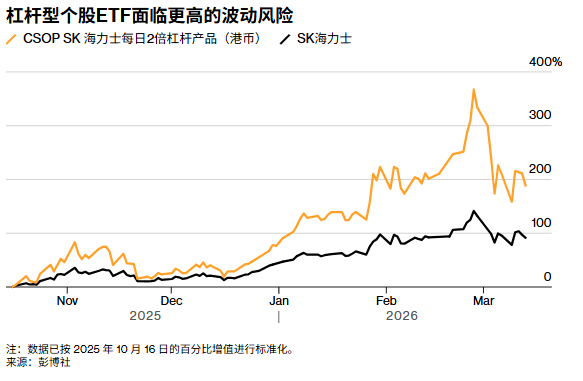
韩版“英伟达杠杆”来了?韩国首批三星、SK海力士杠杆ETF最快5月上市
Zhi Tong Cai Jing· 2026-03-23 07:25
Core Viewpoint - The introduction of single stock leveraged ETFs in South Korea, linked to major chip companies Samsung Electronics and SK Hynix, is set to occur as early as May, driven by demand from retail investors seeking higher returns in the semiconductor sector [1][3]. Group 1: Market Dynamics - The Financial Services Commission (FSC) of South Korea is expediting the approval process for single stock products to diversify offerings and allow more leveraged trading [3]. - The leveraged ETFs will amplify the daily performance of the underlying stocks by two to three times, with a cap on leverage set at two times the price movement of the underlying stock [3]. - The introduction of these products is expected to increase market volatility, particularly in a retail-driven market where funds tend to concentrate on major semiconductor stocks [3]. Group 2: Global Implications - Samsung and SK Hynix's stock prices are highly correlated with the Nasdaq 100 and Philadelphia Semiconductor Index, making the new leveraged ETFs a more liquid option for global investors [4]. - The launch of domestic leveraged ETFs is anticipated to redirect significant capital back to South Korea, alleviating passive buying pressure on related stocks in the U.S. market [6]. - This development indicates a potential restructuring of global semiconductor asset liquidity, as investors have previously sought high-risk returns in Hong Kong or U.S. markets due to the lack of local options [4].
能源+氦气双重打击,全球芯片行业或飞出黑天鹅
财联社· 2026-03-23 06:49
市场此前广泛担忧中东氦气出口中断将对亚洲芯片产业造成打击,但现在分析师们担忧,能源加上半导体关键材料短缺的双重压力,将在芯 片行业引发一场黑天鹅事件。 中东冲突可能将对全球芯片行业造成毁灭性打击,而市场目前还未对此风险进行充分定价。 巴克莱银行研究团队指出,中东冲突已经超过三周,这与中东原油和天然气运往北亚的典型运输周期相吻合。随着时间推移,能源中断的影 响将逐步显现,市场的关注点也将从石油价格会否突破每桶100美元,转移到半导体行业能否维持其电力和原材料供应。 分析机构牛津经济研究院则预计,由于中东冲突导致卡塔尔向东亚供应液化天然气中断,东亚地区的投资和工业生产增长将放缓0.4个百分 点。 牛津经济研究院尤其警告半导体行业面临的风险。其中, 由 于中国 台湾 地区和韩国对天然气的依赖程度较高,因此极容易受到能源短缺 的影响,而半导 体产品的生产对电力压力尤其敏感,持续的供应限制最终将影响芯片生产,并对整条供应链产生溢出影响。 多米诺骨牌 而考虑到人工智能建设对全球经济的推动作用,如果中东冲突加剧,人工智能竞赛中的所有参与者都会感受到余震。 下载财联社APP获取更多资讯 准确 快速 权威 专业 7x24h电报 ...