消费建材

Search documents
建材行业双周报(2026/01/16-2026/01/29):部分消费建材产品再次提价,行业盈利持续修复可期-20260130
Dongguan Securities· 2026-01-30 11:14
Investment Rating - The report maintains a "Market Weight" rating for the building materials industry, indicating that the industry index is expected to perform within ±10% of the market index over the next six months [49]. Core Insights - The building materials industry is experiencing a recovery in profitability, with some consumer building materials products seeing price increases due to rising raw material costs [2][5]. - The cement sector is expected to show resilience in profitability, supported by significant infrastructure projects and urban renewal initiatives in 2026, despite a projected decline in cement production in 2025 [4][41]. - The glass and fiberglass sectors are undergoing structural adjustments, with a focus on high-end products and green transformation, while traditional segments face challenges from real estate market weaknesses [42][43]. - The consumer building materials segment is witnessing a trend of price stabilization and recovery, driven by demand for renovation and urban renewal, despite a slowdown in new construction [44]. Summary by Sections Cement Industry - In Q1 2026, cement companies are expected to implement significant production cuts, with an average shutdown period of 46 days nationwide, aimed at balancing supply and demand [4][41]. - The average cost of P.O42.5 bulk cement is reported at 197 RMB/ton, with a gross profit margin of 17% [4]. - The industry is projected to recover gradually, contingent on effective supply-side policies and infrastructure investment [4][41]. Glass and Fiberglass - The flat glass market is expected to stabilize as production capacity is controlled and environmental standards are enforced, although demand remains weak due to real estate sector challenges [42]. - The fiberglass industry is in a recovery phase, with a focus on eliminating inefficient capacity and enhancing production quality through technological upgrades [43]. Consumer Building Materials - Major companies like Keshun and Sankeshu have announced price increases due to rising costs of raw materials, indicating a trend towards price recovery in the sector [44]. - The demand for renovation and urban renewal is expected to drive growth, while leading companies are enhancing their market share through brand strength and service improvements [44]. Recommended Stocks - The report suggests focusing on companies with strong fundamentals and high dividend yields, including Shangfeng Cement, Tapa Group, and Huaxin Cement [4][45].


建材电话会-聚焦涨价链条-挖掘宝藏个股
2026-01-29 02:43
Summary of Conference Call on Building Materials Industry Industry Overview - The building materials industry is experiencing a price increase trend driven primarily by demand, particularly in the electronic fabric sector, with significant contributions from AI electronic fabric expected in 2026 [1][2] - The fiberglass industry is projected to continue its upward trajectory, with traditional electronic fabric prices having increased three times since Q4 2025, totaling approximately 0.6 yuan [1][2] Key Insights - **Fiberglass Market**: The demand for AI electronic fabric is a major driver for fiberglass price increases, with expectations of continued growth in 2026 [1][2] - **High-End Yarn Market**: The supply of high-end yarn (e.g., wind power sand, thermoplastic sand) remains stable, with a marginal decrease in effective supply of approximately 400,000 tons compared to 2025. Wind power sand demand was close to 1.2 million tons last year, maintaining high levels [5] - **Consumer Building Materials**: The consumer building materials sector has seen a significant decline in real estate demand since 2021, with the waterproof materials market size dropping from 200 billion to around 80-90 billion. The CR3 market share has increased from over 30% to over 40% due to a high exit rate of small enterprises [6] Company Recommendations - **Fiberglass Leaders**: China Jushi is recommended as the largest traditional building materials leader, with an expected profit of approximately 5 billion yuan and a market capitalization space of 120-130 billion yuan [3] - **Consumer Building Materials**: Recommended companies include: - Sanke Tree - Rabbit Baby - Henkel Group - Additional companies to watch: Yuhong, Keshun, Weixing, and Beixin Building Materials [3][6] - **Glass Industry**: Key players to focus on include: - Qibin Group - Xinyi Glass - These companies are expected to have strong profitability and may benefit from price recovery once the industry reaches a supply-demand balance [7] Challenges and Opportunities - **Glass Industry Challenges**: The glass industry is expected to face overall losses starting in the second half of 2024, with significant pressure on small enterprises leading to potential bankruptcies. Inventory levels are high, with some small companies holding over 40 days of inventory [7] - **Production Capacity**: Anticipated cold repairs of production lines in Q1 may further reduce capacity to around 140,000-145,000 tons [7] Conclusion - The building materials sector is currently navigating a complex landscape of price increases driven by demand, particularly in electronic fabrics and high-end yarns. Key companies in fiberglass and consumer building materials are positioned to benefit from these trends, while the glass industry faces significant challenges that may present both risks and opportunities for recovery in the future [1][2][3][6][7]



东方雨虹:预期差中的市场共识重塑
Ge Long Hui· 2026-01-28 00:14
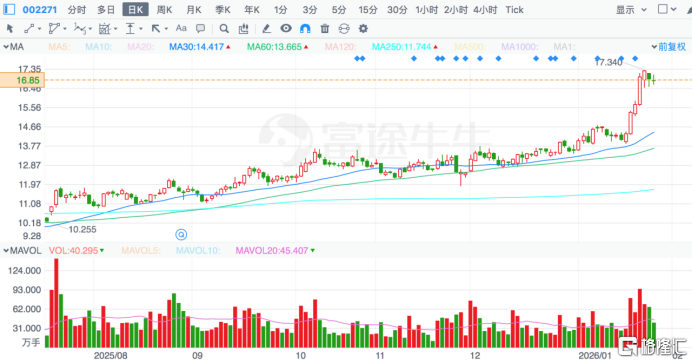
Core Viewpoint - The stock price of Dongfang Yuhong (002271.SZ) has shown strong performance, with a cumulative increase of approximately 24% since the beginning of the year, and its market capitalization has surpassed 40 billion [1][3]. Group 1: Company Developments - The controlling shareholder has announced a plan to reduce holdings by up to 3% of the total share capital, which will be used to fulfill employee stock ownership commitments and repay personal pledged loans [3]. - This reduction is seen as a move to stabilize the governance structure and reduce potential risks to the company, aligning with recent strategic actions such as selling multiple real estate assets and liquidating holdings in Jinke Services [3]. - The company is optimizing its asset structure to focus more on its core business, preparing for strategic initiatives in 2026 and beyond [3]. Group 2: Industry Trends - The construction materials industry is at a turning point, transitioning from a high-growth model reliant on real estate development to new structural opportunities [4]. - The industry is expected to reach a bottom in fundamentals by 2024-2025, with potential for growth in 2026 as supply-side improvements stabilize prices [5]. - The demand structure is fundamentally changing, with a significant shift towards renovation needs, which currently account for about 50% of demand and are expected to rise to nearly 70% by 2030 [5]. Group 3: Company’s Strategic Positioning - Dongfang Yuhong is undergoing a strategic transformation from a high accounts receivable model to a healthier development model focused on retail and engineering channels, with a projected revenue contribution from these channels reaching 84.06% by mid-2025 [8]. - The company is also expanding its sand powder and overseas businesses, with sand powder production expected to exceed 12 million tons in 2025, marking a 50% increase from 2024 [10]. - Recent acquisitions, such as the purchase of Construmart in Chile, are part of a strategy to establish an international retail platform and enhance global distribution capabilities [12]. Group 4: Market Expectations and Recovery Signals - There are three significant expectation gaps regarding Dongfang Yuhong: the market underestimates the depth of its strategic transformation, overlooks the reality of its new business growth engines, and focuses on overall industry lows while ignoring positive turning points [7][10][13]. - The company has shown a revenue growth of 8.51% year-on-year in Q3 2025, marking the first positive growth in recent years, indicating a shift in growth momentum [13]. - The competitive environment is improving, with supply-side adjustments and price stabilization signaling an end to the most intense phases of price competition, suggesting a recovery in profitability for leading companies in 2026 [13][14].


东方雨虹(002271.SZ):预期差中的市场共识重塑
Ge Long Hui· 2026-01-28 00:12
Core Viewpoint - The stock price of Dongfang Yuhong (002271.SZ) has shown strong performance, with a cumulative increase of approximately 24% since the beginning of the year, and its market capitalization has surpassed 40 billion [1] Group 1: Company Developments - The controlling shareholder has announced a plan to reduce holdings by no more than 3% of the total share capital, which has attracted market attention [2] - The funds from the reduction will primarily be used to fulfill employee stock ownership plan commitments and repay personal pledged loans, which will help stabilize the core team and reduce potential risks to the company [2] - The company has been optimizing its asset structure by selling multiple real estate properties and liquidating its holdings in Jinke Services, indicating a focus on its core business for future strategic initiatives [2][4] Group 2: Industry Trends - The construction materials industry is at a crossroads, transitioning from a high-growth model reliant on real estate development to new structural opportunities [4] - The industry is expected to reach a bottom in fundamentals by 2024-2025, with potential for growth in 2026 [5] - The demand structure is fundamentally changing, with a significant shift towards renovation needs, which currently account for about 50% of demand and are expected to rise to nearly 70% by 2030 [7] Group 3: Market Dynamics - The most intense phase of price competition in the industry appears to be over, with leading companies expected to see profit recovery in 2026 [7][8] - The global market presents a second growth opportunity for the industry, driven by initiatives like the Belt and Road and the wave of Chinese manufacturing going abroad [8] Group 4: Company-Specific Expectations - Dongfang Yuhong has significant potential for profit and valuation recovery, with three key expectation gaps identified [10] - The first gap is the market's underestimation of the depth and long-term value of the company's strategic transformation from a high receivables model to a healthier retail and engineering channel model [11] - The second gap is the market's perception of new business ventures as long-term stories, while they are already becoming significant growth engines, particularly in the sand powder and overseas markets [13][14] - The third gap is the market's focus on overall industry lows, overlooking multiple signals of recovery, including a revenue growth of 8.51% year-on-year in Q3 2025, marking the first positive growth in recent years [16]
建筑材料行业深度分析:12月投资端降幅扩大,2026年有望开门红
GF SECURITIES· 2026-01-27 08:49
[Table_Page] 深度分析|建筑材料 证券研究报告 [Table_Title] 建筑材料行业 12 月投资端降幅扩大,2026 年有望开门红 [Table_Summary] 核心观点: [Table_Grade] 行业评级 持有 前次评级 持有 报告日期 2026-01-27 识别风险,发现价值 请务必阅读末页的免责声明 1 / 25 972918116公共联系人2026-01-27 16:41:57 ⚫ 12 月地产/基建投资降幅环比扩大,2026 年有望开门红。12 月固定资 产投资当月同比-15.1%,前值-12.0%;其中制造业/地产/狭义基建/广 义基建投资单月同比分别为-10.5%/-35.8%/-12.2%/-15.9%,增速环比 分别-6.1/-5.5/-2.5/-4.0pct,可能和"推动投资止跌回稳"政策方向既定 的情况下,地方政府会更倾向于把投资节奏集中于 2026 年初有关。 2025 年 1-12 月房地产开发投资/新开工面积/销售面积/竣工面积分别同 比-17.2%/-20.4%/-8.7%/-18.1%,12 月地产相关指标继续低位徘徊, 2026 开年之后二手房成交回暖 ...
建材周专题 2026W4:关注建材涨价品种,双碳政策迎来新机遇
Changjiang Securities· 2026-01-27 05:13
Investment Rating - The investment rating for the building materials industry is "Positive" and maintained [10] Core Insights - The report emphasizes the potential for price increases in building materials, driven by supply-demand improvements and cost reductions. Key areas of focus include electronic fabrics, waterproof materials, and the glass and cement sectors [4][6][7] - The "dual carbon" policy presents new opportunities for the building materials industry, particularly for companies with lower energy consumption and better carbon management [6][7] Summary by Sections Price Trends and Supply-Demand Dynamics - Cement shipments are experiencing seasonal declines, while glass inventories have decreased month-on-month. The report anticipates a recovery in profitability due to supply-demand improvements and cost reductions [2][4] - The report identifies three main lines for 2026: the stock chain, the African chain, and the AI chain, focusing on optimizing demand and clearing supply [7] Sector-Specific Insights - **Glass**: The current daily melting capacity is approximately 150,000 tons, with expectations for a reduction to 145,000 tons to achieve supply-demand balance. Companies like Xinyi Glass and Pilkington are highlighted as key players [5][6] - **Cement**: Profitability is at a clear bottom, with supply-demand pressures expected to persist in 2026. Companies such as Huaxin Cement and Conch Cement are noted for their market positions [5][6] - **Waterproof Materials**: The report highlights a significant exit of supply in the waterproof and coating sectors, benefiting from a year-on-year decline in asphalt prices. Companies like Dongfang Yuhong and Keshun are recommended [4][6] Future Outlook - The report projects a shift in consumer demand towards renovation, with expectations that the share of renovation demand will rise from 50% to nearly 70% by 2030. This change is expected to drive the industry back to historical high levels of demand [7] - The African market is identified as an undervalued growth area, with companies like Keda Manufacturing and Huaxin Cement poised to benefit from population and urbanization trends [7] - The AI chain focuses on the upgrade of special electronic fabrics, with companies like Zhongcai Technology highlighted for their comprehensive product offerings and low valuations [7]
主题风向标1月第3期:增量政策聚焦城市更新与新兴科技
GUOTAI HAITONG SECURITIES· 2026-01-26 15:26
Group 1: Core Insights - The report highlights a decline in trading heat for hot themes, with commercial aerospace, resource products, and building materials leading the gains, while light communication and consumer electronics have seen a pullback [1][7] - The focus of incremental policies is on urban renewal and emerging technologies, with a positive outlook on urban renewal, commercial aerospace, domestic computing power, and new power grids [1][6] Group 2: Urban Renewal - Urban renewal is expected to stabilize the real estate market and expand domestic demand, with a projected 60,015 urban renewal projects nationwide in 2024, totaling an investment of 2.9 trillion yuan [19][25] - Key areas of urban renewal include the renovation of old residential communities, urban villages, and underground pipeline upgrades, with recommendations for investment in waterproofing, piping, and coatings [20][26] Group 3: Commercial Aerospace - Elon Musk indicated that space will become the lowest-cost location for deploying AI data centers within 2-3 years, with reusable spacecraft potentially reducing access costs by 100 times [21][36] - The report anticipates the establishment of a leading space computing center in China by 2030, focusing on green and low-carbon solutions [38][40] Group 4: Domestic Computing Power - TSMC's capital expenditure is expected to exceed expectations, with a projected 37% increase in 2026 to reach $56 billion, indicating strong demand in the semiconductor manufacturing sector [21][48] - The rapid iteration of domestic AI models is expected to drive investment demand in domestic computing power, with significant increases in user engagement and data usage [22][49] Group 5: New Power Grids - The State Grid's investment during the 14th Five-Year Plan is projected to reach 4 trillion yuan, a 40% increase from the previous plan, aimed at accelerating the construction of new power systems [21][22] - By 2025, non-fossil energy consumption in China is expected to account for 20% of total energy consumption, increasing to 25% by 2030 [21][22]


建筑材料行业周报:防水发布涨价函,关注内需弹性品种
China Post Securities· 2026-01-26 05:24
证券研究报告:建筑材料|行业周报 发布时间:2026-01-26 行业投资评级 强于大市|维持 | 行业基本情况 | | | | --- | --- | --- | | 收盘点位 | | 6032.51 | | 52 | 周最高 | 6032.51 | | 52 | 周最低 | 4167.51 | 行业相对指数表现 研究所 分析师:赵洋 SAC 登记编号:S1340524050002 Email:zhaoyang@cnpsec.com 近期研究报告 《年末需求进入淡季,关注供给改善品 种》 - 2026.01.19 建材行业报告 (2026.01.19-2026.01.25) 防水发布涨价函,关注内需弹性品种 投资要点 本周受防水涨价及风格切换因素影响,建材板块表现较好,尤其 内需涨价逻辑相关标的涨幅居前。展望 26 年,我们认为消费建材弹 性明显,防水、涂料、石膏板等行业均有持续涨价预期,目前行业需 求处于淡季,我们判断在竞争格局改善及反内卷大环境下,行业将持 续延续涨价逻辑,建议关注:东方雨虹、科顺股份、三棵树、兔宝宝、 北新建材。 水泥:年末全国市场逐步进入淡季,整体来看,全国需求仍呈现 下滑态势,房建 ...
涨价品种梳理
2026-01-26 02:49
Summary of Conference Call on Construction Materials Sector Industry Overview - The construction materials sector is undergoing a price recovery, with electronic fabrics starting to see price increases from 2024. Consumer construction materials such as waterproof materials, gypsum boards, and coatings are expected to see price hikes in 2025, while glass and cement prices have less certainty regarding increases [2][3]. Key Points and Arguments - **Price Adjustments**: - Waterproof materials and coatings have initiated price adjustments, with leading companies issuing multiple price increase notices. Gypsum boards have attempted price increases but with mixed results. The market dynamics are shifting from demand-driven to supply-driven, which is expected to enhance the effectiveness of price increases [2][6]. - **Challenges in Waterproof Materials**: - The waterproof materials industry faces low profit margins and intense competition, leading to some second-tier companies experiencing losses. Major companies are responding by issuing joint price increase notices to combat these challenges. Since June of the previous year, product prices have not decreased, indicating a unified profit demand among leading companies, which is expected to improve profit margins this year [7]. - **Investment Opportunities**: - The consumer construction materials sector has undergone significant market clearing over the years, and current valuations remain at historical lows, highlighting investment potential. Investors are advised to focus on leading companies such as Sanke Tree (涂料龙头三棵树), Dongfang Yuhong (防水龙头东方雨虹), Keshun (科顺股份), Beixin Building Materials (北新建材), and upstream companies in the home furnishing industry like Tubao (兔宝宝) [8][9]. - **Price Recovery Logic**: - The fiberglass sector is one of the earliest construction materials to have a basis for price increases, driven by AI demand affecting traditional supply. The conversion of weaving machines for AI production has reduced the supply of traditional electronic fabrics, leading to price increases, a trend expected to continue [10]. Additional Insights - **Market Trends**: - The electronic fabric market has seen significant price increases, particularly during the traditional off-season in December and January. With low inventory levels and no significant stockpiling from downstream, this trend is expected to persist into the first half of 2026 [11]. - **Supply and Demand in Fiberglass**: - 2026 is projected to be a year of limited fiberglass supply, with high market share and concentration. Companies are focusing on adjusting product structures rather than expanding production. Demand from sectors like wind power, automotive, and home appliances will be crucial to monitor [12]. - **Wind Power Sector Outlook**: - The wind power sector's future requires attention to the pricing stability of wind power sand and downstream wind blade companies. While demand may be impacted in 2026, there remains potential for growth [13]. - **Glass Industry Price Trends**: - The glass industry may experience significant price elasticity in the second and third quarters of 2026, with current low prices due to a slowdown in cold repair schedules. Anticipated demand drops post-Spring Festival could lead to increased inventory pressure, prompting manufacturers to undertake more cold repairs, which may drive prices up [14]. - **Cement Industry Outlook**: - Although short-term drivers for the cement industry are weaker than those for glass, long-term positive changes in supply dynamics are occurring, such as measures to curb overproduction and the inclusion of the cement industry in carbon trading markets. This is expected to lead to a gradual upward trend in cement prices [15].
建筑材料行业周报:新一轮城市更新开启,关注消费建材底部向上的弹性-20260125
East Money Securities· 2026-01-25 14:49
Investment Rating - The report maintains an "Outperform" rating for the construction materials sector, indicating a positive outlook compared to the broader market [2] Core Views - A new round of urban renewal is beginning, which is expected to provide significant opportunities in the consumer building materials sector, effectively countering the decline in new housing market demand [8] - The report highlights that after a prolonged downturn in the real estate sector, profitability in various segments of the construction supply chain is starting to recover, particularly for leading companies that have undergone strategic adjustments [8] - The report emphasizes the potential for price increases in certain segments, such as waterproofing and coatings, as companies respond to improved market conditions [8] Summary by Sections Cement - The cement market is entering a seasonal downturn, with demand expected to decline. The average shipment rate for major regions has dropped to 29%, a decrease of approximately 10 percentage points [27][34] - The national average price for cement remains stable at around 353 RMB per ton, with minor fluctuations observed in specific regions [28][34] - The report suggests that after the Spring Festival, demand may recover as new key projects are expected to commence, potentially stabilizing prices [34] Glass - The glass market is also experiencing a decline in demand, with production capacity decreasing to approximately 14.95 million tons, the lowest in recent years [53] - The average price for float glass has increased slightly to 1,139 RMB per ton, with inventory levels decreasing [38] - The report indicates that the glass industry is facing profitability challenges, leading to accelerated production line cold repairs, which may help stabilize the market [53] Fiberglass - The fiberglass market is seeing stable pricing for both roving and electronic fabrics, with the price of 7628 electronic fabric currently at approximately 4.4-4.85 RMB per meter [55] - The report anticipates continued high demand for electronic fabrics, supported by structural adjustments and a shortage of high-end products [55] - Key recommendations include focusing on leading companies like China Jushi, with additional attention on International Composite Materials and Zhongcai Technology [55] Carbon Fiber - Carbon fiber prices are expected to remain stable in the short term, with the rapid development of commercial aerospace potentially driving new demand [55] - The report notes that the current price stability is a necessary step for increased market penetration, with significant growth expected in the aerospace sector [55] Consumer Building Materials - The report highlights the resilience of consumer building materials, with leading companies like Sanke Tree and Rabbit Baby showing strong growth potential as they emerge from profitability challenges [8] - The urban renewal initiative is expected to create substantial market opportunities, particularly for high-quality consumer building materials [8]