
煤炭行业

Search documents
午评:沪指跌0.66% 深圳国企改革、煤炭板块领涨 工程机械、培育钻石板块领跌
Xin Hua Cai Jing· 2025-10-23 05:51
Market Overview - The Shanghai and Shenzhen stock markets opened lower on October 23, with significant declines observed after initial rebounds, leading to notable drops by midday [1] - The Shanghai Composite Index closed at 3888.08 points, down 0.66%, with a trading volume of approximately 456.5 billion yuan; the Shenzhen Component Index fell 0.87% to 12883.89 points, with a volume of about 590.7 billion yuan [1] Sector Performance - Shenzhen state-owned enterprise reform concept stocks opened strongly, while low P/E and dividend stocks showed early gains; sectors such as coal, oil, and banking experienced significant increases [1] - Conversely, the engineering machinery and cultivated diamond sectors, which had seen gains in previous sessions, underwent notable corrections, and the tech-focused sectors like CPO concept and semiconductors also faced substantial adjustments [1] Institutional Insights - Huatai Securities highlighted a new action plan from the Shanghai government aimed at promoting high-quality development in the construction industry, which is expected to alleviate growth bottlenecks and optimize the industrial ecosystem [2] - CITIC Construction Investment noted that the humanoid robot sector has retraced its September gains, suggesting that current adjustments may present buying opportunities, especially ahead of Tesla's Q3 report and shareholder meeting [2] Energy Sector Data - The National Energy Administration reported that the total electricity consumption in September reached 888.6 billion kWh, marking a year-on-year increase of 4.5%, with the first and second industries showing growth rates of 7.3% and 5.7%, respectively [3] M&A Development Plans - Shenzhen's financial management bureau released an action plan for promoting high-quality M&A and restructuring from 2025 to 2027, focusing on strategic emerging industries such as integrated circuits, AI, and renewable energy [4] - The plan encourages leading companies to engage in M&A activities that enhance supply chain capabilities and technological advancements, particularly in future industries like synthetic biology and quantum information [4]
全球矿业研究 | 基本金属估值显现吸引力,哪类金属性价比最高?
彭博Bloomberg· 2025-10-21 06:05
Core Insights - The global energy market is experiencing volatility due to rapid industry development, geopolitical tensions, and fluctuating supply-demand dynamics [1] Group 1: Metal Valuation and Market Trends - Basic metal valuations show attractiveness, with nickel currently offering the best value as its price is below marginal costs and its inflation-adjusted 5-year and 8-year averages, despite a relatively weak supply-demand outlook [3] - Aluminum, palladium, and both thermal and metallurgical coal prices are close to marginal costs, indicating solid price support and a more balanced market outlook [3] - In contrast, copper prices appear expensive, significantly above marginal costs and long-term adjusted averages [3] - Precious metals, led by gold, are significantly overvalued, with rising risk aversion pushing gold prices to new highs and driving silver prices up as well [3] - Platinum benefits from improved fundamentals, while palladium's industrial characteristics limit its price increase [3] Group 2: Company Comparisons and Valuations - Zijin Gold International's implied enterprise value/reserve ratio is $782 million per million ounces, which is a 26% discount to the average of large gold mining companies ($1,057 million) and a 31% discount to medium-sized companies ($1,128 million) [4][5] - The company plans to raise $320 million, which represents 15% of its total equity, and has a net debt of $430 million for 2024, leading to an estimated enterprise value of approximately $2.18 billion [4] Group 3: Acquisition Challenges - Glencore faces three major obstacles if it intends to restart a potential acquisition of Teck Resources: it must offer a bid higher than Anglo American's current proposal, reassess its coal strategy to alleviate shareholder concerns, and consider relocating its headquarters to Vancouver to align with Canadian policymakers [6] Group 4: Production Outlook - Fresnillo's silver production is projected to peak at 54 million ounces in 2024 but may decline below 50 million ounces by 2027 due to the nearing end of mine life for certain deposits [9] - Positive exploration results in the Juanicipio area may improve lead and zinc grades, but declining silver grades could offset byproduct revenues, leading to an overall production decline [9] Group 5: Steel Market Dynamics - Nucor and CMC are expected to continue raising rebar prices despite stable scrap costs, driven by supply-demand imbalances in the U.S. East Coast market [11] - The increase in prices may be limited by moderate downstream demand and a lack of price increases in the West during the summer [11] - The absence of new import orders due to a 50% tariff has further constrained supply, supporting rebar prices through the construction peak season [11]


宏观金融数据日报-20251021
Guo Mao Qi Huo· 2025-10-21 03:19
Report Summary 1. Core View - The LPR quotes remained stable in October 2025. The 1 - year LPR was 3.0% and the 5 - year LPR was 3.5%, the same as last time [4]. - China's GDP in the first three quarters of 2025 was 101.5036 trillion yuan, with a year - on - year increase of 5.2% at constant prices. In the third quarter, GDP was 35.45 trillion yuan, with a year - on - year increase of 4.8% at constant prices. In September, the year - on - year growth rate of consumption weakened to 3%, and the cumulative year - on - year growth rate of fixed - asset investment dropped significantly to 1.1%, mainly dragged down by real estate investment, which had a cumulative year - on - year growth rate of - 13.9% from January to September [6]. - Due to the uncertainty of Sino - US economic and trade policies, the market risk appetite may fluctuate in the short term. After the adverse factors of trade frictions gradually ease, the stock index is expected to return to the upward channel. Before November 1 when the 100% US tariff takes effect, the stock index is expected to fluctuate as the situation may become clearer after the possible meeting between the top leaders of China and the US at the APEC meeting [6]. 2. Market Data Interest Rate Market | Variety | Closing Price | Change from Previous Value (bp) | | --- | --- | --- | | DR001 | 1.47 | 0.00 | | DR007 | 1.59 | 2.25 | | GC001 | 1.16 | - 6.00 | | GC007 | 1.45 | - 1.00 | | SHBOR 3M | 1.58 | 0.20 | | LPR 5 - year | 3.50 | 0.00 | | 1 - year Treasury Bond | 1.47 | 0.00 | | 5 - year Treasury Bond | 1.59 | 2.25 | | 10 - year Treasury Bond | 1.77 | 2.10 | | 10 - year US Treasury Bond | 4.02 | 1.80 | [3] - The central bank conducted 189 billion yuan of 7 - day reverse repurchase operations yesterday at an operating rate of 1.40%, with a bid volume, winning bid volume of 189 billion yuan. With 253.8 billion yuan of reverse repurchases maturing on the same day, the net withdrawal was 64.8 billion yuan [3]. - This week, 1.021 trillion yuan of reverse repurchases in the central bank's open market will mature, with 612 billion yuan and 409 billion yuan maturing on Thursday and Friday respectively [4]. Stock Index Market | Variety | Closing Price | Change from Previous Day (%) | | --- | --- | --- | | CSI 300 | 4538 | 0.53 | | IF Current Month | 4520 | 0.5 | | SSE 50 | 2975 | 0.24 | | IH Current Month | 2972 | 0.3 | | CSI 500 | 7070 | 0.76 | | IC Current Month | 6972 | 0.7 | | CSI 1000 | 7239 | 0.75 | | IM Current Month | 7138 | 0.5 | | IF Trading Volume | 112287 | - 33.7 | | IF Open Interest | 257451 | - 3.1 | | IH Trading Volume | 52619 | - 41.0 | | IH Open Interest | 89892 | - 8.2 | | IC Trading Volume | 134833 | - 21.8 | | IC Open Interest | 243216 | - 1.4 | | IM Trading Volume | 228283 | - 21.5 | | IM Open Interest | 354337 | - 2.7 | [5] - Yesterday, the CSI 300 rose 0.53% to 4538.2, the SSE 50 rose 0.24% to 2974.9, the CSI 500 rose 0.76% to 7069.6, and the CSI 1000 rose 0.75% to 7239.2. The trading volume of the two markets was 1.7376 trillion yuan, a decrease of 200.5 billion yuan from the previous trading day. Most industry sectors rose, with coal, gas, non - metallic materials, motors, airports, communication services, batteries, communication equipment, and consumer electronics leading the gains, while the precious metals sector tumbled [5]. Futures Premium and Discount | | Current Month Contract | Next Month Contract | Current Quarter Contract | Next Quarter Contract | | --- | --- | --- | --- | --- | | IF Premium/Discount | 4.63% | 4.21% | 2.99% | 3.03% | | IH Premium/Discount | 1.10% | 0.91% | 0.23% | 0.26% | | IC Premium/Discount | 15.75% | 13.81% | 11.02% | 10.72% | | IM Premium/Discount | 16.01% | 15.12% | 13.28% | 12.54% | [7] Note: The values in brackets are the annualized premium/discount rates (green indicates premium, red indicates discount).
涨停风格迁移!培育钻石板块再度闪耀
Mei Ri Jing Ji Xin Wen· 2025-10-20 09:24
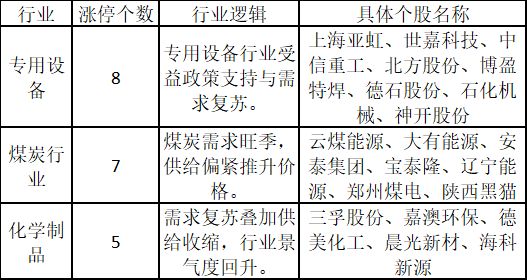
Market Overview and Sector Characteristics - The Shanghai Composite Index rose by 0.63%, with nearly 3,900 stocks increasing in value, and the median stock price change was an increase of 1.07% [1][3] - A total of 76 stocks hit the daily limit up, an increase of 39 from the previous day, while only 2 stocks hit the limit down, a decrease of 20 [3] - The leading sectors for limit-up stocks included specialized equipment, coal, and chemical products, indicating a shift in market focus from technology to traditional energy sectors [4][5] Sector and Concept Analysis - The coal sector saw 12 stocks limit up, driven by seasonal demand and tight supply pushing prices higher [5] - The natural gas sector had 7 stocks limit up, influenced by winter heating demand and low inventory levels [6] - The consumer sector had 6 stocks limit up, supported by policy boosts and holiday economic activity [6] Notable Stocks - Three stocks reached historical highs: Hengsheng Energy (30.03 CNY), Sanlian Forging (25.97 CNY), and Fashilong (59.74 CNY) [7] - 26 stocks reached near one-year highs, including Sanfu Co., YD Holdings, and Daya Energy, indicating significant upward momentum [8] Main Capital Inflows - The top five stocks by net capital inflow included Innovation Medical (5.45 million CNY), Qingshan Paper (4.32 million CNY), and Cambridge Technology (4.23 million CNY) [9] - The top five stocks by net capital inflow as a percentage of market value included Tengda Technology (8.37%), Feiwo Technology (7.07%), and Huifeng Diamond (6.12%) [10] Limit-Up Stock Characteristics - The stocks with the highest limit-up capital included Pioneer Electronics (4.29 million CNY) and Chaoxun Communication (2.99 million CNY) [11] - There were 66 first-time limit-up stocks today, with 5 stocks achieving two consecutive limit-ups and another 5 stocks achieving three or more consecutive limit-ups, indicating strong market interest [12]


9月物价数据解读:CPI边际改善,PPI延续回升
Yin He Zheng Quan· 2025-10-15 09:46
Group 1: CPI Analysis - In September, CPI increased by 0.1% month-on-month, with a year-on-year decline narrowing from 0.4% to 0.3%[1] - Food prices rose by 0.7% month-on-month, while year-on-year they decreased by 4.4%, contributing approximately 0.83 percentage points to the CPI decline[1] - Core CPI remained flat month-on-month and increased by 1.0% year-on-year, marking the fifth consecutive month of growth[1] Group 2: PPI Analysis - In September, PPI remained flat month-on-month and the year-on-year decline narrowed to -2.3% from -2.9%[2] - Production demand improved, supporting price increases in some energy and raw material sectors[2] - The coal processing price rose by 3.8% month-on-month, while the prices for coal mining and washing increased by 2.5%[2] Group 3: Market Outlook - The improvement in CPI may continue into October due to tailwind factors, with a focus on the progress of pig production capacity reduction[2] - The real estate market remains weak, with property sales area and sales value down 4.7% and 7.3% year-on-year, respectively[2] - M1 growth has been rising, which is expected to support PPI improvement, although the overall PPI is unlikely to turn positive this year[2]
9月3日券商今日金股:14份研报力推一股(名单)
Zheng Quan Zhi Xing· 2025-09-03 08:28
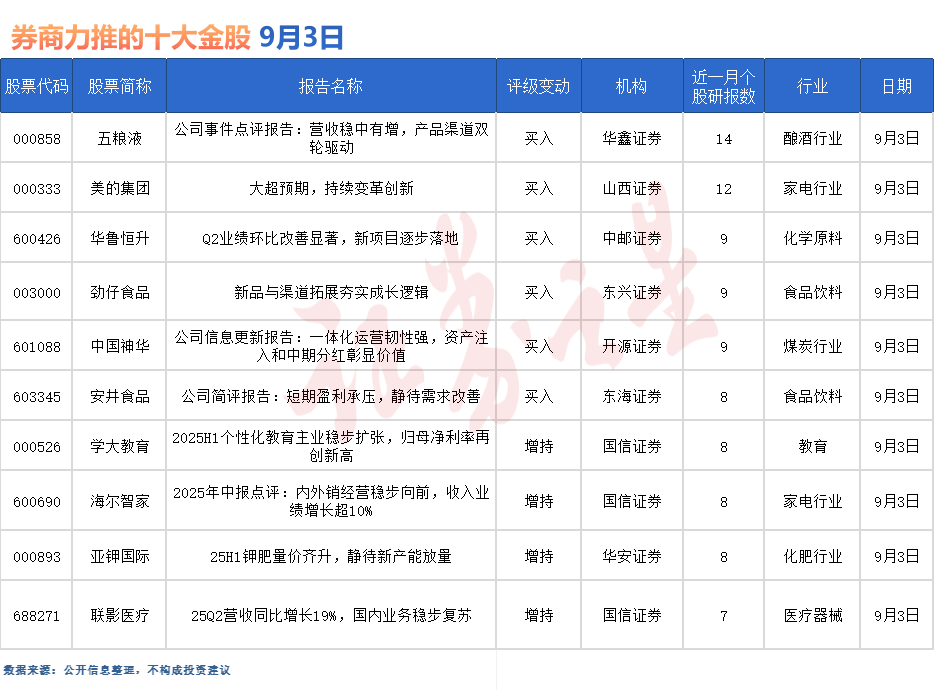
Core Viewpoint - On September 3, securities firms issued "buy" ratings for nearly 150 A-share listed companies, focusing on industries such as liquor, home appliances, chemical raw materials, food and beverage, coal, and education [1] Group 1: Top Recommended Stocks - Wuliangye (000858) received 14 research reports from various securities firms, making it the most recommended stock on September 3, with a report highlighting stable revenue growth and a dual-channel strategy [2][3] - Midea Group (000333) was the second most recommended stock, with 12 reports emphasizing strong performance and ongoing innovation, projecting EPS of 6.09, 6.86, and 7.73 for 2025-2027 [2][3] - Hualu Hengsheng (600426) ranked third with 9 reports, noting significant improvement in Q2 performance and the gradual rollout of new projects [2][4] Group 2: Industry Insights - The liquor industry, represented by Wuliangye, is seeing a recovery in channel confidence and a commitment to maintaining pricing strategies, which is expected to enhance brand value [3] - The home appliance sector, led by Midea Group, is characterized by strong growth resilience and low valuation, making it an attractive investment opportunity [3] - The food and beverage industry, including companies like Jinzai Food and Anjuke Food, is also under the spotlight, with expectations for demand recovery and profitability improvements [4]



券商今日金股:14份研报力推一股(名单)
Zheng Quan Zhi Xing· 2025-09-03 08:21
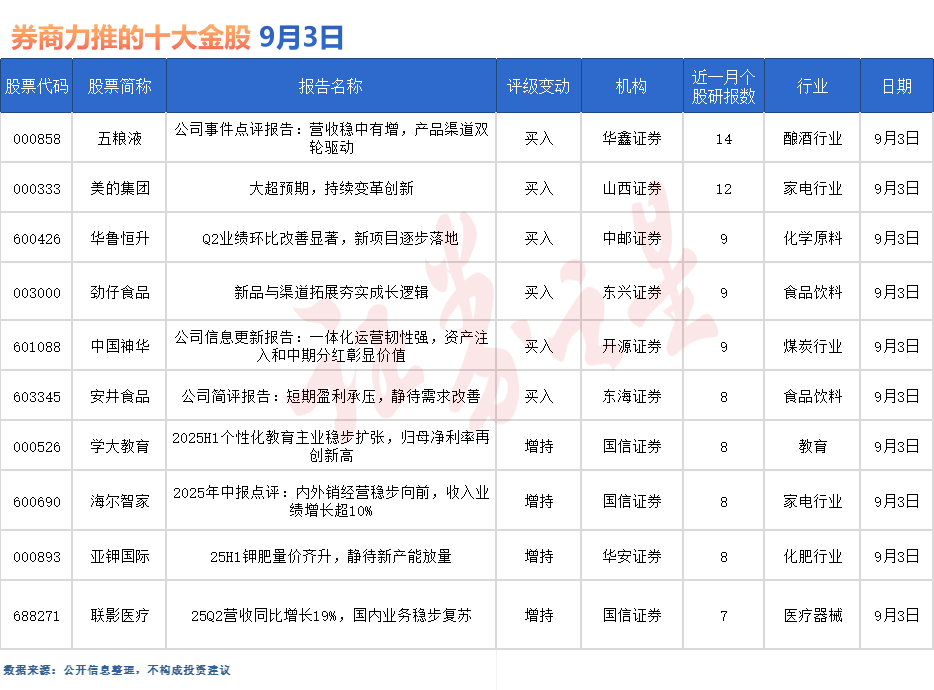
Core Viewpoint - On September 3, securities firms issued "buy" ratings for nearly 150 A-share listed companies, focusing on industries such as liquor, home appliances, chemical raw materials, food and beverage, coal, and education [1] Group 1: Company Ratings and Reports - Wuliangye (000858) received significant attention from brokers, with 14 reports in the past month, ranking first among stocks recommended by brokers on September 3 [2][3] - Midea Group (000333) was also highly regarded, with 12 reports in the past month, placing it second on the broker recommendation list [3] - Hualu Hensheng (600426) ranked third, receiving 9 reports from various brokers in the last month [4] Group 2: Earnings Projections - Wuliangye's EPS estimates for 2025-2027 are projected to be 8.29, 8.65, and 9.13 yuan, with corresponding PE ratios of 16, 15, and 14 times [3] - Midea Group's EPS estimates for 2025-2027 are projected to be 6.09, 6.86, and 7.73 yuan, with PE ratios of 12.5, 11.1, and 9.9 times based on the closing price of 76.16 yuan on September 2 [3] - Hualu Hensheng's report highlighted significant improvement in Q2 performance and the gradual rollout of new projects, indicating potential for further earnings growth [4] Group 3: Industry Focus - The industries attracting broker attention include liquor, home appliances, chemical raw materials, food and beverage, coal, and education, indicating a diverse range of investment opportunities [1] - The reports suggest a focus on companies with strong growth potential and resilience in their respective sectors, such as Midea Group's innovation and Wuliangye's brand value recovery [3][4]
NIFD季报:国内宏观经济
Guo Jia Jin Rong Yu Fa Zhan Shi Yan Shi· 2025-08-22 08:22
Global Economic Trends - Global economic growth is expected to be 2.8% in 2025, which is 0.4 percentage points lower than the average growth rate from 2010 to 2019[14] - The World Bank predicts a global economic growth of only 2.3% in 2025, down from earlier forecasts[15] - International trade growth is anticipated to decline, with a projected decrease of 0.2% in global merchandise trade volume in 2025[16] China's Economic Outlook - China's GDP is projected to grow by approximately 4.7% in the second half of 2025, with a nominal GDP growth of 4.3% in the first half[27][28] - The Consumer Price Index (CPI) may turn negative in the second half of 2025, while the Producer Price Index (PPI) is expected to decline by around 3.0% for the year[30] - The unemployment rate for urban areas averaged 5.2% in the first half of 2025, reflecting a slight increase from the previous year[27] A-Share Market Performance - A-share companies' overall market value creation ability decreased by nearly 40 basis points in 2024 compared to 2023[40] - The performance of A-share companies is increasingly diverging from nominal GDP growth, particularly in the manufacturing sector[40] - The return on assets (ROA) and return on equity (ROE) for A-share companies continued to decline in 2024[40] Sector-Specific Insights - The first industry saw a significant recovery in asset returns due to rising pork prices, while the second and third industries experienced declines[10] - R&D investment in some sectors continued to rise in 2024, although some industries began to see a decrease[10] - The manufacturing sector is facing severe "involution" competition, impacting profitability and pricing power[30]
港股收评:恒指跌0.37%,“反内卷”板块陷低迷,内险股全天强势
Ge Long Hui· 2025-08-14 08:54
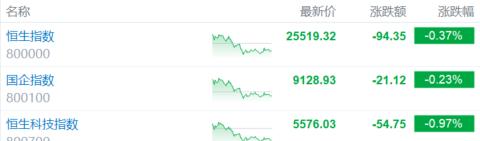
Market Overview - The Hong Kong stock market experienced a high open but closed lower, failing to maintain the previous day's strong performance. The Hang Seng Index fell by 0.37% to 25,519.32, while the Hang Seng Tech Index and the National Enterprises Index dropped by 0.97% and 0.23%, respectively [1][2]. Sector Performance - Major technology stocks mostly turned from gains to losses, with notable declines in NetEase (-3.53%), JD.com (-1.81%), Alibaba (-1.54%), and Xiaomi (-0.09%). Tencent, however, saw a slight increase of 0.68% after reporting better-than-expected Q2 earnings [4][5]. - Steel stocks experienced significant declines, with Angang Steel falling over 5% and Chongqing Steel down over 3%. Analysts suggest that the steel industry's outlook may improve from Q3 2024 to H1 2025 due to self-initiated production cuts [6][7]. - Coal stocks also faced downward pressure, with Jinma Energy dropping over 7% and Yanzhou Coal down over 4%. Analysts recommend focusing on the implementation of "anti-involution" policies that may drive supply reductions in the coal sector [7]. - Apple-related stocks declined, with BYD Electronics and Sunny Optical Technology both falling over 5%. Reports indicate that Apple plans to re-enter the AI space with new devices [8]. - The biopharmaceutical sector showed strength, with Rongchang Biologics rising over 14% and Junshi Biosciences up over 5%. Analysts note a recovery trend in the investment and financing landscape [9]. - The financial sector saw gains, particularly in insurance stocks, with Sunshine Insurance up over 7%. Analysts believe the insurance industry is moving towards high-quality development despite challenges [10]. Capital Flows - Southbound funds recorded a net inflow of HKD 1.034 billion, with the Shanghai-Hong Kong Stock Connect seeing a net buy of HKD 1.645 billion and the Shenzhen-Hong Kong Stock Connect a net sell of HKD 611 million [12]. Future Outlook - Analysts expect the market to shift from liquidity-driven to performance-driven and policy-verification phases. Stocks with better-than-expected earnings and upward guidance are likely to benefit [12]. - Recommended sectors for investment include those directly benefiting from the implementation of "anti-involution" policies, such as solar energy, rare earths, lithium, and express delivery, as well as pharmaceuticals and technology with high growth potential [13].
红利资产持续大热 能源、周期分红较多
Di Yi Cai Jing· 2025-08-13 13:51
Core Viewpoint - High dividend assets have become a focal point for funds amid market sentiment and policy resonance, with A-shares experiencing a surge in mid-year dividend announcements, reflecting a growing "cash return" ecosystem in the market [1][2]. Group 1: Market Performance and Trends - As of August 13, the Shanghai Composite Index surpassed 3674.4 points, reaching a nearly four-year high, driven by robust mid-year earnings reports and significant dividend announcements from listed companies [1]. - Approximately 50 listed companies have disclosed mid-year dividend plans, with 46 companies proposing cash dividends totaling over 720 billion yuan [1][3]. - The demand for stable returns has increased among investors, making high-dividend stocks more attractive in a low-interest-rate environment [1][2]. Group 2: Dividend Asset Characteristics - High dividend assets are viewed as a "safe haven" due to their stable cash flow and low valuation characteristics, with the Hang Seng High Dividend Low Volatility Index rising by 0.35% as of August 13 [2]. - The net inflow for the Dividend Low Volatility ETF exceeded 8 billion yuan by the end of July, indicating strong investor interest in dividend products [3]. - The total dividend scale for 2024 is projected to reach 2.4 trillion yuan, a 9% increase from 2023, reflecting a trend of increased dividend payouts among listed companies [3][7]. Group 3: Sector-Specific Dividend Insights - Different sectors exhibit varying dividend distributions, with energy and cyclical industry leaders dominating the large dividend payouts [5][6]. - Notable companies such as CATL and Oriental Yuhong have announced substantial cash dividends, with total proposed payouts reaching 45.68 billion yuan and 22.1 billion yuan, respectively [5]. - The banking sector remains a significant contributor to dividends, with A-share listed banks expected to distribute over 630 billion yuan in dividends for 2024 [7]. Group 4: Investment Strategy and Outlook - The current market recovery, driven by economic revival, suggests that cyclical manufacturing dividend assets warrant close attention, alongside consumer, banking, and public utility dividend assets [3][9]. - Analysts recommend constructing a defensive portfolio with high dividend energy and financial stocks while also considering growth opportunities in technology sectors [7][10]. - Despite the recent market uptrend, the valuation of dividend assets remains relatively low compared to the overall market, indicating potential for further appreciation [10].