科技行业

Search documents
今年北京将重点查处平台经济领域垄断行为
Bei Jing Shang Bao· 2026-02-07 11:48
Core Insights - Beijing's market regulatory meeting announced that by the end of 2025, the number of business entities in Beijing is expected to reach 2.8697 million, representing a year-on-year growth of 6.83%, with over 40% being technology-based enterprises [1] - The city will focus on investigating monopolistic behaviors in public utilities and platform economy sectors, while also addressing issues such as counterfeit goods, false advertising, predatory pricing, and illegal advertisements to foster a competitive market environment [1] - Additionally, new measures will be developed this year to promote high-quality development in the innovative pharmaceutical sector, and there will be a further deepening of the comprehensive regulation of "involution" competition among accommodation and catering platform enterprises [1]
美股道指首次突破50000点
Xin Lang Cai Jing· 2026-02-07 01:11
Group 1 - The US stock market indices closed higher on February 6, with the Dow Jones Industrial Average surpassing the 50,000 points mark for the first time, closing at 50,115.67 points, up 1,206.95 points or 2.47% [1] - The Nasdaq Composite Index rose by 490.63 points, closing at 23,031.21 points, a gain of 2.18%, while the S&P 500 increased by 133.90 points to close at 6,932.30 points, up 1.97% [1] - Many technology stocks rebounded after a period of significant sell-off, with Nvidia rising by 7.87%, Tesla by 3.50%, and Microsoft by 1.90%, although companies like Amazon and Google continued to see declines due to concerns over their substantial investments in AI [1] Group 2 - Analysts suggest that the recent adjustment in the US stock market can be viewed as a "bubble deflation," indicating that the market has adapted to higher interest rates and slower economic growth [2] - The future performance of the US stock market is expected to rely more on fundamentals, particularly in 2026, as uncertainties in global factors persist [2] - Investors are advised to monitor risks if technology stocks experience significant pullbacks in the coming weeks [2]
道指首破5万点创历史新高 分析师:市场已适应全球不确定性 投资者信心真实存在
智通财经网· 2026-02-06 23:49
Group 1 - The Dow Jones Industrial Average (DJIA) surged over 1200 points, approximately 2.5%, closing at a historic high of 50,115.67 points, marking the fastest completion of a 10,000-point increase from 40,000 to 50,000 since May 2024 [1] - The upward trend in the DJIA has shifted from a focus on technology stocks to a broader range of sectors, benefiting traditional industries and defensive sectors, with notable performances from Goldman Sachs, Caterpillar, Amgen, and Sherwin-Williams [1] - The strong corporate earnings, resilient U.S. economy, and the Federal Reserve's interest rate cuts last year have collectively driven the overall market higher [1] Group 2 - Gina Bolvin, President of Bolvin Wealth Management Group, indicated that the DJIA's breakthrough of 50,000 is more of a confirmation than a celebration, reflecting investor confidence amidst higher interest rates and global uncertainties [2] - Healthcare stocks, particularly Johnson & Johnson and Merck, have shown resilience, ranking as the second and fifth best-performing components of the DJIA over the past 12 months [2] - Investors are increasing allocations to high-dividend and defensive consumer staples stocks, with Coca-Cola and Walmart being among the top gainers in the DJIA over the past year [2] - Despite the market's broadening focus, technology and AI sectors remain strong, with Nvidia's stock rising approximately 44% over the past year, making it the third-largest gainer in the DJIA [2]



资金加仓!这一方向显著吸金
Zhong Guo Zheng Quan Bao· 2026-02-06 13:16
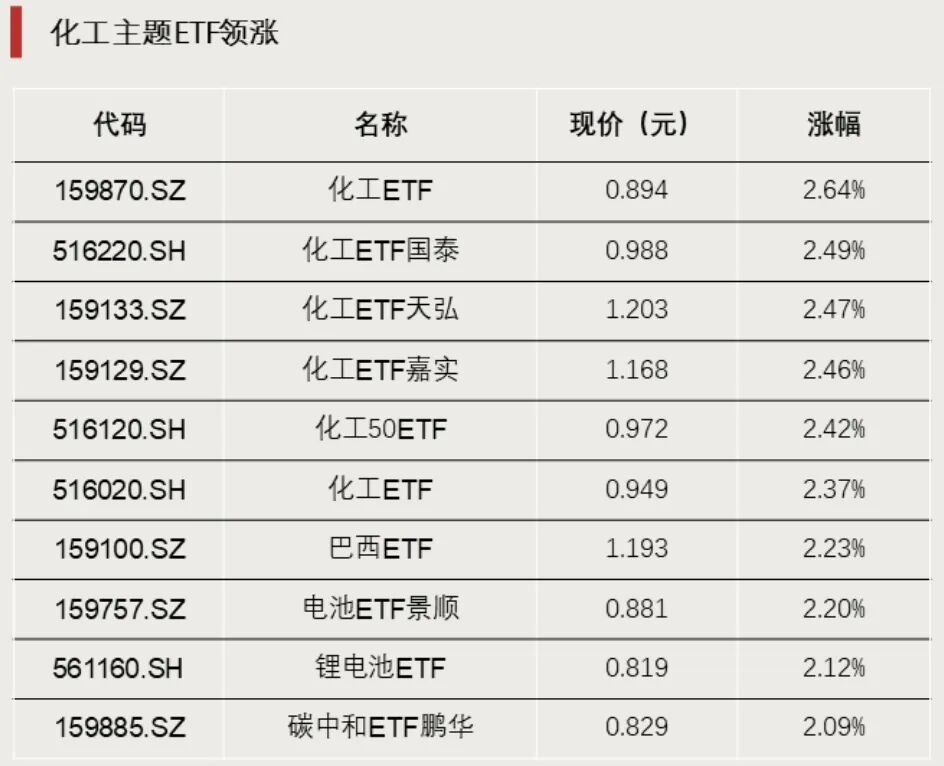
Group 1: Chemical Sector Performance - On February 6, the A-share chemical sector experienced a strong rally, with multiple sub-sectors such as chemical fibers, chemical products, chemical raw materials, and petrochemicals showing significant gains, leading to several chemical-themed ETFs rising over 2% [2][4] - The chemical ETF performance included notable increases: Chemical ETF (159870.SZ) rose by 2.64%, Chemical ETF Guotai (516220.SH) by 2.49%, and Chemical ETF Tianhong (159133.SZ) by 2.47% [3] - Analysts from Zhongyuan Securities noted a significant recovery in chemical prices in January, with liquid chlorine, acetonitrile, and butadiene performing well, suggesting that supply constraints in the chemical industry may strengthen in the future [3] Group 2: New Energy and Battery Sector - The new energy and battery sectors saw strong performance, with several related ETFs actively rising, including the Science and Innovation New Energy ETF and Battery ETF Jiashi, both nearing a 2% increase [4][5] - The Science and Innovation New Energy ETF (588830.SH) increased by 1.99%, while the Battery ETF Jiashi (562880.SH) rose by 1.96% [5] Group 3: ETF Market Trends - The ETF market has seen significant inflows, particularly in technology-themed ETFs, with the top ten products by net inflow mostly being technology-related [8] - The Huatai-PB Hang Seng Technology ETF recorded a net inflow of over 3.1 billion yuan, while other technology ETFs also saw substantial inflows exceeding 2 billion yuan [9] Group 4: A500 Index and Investment Value - The A500 index, represented by the A500 ETF (563800), has shown significant investment value due to its balanced industry distribution and focus on leading companies, making it attractive for long-term investment [10] - Analysts from GF Fund highlighted the index's advantages, including its ability to effectively capture growth opportunities while mitigating risks associated with single industries [10]

摩根大通刘鸣镝:2026年中国资产吸引力凸显 关注价值及预期洼地
Zhong Guo Jing Ying Bao· 2026-02-06 10:55
Core Viewpoint - The Chinese stock market is expected to see improved foreign investment allocation in 2026, driven by reasonable valuations, a stable currency, and strong innovation capabilities in AI and other fields [1][2]. Group 1: Market Positioning and Fund Allocation - Despite global active funds being underweight in China, there has been a marginal improvement in allocation, particularly among global and Asia-Pacific funds [2]. - As of December 2025, the allocation of Chinese stocks in global (including U.S.) active equity funds is approximately 3.1%, while it is 9% in Asia-Pacific excluding Japan, 29% in emerging market funds, and 32.7% in Asia excluding Japan [2]. - The underweight position in Chinese stocks for global (including U.S.) active equity funds is 1.8%, and for Asia-Pacific excluding Japan, it is 2.4% [2]. Group 2: Valuation and Performance Expectations - The MSCI China index is currently valued at a price-to-earnings (P/E) ratio of 12.5, which is relatively reasonable compared to the MSCI Asia-Pacific and Asia excluding Japan, which have P/E ratios of 15.3 and 13.9, respectively [3]. - The expected earnings growth for the MSCI China index is 12.3% this year, with the CSI 300 expected to grow by 18%, suggesting potential benchmark targets of 100 and 5200 for these indices [3]. Group 3: Real Estate and Consumer Market Insights - The ratio of residential property value to GDP in China is 1.8 times as of the end of 2025, lower than the historical median of 2 times since 1998, indicating room for stabilization in the real estate market [3]. - The cost of purchasing homes has significantly decreased compared to 2021, and there are signs of policy easing in first-tier cities that could stabilize property prices and boost consumer spending [3]. - China's household consumption market is valued at $7 trillion, with a decrease in household debt to GDP ratio from 62% in 2021 to 59.4% by the end of 2025, indicating a healthier financial environment for consumers [4]. Group 4: Investment Opportunities in Key Sectors - Key investment sectors identified include technology, consumer goods, and exports, with a focus on AI and its ongoing growth potential [5]. - The essential consumer sector is noted for its low valuations compared to markets in the U.S., Japan, and India, with a focus on the food and beverage industry, which is seen as undervalued and having room for innovation [5]. - Other themes to watch in 2026 include export stocks, the impact of reducing excessive competition on profitability, and AI infrastructure developments that have not yet been fully priced in [5].

专访瑞银卡普顿:股票或是最值得配置的资产
21世纪经济报道· 2026-02-06 08:08
记者丨 李依农 技术将对经济产生变革性影响 编辑丨李莹亮 和佳 2026年伊始,全球经济正回归长期潜在增长轨道,信贷逐步修复,市场信心边际回升。瑞银全 球经济和策略研究主管卡普顿(Arend Kapteyn)在接受南方财经记者专访时表示,在利差收 窄、汇率波动有限且市场流动性充足的背景下,股票仍是最具优势的资产类别,美股今年预计 可涨约10%,欧洲与日本市场也有望录得约8%的涨幅。 他对中国经济保持乐观:新兴经济部门已贡献约四分之一的增长,是推动整体经济的重要动 力。他建议投资者在新兴市场中重点关注中国与巴西,这不仅可获取AI相关敞口,也兼顾估值 与盈利增长优势。 同时,他提醒,投资者仍需关注美国潜在的财政刺激、劳动力市场结构性风险以及整体不确定 性,这些因素可能成为全球市场的主要风险;相比之下,地缘政治因素虽然难以预测,但对金 融市场的直接冲击或相对有限。 卡普顿。资料图 中国在全球新经济领域领先 南方财经: 我们把目光转向中国。怎么看中国经济前景?未来推动经济增长的主要动 力会来自哪些方面? 卡普顿: 现在还处在年初阶段,我们的预测通常还会经历多次调整。 我们认为,新兴经济部门对整体经济增长的贡献,已经接 ...

A股超3800股上涨,化工锂电爆发,港股科技股下挫,茶饮股走强
2 1 Shi Ji Jing Ji Bao Dao· 2026-02-06 04:10
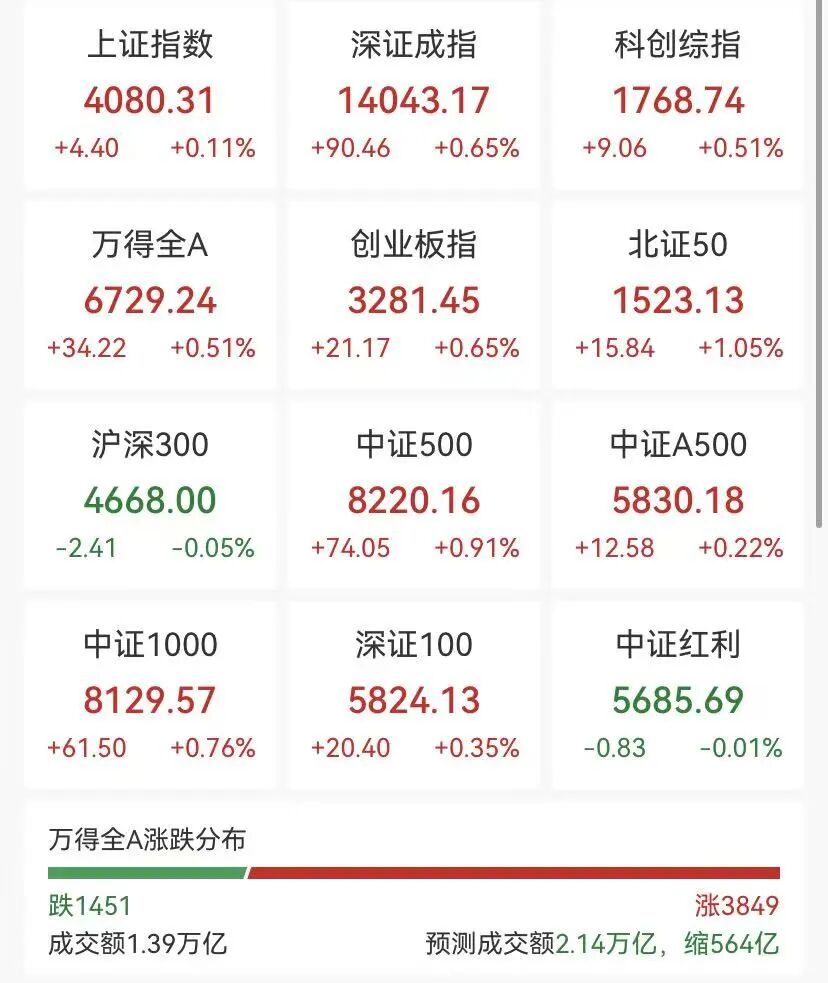
Market Overview - The Shanghai Composite Index closed at 4080.31, up 0.11%, while the Shenzhen Component Index rose by 0.65% to 14043.17 [1] - The total trading volume reached 1.39 trillion yuan, with a predicted volume of 2.14 trillion yuan, down by 56.4 billion yuan [1] Pharmaceutical Sector - The traditional Chinese medicine sector saw significant gains, with Hansoh Pharmaceutical hitting the daily limit, and Zhen Dong Pharmaceutical and Bioventure rising over 10% [1] - The Ministry of Industry and Information Technology, along with eight other departments, released a plan for the high-quality development of the traditional Chinese medicine industry, aiming to cultivate 10 major products and promote the approval of innovative drugs [1] Chemical Sector - The chemical sector experienced a surge, with stocks like Jangtian Chemical and Wanrun New Energy hitting the daily limit, and several others rising over 10% [2] - Lithium battery electrolyte stocks also saw substantial increases, with companies like Shanshan and Tianji shares reaching the daily limit, and others gaining over 5% [2] Consumer Sector - The consumer sector faced a collective decline, particularly in the liquor and tourism industries, with Huangtai Liquor hitting the daily limit and Guizhou Moutai dropping over 2.6% [4] - Reports of issues with the iMoutai purchasing page contributed to the decline in Moutai's stock [4] Gold and Silver Market - The precious metals sector rebounded after a significant drop, with spot gold rising back above $4800 and silver recovering to $71 per ounce [3] A-Share Market Outlook - Analysts predict that the A-share market may reach new highs this year, driven by factors such as a potential interest rate cut by the Federal Reserve and a strengthening of the RMB [6] - The report emphasizes that market movements may not always align with economic growth, highlighting liquidity as a key driver of market changes [6] Hong Kong Market - The Hong Kong stock market saw a significant drop, with the Hang Seng Index falling over 1.2% and major tech stocks like Alibaba and JD Health declining by more than 3% [8] - Despite the overall decline, tea beverage stocks showed strength, with several companies experiencing gains [9]


美国1月裁员创17年同期新高!降息预期再度升温,3月会转向吗?
Sou Hu Cai Jing· 2026-02-05 15:34
Labor Market Conditions - The U.S. labor market is showing significant signs of weakness, with January layoffs reaching 108,435, a year-on-year increase of 117.8%, marking the highest level for January since the 2009 financial crisis [1][3] - The Challenger report indicates that the number of new job postings in January fell to 5,306, a decline of 13% year-on-year, representing the worst January data since records began in 2009 [1][3] Industry-Specific Layoffs - The transportation sector experienced the highest layoffs, totaling 31,243, primarily due to UPS announcing a layoff of 30,000 employees after ending its partnership with Amazon [3] - The technology sector followed with 22,291 layoffs, including 16,000 from Amazon as part of a management restructuring [3] - The healthcare sector saw 17,107 layoffs, the highest monthly figure since April 2020, driven by inflation, high labor costs, and reduced reimbursement rates [3] Economic Outlook and Policy Implications - The increase in layoffs and initial jobless claims, which rose to 231,000, significantly above the expected 212,000, has led to market speculation regarding potential interest rate cuts by the Federal Reserve [4] - The market's expectations for maintaining interest rates in March decreased from 90.1% to 84.2%, while the probability of a 25 basis point rate cut increased to 15.8% [4] - Internal divisions within the Federal Reserve are evident, with some members advocating for more aggressive rate cuts, while others express concerns about inflation and the need to maintain current rates [6]


南方基金旗下恒生科技ETF南方(520570)获资金逆势布局,机构:当前恒生科技指数具备较高安全边际和修复空间
Ge Long Hui· 2026-02-05 08:22
Group 1 - The Hang Seng Technology Index opened lower and fluctuated, dropping over 1.5% at one point, and closed down approximately 0.34% at 5349.48 points [1] - The Hang Seng Technology ETF (520570) experienced active trading with a transaction amount of about 115 million yuan and a turnover rate of approximately 4.41%, indicating intense market competition [1] - The ETF saw a net subscription of about 77.85 million yuan yesterday, ranking 17th out of 212 in net inflows among cross-border ETFs, with a cumulative net inflow of approximately 78.75 million yuan over the past five days, reflecting a strong long-term investment interest in the Hong Kong tech sector [1] Group 2 - Analysts believe that the current valuation of the Hong Kong tech sector is at a near five-year low, with the Hang Seng Technology Index showing a historical high in the yield gap compared to the ChiNext Index, indicating a high margin of safety [1] - The Hong Kong tech sector is positioned at the core of AI application and commercialization, with strong earnings growth certainty, supported by expectations of a stable yuan and a weak US dollar [1] - Southbound funds saw a net purchase of approximately 6.16 billion HKD on February 4, with significant net buying in tech giants like Tencent and Alibaba, and over 8 billion HKD on February 5, indicating a growing interest from mainland investors in Hong Kong tech assets [1]
美联储“鹰派赘婿”凯文·沃什上位:全球金融变局下的中国投资新逻辑
Sou Hu Cai Jing· 2026-02-05 01:55
Core Viewpoint - The nomination of Kevin Warsh as the next Federal Reserve Chairman by President Trump signals a potential major shift in global monetary policy, with immediate impacts on financial markets, including a significant drop in gold and silver prices [1][3]. Group 1: Kevin Warsh's Profile and Policy Stance - Kevin Warsh, at 55, has a background that includes being the youngest Federal Reserve Governor and has experience during the financial crisis, which shapes his policy approach [4]. - Warsh is characterized as a "hawkish inflationist" and "balance sheet hawk," criticizing the Fed's prolonged stimulus measures and advocating for a reduction in the balance sheet to control inflation [5]. Group 2: Global Market Implications - Warsh's potential policies may lead to a dual approach of "preemptive rate cuts and active balance sheet reduction," creating a complex liquidity environment globally [9][10]. - The dollar's status as a global reserve currency will be influenced by Warsh's policies, with short-term rate cuts possibly weakening the dollar, while long-term balance sheet reductions may support its value [11]. Group 3: Impact on China - China may face short-term pressures from capital flows and currency fluctuations due to reduced dollar liquidity, but long-term opportunities may arise from a weaker dollar strategy that enhances export competitiveness [14]. - The emphasis on AI and anti-inflation measures by Warsh aligns with China's strategic focus on new productive forces, potentially attracting global capital in sectors like AI and high-end manufacturing [14]. Group 4: Investment Strategies - In the primary market, investment strategies should focus on hard technology sectors, consumer upgrades, and cross-border opportunities, emphasizing risk management and long-term value [16][18]. - In the secondary market, a balanced approach of risk aversion and strategic positioning is recommended, with a focus on sectors benefiting from domestic policy support and potential interest rate changes [19][20].