财富管理

Search documents
美股前瞻02.11:AI“受害者”再遭抛售,降息预期提升难振风偏
East Money Securities· 2026-02-11 13:11
Market Overview - The US retail sales data for December remained flat month-on-month, falling short of the expected growth of 0.4%, indicating a gradual weakening in consumer spending as the holiday season comes to an end [1] - Following the data release, the market slightly increased the probability of three interest rate cuts within the year, with two already fully priced in, leading to a significant drop of 6 basis points in the 10-year US Treasury yield, reaching a near one-month low [1] - The overall market sentiment was cautious ahead of the non-farm payroll report, resulting in a mixed performance across major indices, with the Nasdaq down 0.59% and the Dow Jones up 0.10% [1] Core Insights - The launch of an AI-based tax planning tool by the technology platform Altruist has raised concerns about AI's impact on traditional wealth management, leading to a drop of over 7% in Charles Schwab's stock, mirroring previous sell-offs in the insurance brokerage and software sectors [3] - The narrative surrounding AI's potential to replace professional roles in legal research, data organization, financial analysis, and code collaboration may continue to trigger rotational sell-offs in the short term [3] - Despite a recent stabilization in software stocks after significant declines, the overall sector remains fragile, with capital rotating into materials and utilities, which are less affected by AI trading [3] - The focus of trading is shifting from beneficiaries of favorable conditions to victims of adverse impacts, with previously concentrated sectors like computing power, networking, and energy showing signs of stagnation [3] - Concerns regarding AI threats are nearing a peak, and the recent declines in certain sectors may reflect an overpricing of short-term AI impacts, suggesting potential opportunities to capture mispriced assets within the sector [3] - The upcoming non-farm payroll report is expected to show job growth in the range of 60,000 to 80,000, with a better-than-expected result potentially boosting market confidence and alleviating recent selling pressures [3]
AI“屠刀”砍向保险中介:巨头遭遇史诗级暴跌,传统模式进入死亡倒计时?
Xin Lang Cai Jing· 2026-02-11 12:42
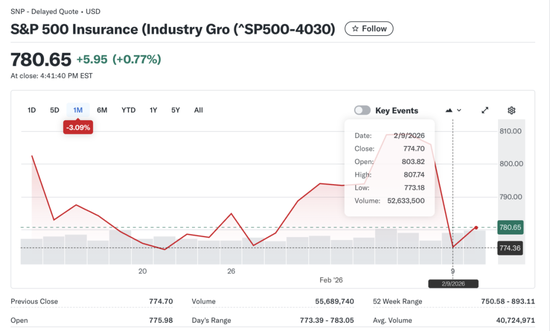
当地时间2月9日,美国标普500保险指数单日下挫超3%,创下2025年10月以来的最大跌幅,一众老牌保 险经纪巨头的股价纷纷暴跌,跌幅高达7-12%。 这场暴跌的导火索,是OpenAI批准了首批基于ChatGPT的保险应用。其中既包括美国在线保险平台 Insurify推出的车险比价应用,也包括西班牙保险公司Tuio的房屋保险报价工具。这也意味着,AI技术 正式切入保险分销的核心环节。 全球保险中介行业正遭遇AI的降维打击。 熊彼特曾说:"创造性破坏是经济发展的本质,但对于身处其中的个体和行业,破坏往往先于创造到 来。"对于保险中介行业而言,AI带来的冲击也意味着一场前所未有的生存挑战。 图片来源:Yahoo finance 01 AI利刃刺向保险中介,保险购买进入智能对话时代,全球保险经纪巨头估值暴跌 来源:慧保天下 资本市场中股价的短期波动本就受多重因素交织影响,但板块内一众龙头个股出现集体暴跌,背后必然 有直接且重磅的利空消息驱动。 此次全球保险经纪巨头股价集体重挫,其直接原因正是AI技术落地保险领域带来的去中介化冲击戳中 了传统保险中介行业的生存命脉。 2月9日,美国头部在线保险平台Insurify发布 ...

美股下一个“AI受害者”已经出现,市场正在提前定价!
美股研究社· 2026-02-11 11:06
Core Viewpoint - The article discusses the recent internal rotation in the U.S. stock market, highlighting a shift from a few large-cap stocks leading the market to a broader participation across various sectors, while also addressing the impact of AI on traditional business models and the resulting market volatility [5][7][8]. Market Performance - On Tuesday, the S&P 500 fell by approximately 0.3%, while the Dow Jones Industrial Average rose by about 0.1%, reaching a new historical high [5]. - The equal-weighted S&P index also reached a record high, indicating a shift in market dynamics with around 300 stocks in the S&P 500 rising [7]. Retail Sales Data - The U.S. Commerce Department reported that December retail sales were flat month-over-month, significantly below the expected 0.4% growth, indicating a slowdown in consumer spending [9]. - Core retail sales, excluding autos and gas, even showed a decline, reflecting weakened consumer spending momentum during the holiday season [9]. Interest Rate Expectations - The weak retail data led to a rise in U.S. Treasury prices and a decline in yields, with the futures market increasing the probability of three rate cuts within the year, with two already priced in [9]. - Historical trends suggest that rate cut expectations typically support risk assets, but the current market shows a divergence where rates are falling but stocks are not rising, particularly in the tech sector [11]. AI Impact on Market Sentiment - Market participants are shifting their interpretation of AI's impact from a growth narrative to concerns about short-term disruptions, leading to a "sell first, think later" mentality [12]. - Investors are moving from an "AI is a panacea" mindset to a more pragmatic "performance realization" phase, anticipating greater differentiation between winners and losers in the market [12]. Institutional Perspectives - There is a noticeable divergence in institutional views on the tech sector, with Goldman Sachs warning about the risks of overestimating AI's growth potential and emphasizing the need for actual earnings and cash flow improvements to support tech valuations [13]. - UBS downgraded its rating on the U.S. tech sector from "overweight" to "neutral," citing key risks while still acknowledging the long-term potential of AI [14]. Wealth Management Sector - The wealth management sector has come under scrutiny following the launch of an AI tool by Altruist Corp., which automates tasks traditionally reliant on human expertise, raising concerns about the core revenue models of wealth management firms [17][18]. - The market reacted sharply, with significant declines in stocks of major wealth management firms, indicating fears about the long-term competitive structure of the industry under AI pressure [19][21]. Broader Market Reactions - The sell-off in the market has been attributed to fears that AI tools could undermine the intermediary value of insurance brokers, leading to a significant drop in the insurance brokerage sector [22]. - The recent downturn in the software sector has seen substantial market capitalization losses, with estimates indicating a combined loss of approximately $611 billion across software, financial services, and asset management sectors [26]. Conclusion - The current market environment reflects a transition from viewing AI as a beneficiary narrative to recognizing potential victims, with traditional software companies facing heightened scrutiny and volatility [27]. - The article suggests that this phase serves as a valuation and business model stress test, prompting a reevaluation of which revenue models are based on irreplaceable value versus those reliant on information asymmetry [34].






美股财富管理类股掀抛售潮美企推出AI税务规划工具
Xin Lang Cai Jing· 2026-02-11 10:13
Core Insights - The launch of Altruist's AI tax planning tool has raised concerns within the financial industry, particularly regarding its potential to disrupt traditional wealth management services [1] - Following the announcement, wealth management stocks in the U.S. experienced significant declines, with Charles Schwab down over 7%, Raymond James down over 8%, and Morgan Stanley down over 2% [1] - Analysts suggest that the sell-off reflects a market reassessment of AI tools' ability to replace human advisory services in wealth management [1] Company Impact - Altruist's introduction of AI technology directly targets the core business of traditional wealth management firms [1] - The immediate market reaction indicates a loss of confidence in established financial institutions' ability to compete with emerging AI solutions [1] Industry Trends - The financial sector is witnessing a shift as AI tools are increasingly viewed as potential replacements for human advisors, prompting a reevaluation of business models in wealth management [1] - The sell-off in wealth management stocks may signal broader market concerns about the sustainability of traditional financial advisory roles in the face of technological advancements [1]

华尔街新交易逻辑:抛售处于AI冲击范围内的股票
Xin Lang Cai Jing· 2026-02-11 09:52
Core Viewpoint - Concerns about artificial intelligence (AI) are escalating on Wall Street, leading to significant sell-offs across various sectors, particularly in companies perceived to be at risk of disruption by AI technologies [1][14]. Group 1: Market Reactions - A recent sell-off was triggered by the launch of a tax strategy tool by Altruist Corp, resulting in stock price declines of over 7% for major financial firms like Charles Schwab and Raymond James [1][14]. - The sell-off extended to European wealth management firms, with companies like AJ Bell and St. James's Place experiencing simultaneous declines [1][14]. - This downturn is noted as one of the most significant since the market turmoil in April, reflecting a "sell first, ask questions later" mentality among investors [1][14]. Group 2: Investor Sentiment - Investors are shifting focus from identifying potential winners to avoiding any companies that exhibit even a slight risk of being replaced by AI [4][17]. - The narrative around AI has evolved from skepticism about its practical applications to a recognition of its disruptive potential, as evidenced by the rapid deployment of powerful AI tools [6][20]. - The market's reaction indicates a heightened sensitivity to negative news, with stock prices plummeting by 10% on minor adverse signals, a phenomenon unlikely to occur in markets with lower valuations [27]. Group 3: Industry Implications - The software industry has been particularly affected by AI-related anxieties, with fears spreading to other sectors such as finance, insurance, and legal services following the introduction of new AI tools [8][21]. - Altruist's CEO noted the unexpected market reaction, which resulted in the evaporation of billions in market value for several investment firms, highlighting the competitive threat posed by their new product [22][21]. - The architecture used to develop Altruist's tool is perceived as capable of replacing roles within the wealth management industry, suggesting a significant shift in operational dynamics [10][24]. Group 4: Future Outlook - Experts express uncertainty about the future impact of AI, with some suggesting that the actual disruption may occur more slowly than anticipated [25][26]. - The current market environment reflects a broader anxiety about the sustainability of high valuations driven by AI investments and the resilience of the U.S. economy [27][12]. - The ongoing developments in AI are still in their infancy, and making definitive predictions about their long-term effects remains challenging [13][12].
华夏理财发布首个品牌IP“玲珑”:以具象化叙事 开启“ 金融为民”新篇章
Zheng Quan Ri Bao Wang· 2026-02-11 09:49
今日,华夏理财有限责任公司(以下简称"华夏理财")正式发布其首个企业IP形象——"玲珑"。在当前 财富管理行业向着专业化、数字化、人性化演进的浪潮中,华夏理财此次发布不仅是一次品牌形象的焕 新,更是一次从"功能传达"到"价值共鸣"与"生态共创"的战略升级。 一、时代命题与战略应答:为何是"玲珑"? 当下,中国财富管理行业正历经一场深刻的范式转移。净值化转型重塑产品逻辑,数字化浪潮革新服务 模式,而伴随财富世代更迭与金融知识普及,客户的需求已从单纯的产品收益,日益延伸到情感认同与 长期陪伴。 在信息碎片化、注意力稀缺的数字生态中,一个专业的金融品牌如何穿透复杂术语的迷雾,真正抵达人 心,建立超越交易关系的信任与认同? 在此背景下,华夏理财的回应是:创造一个超越传统符号、兼具文化厚度与数字灵感的品牌价值化身。 这便是"玲珑"。 "玲珑"的构思,源于华夏理财对"金融为民"初心的深刻理解与品牌价值的自觉追寻。其名寓指"精巧于 心,通明于行",凝练了专业匠心与透明坦诚的待客之道。其形源于品牌核心图腾,根植华夏沃土,心 向璀璨未来。 据此,华夏理财为"玲珑"设定了清晰的战略角色:它被定义为客户财富旅程的长期陪伴者,以及公 ...
AI淘金热变成AI恐慌潮!华尔街新共识:躲开一切可能被颠覆的公司
华尔街见闻· 2026-02-11 09:15
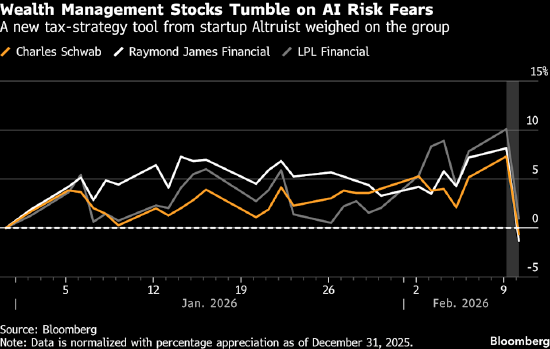
Core Viewpoint - The investment logic on Wall Street is undergoing a significant transformation, with investors rapidly selling stocks of companies that may be disrupted by AI, rather than focusing on identifying AI winners [3][4]. Group 1: Market Reactions - A recent sell-off was triggered by the launch of Altruist Corp.'s tax strategy tool, Hazel, which caused major wealth management companies like Charles Schwab and Raymond James Financial to see stock declines of over 7%, marking the largest drop since the market crash in April [4]. - The panic began when Anthropic introduced a new tool, leading to a deep correction across software, financial services, asset management, and legal services sectors [5][7]. - The insurance brokerage industry was also affected, with stocks plummeting after Insurify launched a ChatGPT-based application for comparing auto insurance rates [7]. Group 2: Industry Impact - Altruist's Hazel tool highlights the market's deep anxiety regarding AI's potential to disrupt traditional financial services, as it can perform tasks that typically require an entire team for just $100 a month [6][7]. - The fear of AI disruption has spread from the software industry to broader sectors, indicating a significant shift in market sentiment [5][7]. Group 3: Diverging Opinions - Despite the prevailing panic, some market participants question the speed and extent of AI disruption, suggesting that technological upheaval often takes longer than anticipated [10][11]. - Concerns about AI's impact on various industries may be premature, as the market is still in the early stages of understanding AI's long-term implications [12]. Group 4: Market Sensitivity - The current sell-off reflects a general anxiety over high valuations in the market, which have been driven by a surge in AI spending and unexpected economic resilience [13]. - In a highly sensitive market environment, even minor negative signals can lead to significant stock declines, as investors prefer to err on the side of caution regarding potential AI disruptions [13].


华尔街新交易策略:抛售处于AI冲击范围内的股票
Xin Lang Cai Jing· 2026-02-11 09:08
Core Viewpoint - Concerns about artificial intelligence (AI) are escalating on Wall Street, leading to significant stock sell-offs across various companies, from small software firms to large wealth management firms [1][3][9]. Group 1: Market Reactions - A recent sell-off was triggered by the launch of a tax planning tool by the startup Altruist, causing stocks of companies like Charles Schwab, Raymond James Financial, and LPL Financial Holdings to drop by 7% or more [1][4]. - The sell-off extended to Europe, impacting wealth management companies such as AJ Bell, Brewin Dolphin, and St. James's Place [1][3]. - This decline is noted as one of the most severe since the market downturn in April due to trade tensions, reflecting a "sell first, ask questions later" mentality among investors [1][7]. Group 2: Industry Impact - The software industry has been particularly affected, with companies like Dassault Systemes experiencing a 20% drop in stock price following disappointing earnings reports [3][9]. - The introduction of AI tools by companies like Anthropic has led to widespread declines in stocks across software, financial services, asset management, and legal services sectors [3][9]. - The insurance sector also faced significant stock declines after Insurify launched a new application utilizing ChatGPT for comparing auto insurance rates [4][10]. Group 3: Investor Sentiment - Investors are shifting from selecting potential winners in the AI space to avoiding any companies perceived to be at risk of being replaced by AI technologies [3][9]. - The CEO of Graniteshares expressed uncertainty about future developments, indicating a shift in sentiment from optimism about AI to fear of its disruptive potential [3][9]. - Concerns about the sustainability of stock valuations have intensified, with market participants reacting sharply to any negative signals [11].
AI淘金热变成AI恐慌潮!华尔街新共识:躲开一切可能被颠覆的公司
硬AI· 2026-02-11 08:40
Core Viewpoint - Investors are shifting from seeking AI winners to rapidly selling stocks of companies that may be disrupted by AI, leading to a panic selling mentality across various sectors, including software, financial services, wealth management, insurance brokerage, and legal services [2][3]. Group 1: Market Reaction to AI Disruption - The latest wave of selling was triggered by the launch of a tax strategy tool, Hazel, by Altruist Corp., which caused significant stock price drops of over 7% for wealth management firms like Charles Schwab, Raymond James Financial Inc., and LPL Financial Holdings Inc., marking the largest decline since the market crash in April [3][5]. - The panic began when Anthropic introduced a new tool that led to a deep correction in software, financial services, asset management, and legal services sectors, indicating a turning point in market sentiment [6][8]. - The insurance brokerage sector was also heavily impacted after Insurify launched a new application using ChatGPT to compare auto insurance rates, resulting in substantial stock losses for U.S. insurance brokers [6][8]. Group 2: Concerns Over AI's Impact - The introduction of AI tools like Hazel highlights deep-seated anxieties about AI disrupting traditional financial services, as these tools can perform tasks that typically require entire teams, with costs as low as $100 per month [5][6]. - Market participants are increasingly concerned that any intermediary services that could be replaced by AI face existential threats, leading to widespread selling [6][8]. Group 3: Diverging Market Opinions - Despite the prevailing panic, some market analysts express skepticism about the speed and extent of AI disruption, suggesting that technological upheaval often takes longer to materialize than anticipated [8]. - Historical context indicates that industries like banking have faced challenges from emerging technologies, such as cryptocurrencies and electronic services, but these have not significantly undermined their dominance [8]. Group 4: Market Sensitivity and Valuation Concerns - The current sell-off reflects broader anxieties regarding elevated stock valuations, which have been pushed up by a surge in AI spending and unexpected economic resilience in the U.S., making investors highly sensitive to negative signals [10]. - In a tense market environment, even minor product launches from small startups can lead to significant volatility in large public companies, as investors prefer to err on the side of caution regarding potential AI disruptions [10].

“AI颠覆”忧虑再蔓延!华尔街年初热门交易全军覆没,市场怎么了?
Di Yi Cai Jing Zi Xun· 2026-02-11 07:41
Core Viewpoint - The recent concerns regarding AI's potential to disrupt various industries have led to significant sell-offs in the stock market, particularly affecting software and wealth management stocks, as investors reassess the implications of AI advancements on traditional business models [1][3][6]. Group 1: Market Reactions - The sell-off was triggered by the launch of Altruist's new tool, Hazel, which aims to automate financial advisory services, raising fears about the efficiency of wealth management firms [3][4]. - Major wealth management firms experienced substantial declines, with Raymond James Financial down 8.8%, Charles Schwab down 7.4%, and LPL Financial down 8.3%, marking their largest single-day drops since April [3][4]. - The S&P 500 insurance index fell 3.9% on September 9, the largest single-day drop since October of the previous year, due to similar concerns in the insurance sector [3]. Group 2: AI Investment Trends - Analysts suggest a shift in AI investment focus from "AI enablers," which build the necessary infrastructure, to "AI beneficiaries," which are companies that will benefit from increased productivity and efficiency through AI [5]. - There is a belief that while AI may not completely disrupt certain industries, it will significantly enhance productivity and profitability in sectors that seem unrelated to AI [5]. Group 3: Broader Market Context - The overall market has seen a significant downturn, with the Nasdaq index down 1.8% for the week and the S&P 500 software and services index down nearly 8%, marking its worst weekly performance since March 2020 [6][7]. - The market's volatility is attributed to a combination of factors, including concerns over AI's impact, potential changes in Federal Reserve leadership, and high valuations in various asset classes [7][8]. - Despite the recent sell-off, some analysts view the market's reaction as an overreaction, suggesting that the fundamentals remain strong and that the current adjustments may set the stage for future growth [7][8].