造船

Search documents
◆中远海运开通常态化跨四国汽配联运通道◆天津港与中远海特华北分部首单“重进重出”业务落地
Xin Lang Cai Jing· 2026-02-06 11:25
Group 1: Logistics and Shipping Developments - COSCO Shipping has established a normalized automotive parts intermodal transport corridor spanning four countries, facilitating a logistics chain from Mexico to Uzbekistan, covering approximately 21,800 kilometers [1] - The "Silk Road Maritime" route has surpassed a cumulative container throughput of 26 million TEUs, with a projected growth of 9.11% to over 5.4 million TEUs by 2025 [2] - Tianjin Port and COSCO Shipping have successfully launched their first "import-export" dual business, involving 28,000 tons of imported pulp and 33,000 tons of exported steel, enhancing shipping efficiency and reducing logistics costs [3][12] - Qingdao Port has opened four new container foreign trade routes in January, expanding its total to nearly 240 routes, connecting with over 700 ports globally [4][6] Group 2: Financial and Investment Activities - CITIC Bank plans to increase its investment in CITIC Financial Leasing by 2 billion RMB, raising its registered capital from 10 billion RMB to 12 billion RMB [4][5] - The capital ranking of domestic financial leasing companies places CITIC Financial Leasing at 8th with 12 billion RMB, following larger firms like ICBC Leasing and CMB Leasing [5][13] Group 3: Shipbuilding and Environmental Initiatives - Huangpu Wenchong has signed a contract with Evergreen Marine for 16 new 3,000 TEU container ships, incorporating advanced eco-friendly technologies to reduce fuel consumption and emissions [7][14] - Hapag-Lloyd has won a second ZEMBA tender for zero-emission fuel procurement, committing to use hydrogen-based e-methanol as marine fuel starting in 2027, aiming for significant CO2 emissions reduction [9][16] Group 4: Oil Market Dynamics - Venezuelan oil is flooding into the U.S. market, leading to challenges in absorption due to increased supply, which is putting pressure on oil prices [8][15] - Traders are facing difficulties in finding buyers for Venezuelan crude oil in the Gulf Coast, indicating a supply-demand imbalance [8][15]



工银瑞信年度策略解读:把握传统产业升级、新兴产业扩张与前沿领域投资机遇
Jiang Nan Shi Bao· 2026-02-06 02:15
Core Viewpoint - The "15th Five-Year Plan" is expected to provide clear direction and policy support for the capital market, with a focus on traditional industry upgrades, emerging industry demand expansion, and thematic investments in frontier industries [1] Macro Analysis: Opportunities in Financial Assets - The liquidity environment is expected to remain relatively loose both globally and domestically, providing opportunities across various financial assets, with a particular emphasis on the A-share equity market [2] - Current A-share market valuations are considered reasonable based on historical rolling returns, suggesting that the market is not overly expensive [2] - Two core supporting factors for the A-share market include a friendly liquidity environment and an anticipated upward trend in the profit cycle due to improved supply-demand dynamics [2] Trend Assessment: Technological Self-Reliance - The "15th Five-Year Plan" emphasizes technological self-reliance as a strategic task, highlighting the importance of technological innovation and productivity improvement for sustainable economic development [4] Insight into Opportunities: Three Structural Directions - The "15th Five-Year Plan" outlines three key investment directions: 1. Traditional industries such as chemicals, shipbuilding, and metallurgy are expected to enhance profitability through supply-side policies and optimization [5][6] 2. Emerging industries like artificial intelligence and energy storage are projected to experience sustained demand growth, leading to rapid development [6] 3. Frontier industries, including embodied intelligence and quantum technology, are seen as having significant growth potential and should be monitored for breakthroughs in basic scientific research [6] Rational Layout: Understanding Industry Trends - Investors are advised to recognize industry trends and avoid frequent timing based on short-term fluctuations, particularly in the high-growth and high-volatility technology sector [7] - The investment strategy should focus on understanding industry development trends and adjusting strategies only when substantial changes occur in the underlying fundamentals [7]
中信建投期货:2月6日黑色系早报
Xin Lang Cai Jing· 2026-02-06 01:09
Group 1: Economic Indicators - 30 provinces in China have set GDP growth targets for 2026, with several major economic provinces aiming for over 5% growth. Shanghai's government report indicates a target growth of around 5% for 2026 [4][16] - China's official manufacturing PMI for January is 49.3%, a decrease of 0.8 percentage points month-on-month, indicating a decline in manufacturing activity due to seasonal factors and insufficient market demand [4][16] Group 2: Shipbuilding Industry - In 2025, China's shipbuilding completion volume reached 53.69 million deadweight tons, a year-on-year increase of 11.4%, accounting for 56.1% of the global total. However, new orders decreased by 4.6% year-on-year [4][16] Group 3: Steel Market Overview - On February 5, the national main port iron ore transactions totaled 986,000 tons, a decrease of 4.6% month-on-month, while the transaction volume of construction steel from 237 mainstream traders dropped by 22.7% [5][17] - The profitability rate of 247 steel mills is 39.39%, remaining stable compared to the previous week, with an average daily pig iron output of 2.2858 million tons, a slight increase of 0.6 tons [6][18] - Total supply of five major steel products is 8.199 million tons, a week-on-week decrease of 32,700 tons, while total inventory increased by 4.6% to 13.3775 million tons [6][18] Group 4: Rebar and Hot Rolled Steel - Rebar production decreased by 81,500 tons to 1.9168 million tons, with total inventory increasing by 440,400 tons to 5.1957 million tons. Demand has decreased significantly due to seasonal factors [7][19] - Hot rolled steel production slightly decreased by 500 tons to 3.0916 million tons, with total inventory increasing by 36,200 tons. The market is expected to continue experiencing narrow fluctuations as demand declines [8][20] Group 5: Alloy Market - Alloy prices are expected to fluctuate within a limited range, with overall supply remaining low and production changes being minimal. Demand from steel mills has slightly increased, but recovery progress is constrained by profit margins and safety production [10][22]



中船防务签最高金额62.2亿造船合同 效率提升毛利率11.36%创14年来新高
Chang Jiang Shang Bao· 2026-02-06 00:20
业绩高速增长之时, 中船防务 (600685.SH、00317.HK)又签下大单。 2月4日晚间,中船防务公告显示,公司控股子公司中船黄埔文冲船舶有限公司与EVERGREEN MARINE (ASIA) PTE.LTD.签订16艘支线集装箱船建造合同,合同交易总金额7.36亿美元(约合人民 币51.1亿元)至8.96亿美元之间(约合人民币62.2亿元)。 业绩方面,中船防务预计2025年实现归母净利润9.4亿元到11.2亿元,同比增加149.61%到196.88%。 对于盈利能力大幅提升,中船防务解释称,其中重要的一点是,船舶产品收入及生产效率有所提升,产 品毛利同比改善。 长江商报记者发现,2025年前三季度,公司销售毛利率达11.36%,为14年以来新高。 签16艘支线集装箱船建造合同 中船防务是 中国船舶 集团有限公司属下的大型造船骨干企业之一,其前身是广州广船国际股份有限公 司。公司于1993年在上海证券交易所和香港联交所上市,是中国第一家"A+H"股上市造船企业。 2月4日晚间,中船防务公告显示,公司控股子公司中船黄埔文冲船舶有限公司与EVERGREEN MARINE (ASIA) PTE.LTD. ...

格林大华期货早盘提示:钢材-20260205
Ge Lin Qi Huo· 2026-02-05 05:25
| | | | | | | 钢材: | | --- | --- | --- | --- | | | | | 【行情复盘】 | | | | | 周三螺纹热卷收涨。夜盘收跌。 | | | | | 【重要资讯】 | | | | | 1、2 月 3 日上午,国家主席习近平在北京人民大会堂同来华进行国事访问的乌拉圭 | | | | | 总统奥尔西举行会谈。会谈后,两国元首共同见证签署投资促进、贸易等领域 10 | | | | | 余份合作文件。 | | | | | 2、2 月 3 日,上海市市长龚正作《政府工作报告》。龚正说,综合各方面因素,建 | | | | | 议今年全市经济社会发展的主要预期目标是:全市生产总值增长 5%左右。 | | | | | 3、据 Mysteel 不完全统计,截至 2 月 3 日,已有 11 个省份公布 2026 年省级重点 | | | | | 项目投资计划,合计 7693 个项目。其中,广东、湖北、山西、北京等 8 个省份公 | | 黑色建材 | 钢材 | 震荡 | 布年度计划投资,合计约 4.34 万亿元。 | | | | | 4、中指研究院数据显示,1 月 20 城二手住宅共成交 1 ...
格林大华期货早盘提示:铁矿-20260205
Ge Lin Qi Huo· 2026-02-05 03:08
| | | 更多精彩内容请关注格林大华期货官方微信 格林大华期货研究院 证监许可【2011】1288 号 2026 年 2 月 5 日星期四 研究员: 纪晓云 从业资格: F3066027 交易咨询资格:Z0011402 联系方式:010-56711796 Morning session notice 早盘提示 | | | | 铁矿: 【行情复盘】 周三铁矿收跌。夜盘收跌。 【重要资讯】 1、2 月 3 日上午,国家主席习近平在北京人民大会堂同来华进行国事访问的乌拉圭 总统奥尔西举行会谈。会谈后,两国元首共同见证签署投资促进、贸易等领域 10 余份合作文件。 | | --- | --- | --- | --- | | 黑色建材 | 铁矿 | 震荡 | 2、2 月 3 日,上海市市长龚正作《政府工作报告》。龚正说,综合各方面因素,建 议今年全市经济社会发展的主要预期目标是:全市生产总值增长 5%左右。 3、据 Mysteel 不完全统计,截至 2 月 3 日,已有 11 个省份公布 2026 年省级重点 项目投资计划,合计 7693 个项目。其中,广东、湖北、山西、北京等 8 个省份公 布年度计划投资,合计约 ...
A股晚间热点 | 央行发声!着力支持扩大内需、科技创新等重点领域
智通财经网· 2026-02-04 15:26
Group 1 - President Xi Jinping had a phone call with US President Trump on February 4 [2] - The People's Bank of China emphasized support for expanding domestic demand, technological innovation, and small and micro enterprises during the 2026 credit market work meeting [3] - Guangdong Province is expanding the operational area for autonomous public transportation and encouraging the development of smart transportation services [4] Group 2 - Elon Musk's team visited several Chinese photovoltaic companies, raising market interest in the solar sector [5] - Investor Duan Yongping expressed his preference for Tesla vehicles while maintaining a critical view of Elon Musk [6][7] - The EU announced an investigation into Chinese wind power giant Goldwind, citing concerns over market competition distortion due to government subsidies [8] Group 3 - The Chinese mainland will soon resume tourism for Shanghai residents to Kinmen and Matsu, promoting cross-strait exchanges [9] - The A-share market is showing signs of recovery, with major indices rebounding and a notable increase in ETF shares [9] - Samsung Electronics' market value surpassed 1 trillion Korean won, driven by a super cycle in the storage industry [11]

未知机构:申万交运1月造船行业量价变化汇总核心变化新船价-20260204
未知机构· 2026-02-04 01:55
Summary of Shipbuilding Industry Conference Call Industry Overview - The conference call focuses on the shipbuilding industry, specifically analyzing the changes in new and second-hand ship prices, order trends, and global order backlog [1][2]. Key Points Price Trends - New ship prices have ended a 25-year downward trend, stabilizing with a slight monthly decline of 0.2%, resulting in a new ship price index of 184.29 points for January [1] - Price changes by ship type for new ships in January: - Container ships: -0.4% - Oil tankers: +0.4% - Bulk carriers: +0.6% [1] - Second-hand ship prices have continued to rise, with a monthly increase of 2.6%, leading to a second-hand ship price index of 195.96 points [1]. Order Trends - New orders signed in January decreased by 40% month-over-month but increased by 39% year-over-year, with oil tankers being the primary contributor to new orders [2]. - The total new orders for January amounted to 178 million USD, with oil tankers accounting for 50% of the orders [2]. - The global shipbuilding order backlog has reached 450 million DWT, reflecting a 5% increase month-over-month and a 14% increase year-over-year [2]. Company-Specific Data - Specific companies mentioned include: - China Shipbuilding: 649 million DWT (up from 613 million DWT at the end of December) - China Shipbuilding Defense: 76 million DWT (down from 78 million DWT at the end of December) - Hengli Heavy Industry: 206 million DWT (up from 195 million DWT at the end of December) - Yangzijiang Shipbuilding: 201 million DWT (down from 210 million DWT at the end of December) [2]. Additional Insights - The divergence in price trends between new and second-hand ships indicates a growing disparity in ship asset values, with the back structure of ship assets becoming more pronounced [1]. - The overall accumulation of global orders suggests a robust demand for shipbuilding, particularly in the oil tanker segment, which may present investment opportunities in the sector [1][2].
韩国人赚麻了?
虎嗅APP· 2026-02-04 00:15
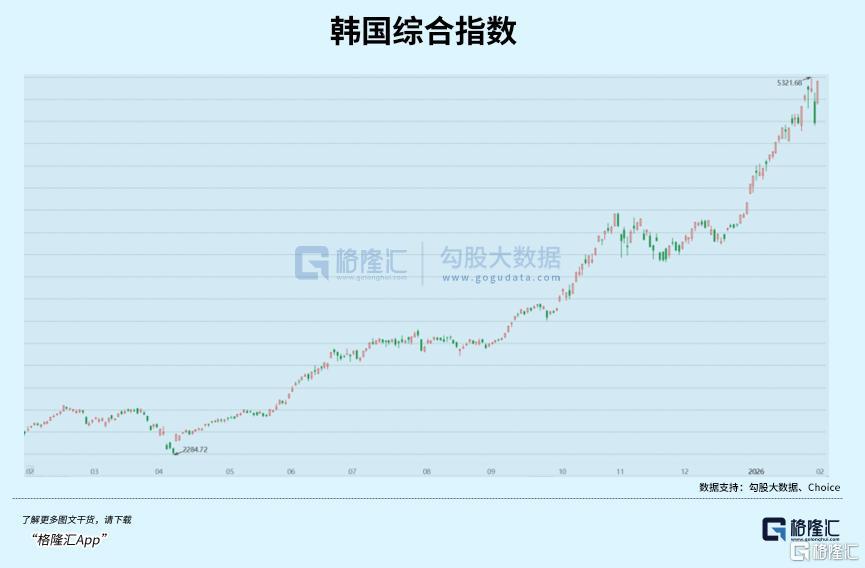
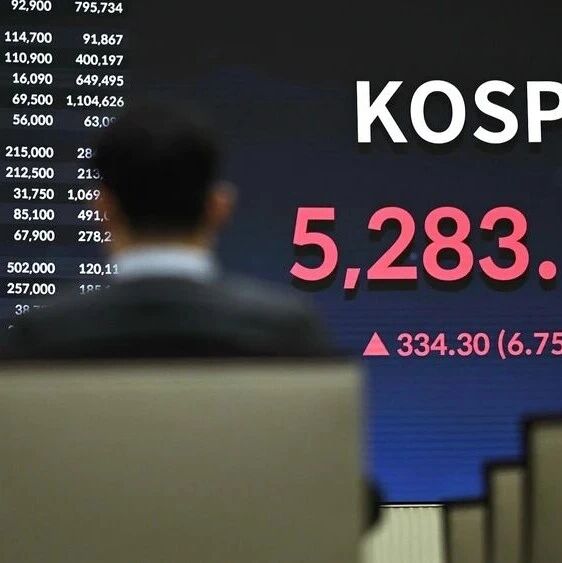
Core Viewpoint - The article discusses the remarkable performance of the South Korean stock market, highlighting its significant gains and the factors driving this growth, including key industries and government reforms [5][38]. Group 1: Market Performance - On February 2, the KOSPI index fell below 5000 points, with foreign investors selling 25.2 trillion KRW and institutions selling 22.1 trillion KRW, while retail investors bought over 50 trillion KRW, setting a historical record [5][6]. - The following day, the market rebounded, rising 6.84%, nearly recovering from the previous day's losses [7]. - Since April of the previous year, the KOSPI has increased by over 130%, surpassing 5300 points [9]. Group 2: Key Industries - The South Korean stock market is heavily weighted, with the top 20 stocks accounting for over 60% of the KOSPI, particularly in semiconductors, shipbuilding, and battery sectors, which contributed over 70% to the recent gains [17][18]. - The semiconductor sector saw a staggering 280% increase, driven by a supply-demand imbalance expected to peak in 2025, with a projected 78% year-on-year growth in semiconductor exports [19][23]. - The shipbuilding industry experienced a 190% increase, with global new ship orders expected to rise by 45% in 2025, with South Korean companies capturing 48% of these orders [29][30]. - The battery sector grew by 120%, focusing on high-end electric vehicles and energy storage, despite a decrease in market share [34][35]. Group 3: Government Reforms - The South Korean government implemented significant reforms in April 2025, including easing foreign investment restrictions and reducing transaction taxes, which led to a net foreign purchase of 38.6 trillion KRW in stocks from April to December 2025 [43][46]. - The National Pension Service (NPS) significantly increased its holdings in domestic stocks, reaching a market value of 247.4 trillion KRW by the end of 2025, focusing on key sectors [50]. - Reforms also included improving short-selling regulations, which increased market participation and led to a surge in retail investor activity, with retail trading accounting for 78% of total trading [60][61]. Group 4: Retail Investor Dynamics - The number of active retail investors surged from 72 million in April 2025 to 98 million by February 2026, indicating widespread participation in the stock market [67]. - Retail investors' total holdings increased from 380 trillion KRW to 920 trillion KRW, reflecting a 142% growth [71]. - Despite the overall market gains, the average profit for retail investors was only about 255,000 KRW, highlighting that many investors did not benefit proportionately from the market's rise [75][78].
韩国人赚麻了?
Ge Long Hui· 2026-02-03 14:17
Group 1 - The South Korean stock market has experienced extreme volatility, triggering circuit breakers due to both significant declines and subsequent recoveries [1][3] - The KOSPI index has seen a remarkable increase of over 130% since April of the previous year, surpassing 5300 points [5][6] - The market's performance is attributed to concentrated weight in key sectors, particularly semiconductors, shipbuilding, and battery industries, which contributed over 70% to the recent gains [10][29] Group 2 - The semiconductor sector has shown a staggering increase of 280%, with expectations of a significant demand surge in 2025 due to AI server needs [11][14] - South Korea's dominance in the HBM market, with SK Hynix and Samsung holding nearly 90% market share, is expected to drive substantial revenue growth [14][15] - The shipbuilding industry has also performed well, with a 190% increase, driven by a global economic recovery and a 45% rise in new ship orders [19][20] Group 3 - The battery sector has seen a 120% increase, with South Korean manufacturers focusing on high-end electric vehicles and energy storage, despite a decline in market share [24][25] - In 2025, the combined contribution of semiconductors, shipbuilding, and batteries to South Korea's GDP is projected to be 28%, accounting for 65% of total stock market profits [29] - The government has implemented reforms to attract foreign investment, resulting in a significant increase in foreign ownership of South Korean stocks [30][32] Group 4 - The South Korean stock market has become highly active, with retail investors significantly increasing their participation, leading to a surge in trading volumes [44][45] - Despite the overall market gains, the majority of retail investors have not profited, with a significant portion experiencing losses [58][60] - The disparity in earnings indicates that while the market is booming, the benefits are not evenly distributed among all investors [57][58]