
软件

Search documents
8点1氪丨美司法部长拒向爱泼斯坦案幸存者道歉;影石CEO回应年会送房;12306新增“低人一等座”提醒
3 6 Ke· 2026-02-13 00:13
Group 1 - In 2025, a total of 6.763 million marriage registrations were recorded in China, an increase of 657,000 compared to the previous year, representing a growth of 10.76% [3][4] - The new marriage registration regulations effective from May 10, 2025, will eliminate regional restrictions and allow nationwide processing of marriage certificates [3][4] - The increase in marriage registrations is particularly notable in cities with high influxes of migrant populations [3] Group 2 - Elon Musk was ranked as the greatest innovator in the Forbes "Innovators 250" list, with Nvidia CEO Jensen Huang placed fifth [4] - The top ten innovators include notable figures such as Jeff Bezos, Bill Gates, and George Lucas [4] - The U.S. stock market saw a collective decline, with major tech stocks like Apple dropping by 5% [4] Group 3 - The CEO of Insta360, Liu Jingkang, announced the distribution of five apartments and several luxury cars as incentives during the company's annual meeting [2][3] - The total value of the cars given away exceeded 10 million yuan, highlighting the importance of material incentives for employee motivation [2] Group 4 - The Chinese market for high-end talent is increasingly influenced by both intrinsic motivations like achievement and extrinsic incentives such as material rewards [2] - The introduction of a "low-quality seat" reminder by the 12306 ticketing platform has sparked discussions among consumers regarding the quality of available seating options [2] Group 5 - Samsung Electronics has begun mass production of HBM4 memory and is actively expanding its production capacity, anticipating a threefold increase in sales compared to 2025 [7] - Nuveen is set to acquire Schroders for £9.9 billion, marking the end of the latter's 200-year independence [7] Group 6 - LV, Dior, and Tiffany were fined over 36 billion KRW in South Korea due to poor management of customer information leading to data leaks [12] - The fines were imposed by the Personal Information Protection Commission, with LV facing the largest penalty of 21.385 billion KRW [12] Group 7 - SoftBank Group reported a net profit increase to 3.1726 trillion yen for the period from April to December 2025, marking a fivefold increase compared to the previous year [20] - Hermes announced a revenue of 16 billion euros for 2025, reflecting a 5.5% year-on-year growth [20] - Siemens reported a net profit of 2.222 billion euros for the first quarter of 2026, a decrease of 43% year-on-year [20]




苹果大跌5%
财联社· 2026-02-12 23:41
Core Viewpoint - Concerns over the disruptive potential of artificial intelligence (AI) have led to a decline in major stock indices, with the Nasdaq falling by 2% and the S&P 500 and Dow Jones also experiencing significant drops [1][4]. Group 1: Market Performance - The Dow Jones index closed down 1.34% at 49,451.98 points, the S&P 500 index fell 1.57% to 6,832.76 points, and the Nasdaq index dropped 2.03% to 22,597.15 points [4]. - Major technology stocks saw declines, with Apple down 5%, erasing its gains for the year, and Nvidia down 1.64% [9]. Group 2: Sector Impact - The introduction of AI tools has negatively impacted various sectors, including software companies, publishers, and financial services, raising concerns about potential business model replication and profit margin erosion [5]. - Financial stocks, such as Morgan Stanley, faced pressure due to fears that AI could disrupt wealth management services [5]. - Trucking and logistics companies, like C.H. Robinson, saw a 14% drop in stock price as AI is expected to optimize freight operations, potentially reducing revenue sources [5]. Group 3: Real Estate and Defensive Sectors - The real estate sector is also affected, with concerns that higher unemployment rates will reduce demand for office space, leading to declines in stocks like CBRE and SL Green Realty [6]. - Investors are shifting towards more defensive sectors, with Walmart and Coca-Cola seeing stock price increases of 3.8% and 0.5%, respectively [7]. - In the S&P 500, the consumer staples and utilities sectors outperformed, both rising over 1%, with the consumer staples sector reaching a historical closing high [8].



道指重挫逾600点!AI抛售潮重燃 思科暴泻12% 商业地产遭遇“黑色星期四”
Di Yi Cai Jing· 2026-02-12 23:27
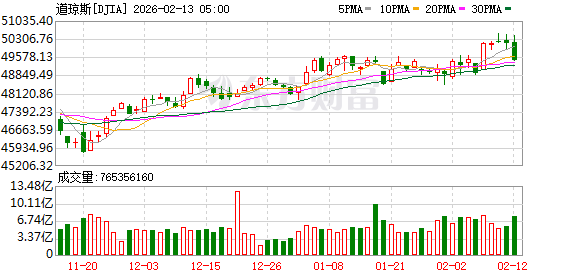
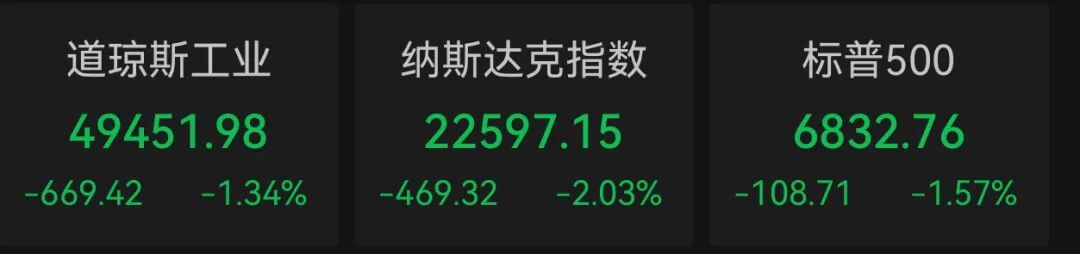
Market Overview - US stock market experienced a significant decline, driven by concerns over the accelerated penetration of artificial intelligence impacting the software industry and office space demand, leading to pressure on commercial real estate and tech sectors [2] - The Dow Jones Industrial Average fell by 669.42 points, a decrease of 1.34%, closing at 49,451.98 points; the S&P 500 dropped by 108.71 points, down 1.57%, closing at 6,832.76 points; the Nasdaq Composite decreased by 469.32 points, a decline of 2.03%, closing at 22,597.15 points [2] Popular Stocks Performance - Major tech companies faced significant losses, with Apple plunging 5%, marking its largest single-day drop since April 2025, following claims by the US Federal Trade Commission regarding Apple's suppression of conservative content [3] - Other notable declines included Meta Platforms down 2.82%, Amazon down 2.20%, Tesla down 2.62%, Nvidia down 1.64%, Microsoft down 0.63%, and Google C shares down 0.63% [3][4] Commercial Real Estate and Financial Services - The current sell-off in the US stock market is primarily focused on commercial real estate and related financial services, with fears that increased use of AI tools may structurally weaken demand for office space, impacting leasing and valuation [5] - Major commercial real estate service companies saw significant stock price drops, with CBRE Group down 8.8%, JLL down 7.6%, and Colliers International down 11.5% [5] - Analysts noted that the discussion around AI reducing office demand has been ongoing, but the recent sell-off in brokerage stocks has led investors to reassess commercial real estate risks more directly [5] Transportation and Logistics Sector - The trucking and logistics sector also faced notable pressure, with the Dow Jones Transportation Average dropping over 4%, marking its worst day since the US announced tariff increases in April of last year [6] - Among the 20 component stocks of the Dow Jones Transportation Average, 17 experienced declines, with Landstar System and C.H. Robinson seeing drops of 15.6% and 14.5%, respectively [6] - Concerns were heightened following Algorhythm Holdings' disclosure that its SemiCab division increased customer freight volumes by 300% to 400% without a corresponding increase in workforce, raising fears about AI's potential to reduce labor demand in logistics [6] Labor Market Data - Recent labor market data showed that initial jobless claims fell by 5,000 to 227,000, indicating overall stability in the job market [7] Bond Market Reaction - US Treasury yields fell, with the 10-year Treasury yield decreasing by 8.1 basis points to 4.102%, marking the largest single-day drop in October; the 2-year yield fell by 4.8 basis points to 3.464% [8] Commodity Market Performance - International oil prices saw a significant decline, with light crude oil futures for March delivery dropping by $1.79 to $62.84 per barrel, a decrease of 2.77%; Brent crude futures for April fell by $1.88 to $67.52 per barrel, down 2.71% [10] - Precious metals also faced pressure, with spot gold down 3.26% to $4,918.36 per ounce and silver down 10.89% to $75.0942 per ounce [10]


AI恐慌扩散,科技股再度拖垮美股,地产股连日重挫,苹果一日蒸发2000亿
Hua Er Jie Jian Wen· 2026-02-12 23:25
Group 1 - The core viewpoint of the articles highlights a significant market downturn driven by fears surrounding the disruptive impact of artificial intelligence (AI) on traditional industries, leading to panic selling among investors [1][4][12] - Major U.S. stock indices fell over 1%, with the Nasdaq dropping approximately 2%, marking a three-day decline, while the Dow Jones Industrial Average closed below the 50,000 mark for the first time in a week [1][2] - The technology sector was identified as the primary culprit for the market decline, with Cisco's stock plummeting 12% due to disappointing gross margin guidance, and the "big seven" tech companies all experiencing losses [2][8] Group 2 - Concerns about the return on AI investments have intensified, with major tech firms like Amazon, Google, Meta, and Microsoft expected to spend around $650 billion on AI this year, raising doubts about whether such capital expenditures will yield tangible returns [4][6] - The narrative in the market has shifted from identifying beneficiaries of AI to recognizing potential victims, with sectors such as software, insurance brokerage, asset management, and commercial real estate facing significant pressure [6][11] - The commercial real estate sector has been particularly hard hit, with companies like CBRE and Jones Lang LaSalle seeing stock declines exceeding 25% over two days, as fears grow that AI could automate key functions and reduce demand for human brokers [5][12] Group 3 - The market sentiment has transitioned from "AI euphoria" to "AI phobia," with investors reassessing whether AI capital expenditures are overheated and if the commercialization of AI is lagging behind expectations [6][10] - Analysts have noted that the recent sell-off appears disproportionate to the actual risks, suggesting that the market may be overreacting to AI-related concerns [12] - Despite the overall downturn, some segments within the semiconductor industry, such as storage chip stocks, have managed to maintain gains, indicating a divergence within the tech sector [8][10]
道指重挫逾600点!AI抛售潮重燃,商业地产遭遇“黑色星期四”
Di Yi Cai Jing· 2026-02-12 23:24
Market Overview - US stock market experienced a significant decline, driven by concerns over the accelerated penetration of artificial intelligence impacting the software industry and office space demand [1] - The Dow Jones Industrial Average fell by 669.42 points, a decrease of 1.34%, closing at 49,451.98 points; the S&P 500 dropped by 108.71 points, down 1.57%, closing at 6,832.76 points; the Nasdaq Composite decreased by 469.32 points, a decline of 2.03%, closing at 22,597.15 points [1] Technology Sector Performance - Major tech stocks faced pressure, with Apple experiencing a sharp decline of 5%, marking its largest single-day drop since April 2025, following claims by the US Federal Trade Commission regarding Apple's suppression of conservative content [3] - Other tech giants also saw declines: Meta Platforms down 2.82%, Amazon down 2.20%, Tesla down 2.62%, Nvidia down 1.64%, Microsoft down 0.63%, and Alphabet's Class C shares down 0.63% [3][4] Commercial Real Estate Impact - The sell-off in the US stock market focused on commercial real estate and related financial services, with fears that increased use of AI tools could structurally weaken demand for office space, impacting leasing and valuation systems [5] - Major commercial real estate service companies saw significant stock price drops, with CBRE Group down 8.8%, JLL down 7.6%, and Cushman & Wakefield down 11.5% [6] - Analysts noted that the discussion around AI reducing office demand has been ongoing, and the recent sell-off in brokerage stocks has led investors to reassess commercial real estate risks more directly [6] Transportation and Logistics Sector - The transportation and logistics sector also faced significant pressure, with the Dow Jones Transportation Average dropping over 4%, marking its worst day since the US announced tariff increases in April of last year [6] - Among the 20 components of the Dow Jones Transportation Average, 17 stocks declined, with Landstar System and C.H. Robinson experiencing the largest drops of 15.6% and 14.5%, respectively [7] - Concerns were heightened following Algorhythm Holdings' disclosure that its SemiCab division increased customer freight volumes by 300% to 400% without a corresponding increase in workforce, raising fears about AI's impact on labor demand in the logistics industry [7] Global Market Reactions - The impact of the US market decline extended to European markets, with Swiss logistics group Kuehne + Nagel's stock falling by 13% and Danish logistics firm DSV A/S dropping over 10% [8] Economic Data and Interest Rates - Recent labor market data showed a smaller-than-expected decline in initial jobless claims, leading to fluctuating market expectations regarding the Federal Reserve's interest rate path for the year [8] - The yield on 10-year US Treasury bonds fell by 8.1 basis points to 4.102%, marking the largest single-day drop since October, while the yield on 2-year bonds decreased by 4.8 basis points to 3.464% [8] Commodity Market Performance - International oil prices saw a notable decline, with light crude oil futures for March dropping by $1.79 to $62.84 per barrel, a decrease of 2.77%, and Brent crude oil futures for April falling by $1.88 to $67.52 per barrel, down 2.71% [9] - Precious metals also faced pressure, with spot gold down 3.26% to $4,918.36 per ounce and silver down 10.89% to $75.0942 per ounce [9]

道指重挫逾600点!AI抛售潮重燃,思科暴泻12%,商业地产遭遇“黑色星期四”
第一财经· 2026-02-12 23:22
Core Viewpoint - The article discusses the significant decline in the U.S. stock market, driven by concerns over the impact of artificial intelligence on the software industry and office space demand, leading to a reassessment of the Federal Reserve's interest rate path [3]. Market Performance - Major U.S. indices fell sharply, with the Dow Jones Industrial Average down 669.42 points (1.34%) to 49,451.98, the S&P 500 down 108.71 points (1.57%) to 6,832.76, and the Nasdaq Composite down 469.32 points (2.03%) to 22,597.15 [3]. - Tech giants faced significant pressure, with Apple dropping 5% (largest single-day decline since April 2025), Meta down 2.82%, Amazon down 2.20%, and Tesla down 2.62% [6][7]. Commercial Real Estate Concerns - The sell-off focused on commercial real estate and related financial services, with fears that increased AI usage could structurally weaken demand for office space, impacting leasing and valuation [10]. - Major commercial real estate service companies saw significant stock declines, with CBRE down 8.8%, JLL down 7.6%, and Colliers down 11.5% [10]. - Analysts noted that the discussion around AI reducing office demand has been ongoing, but recent sell-offs in brokerage sectors have intensified fears regarding commercial real estate risks [10]. Transportation and Logistics Sector - The transportation and logistics sector also faced declines, with the Dow Jones Transportation Average dropping over 4%, marking its worst day since April of the previous year [11]. - Key logistics companies like Landstar System and C.H. Robinson saw declines of 15.6% and 14.5%, respectively, due to concerns over AI potentially reducing labor demand in the logistics industry [12]. Economic Data and Federal Reserve Outlook - Recent labor market data showed a smaller-than-expected drop in initial jobless claims, leading to fluctuating market expectations regarding the Federal Reserve's interest rate decisions [12]. - The market is currently pricing in a cumulative rate cut of 59 basis points by the end of the year, up from 54 basis points earlier in the day [12]. Commodity Market Trends - International oil prices fell significantly, with WTI crude down $1.79 to $62.84 per barrel (2.77% decline) and Brent crude down $1.88 to $67.52 per barrel (2.71% decline) [15]. - Precious metals also faced pressure, with spot gold down 3.26% to $4,918.36 per ounce and silver down 10.89% to $75.0942 per ounce [15].


AI寒流来袭:全球风险资产撤退 美债成避风港
Sou Hu Cai Jing· 2026-02-12 23:07
由于针对人工智能的新一轮看跌情绪席卷华尔街,重创美国科技股及贵金属,并促使投资者转向美债寻 求避险,预计亚洲股市周五开盘走低。新加坡Vantage Point资产管理公司首席投资官Nick Ferres表 示:"软件股现在的表现就像2008年的银行股。亚洲市场今年以来表现良好,但我担心其与全球市场的 相关性以及随之而来的战术性平仓。"周五晚些时候,美国将公布1月份通胀数据。市场中值预测核心消 费者价格指数同比将增长2.5%。目前交易员仍认为美联储在3月会议上降息的可能性极小,而7月降息 已完全计入定价。大宗商品方面,由于风险规避情绪弥漫全球市场,加之投资者正在消化继续影响供应 前景的美伊紧张局势新进展,油价出现下滑。 来源:滚动播报 ...
道指重挫逾600点!AI焦虑抛售潮重燃,思科暴泻12%,商业地产遭遇“黑色星期四”
Di Yi Cai Jing Zi Xun· 2026-02-12 23:03
Market Overview - The U.S. stock market experienced a significant decline, with concerns about the impact of artificial intelligence on the software industry and office space demand leading to a sell-off in commercial real estate and tech sectors [1] - The Dow Jones Industrial Average fell by 669.42 points, a decrease of 1.34%, closing at 49,451.98 points; the S&P 500 dropped by 108.71 points, down 1.57%, closing at 6,832.76 points; and the Nasdaq Composite decreased by 469.32 points, a drop of 2.03%, closing at 22,597.15 points [1] Technology Sector Performance - Major tech stocks faced pressure, with Apple experiencing a 5% drop, marking its largest single-day decline since April 2025, following claims by the U.S. Federal Trade Commission regarding content suppression [2][3] - Other tech giants also saw declines: Meta Platforms down 2.82%, Amazon down 2.20%, Tesla down 2.62%, Nvidia down 1.64%, Microsoft down 0.63%, and Alphabet (Google) down 0.63% [2][3] Commercial Real Estate Impact - The commercial real estate sector faced a sharp sell-off, with major service companies like CBRE Group down 8.8%, JLL down 7.6%, and Cushman & Wakefield down 11.5% [4] - Analysts noted that the discussion around AI reducing office demand has been ongoing, and the recent sell-off in brokerage stocks has led investors to reassess risks in commercial real estate [4] Transportation and Logistics Sector - The transportation and logistics sector also suffered, with the Dow Jones Transportation Average dropping over 4%, marking its worst day since the U.S. announced tariff increases in April of last year [5] - 17 out of 20 stocks in the Dow Jones Transportation Average declined, with Landstar System and C.H. Robinson falling by 15.6% and 14.5%, respectively, due to concerns over AI reducing labor demand in logistics [6] Economic Data and Interest Rates - Recent labor market data showed a smaller-than-expected decline in initial jobless claims, leading to fluctuating expectations regarding the Federal Reserve's interest rate cuts for the year [6] - The yield on 10-year U.S. Treasury bonds fell by 8.1 basis points to 4.102%, marking the largest single-day drop since October [7] Commodity Market Performance - International oil prices saw a notable decline, with light crude oil futures dropping by $1.79 to $62.84 per barrel, a decrease of 2.77% [8] - Precious metals also faced pressure, with spot gold down 3.26% to $4,918.36 per ounce and silver down 10.89% to $75.0942 per ounce [8]
24:00加速下跌,这一切发生得太快了
Xin Lang Cai Jing· 2026-02-12 22:35
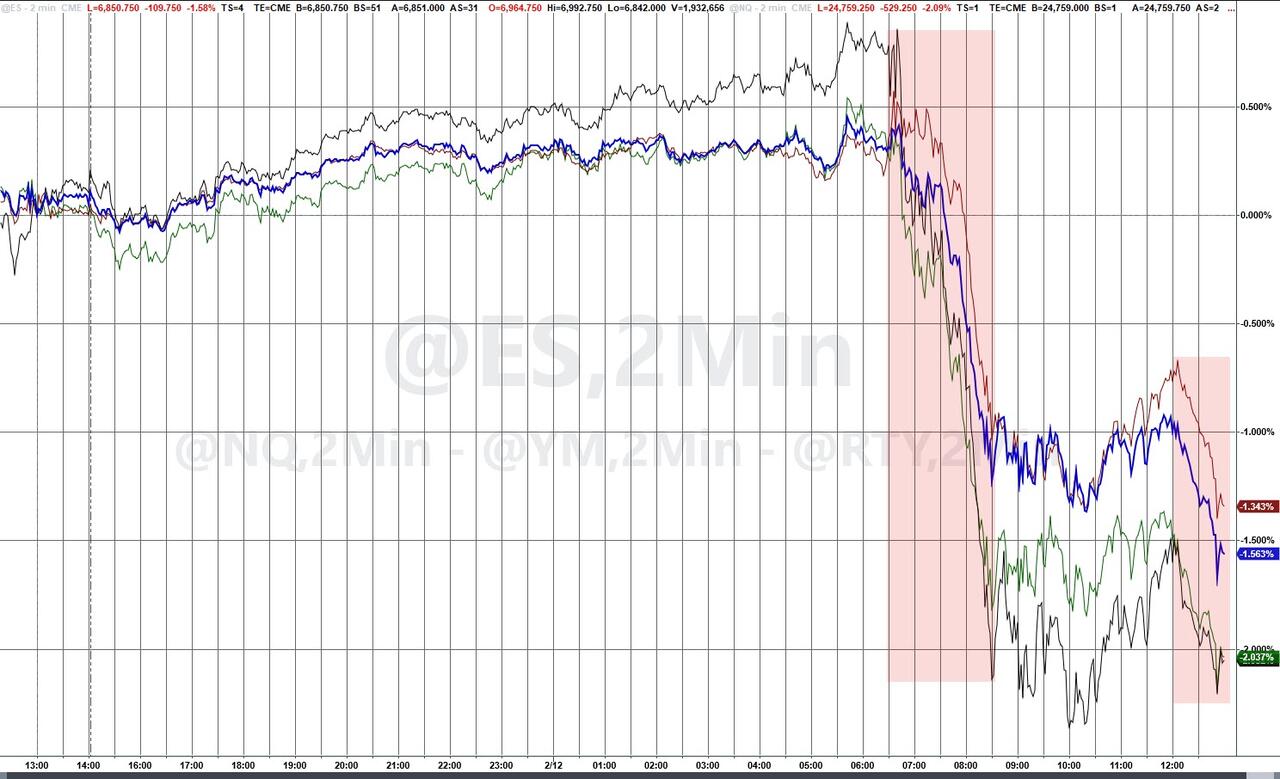
Market Overview - The U.S. stock market experienced a significant decline, with the Dow Jones index falling by 1.33%, the S&P 500 index down by 1.57%, and the Nasdaq index dropping by 2.03% [2] - Gold prices plummeted by 4%, while silver saw an 11% drop, indicating that both metals are heavily influenced by market sentiment [2] - Oil prices decreased by 2.7%, copper prices fell by 2.9%, and Bitcoin dropped to $65,000 [2] - The U.S. dollar index remained stable, closing nearly flat [2] AI Impact on Various Industries - Concerns regarding the disruptive impact of artificial intelligence (AI) have spread from software stocks to logistics, commercial real estate, and other sectors, with fears that AI could compress industry profits further [2] - The market's shift from enthusiasm for AI to fear of its potential to destroy industries occurred rapidly, marking a period of uncertainty in the U.S. bull market [2] Market Reactions and Future Outlook - The recent market downturn began at the opening of U.S. markets and accelerated after midnight, with gold prices dropping by $180 in one hour [3] - This decline occurred just before the release of key inflation data, with investors generally expecting a decrease in inflation, which could maintain hopes for interest rate cuts [3] - However, even positive CPI data may only result in a temporary market rebound, as the underlying concern about AI's impact on profits remains unresolved [3] Additional Insights - There is a notable lack of buyers willing to step in during the market downturn, indicating a significant shift in market sentiment [4] - A report titled "Global Market Notes: A Big Change is Coming" suggests that the current calm in the market is deceptive, with predictions for the next three years outlined [4] - The report also discusses the potential for a multi-year bull market in gold, silver, and copper, along with forecasts for A-shares, Hong Kong stocks, and commodities [4] - The report highlights a historical cycle for the Chinese yuan, suggesting unexpected future movements [4]
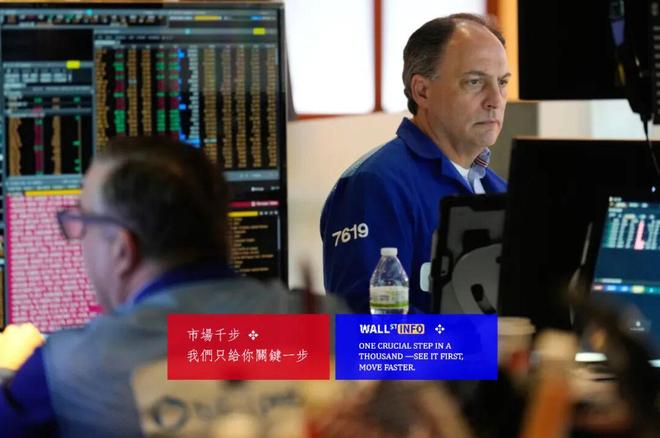
美国股市:三大股指全线下跌 AI颠覆风险引发的抛售迅速蔓延
Xin Lang Cai Jing· 2026-02-12 22:32
Core Viewpoint - Major US stock indices experienced a decline, driven by sell-offs in companies threatened by artificial intelligence, with selling pressure spreading across multiple sectors [1][8]. Group 1: Market Performance - The S&P 500 index fell by 1.6%, marking its third consecutive day of decline, with most large-cap stocks, including Apple, also declining [2][9]. - The Nasdaq 100 index dropped by 2%, recording its fifth single-day decline of at least 1% in the past 10 trading days, led by technology stocks [3][10]. - The Dow Jones Industrial Average decreased by 1.3%, influenced by significant drops in transportation stocks that had previously driven the index to record highs [4][11]. - The Russell 2000 index, which had been performing well this year, also fell by 2% [5][12]. Group 2: Sector Analysis - Defensive sectors such as consumer staples and utilities showed the best performance, indicating a shift in investor sentiment towards safer investments [4][11]. - Technology stocks were notably under pressure, with Cisco experiencing a 12% drop due to concerns over hardware and storage chip prices impacting future prospects [3][10]. - The overall market theme suggests a pattern of immediate sell-offs in response to any news related to artificial intelligence, as noted by Jeffrey Favuzza from Jefferies LLC [4][11]. Group 3: Economic Indicators - Major indices opened higher initially, following a slight decrease in the number of Americans filing for unemployment benefits, but these gains were quickly reversed [6][13]. - Traders are closely monitoring an upcoming inflation report for insights into the Federal Reserve's interest rate trajectory [7][14].