
银行理财

Search documents
周报 | 理财公司加快布局指数投资,华夏理财再发5只指数产品
2 1 Shi Ji Jing Ji Bao Dao· 2025-09-24 10:16
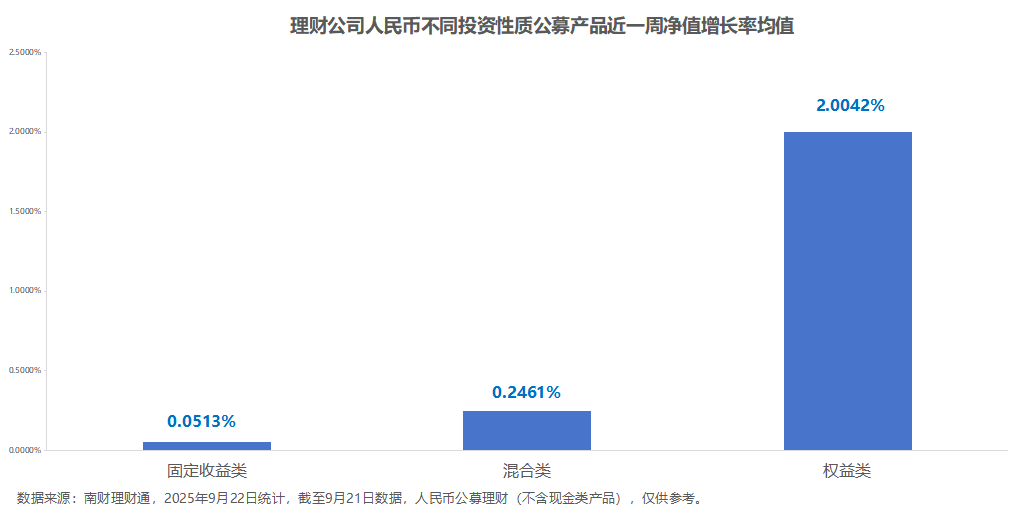
Market Overview - The bond market experienced fluctuations with a tight funding environment, as indicated by a weighted average of DR007 at 1.5096% and a 10-year government bond yield closing at 1.88% [2] - The A-share market showed wide fluctuations, with the ChiNext Index and the Sci-Tech Innovation 50 Index increasing by 2.34% and 1.84% respectively, while the Shanghai Composite Index and the CSI 300 Index decreased by 1.30% and 0.44% respectively [2] Product Performance - The number of products below net asset value remains low, with 26,354 public wealth management products in existence, of which 285 have a cumulative net value below 1, resulting in a comprehensive break-even rate of 1.08% for bank wealth management [3] - The break-even rates for equity and mixed wealth management products are 18.37% and 3.04% respectively, while fixed income public wealth management products have a break-even rate of 0.95% [3] New Product Issuance - A total of 467 wealth management products were issued by 32 wealth management companies from September 15 to September 19, with the highest issuance from joint-stock banks [5] - The newly issued products primarily consist of R2 (medium-low risk), closed-end net value type, and fixed income public products, with mixed and equity products each issuing 5 products [5] - Pricing varied across different term products, with a notable increase of 7 basis points for 3-6 month term products, while 1-3 month and 2-3 year term products saw significant declines of 25 basis points [5] Investment Strategies - Huaxia Wealth Management has intensified its investment in equity products, issuing 5 index tracking products on September 18, which track various indices related to AI, high dividends, and military electronics [6] - The products have a fundraising scale of around 2 million, with the highest being 2.3581 million for the "Tian Gong Ri Kai Product 19" [6] - Other wealth management companies, such as Zhuhai Wealth Management and Jiangyin Wealth Management, are also accelerating their index investment strategies [7] Yield Performance - Fixed income wealth management products saw a slight recovery in average net value growth rate to 0.0513%, while mixed and equity products had average growth rates of 0.2461% and 2.0042% respectively [8] - Among fixed income products, those with a term of over 3 years had the highest average net value growth rate of 0.0975% [8] Industry Trends - Recent announcements from listed companies indicate a shift towards wealth management, primarily using self-owned funds for investments in structured deposits and bank wealth management products, typically with terms of 6 months to 1 year [14] - The demand for wealth management is driven by the need for stable returns and liquidity, with expectations for steady growth in corporate wealth management scale [14] Notable Developments - Zhong Postal Wealth Management participated in the successful IPO of Hesai Technology, marking a significant event in the return of Chinese concept stocks to the market [15] - Shanghai Pudong Development Bank Wealth Management launched its first "Shanghai Sci-Tech Financial Theme" wealth management product, aligning with national innovation strategies [16] - Jianxin Wealth Management successfully issued its first structured wealth management product, combining fixed income assets with derivatives linked to gold [17]

近一个月年化收益近18%?这一银行多款活期产品被疯抢
第一财经· 2025-09-24 10:12
2025.09. 24 本文字数:2114,阅读时长大约4分钟 作者 | 第一财经 安卓 "蹲了大半个月,终于在一大早被我抢到了。"陈胜说。陈胜口中的"抢手货"正是微众银行"活期 +Plus"于9月初上线的新品"北银理财京华远见春系列—诚享7天持有期19号理财产品"(下称"诚享19 号")。 9月23日数据显示,诚享19号成立以来年化收益6.27%,最近一个月年化收益为8.8%,远远跑赢"活 期+Plus"中的其他产品,再加上自上线后从未挂0(收益为0),被投资者称之为"理财铁饭碗"。 第一财经记者发现,"活期+Plus"每隔一段时间就会出现一两个爆款,吸引投资者大量买入,额度秒 光,而为了能够及时获知产品额度信息,投资者甚至成立了"额度提醒互助群",如今,银行理财也如 同基金一样,呈现"饭圈化"趋势。 高收益理财产品被疯抢 微众银行APP显示,诚享19号自9月1日上线以来,近一个月年化收益持续在4%以上,最新为 8.65%。 活期+Plus | 诚享19号 较低风险 8.65% 1.00元起购 近一个月年化 1 持满7天可转出 500万内实时到账 【温馨提示】本产品为新发产品,尚处于建仓 期,单日净值涨幅对 ...

25Q2理财的基金投资有何变化?:银行理财资产配置专题分析
Hua Yuan Zheng Quan· 2025-09-24 07:43
Group 1: Investment Rating - No investment rating for the industry is provided in the report. Group 2: Core Views - The bank wealth - management industry has entered the era of wealth - management companies, with regulatory requirements approaching those of the public fund industry. The scale of wealth management increased in 25Q2 compared to 25Q1, and the net - breaking rate decreased slightly in 25Q2 but increased since late July. The industry increased its allocation to public funds in 25H1, mainly increasing positions in money - market and bond funds in 25Q2 [2][6][10]. - Different types of wealth - management companies have different performance and asset - allocation characteristics. Large - bank wealth - management companies generally increased their allocation to public funds, and their overall scale and proportion of public - fund investment rose. Joint - stock bank wealth - management companies also generally increased their allocation to public funds and slightly increased their allocation to deposit - type assets. Most urban and rural commercial bank wealth - management companies increased their allocation to deposit - type and public - fund assets and reduced their allocation to bond assets [37][39][42]. - The indirect investment ratio of wealth - management companies has increased in recent years, which may be related to the configuration of deposits through insurance asset management and trust plans and bond investment through SPV [45]. Group 3: Summary by Directory 1. 25H1 Wealth - Management Scale Steady Growth 1.1 Bank Wealth Management Enters the Era of Wealth - Management Companies - Regulatory requirements for bank wealth management are getting closer to those of the public fund industry. Since 2018, a series of regulatory policies have been introduced, narrowing the gap between the two industries. As of September 2025, 32 wealth - management companies have been approved for establishment and all are in operation. It is expected that there will be about 40 wealth - management companies in the future, and small and medium - sized banks without wealth - management companies will gradually withdraw from the wealth - management business [6][10]. - In the first half of 2025, the net profit of wealth - management companies showed stable growth. The overall net profit increased by 1.7% year - on - year, with large - bank and joint - stock bank wealth - management companies seeing growth of 7.2% and 0.2% respectively, while urban and rural commercial bank wealth - management companies' net profit decreased by 7.3% [12]. 1.2 25Q2 Wealth - Management Scale Slightly Increased Compared to 25Q1 - As of June 2025, the wealth - management scale was 30.67 trillion yuan. In 25Q1, the scale decreased by 0.8 trillion yuan, and in 25Q2, it increased by about 1.5 trillion yuan. In July 2025, the scale increased seasonally, and the growth slowed down in August [15][17]. - In 25Q2, the wealth - management scale of most wealth - management companies increased, with large - bank, joint - stock bank, and urban and rural commercial bank wealth - management companies seeing increases of 7.8%, 4.6%, and 10.9% respectively compared to 25Q1. By type, the scale of fixed - income and hybrid products of various wealth - management companies increased in Q2 compared to Q1 (except for the hybrid products of joint - venture wealth - management companies) [20][23]. - The net - breaking rate of wealth - management products decreased slightly in 25Q2 but increased since late July. As of September 14, 2025, the net - breaking rate of public wealth - management products of wealth - management companies was about 2.28%, higher than that at the beginning of the year. The average performance comparison benchmark of newly issued RMB fixed - income wealth - management products of wealth - management companies has been declining [25][28]. 2. Bank Wealth Management Increased Allocation to Public Funds in 25H1 2.1 Wealth Management's Investment Proportion in Public Funds Increased Significantly in 25Q2 - In 25H1, bank wealth - management products increased their allocation to public funds. As of June 2025, the proportion of bank wealth - management products invested in bonds, deposits, non - standard assets, equities, and public funds was 55.6%, 24.8%, 5.5%, 2.4%, and 4.2% respectively, with changes of - 1.8, + 1.5, - 0.1, - 0.2, + 1.2 percentage points compared to 25Q1 [32]. - In 25Q2, most wealth - management companies increased their allocation to public funds. Bohai Bank Wealth Management and Huaxia Bank Wealth Management had relatively large increases in the proportion of public - fund investment [33]. 2.2 Asset - Allocation Changes of Wealth - Management Companies' Wealth Management in the First Half of 2025 - Large - bank wealth - management companies generally increased their allocation to public funds, with the total scale rising to 0.4 trillion yuan and the proportion rising to 3.8%. Except for Jianxin and Jiaotong Wealth Management, the proportion of deposit - type assets decreased, and except for Jianxin and Nongyin Wealth Management, the proportion of bond assets decreased [37]. - Joint - stock bank wealth - management companies generally increased their allocation to public funds, with the overall proportion rising from 2.6% at the end of 2024 to 3.8%. Bohai Bank Wealth Management and Huaxia Bank Wealth Management had relatively large increases in the proportion of public - fund investment. They also slightly increased their allocation to deposit - type assets [39]. - Most urban and rural commercial bank wealth - management companies increased their allocation to deposit - type and public - fund assets and reduced their allocation to bond assets. The three urban and rural commercial bank wealth - management companies with the highest proportion of public - fund allocation were Qingyin, Huiyin, and Shangyin [42]. - The indirect investment ratio has increased. As of H1 2025, the indirect investment scale of 20 wealth - management companies was 10.97 trillion yuan, accounting for 65.8%, and the proportion has increased in recent years [45]. 3. Wealth Management Increased Allocation to Money - Market and Bond Funds in 25Q2 - In 25Q2, the scale of wealth management's allocation to public funds increased significantly. As of June 2025, the scale was about 1.3 trillion yuan, accounting for 4.2%, the highest since 2020, an increase of 1.2 percentage points compared to 25Q1 [49]. - Bond funds are still the main type of public funds allocated by bank wealth management. In 25Q2, bank wealth management mainly increased its allocation to money - market and bond funds, with increases of about 0.05 trillion yuan and 0.29 trillion yuan respectively. It reduced its allocation to hybrid, stock, and alternative investment funds, and slightly reduced its allocation to REITs and QDII/international funds [50]. - In terms of the breakdown of bond funds, in 25Q2, the investment proportion of medium - and long - term pure - bond funds and first - class hybrid bond funds decreased, while the investment proportion of passive index - type bond funds and short - term pure - bond funds increased. In 25Q2, wealth management increased its allocation to medium - and long - term pure - bond funds, short - term pure - bond funds, and passive index - type bond funds by 0.08, 0.1, and 0.1 trillion yuan respectively [55]. - Wealth - management products prefer to invest in bond funds with large scales. The top three bond funds in terms of wealth - management holdings as of June 2025 were Fuguo Two - Year Financial Management Bond, Huitianfu Changtianli Fixed - Open Bond, and Huitianfu China Bond Preferred Investment - Grade Credit Bond Index Initiation [62]. - In terms of the breakdown of stock and hybrid funds, in 25Q2, the investment proportion of flexible - allocation funds increased, while the investment proportion of passive index - type and common stock funds decreased. The investment scale in stock and hybrid funds decreased, with reductions of about 100 million yuan, 380 million yuan, and 70 million yuan in flexible - allocation, passive index - type, and partial - debt hybrid funds respectively [64]. - Wealth management's investment in stock and hybrid funds prefers flexible - allocation and passive index - type funds. As of June 2025, the top three stock and hybrid funds in terms of wealth - management holdings were Penghua Hongkang Hybrid, Guangfa Anying Hybrid, and Dongfanghong CSI Dongfanghong Dividend Low - Volatility Index [69]. 4. Differences in Public - Fund Investment of Different Types of Wealth Management - Fixed - income wealth management has the largest absolute scale of public - fund holdings, while hybrid and equity wealth management have relatively high proportions of public - fund allocation. As of June 2025, fixed - income and hybrid wealth management held public funds worth 1.22 trillion yuan and 0.08 trillion yuan respectively, accounting for 90.1% and 5.98% of the total public - fund investment scale of wealth management. The proportion of public - fund investment in hybrid wealth management was about 11%, higher than the 5% of fixed - income wealth management [71].
【银行理财】理财公司加码指数化布局:跟踪现有指数、自主构建双策并行——银行理财周度跟踪(2025.9.15-2025.9.21)
华宝财富魔方· 2025-09-23 12:57
Core Viewpoints - The article discusses the increasing trend of wealth management companies in China to develop index-based financial products, driven by the ongoing transformation towards net value management and the acceleration of medium to long-term capital entering the market [3][7]. Regulatory and Industry Dynamics - Wealth management companies are actively launching index-based financial products, with an increase in both the number and issuance of such products in the market [3][7]. - Major banks like 招银理财 and 交银理财 have introduced new index products, with 招银理财 launching its self-developed "湾区全球资产优选配置指数" and 交银理财 collaborating with 中诚信指数服务 to create a new index [7][8]. - The core motivations for this shift towards index-based products include reducing active management risks, enhancing strategy transparency, and meeting customized client demands [8]. Innovations in the Industry - 华夏理财 and 华夏基金 have signed a memorandum to deepen cooperation in the index business, aiming to build a market-influential "双华夏" index ecosystem [9][10]. - 中邮理财 participated in the successful IPO of 禾赛科技, marking it as the largest Chinese concept stock IPO in Hong Kong in four years, reflecting a strategic move towards IPO investments [11][12]. - 浦银理财 launched its first "上海科创金融主题" financial product, raising 220 million yuan, with 80% of the funds directed towards bonds issued by quality technology enterprises in Shanghai [13][14]. Performance of Financial Products - The annualized yield of cash management products was recorded at 1.29%, remaining stable, while money market funds saw a slight increase to 1.19% [15][17]. - The yield on 10-year government bonds slightly increased to 1.80%, influenced by market sentiment and the Federal Reserve's dovish rate guidance [17][19]. Tracking of Net Value - The net value break rate for bank wealth management products decreased to 2.04%, down by 0.61 percentage points, with credit spreads also narrowing [22]. - The relationship between break rates and credit spreads indicates that if credit spreads continue to widen, it may put upward pressure on break rates [22].

ESG投资周报:本月新发8只ESG基金,流动性环比宽松-20250923
GUOTAI HAITONG SECURITIES· 2025-09-23 12:29
Fund Issuance - Eight new ESG funds were launched this month, with a total issuance of 3.749 billion units, primarily focused on social responsibility and environmental protection[9] - A total of 251 ESG public funds were issued in the past year, with a total issuance of 175.353 billion units[9] - The total net asset value of existing ESG funds reached 1,029.312 billion RMB, with ESG strategy funds accounting for the largest share at 50.46%[11] Market Performance - During the week of September 15-19, 2025, the CSI 300 index fell by 0.44%, while the ESG 300 index rose by 0.39%[5] - The average daily trading volume in the A-share market was approximately 2.52 trillion RMB, indicating a loosening of liquidity[5] Green Bonds - A total of 43 new green bonds were issued in the interbank and exchange markets last week, with a planned issuance scale of approximately 34.468 billion RMB[16] - In September 2025, 120 ESG bonds were issued, amounting to 54.2 billion RMB, with a total of 1,095 ESG bonds issued in the past year, totaling 1,189.9 billion RMB[16] Bank Wealth Management Products - 67 ESG bank wealth management products were issued this month, with a total of 1,102 existing products in the market[22] - Pure ESG products accounted for the largest share at 55.99% among existing ESG bank wealth management products[22] Risk Factors - Potential risks include insufficient policy support for ESG initiatives, lack of unified data reporting standards, and lower-than-expected product issuance scales[25]
践行“投资·向善”,共议ESG与高校基金会资产管理新路径——2025复旦管院·兴动ESG大讲堂举办
Zhong Guo Jin Rong Xin Xi Wang· 2025-09-23 12:14
Core Viewpoint - The forum "Investment for Good" focused on ESG investment, asset management of university foundations, and asset allocation, emphasizing the importance of collaboration between asset management institutions and university foundations to foster long-term growth and value creation [1][2]. Group 1: ESG Investment - ESG investment is recognized as a crucial force for promoting economic, environmental, and social development, representing an innovative investment philosophy and a deep exploration of future development models [3]. - The establishment of a comprehensive ESG product system in fixed income and the creation of multi-asset and equity products highlight the commitment of financial institutions to ESG investment [3]. Group 2: University Foundations - University foundations are transitioning from direct investments to enhanced external cooperation and resource sharing, indicating a shift towards diversified asset allocation and systematic decision-making in investment strategies [2]. - The characteristics of university foundation investments include long-term focus, low-risk preference, and liquidity constraints, which necessitate a tailored approach to investment management [2]. Group 3: Collaboration and Innovation - The collaboration between asset management firms and university foundations aims to deepen understanding and cooperation, fostering a supportive environment for professional management and investment growth [1][2]. - The discussions highlighted the need for strategic support and the establishment of error tolerance mechanisms to drive innovation in investment practices within university foundations [2].
银行理财周度跟踪(2025.9.15-2025.9.21):理财公司加码指数化布局:跟踪现有指数、自主构建双策并行-20250923
HWABAO SECURITIES· 2025-09-23 08:58
Investment Rating - The report does not explicitly provide an investment rating for the industry Core Insights - The report highlights a significant trend in the banking wealth management sector, with companies increasingly focusing on index-based products to enhance their offerings and meet market demands [4][11] - The collaboration between financial institutions, such as the partnership between Huaxia Wealth and Huaxia Fund, aims to create a robust index ecosystem to support high-quality development in asset management [13][14] - The report notes the successful IPO of Hesai Technology, marking a significant event in the market, with postal wealth management participating in this investment [15][16] - The introduction of the Shanghai Sci-Tech Financial Theme Wealth Management Product by Puyin Wealth Management reflects a strategic move to align with national innovation policies and support local tech enterprises [18] Summary by Sections 1. Regulatory and Industry Dynamics - Wealth management companies are actively launching index-based products, with an increase in both the number and issuance of such products in the market [4][11] - The core motivation for this shift includes reducing active management risks, enhancing strategy transparency, and meeting customized client demands through self-constructed indices [12] 2. Peer Innovation Dynamics - Huaxia Wealth and Huaxia Fund have signed a memorandum to deepen cooperation in the index business, aiming to build a market-influential index ecosystem [13][14] - Puyin Wealth Management has launched a new product focused on technology finance, raising 220 million yuan to support quality tech enterprises in Shanghai [18] 3. Yield Performance - Cash management products recorded a 7-day annualized yield of 1.29%, remaining stable compared to the previous week, while money market funds saw a slight increase to 1.19% [19][20] - The report indicates a general recovery in annualized yields for fixed-income products across various maturities [23][27] 4. Net Value Tracking - The net value ratio of banking wealth management products decreased to 2.04%, down by 0.61 percentage points, indicating a positive trend in credit spreads [29][32]

一批经历了市场检验的绩优固收+
Xin Lang Cai Jing· 2025-09-23 02:16
Group 1 - The Federal Reserve successfully lowered interest rates by 25 basis points, but the market had already priced in this reduction, leading to a mixed reaction from investors [1] - Market expectations suggest that there may be two more rate cuts by the end of the year, contingent on the Federal Reserve's actions [3] - The performance of various asset classes in September shows that gold has finally started to move after months of stagnation, while U.S. stocks continue to reach new highs [3][4] Group 2 - The rise in gold prices is primarily driven by central banks accumulating gold, indicating a potential disconnect from traditional U.S. Treasury yield pricing [4] - Despite debates about the valuation of U.S. stocks, the market is likely to absorb regular adjustments due to strong buying interest, especially given the political ties to the stock market [5][6] - Global liquidity remains abundant, providing support for various asset classes, including gold, U.S. stocks, and cryptocurrencies [6][8] Group 3 - The bond market has shown little improvement, with yields on Chinese and U.S. government bonds fluctuating, leading to a cautious outlook among investors [17] - The current investment strategy focuses on maintaining a balanced position across different asset classes to mitigate risks while seeking opportunities [20][21] - The performance of multi-asset products, particularly those with a focus on risk management and stable returns, has been favorable, demonstrating resilience during market fluctuations [22][25] Group 4 - The introduction of multi-asset strategies in wealth management is gaining traction, with a focus on low volatility and diversified returns [29][30] - Recent trends indicate an increasing emphasis on index-enhanced strategies, which aim to capture market upside while controlling downside risk [33][35] - The overall market sentiment reflects a cautious yet optimistic approach, with investors looking for strategies that can perform well in both bull and bear markets [35]
年内银行理财子公司指数化投资升温
Zheng Quan Ri Bao· 2025-09-22 16:13
Group 1 - The core viewpoint of the articles highlights the increasing trend of bank wealth management subsidiaries launching index-based financial products, driven by the ongoing transformation towards net value-based management and the acceleration of long-term capital entering the market [1][4]. - Index-based investment is gaining traction as a significant entry point for bank wealth management subsidiaries into the equity market, characterized by clear strategies, stable styles, and ease of understanding [1][4]. Group 2 - Recent activities include the launch of new index products by major bank wealth management subsidiaries such as China Merchants Bank Wealth Management and Bank of Communications Wealth Management, with specific indices developed for diversified asset allocation [2][3]. - The "China Merchants Bank Wealth Management Bay Area Global Asset Preferred Allocation Index" and the "China Chengxin - Bank of Communications Wealth Management Multi-Strategy Asset Allocation Index" are examples of newly introduced indices aimed at quantifying and diversifying risks across global assets [2][3]. Group 3 - As of May 2025, there are nearly 600 existing index-based financial products, reflecting an increase of over 100 products compared to the end of 2024, indicating a rise in both the number and popularity of these products [3]. - The trend of tracking mature indices is also noted, with new products launched that follow established indices such as the MSCI Dividend Index and the China Bond - National Development Bank Bond Total Wealth Index [3]. Group 4 - The average annualized return of newly issued index-based financial products in 2023 is reported at 16.72%, significantly higher than the overall market average of 2.85% [5]. - The demand for index-based investment is increasing, prompting a need for effective performance benchmarks and investment strategies, while balancing return elasticity and risk control remains a common challenge for bank wealth management subsidiaries [5].
兴银理财贺轶:持续拓展多资产、多策略及权益类ESG产品,不断丰富产品货架
Xin Lang Ji Jin· 2025-09-22 06:35
Group 1 - The conference "Investment for Good" focused on the importance of ESG (Environmental, Social, and Governance) investment as a significant innovation in investment philosophy and a crucial exploration of future development directions [1] - The company has been a pioneer in green finance in China, establishing a comprehensive green finance system over 19 years, which includes diverse products and carbon finance services [1] - The company integrates ESG principles into its product lines and continuously enhances its green finance product and service system [1] Group 2 - The company actively seeks high-quality ESG assets and emphasizes the performance of financing entities in ESG aspects, creating an ESG green asset index to support investment decisions [2] - The company has developed a comprehensive ESG product system in fixed income, covering short, medium, and long-term strategies, and is expanding into multi-asset and equity ESG products [2] - The company aims to leverage the forum to collaborate with various parties to promote the development of ESG investment and contribute to the construction of a beautiful China [2]