
智能网联汽车

Search documents
雷军:汽车安全是基础,共同抵制网络水军和黑公关;巨头宣布将裁员1.6万人;蔚来回应被指控收入虚增;曹德旺辞去福耀玻璃董事长职务
Sou Hu Cai Jing· 2025-10-17 00:57
Group 1 - The article discusses the proposed regulations by the State Administration for Market Regulation regarding food safety responsibilities for online food delivery platforms and providers [3] - The regulations include a requirement for platforms to establish food safety management systems and clarify responsibilities among all parties involved [3] - It emphasizes the "one certificate, one store" operating model, prohibiting providers from using the same business license to open multiple online stores on the same platform [3] Group 2 - JD.com has announced a trial in 25 cities to eliminate penalties for delivery riders who exceed order delivery times, replacing it with a "service score" management system [4] - Ele.me is also testing a similar service score system to replace the penalty for late deliveries, with plans to expand to more cities [4] - Meituan has stated that it will fully eliminate penalties for late deliveries by the end of 2025, having already implemented a trial in 22 cities [4] Group 3 - Xiaomi's CEO Lei Jun emphasized the importance of safety and quality in the automotive industry during a conference, highlighting the company's commitment to innovation and collaboration [5] - NIO responded to a lawsuit from Singapore's sovereign wealth fund, stating that the claims are based on false accusations from a short-seller report [5] - The article mentions that the lawsuit is not related to NIO's recent business performance and that an independent investigation found no basis for the accusations [5] Group 4 - Nestlé announced plans to cut approximately 16,000 jobs over the next two years, which represents about 6% of its total workforce [7] - The layoffs will affect 12,000 white-collar jobs and 4,000 positions in manufacturing and supply chain [7] - This announcement comes despite the company exceeding sales expectations in the third quarter [7] Group 5 - The article reports on the successful launch of 12 low-orbit satellites for satellite internet by China, marking the 600th launch of the Long March series rockets [26] - The launch was part of a broader strategy to enhance satellite internet capabilities [26] - The satellites were successfully placed into their designated orbits [26]



蔚来遭新加坡主权基金诉讼?知情人士:三年前就已澄清;董明珠回应在外霸道私下可爱:工作上一定要霸道;一具身智能明星企业原地解散
雷峰网· 2025-10-17 00:44
Key Points - NIO is facing a lawsuit from Singapore's sovereign wealth fund GIC, but the allegations were clarified three years ago, stemming from a short-selling report by Grizzly Research in June 2022 [2][3] - Honor's imaging team claims to have reached a competitive level with peers, expressing confidence in competing with Apple across multiple dimensions [4] - Lei Jun emphasizes that the development of smart connected vehicles is not a zero-sum game and calls for industry collaboration to resist negative online practices [5] - Dong Mingzhu asserts the importance of strict management principles in her leadership style, while also announcing plans for Gree Electric's expansion in Northern Europe [6][7] - Xiaopeng Motors plans to mass-produce flying cars next year, with a production capacity of 10,000 units annually, aiming for a market share surpassing traditional cars [11] - Geely's founder's son's startup in embodied intelligence has reportedly disbanded shortly after its establishment [13] - Meituan's CEO discusses the need for structural cost advantages in the restaurant industry rather than relying on internal competition [14] - Ant Group has restructured its content business by forming a new AIRS department to integrate search, advertising, and recommendation capabilities, focusing on AI-driven development [21] - Fuyao Glass announces a leadership change with Cao Dewang stepping down as chairman, while Cao Hui is elected as the new chairman [22] - Polestar has closed its last direct sales store in China but continues to focus on production for international markets [19][20]


工信部:开展城域“毫秒用算”专项行动 台积电称AI需求比3个月前预期的还强劲
Xin Lang Cai Jing· 2025-10-17 00:26
Group 1: Apple Inc. - Apple is preparing to launch a MacBook Pro with a touch screen, featuring an OLED display and M6 series chips, expected to be released in late 2026 or early 2027, with a potential price increase of several hundred dollars due to higher component costs [6][7] - Apple CEO Tim Cook met with China's Minister of Commerce Wang Wentao to discuss US-China trade relations and Apple's business development in China, emphasizing the need for stable cooperation between the two countries [3] Group 2: Semiconductor Industry - Chip manufacturer Xilinx plans to increase capital by 1.8 billion yuan to support its 12-inch integrated circuit manufacturing project [7] - TSMC raised its revenue growth forecast for 2025 to the mid-range of 30%, citing stronger-than-expected AI demand, with a projected gross margin of 59% to 61% for Q4 [5] Group 3: Financial Performance - Rongzhi Rixin expects a net profit increase of 871% to 908% year-on-year for the first three quarters of 2025, projecting a profit of 26.4 million to 27.4 million yuan [7] - Shijia Photon reported a 727.74% year-on-year increase in net profit for the first three quarters of 2025, with revenue growth of 113.96% [8]


【8点见】外卖“无堂食”商家将加注专属标识
Yang Shi Wang· 2025-10-17 00:06
Group 1 - The Philippines' two reconnaissance aircraft illegally entered China's Huangyan Island airspace, prompting the Chinese Coast Guard to monitor and drive them away [2] - The 2025 World Intelligent Connected Vehicle Conference opened, showcasing China's complete industrial system for intelligent connected vehicles [2] - The State Administration for Market Regulation revised and released two national standards for motor vehicle driver training [2] Group 2 - China successfully launched a satellite internet low-orbit constellation consisting of 12 satellites [4] - The summer grain purchasing season concluded with nearly 108 million tons of wheat acquired [4] - The National Railway Administration launched the 12327 national railway supervision hotline [4] - The National Healthcare Security Administration is advancing the reform of instant settlement of medical insurance funds [4] - The State Administration for Market Regulation is soliciting public opinions on a proposed regulation requiring food delivery platforms to label "no dine-in" merchants [4] - A large gold mine was discovered in China, adding over 40 tons of gold resources [4] - Chinese scientists have solved a key issue in solid-state battery charging, potentially allowing new energy vehicles to exceed 1000 kilometers of range [4] - The 10th China International Copyright Expo opened in Qingdao, with over 1100 companies participating [4] - The Shanghai women's air pistol team set a new world record at the National Games [4] Group 3 - NATO held its annual "Steadfast Noon" nuclear exercise [5] - A traffic accident in northwestern Pakistan resulted in 15 fatalities [5] Group 4 - A 6.5 magnitude earthquake struck Papua Province, Indonesia [6] - The Israeli military chief stated that the military is fully responsible for the events of October 7, 2023 [6] - Germany pledged 2 billion euros in military aid to Ukraine [6] - Pakistan and Afghanistan have implemented a ceasefire [6] - Japan has entered a flu pandemic period, with experts warning of potential spread to neighboring countries [6]

我国智能网联汽车产业发展取得积极成效
Zhong Guo Zheng Quan Bao· 2025-10-16 20:12
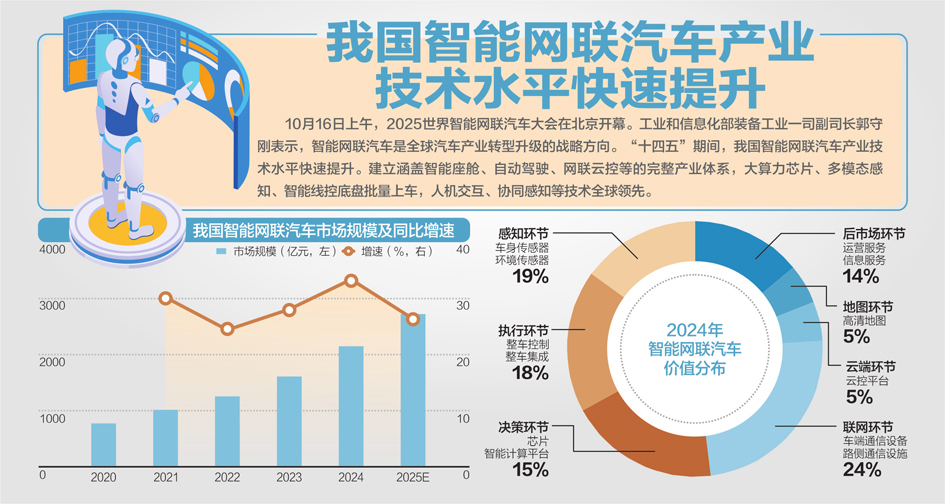
Core Insights - The 2025 World Intelligent Connected Vehicle Conference opened in Beijing, highlighting the progress of China's intelligent connected vehicle industry, which has established a complete industrial system including smart cockpits, autonomous driving, and cloud control [1][2] Industry Development - China's intelligent connected vehicle industry is thriving, with Beijing alone recording over 62 million kilometers of testing for autonomous passenger cars, smart buses, and unmanned delivery vehicles [2] - The new car sales of passenger vehicles equipped with combined driving assistance functions have exceeded 60%, with over 35,000 kilometers of open testing demonstration roads nationwide and more than 11,000 intelligent roadside unit devices deployed [2] Policy and Standards - The policy framework for the intelligent connected vehicle industry is gradually improving, with 88 national and industry standards published, and nearly 10 international standards related to autonomous driving systems and testing scenarios being led [2][3] - The Ministry of Transport emphasizes the importance of artificial intelligence in enhancing smart transportation applications and developing typical application scenarios that are mature, feasible, and replicable [2] Challenges and Future Directions - Experts note that the industry faces challenges such as unbroken key technologies, the need for improved legal regulations, and issues of irrational competition [3] - The Ministry of Industry and Information Technology plans to compile the "14th Five-Year" development plan for the intelligent connected new energy vehicle industry, focusing on high-quality development and supporting technological innovation [3] Cross-Industry Integration - The industry aims to promote cross-industry integration and deepen the "vehicle-road-cloud integration" application trials, while also supporting the establishment of a trusted data space [3] - Companies like Cao Cao Mobility are actively deploying second-generation Robotaxi vehicles and have announced the integration of low-orbit satellite communication technology to enhance operational safety and emergency response capabilities [3][4]
工信部副部长辛国斌:搭载组合驾驶辅助功能的乘用车新车销量占比超过60%
Zhong Guo Jing Ying Bao· 2025-10-16 17:13
Core Insights - The 2025 World Intelligent Connected Vehicle Conference has opened, highlighting the positive developments in China's intelligent connected vehicle industry [1] - The Ministry of Industry and Information Technology (MIIT) aims to deepen the integration of artificial intelligence with the automotive industry, focusing on various aspects of the automotive supply chain [1] Industry Developments - China has established a complete industrial system for intelligent connected vehicles, including smart cockpits, autonomous driving, and networked cloud control [1] - The sales proportion of new passenger cars equipped with combined driving assistance functions exceeds 60% [1] - Key technologies such as high-performance chips and intelligent control chassis are now being mass-produced and deployed [1] Future Initiatives - MIIT plans to promote the deep integration of AI with the automotive industry and establish high-level AI pilot bases [1] - The ministry will support the development of large model applications across the automotive supply chain, enhancing digital transformation [1] - There will be a focus on advancing new-generation electronic and electrical architectures, high-performance chips, and operating systems [1] Cross-Industry Collaboration - The initiative will advance the "vehicle-road-cloud integration" application pilot projects to improve autonomous driving safety through information exchange [1] - Support will be provided for collaboration among automotive, information communication, energy, and transportation sectors to build a trusted data space [1] Policy Framework - The MIIT will draft the "14th Five-Year" plan for the development of intelligent connected new energy vehicles [1] - There will be efforts to accelerate the formulation of standards related to combined driving assistance and autonomous driving [1] - The ministry will optimize the production access management system for intelligent connected vehicles [1]
尹力:北京将积极打造智能网联汽车产业发展高地
Zhong Guo Jing Ying Bao· 2025-10-16 17:13
Core Insights - The World Intelligent Connected Vehicles Conference aims to gather wisdom from various sectors to promote the safe application of intelligent connected technologies [1][2] - Beijing is positioned as a key automotive industry base in China, focusing on innovation and a complete automotive industry system, with initiatives to enhance autonomous driving regulations and smart infrastructure [1] - The conference will feature discussions on policies, technology, safety, artificial intelligence, applications, and data, with participation from over 4,000 representatives from more than 10 countries and regions [2] Group 1 - The conference is co-hosted by the Ministry of Industry and Information Technology, the Ministry of Transport, and the Beijing Municipal Government, lasting for three days [2] - The theme of the conference is "Gathering Wisdom and Energy, Unlimited Connectivity," with various forums and meetings focusing on key industry topics [2] - The event will release significant outcomes related to the standardization of intelligent connected vehicles and a roadmap for network technology [2] Group 2 - Beijing aims to create a highland for the development of the intelligent connected vehicle industry, fostering collaboration between enterprises, universities, and research institutions [1] - The city plans to enhance the industry environment by improving standards and regulatory frameworks, supporting high-level applications, and ensuring safety [1] - The conference promotes international cooperation to maintain the resilience and stability of global supply chains and to facilitate practical collaborations between domestic and foreign automotive companies [1]
汽车产业角逐进入下半场 AI从“锦上添花”变成“核心变量”
2 1 Shi Ji Jing Ji Bao Dao· 2025-10-16 15:15
Core Insights - The integration of artificial intelligence in the automotive industry has shifted from being an optional enhancement to a core variable crucial for survival and development [1] - The development of intelligent connected vehicles is seen as the second half of a competitive game, with significant transformations in product forms, industry structures, infrastructure, and mobility methods underway [3][5] Industry Developments - The Ministry of Industry and Information Technology (MIIT) plans to support technological innovation and promote deep integration of AI with the automotive industry, focusing on breakthroughs in key technologies such as new electronic architectures and high-performance chips [2][10] - China has established a comprehensive industrial system for intelligent connected vehicles, including smart cockpits and autonomous driving, and is actively conducting pilot applications for "vehicle-road-cloud integration" [3][5] Competitive Advantages - China possesses several competitive advantages in the intelligent connected vehicle sector, including a rich variety of application scenarios, a complete supply chain for hardware and software, and a clear national strategy supported by a systematic policy framework [5][6] - The acceptance of intelligent products among younger consumers (80s and 90s) is driving rapid growth in the penetration rate of L2 driver assistance systems in the passenger car market [5] Challenges and Risks - The intelligent connected vehicle sector faces challenges such as standardization and collaboration issues, cost control for computing power, and safety risks associated with diverse communication paths and intelligent perception systems [8][9] - The ability to handle rare scenarios, referred to as "long-tail scenarios," poses a potential safety risk due to insufficient training data [8] Future Directions - The implementation of AI in transportation is expected to be widespread by 2027, with a focus on developing a comprehensive transportation model and deploying intelligent agents [6] - The next phase for the MIIT includes drafting a development plan for the intelligent connected vehicle industry, promoting high-quality development, and enhancing international cooperation in technology and standards [10]
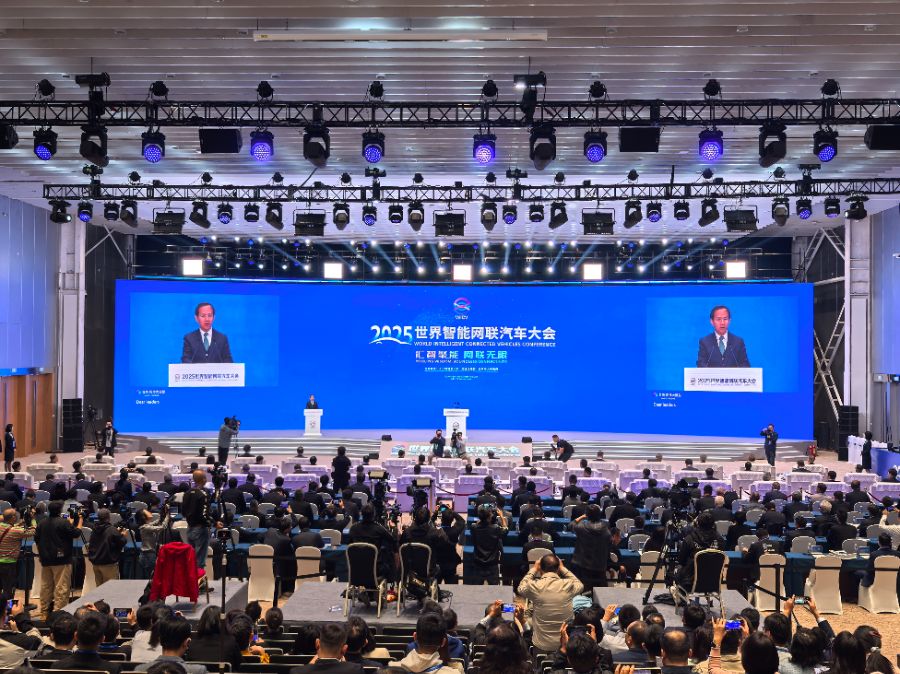
2025世界智能网联汽车大会昨开幕
Mei Ri Jing Ji Xin Wen· 2025-10-16 14:41
Core Insights - The automotive industry is undergoing a significant transformation, with China's electric vehicle market leading the way in electrification and now focusing on intelligent driving technology [3] - Safety is emphasized as the top priority in the development of intelligent driving systems, with industry leaders advocating for strict adherence to safety standards [4][5] - The integration of artificial intelligence in the automotive sector is becoming a core variable for business survival and development [3] Group 1: Industry Transformation - The intelligent driving technology is at a critical turning point for commercialization, with increasing attention on its safety [3] - The global automotive industry is being reshaped by the wave of intelligent technology, with AI evolving from an optional enhancement to a necessity for survival [3] Group 2: Safety Emphasis - Industry consensus highlights that safety must be prioritized in the development of intelligent driving systems, as stated by various leaders [4][5] - The establishment of mandatory safety standards by the government is seen as a crucial step in regulating the intelligent driving market [4] Group 3: Investment and Development - Companies like Xiaomi are significantly investing in advanced driver assistance systems, with an initial investment of 57.9 billion yuan and a dedicated team of over 1,800 people [6] - The focus on reducing accidents is highlighted as a primary goal for the development of autonomous driving technology [6] Group 4: Balancing Safety and Innovation - The automotive industry faces challenges in defining responsibilities among various technology partners to ensure the safety and reliability of vehicles [7] - There is a call for a balanced approach between innovation and safety, ensuring that technological advancements do not compromise safety standards [9]
雷军称小米汽车交付量达40万台
2 1 Shi Ji Jing Ji Bao Dao· 2025-10-16 14:16
Core Insights - The development of intelligent connected vehicles is at a historical opportunity period, requiring industry-wide collaboration to build a new ecosystem [1][2] - Xiaomi has delivered approximately 400,000 vehicles since its entry into the automotive market, with a focus on both electrification and increasing intelligence in vehicles [1] - The combination of advanced driver assistance systems is a focal point for the industry, with significant improvements in experience and safety expected as new policies and regulations are implemented [1] Industry Trends - The first half of the intelligent connected vehicle development has seen initial electrification, while the second half is focusing on deeper intelligence integration [1] - AI large models are expected to provide limitless possibilities for intelligent connected vehicles, enhancing user experience through advanced features like voice control and emotional recognition [2] - The automotive industry is characterized by its complexity and the need for a collaborative ecosystem rather than a single-point competition [2] Strategic Vision - Xiaomi envisions cars as intelligent mobile spaces, integrating them into a broader ecosystem that connects people, vehicles, and homes [2] - The company aims to leverage AI computing power across different scenarios and terminals within its ecosystem, creating vast application opportunities in the intelligent connected vehicle sector [2]