金属

Search documents
工业金属板块9月22日涨0.57%,盛达资源领涨,主力资金净流出4.38亿元
Zheng Xing Xing Ye Ri Bao· 2025-09-22 08:40
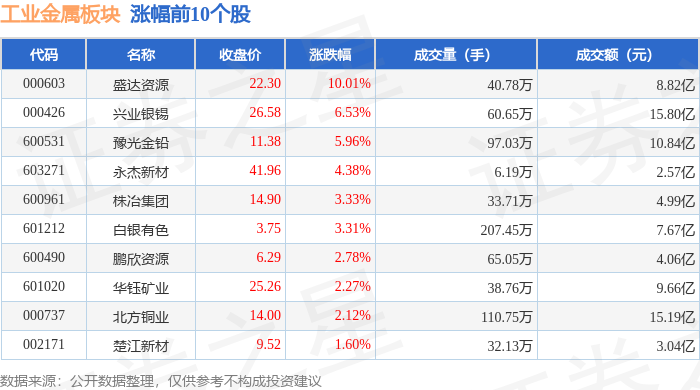
Market Overview - On September 22, the industrial metals sector rose by 0.57% compared to the previous trading day, with Shengda Resources leading the gains [1] - The Shanghai Composite Index closed at 3828.58, up 0.22%, while the Shenzhen Component Index closed at 13157.97, up 0.67% [1] Top Performers - Shengda Resources (000603) closed at 22.30, with a gain of 10.01% and a trading volume of 407,800 shares, amounting to a transaction value of 882 million [1] - Xingyin Tin (000426) closed at 26.58, up 6.53%, with a trading volume of 606,500 shares and a transaction value of 1.58 billion [1] - Yuguang Jin Lead (600531) closed at 11.38, increasing by 5.96%, with a trading volume of 970,300 shares and a transaction value of 1.08 billion [1] Underperformers - Haomei New Materials (002988) closed at 41.00, down 5.64%, with a trading volume of 91,700 shares and a transaction value of 377 million [2] - Xinyuan Intelligent Manufacturing (600615) closed at 13.31, decreasing by 2.42%, with a trading volume of 64,600 shares and a transaction value of 86.42 million [2] - Yiqiu Deyuan (601388) closed at 2.90, down 2.36%, with a trading volume of 936,600 shares and a transaction value of 272 million [2] Capital Flow - On the same day, the industrial metals sector experienced a net outflow of 438 million from institutional investors, while retail investors saw a net inflow of 414 million [2] - The top net inflows from retail investors included Shengda Resources (1.11 million) and Yuguang Jin Lead (1.02 million) [3] Summary of Capital Flow by Company - Shengda Resources had a net inflow of 111 million from institutional investors, while it faced a net outflow of 55 million from speculative funds [3] - Yuguang Jin Lead saw a net inflow of 102 million from institutional investors, with a net outflow of 26 million from speculative funds [3] - Baiyin Youse (601212) had a net inflow of 66.85 million from institutional investors, with a net outflow of 1.39 million from speculative funds [3]


关税威胁下 提供5500亿美元投资的美日协议能否重振美国制造业?
Di Yi Cai Jing· 2025-09-19 15:33
Core Insights - The U.S. government is exploring how to utilize Japan's commitment of $550 billion in investments to revitalize domestic manufacturing following the recent trade agreement with Japan [1][2] - Current data indicates a significant decline in U.S. manufacturing performance, with the New York Fed manufacturing index dropping from 11.9 to -8.7 in September [1] - The investment agreement includes a governance structure and profit-sharing mechanism, with Japan required to complete the investment allocation before the end of Trump's term [2][3] Investment Opportunities - The investment is targeted at key industries such as semiconductors, pharmaceuticals, critical minerals, metals, shipbuilding, energy, AI, and quantum computing [2] - An investment committee led by U.S. Commerce Secretary Ross will oversee the projects, with a consulting committee providing recommendations [2] Economic Outlook - The overall sentiment in the manufacturing sector is pessimistic, with manufacturers hesitant to expand capacity due to uncertain sales prospects [1][3] - The current manufacturing landscape is influenced by previous legislation such as the Inflation Reduction Act and the CHIPS and Science Act, which provided incentives for factory construction [1][3] Trade Policy Implications - The trade agreement allows the U.S. to exert significant control over the investment process, with Japan needing to align its interests with U.S. proposals [3] - The U.S. retains the right to impose tariffs if Japan fails to meet its investment commitments, which serves as a leverage point [3] Challenges and Risks - There is considerable uncertainty regarding the timing and realization of investment commitments, with many plans initiated during the Biden administration [6] - The current tariff policies have led to profit shrinkage and investment stagnation among U.S. companies, with notable examples of layoffs and reduced hiring in the manufacturing sector [6][7] - The legal status of the tariff policies is under scrutiny, with potential adjustments on the horizon following a recent court ruling [7] Supply Chain Dependencies - U.S. manufacturers remain heavily reliant on global markets for raw materials and components, with 69% of intermediate inputs sourced domestically and nearly one-third imported [8]
美联储降息后 哪些资产有望受益?
Jin Rong Shi Bao· 2025-09-19 09:46
Group 1 - The Federal Reserve announced a 25 basis point interest rate cut, impacting global markets significantly [1] - Following the announcement, major US stock indices rose, with the Dow Jones Industrial Average increasing by 124.10 points to 46142.42, the S&P 500 up by 31.61 points to 6631.96, and the Nasdaq rising by 209.40 points to 22470.73 [1] - International gold prices experienced a slight decline, with spot gold down 0.4% to $3644.01 per ounce, as the market reassessed the Fed's stance [1] Group 2 - Analysts predict that the new interest rate cut cycle will benefit various assets, including stocks and gold, although there remains some uncertainty about the Fed's commitment to a prolonged easing cycle [2] - The domestic technology sector is expected to attract overseas investment, particularly in AI and semiconductor fields, which could lead to a continued strong performance in Chinese tech stocks [2] - Historical trends suggest that US stocks typically perform well in the 12 to 18 months following the start of a Fed easing cycle, provided the economy does not enter a recession [2] Group 3 - Long-term concerns regarding the potential loss of the Federal Reserve's independence may lead investors to demand higher risk premiums on US Treasuries, especially long-term bonds [3] - The current independence of the Fed remains intact, but this issue could become increasingly significant over time, warranting investor attention [3]
工业金属板块9月19日涨1.17%,宏创控股领涨,主力资金净流出8.38亿元
Zheng Xing Xing Ye Ri Bao· 2025-09-19 08:42
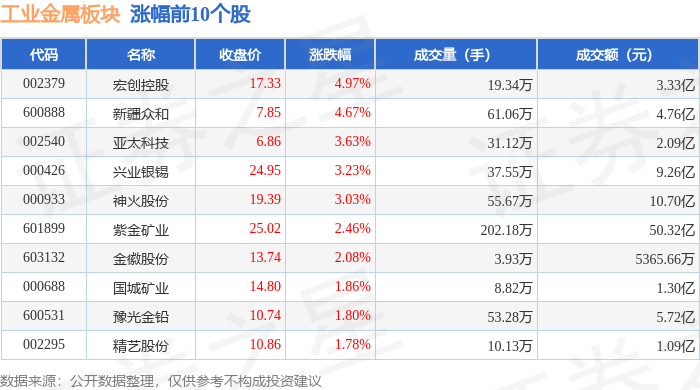
Group 1 - The industrial metal sector increased by 1.17% on September 19, with Hongchuang Holdings leading the gains [1] - The Shanghai Composite Index closed at 3820.09, down 0.3%, while the Shenzhen Component Index closed at 13070.86, down 0.04% [1] - Key stocks in the industrial metal sector showed various performance, with Hongchuang Holdings rising by 4.97% and closing at 17.33 [1] Group 2 - Major stocks that declined included Liyuan Co., down 6.05% to 2.64, and Beifang Copper, down 5.12% to 13.71 [2] - The industrial metal sector experienced a net outflow of 838 million yuan from main funds, while retail investors saw a net inflow of 804 million yuan [2][3] - The stock with the highest net inflow from main funds was China Aluminum, with 79.77 million yuan, while Xinjiang Zhonghe had a net outflow of 5.73 million yuan from retail investors [3]



大宗商品资金流入激增,通胀“交易员”拉响警报:全球通胀或将在6-9个月内重新抬头
Hua Er Jie Jian Wen· 2025-09-18 13:41
Core Insights - The article highlights a contrasting narrative between mainstream market optimism regarding inflation and the warnings from commodity traders about potential inflationary pressures ahead [1][2][3] Commodity Market Insights - Commodity markets are seen as a closer indicator of inflation, with rising raw material prices typically signaling broader price increases [2] - Historical data suggests that metal prices lead global Consumer Price Index (CPI) by approximately 6-9 months, indicating that current increases in metal prices may foreshadow rising inflation [2][3] Inflation Leading Indicators - Multiple inflation leading indicators are showing strong signals of impending price pressure, with a composite indicator based on manufacturing, monetary, and commodity data remaining above 2% and accelerating [3] - Rising freight and fertilizer prices are also noted as indicators that precede increases in food CPI [3] Market Sentiment - There is a notable overconfidence in the stock and bond markets, with significant inflows into major U.S. stock and bond ETFs, showing no signs of decline [4] - Current inflows into stocks and bonds do not reflect expectations of a scenario similar to the inflationary period of the 1970s, where commodities provided significant positive real returns [5]
探七轮美联储降息规律,迎全球“Risk on”行情
2025-09-17 14:59
Summary of Conference Call Notes Industry or Company Involved - The discussion primarily revolves around the U.S. economy and the Federal Reserve's interest rate policies, with implications for various sectors including technology, manufacturing, and commodities. Core Points and Arguments - **Economic Slowdown and Rate Cuts**: The U.S. economy is experiencing a slowdown, with weak non-farm employment and inflation data. The market anticipates the Federal Reserve will cut rates three times in Q4 2025, specifically in September, October, and December, with an additional three cuts expected in 2026 [1][2] - **Historical Context of Rate Cuts**: Historical patterns show that recessionary rate cuts (e.g., 1989-1992, 2001-2003, 2007-2008) typically lead to declines in risk assets, while preventive cuts (e.g., 1995-1996, 1998) can boost stock markets and commodities [1][4] - **Current Market Environment**: The current market conditions are likened to those in July 1995, September 1998, and September 2024, suggesting that equity markets, particularly technology stocks, may benefit from increased liquidity [1][5] - **Sector Performance Expectations**: Sectors expected to perform well include technology, manufacturing, and export-oriented industries, particularly those related to AI, robotics, and low-value stocks showing marginal improvement [1][6] Other Important but Possibly Overlooked Content - **Investment Strategy**: The overall market strategy is characterized as a "slow bull market," with rapid gains in July and August expected to moderate in September. Investors are advised to focus on sectors with improving economic conditions, such as upstream metals, chemicals, lithium batteries, and livestock agriculture [1][6] - **Historical Rate Cut Effects**: Specific historical examples illustrate the varying impacts of rate cuts on different asset classes, emphasizing the importance of context in understanding current market dynamics [4][5] - **Focus on Value Stocks**: There is a recommendation to identify and invest in low-value stocks that have shown signs of improvement over the past two quarters, alongside a focus on sectors like military and logistics [6]
工业金属板块9月17日涨0.21%,电工合金领涨,主力资金净流出6.53亿元
Zheng Xing Xing Ye Ri Bao· 2025-09-17 08:42
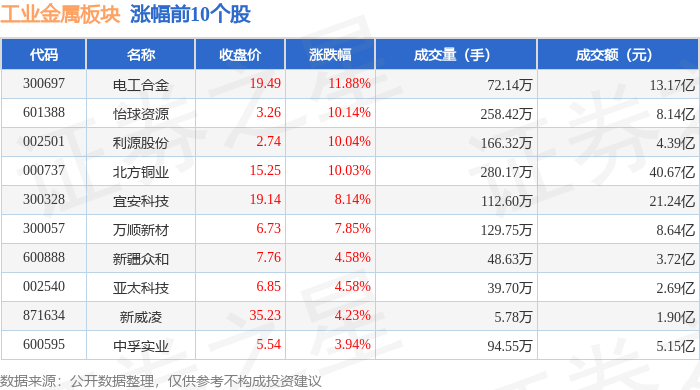
Market Overview - On September 17, the industrial metals sector rose by 0.21% compared to the previous trading day, with Electric Alloy leading the gains [1] - The Shanghai Composite Index closed at 3876.34, up 0.37%, while the Shenzhen Component Index closed at 13215.46, up 1.16% [1] Top Gainers in Industrial Metals - Electric Alloy (300697) closed at 19.49, up 11.88% with a trading volume of 721,400 shares and a transaction value of 1.317 billion yuan [1] - Yiqiu Resources (601388) closed at 3.26, up 10.14% with a trading volume of 2,584,200 shares and a transaction value of 814 million yuan [1] - Liyuan Co. (002501) closed at 2.74, up 10.04% with a trading volume of 1,663,200 shares and a transaction value of 439 million yuan [1] - Northern Copper (000737) closed at 15.25, up 10.03% with a trading volume of 2,801,700 shares and a transaction value of 4.067 billion yuan [1] - Other notable gainers include Yian Technology (300328) and Wanshun New Materials (300057) with increases of 8.14% and 7.85% respectively [1] Top Losers in Industrial Metals - Xingye Silver Tin (000426) closed at 25.00, down 4.58% with a trading volume of 620,700 shares and a transaction value of 1.559 billion yuan [2] - Shengda Resources (000603) closed at 21.20, down 3.37% with a trading volume of 323,700 shares and a transaction value of 685 million yuan [2] - Hailiang Co. (002203) closed at 12.21, down 3.17% with a trading volume of 443,300 shares and a transaction value of 546 million yuan [2] Capital Flow Analysis - On the same day, the industrial metals sector experienced a net outflow of 653 million yuan from institutional investors, while retail investors saw a net inflow of 740 million yuan [2] - The capital flow data indicates that Northern Copper (000737) had a net inflow of 48.216 million yuan from institutional investors, while it faced a net outflow of 191 million yuan from speculative funds [3] - Yiqiu Resources (601388) and Liyuan Co. (002501) also showed significant net outflows from speculative funds, indicating a shift in investor sentiment [3]





铜冠金源期货商品日报-20250917
Tong Guan Jin Yuan Qi Huo· 2025-09-17 02:40
1. Report Industry Investment Rating No relevant content provided. 2. Core Views of the Report - The market is highly concerned about the Fed's interest rate decision, with a general expectation of a 25bp rate cut. Most commodities are in a state of waiting for the outcome of the meeting, and their short - term trends are affected by this expectation [4][6][16]. - Domestic policies are being introduced to boost service consumption, and the A - share market is expected to oscillate at a high level in the short term, while the bond market remains on the sidelines [3]. - Different commodities have different supply - demand fundamentals, which, combined with macro - factors, determine their price trends. 3. Summary by Related Catalogs Macroeconomics - Overseas: The US retail sales in August increased by 0.6% month - on - month, higher than expected, indicating strong consumption. The market is waiting for the FOMC result, with the US dollar index falling, and the gold price hitting a new high [2]. - Domestic: The Ministry of Commerce and other nine departments have introduced new policies for service consumption. The A - share market is oscillating, with more than 3,600 stocks rising. The bond market is sensitive to negatives, and the 10Y and 30Y interest rates have been restored to 1.78% and 2.08% respectively [3]. Precious Metals - Gold and silver showed mixed performance. COMEX gold futures rose 0.23% to $3,727.5 per ounce, while COMEX silver futures fell 0.19% to $42.88 per ounce. The market expects the Fed to cut interest rates, but some funds are cautious as the rate - cut approaches [4]. Copper - Before the Fed's interest rate meeting, the market is cautious. The expectation of a 25 - basis - point rate cut this month may have been digested. The market is highly concerned about the future path of the "dot plot". Part of the overseas long - position funds have taken profits in advance. The dollar index is continuously weakening, and the copper price still has upward potential in the medium term [6]. Aluminum - The aluminum price continued to oscillate strongly. The market's strong expectation of a Fed rate cut has boosted the aluminum price. However, high prices have restricted downstream procurement to some extent. The consumption peak season needs to be verified, and the price needs fundamental support to rise further [7][8]. Zinc - The expectation of a large - scale rate cut has weakened. The LME zinc inventory has been continuously decreasing, supporting the price of London zinc and thus the Shanghai zinc price. The domestic downstream procurement is still cautious, and the zinc price oscillates narrowly in the short term [9]. Lead - The expectation of refinery复产 has increased, and the supply - side support for the lead price has weakened. However, the expected stocking demand of downstream battery enterprises during the National Day holiday and the expected outflow of some goods after delivery will support the price. The lead price is expected to adjust at a high level in the short term [10]. Tin - The LME 0 - 3 BACK has slightly widened, and the slow resumption of tin mines in Myanmar and domestic refinery maintenance support the price. However, the increase in inventory at home and abroad and insufficient downstream consumption make it difficult for the price to rise. The tin price will continue to oscillate horizontally in the short term [11]. Industrial Silicon - The demand expectation has improved, and the industrial silicon price is running strongly. The supply is slightly shrinking, and the demand side shows signs of improvement. The short - term price is expected to oscillate [12][13]. Carbonate Lithium - The lithium price may still rise. The downstream stocking expectation is strong, but the acceptance of prices is weak. The risk of resource disruption has not been eliminated, and the high - level emphasis on anti - involution provides support for the price [14]. Nickel - As the Fed's interest rate meeting approaches, the market generally expects a 25bp rate cut. If there is no more - than - expected rate cut, the nickel price may experience a phased correction. The nickel ore market is generally loose, and the domestic nickel - iron cost pressure remains [15][16]. Crude Oil - Geopolitical tensions and inventory reduction have led to an oscillating and strengthening oil price. Although the market has a strong expectation of oversupply in the fourth quarter, the significant reduction in API crude oil inventory has boosted the bulls' sentiment. Geopolitical premiums are continuously factored in [17][18]. Soda Ash and Glass - Attention should be paid to cross - variety arbitrage opportunities. The soda ash price increase may be related to demand and macro - expectations. The glass factory's shipment is smooth, and the market expects the Fed's interest rate meeting to drive domestic liquidity release. One can pay attention to the opportunity of the narrowing spread between glass and soda ash [19][20]. Steel (Rebar and Hot - Rolled Coil) - The steel price is oscillating. After the continuous rise, the market sentiment has been released, and the fundamental demand is poor. The supply has increased, and the peak - season expectation is difficult to be fulfilled. The price is expected to oscillate, and attention should be paid to the impact of the Fed's rate cut on the market [21]. Iron Ore - The port inventory has decreased, and the futures price is oscillating and rebounding. The external ore shipment has increased significantly, and the demand side is supported by the high - level resumption of blast - furnace operation. There is still an expectation of restocking in mid - to - late September [22]. Soybean Meal and Rapeseed Meal - The market trading is light, and the Dalian soybean meal is oscillating within a range. The short - term supply is under pressure, and the long - term import is uncertain. The future trend depends on the US bio - fuel redistribution plan and Sino - US and Sino - Canadian trade relations [23][24]. Palm Oil - The palm oil is oscillating and adjusting. The price of edible oils, including palm oil, is expected to be firm. The supply is expected to be less than the demand in 2025 and 2026. The strong performance of rapeseed oil and the impact of weather on palm oil production and export support the price [25].
国内高频 | 一线城市新房成交改善(申万宏观·赵伟团队)
申万宏源宏观· 2025-09-16 11:58
Group 1: Industrial Production - Industrial production has shown improvement, with blast furnace operating rates increasing by 3.5% week-on-week and 3.5 percentage points year-on-year to 6.2% [2][5] - The chemical production chain has also seen a rebound, with soda ash and PTA operating rates rising by 1.1% and 5.5% respectively, year-on-year changes of 2.7 percentage points to 12.5% and 8.5 percentage points to -6.3% [2][12] - The automotive semi-steel tire operating rate has improved, increasing by 6% week-on-week and 5.8 percentage points year-on-year to 73.5% [12] Group 2: Construction and Infrastructure - Infrastructure construction remains at a high level, with national grinding operating rates and cement shipment rates rising by 4.3% and 1.1% respectively, year-on-year changes of 5.8 percentage points to -5.5% and 1.1 percentage points to -4.4% [2][16] - Asphalt operating rates have slightly decreased by 1.8% week-on-week but remain at a high level year-on-year at 12.4% [2][22] Group 3: Real Estate and Demand - Real estate transactions have improved, with the average daily transaction area of new homes rising by 9.6 percentage points year-on-year to 6.3%, particularly in first and second-tier cities [2][25] - Port cargo throughput related to exports has shown strong performance, with year-on-year increases of 3% to 7.2% and 7.8% to 13.4% for cargo and container throughput respectively [2][32] Group 4: Price Trends - Agricultural product prices have rebounded, with prices for eggs, vegetables, and pork increasing by 1.3%, 0.8%, and 0.3% respectively [3][57] - Industrial product prices are showing divergence, with the Nanhua Industrial Price Index increasing by 0.1% week-on-week, while energy and chemical prices decreased by 0.2% and metal prices increased by 0.3% [3][63]

工业金属板块9月16日跌1.13%,中孚实业领跌,主力资金净流出26.44亿元
Zheng Xing Xing Ye Ri Bao· 2025-09-16 08:46
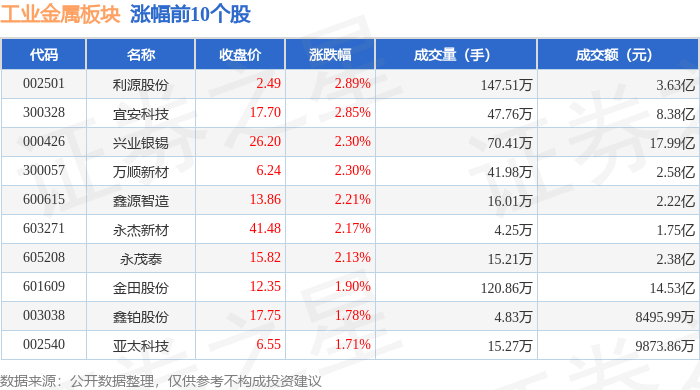
Market Overview - On September 16, the industrial metals sector declined by 1.13%, with Zhongfu Industrial leading the drop [1] - The Shanghai Composite Index closed at 3861.87, up 0.04%, while the Shenzhen Component Index closed at 13063.97, up 0.45% [1] Stock Performance - Notable gainers in the industrial metals sector included: - Liyuan Co., Ltd. (002501) with a closing price of 2.49, up 2.89% on a trading volume of 1.4751 million shares and a turnover of 363 million yuan [1] - Yian Technology (300328) closed at 17.70, up 2.85% with a trading volume of 477,600 shares and a turnover of 838 million yuan [1] - Xingyin Tin (000426) closed at 26.20, up 2.30% with a trading volume of 704,100 shares and a turnover of 1.799 billion yuan [1] - Conversely, significant decliners included: - Santai Wenchu (600595) closed at 5.33, down 4.65% with a trading volume of 1.2563 million shares [2] - Yuguang Jin Lead (600531) closed at 11.46, down 4.26% with a trading volume of 1.6218 million shares [2] - Jiaozuo Wanfang (000612) closed at 8.40, down 3.34% with a trading volume of 622,200 shares [2] Capital Flow - The industrial metals sector experienced a net outflow of 2.644 billion yuan from institutional investors, while retail investors saw a net inflow of 1.998 billion yuan [2][3] - Notable capital flows included: - Xingyin Tin (000426) had a net inflow of 51.23 million yuan from institutional investors, while retail investors had a net outflow of 53.62 million yuan [3] - Tianshan Aluminum (002532) saw a net inflow of 30.43 million yuan from institutional investors, with retail investors experiencing a net outflow of 15.86 million yuan [3]