Workflow
建筑装饰
icon
Search documents
年内超百家公司亮红灯,建筑装饰为何成退市风险“高发区”?
3 6 Ke· 2025-10-10 12:58
Core Viewpoint - The article highlights the increasing pressure on companies facing delisting risks due to stringent regulations aimed at maintaining a healthy capital market, with a significant number of companies already under warning for poor financial performance and misconduct [1][3]. Group 1: Delisting Risks and Regulations - As of this year, 107 companies have been placed under delisting risk warnings, with 83 from the main board and 19 from the ChiNext board [3]. - The new delisting regulations are the strictest in history, targeting companies with long-term poor performance, financial fraud, or other serious issues [1][3]. - Companies on the main board face delisting if they have negative net profits for two consecutive years and revenue below 300 million yuan, while those on the ChiNext and Sci-Tech Innovation boards have lower thresholds [3]. Group 2: Financial Performance of Affected Companies - Among the 83 main board companies, 55 reported revenues below 300 million yuan in their latest audits [3]. - Six companies are undergoing legal restructuring or bankruptcy proceedings, and another six have been involved in fraudulent issuance or severe financial misconduct [3][4]. - Twelve companies reported negative net assets in their latest audits, and four were unable to provide audit reports [3]. Group 3: Industry Impact - The construction and decoration industry has the highest number of companies facing delisting risks, with 12 companies affected [10][11]. - The downturn in the real estate market has directly impacted construction companies, leading to reduced demand and delayed payments, which in turn affects their revenues and profitability [12]. - The complexity of the construction industry, involving multiple stages and significant capital investment, increases the risk of financial instability [12].
能繁母猪存栏微降,浮法玻璃盈利同比转正:——金融工程行业景气月报20251010-20251010
EBSCN· 2025-10-10 11:27
- The report utilizes a methodology from the industry rotation series to track the configuration signals and business indicators of various industries, including coal, livestock farming, steel, structural materials, and fuel refining industries [9] Quantitative Models and Construction Methods Coal Industry Model - **Model Name**: Coal Industry Profit and Revenue Growth Estimation Model - **Model Construction Idea**: The model estimates monthly revenue and profit growth of the coal industry based on the changes in price and production capacity factors [10] - **Model Construction Process**: - The long-term contract mechanism for thermal coal determines the sales price for the next month based on the price index of the last month - Monthly revenue and profit growth are estimated using the year-on-year changes in price factors and production capacity factors [10] - **Model Evaluation**: The model predicts that the coal industry profit for October 2025 will continue to decline year-on-year due to coal prices being lower than the same period last year [14] Livestock Farming Model - **Model Name**: Livestock Supply and Demand Gap Estimation Model - **Model Construction Idea**: The model uses the relationship between the number of breeding sows and the quarterly pig slaughter rate to estimate the supply-demand gap for pigs six months later [15] - **Model Construction Process**: - The model assumes a stable proportional relationship between quarterly pig slaughter and the number of breeding sows six months prior - Formula: $ \text{Slaughter Coefficient} = \frac{\text{Quarterly Pig Slaughter}}{\text{Breeding Sow Inventory (lagged 6 months)}} $ [15] - Potential production capacity after 6 months is calculated as: $ \text{Potential Production Capacity (6 months later)} = \text{Breeding Sow Inventory (current month)} \times \text{Slaughter Coefficient (6 months prior)} $ [16] - Potential demand after 6 months is calculated as: $ \text{Potential Demand (6 months later)} = \text{Quarterly Pig Slaughter (6 months prior)} $ [16] - **Model Evaluation**: Historical experience shows that the slaughter coefficient method effectively identifies pig price upward cycles [16] Steel Industry Model - **Model Name**: Steel Industry Profit and Unit Profit Estimation Model - **Model Construction Idea**: The model predicts monthly profit growth and calculates unit profit for the steel industry by considering comprehensive steel prices and cost indicators such as iron ore, coke, pulverized coal, and scrap steel [18] - **Model Construction Process**: - Comprehensive steel prices and cost indicators are used to predict monthly profit growth - Unit profit is calculated based on the difference between steel prices and costs [18] - **Model Evaluation**: The model predicts that the steel industry profit for September 2025 will grow year-on-year, but the PMI rolling 12-month average remains flat, maintaining a neutral configuration viewpoint [23] Structural Materials and Building Engineering Model - **Model Name**: Glass and Cement Industry Profit Tracking Model - **Model Construction Idea**: The model tracks profitability changes in the glass and cement manufacturing industries using price and cost indicators, and designs configuration signals based on profitability changes [25] - **Model Construction Process**: - Price and cost indicators are used to track profitability changes - Configuration signals are designed based on profitability changes [25] - **Model Evaluation**: - Glass industry profit turned positive year-on-year in September 2025, leading to an upgrade to a positive configuration signal [30] - Cement industry profit remained flat year-on-year, and no positive signals were observed in new housing starts, maintaining a neutral configuration viewpoint [30] Fuel Refining and Oil Services Model - **Model Name**: Fuel Refining and Oil Services Profit and Configuration Signal Model - **Model Construction Idea**: The model estimates industry profit growth and cracking spreads based on changes in refined fuel prices and crude oil prices, and designs configuration signals based on oil prices, cracking spreads, and new drilling changes [31] - **Model Construction Process**: - Refined fuel price changes and crude oil price changes are used to estimate industry profit growth and cracking spreads - Configuration signals are designed based on oil prices, cracking spreads, and new drilling changes [31] - **Model Evaluation**: - The model predicts that the fuel refining industry profit for September 2025 will grow year-on-year due to lower inventory costs from recent low oil prices [31] - Observations show that oil prices in September 2025 were lower than the same period last year, maintaining a neutral configuration viewpoint for the fuel refining and oil services industries [37][38] Model Backtesting Results Coal Industry Model - **Profit Growth**: Predicted to continue declining year-on-year in October 2025 due to lower coal prices compared to the same period last year [14] Livestock Farming Model - **Breeding Sow Inventory**: 4,038 million heads as of August 2025, slightly decreased month-on-month [17] - **Potential Production Capacity (26Q1)**: 19,361 million heads [17] - **Potential Demand (26Q1)**: 19,476 million heads [17] - **Supply-Demand Balance**: Slightly tight [17] Steel Industry Model - **Profit Growth**: Predicted to grow year-on-year in September 2025 [23] - **PMI Rolling Average**: Remained flat for 12 months, not exceeding the threshold [23] Structural Materials and Building Engineering Model - **Glass Industry Profitability**: Turned positive year-on-year in September 2025 [30] - **Cement Industry Profitability**: Remained flat year-on-year in September 2025 [30] - **Manufacturing PMI Rolling Average**: Remained flat for 12 months [30] - **Housing Sales Area**: Observed a year-on-year decline in August 2025 [30] Fuel Refining and Oil Services Model - **Fuel Refining Industry Profitability**: Predicted to grow year-on-year in September 2025 due to lower inventory costs [31] - **Oil Price**: Observed to be lower than the same period last year in September 2025 [37] - **New Drilling Activity**: No significant year-on-year changes observed in the US [38]
本周主力资金净流出1457.50亿元,电子净流出规模居首
Market Overview - The Shanghai Composite Index increased by 0.37% this week, while the Shenzhen Component Index decreased by 1.26%, and the ChiNext Index fell by 3.86%. The CSI 300 Index declined by 0.51% [1] - Among the tradable A-shares, 2,963 stocks rose, accounting for 54.66%, while 2,379 stocks fell [1] Capital Flow - This week, the total net outflow of main funds was 145.75 billion yuan, with every trading day showing a net outflow. The ChiNext saw a net outflow of 50.69 billion yuan, the Sci-Tech Innovation Board had a net outflow of 22.16 billion yuan, and the CSI 300 components experienced a net outflow of 64.64 billion yuan [2][1] Industry Performance - Out of the 28 primary industries classified by Shenwan, 17 industries saw an increase this week. The top-performing sectors were non-ferrous metals and coal, with increases of 4.44% and 4.41%, respectively. The worst-performing sectors were media and electronics, with declines of 3.82% and 2.63% [2][1] - In terms of capital flow by industry, seven industries experienced net inflows, with the construction and decoration industry leading with a net inflow of 0.98 billion yuan and a rise of 2.84%. The public utilities sector followed with a net inflow of 0.97 billion yuan and a rise of 3.45% [2][3] Individual Stock Performance - A total of 1,962 stocks saw net inflows this week, with 138 stocks having net inflows exceeding 100 million yuan. The stock with the highest net inflow was ZTE Corporation, which rose by 13.94% with a net inflow of 4.05 billion yuan. Other notable stocks included Hikvision and Vision China, with net inflows of 0.965 billion yuan and 0.904 billion yuan, respectively [4][1] - Conversely, 375 stocks experienced net outflows exceeding 100 million yuan, with the largest outflows from SMIC, Sunshine Power, and Oriental Fortune, which saw net outflows of 4.525 billion yuan, 4.468 billion yuan, and 3.679 billion yuan, respectively [4][1]
10月10日沪深两市涨停分析
Xin Lang Cai Jing· 2025-10-10 07:50
Group 1 - Leading domestic non-woven fabric manufacturer, producing hot air non-woven fabrics for diapers and other applications [2] - Global leader in color woven fabric, focusing on mid-to-high-end fashion brands, with a turnaround in net profit in the first half of the year [2] - Major player in the dairy product sector in Gansu and Qinghai, expecting significant reduction in losses in the first half of the year [2] Group 2 - Company specializes in the wool industry, producing fine cashmere and cashmere blended products for clothing [2] - Main business includes feed, pig farming, food, and trade, with a subsidiary focused on prepared food [2] - Subsidiary has become a leading MCN organization with over 110 signed influencers and a total fan base exceeding 368 million [2] Group 3 - Company focuses on pet hygiene products and health care items [2] - Major products include shampoos, conditioners, body washes, and skincare products [2] - Largest producer of walnut milk in China, with significant investment in Yangtze Storage Technology [2] Group 4 - Company is a leader in the coal chemical industry in Heilongjiang and a prominent player in the graphene sector [3] - Subsidiary has developed transparent conductive film technology for graphene applications [3] - Company is involved in the power automation sector, focusing on EPC contracting in wind power [3] Group 5 - Company specializes in high-end sanitary ware and has expanded manufacturing bases in Vietnam [4] - Plans to transition from real estate development to renewable energy generation [4] - Company is a leading developer in the Guangdong-Hong Kong-Macao Greater Bay Area [4] Group 6 - Company is a major player in the cement industry in North China, with a significant market share [5] - Engaged in the production and sales of cement, primarily in Hubei province [5] - Company has developed products for the photolithography market, aiming to collaborate with ASML [5] Group 7 - Company is a comprehensive producer of various non-ferrous metals, with an annual silver production capacity of 500 tons [7] - Plans to acquire stakes in multiple companies, with a total estimated transaction value of 2.728 billion [7] - Company expects a substantial increase in net profit due to improved operational performance [7] Group 8 - Leading producer of phosphoric acid, essential for solid-state battery production [8] - Plans to invest in and gain control of a technology company specializing in semiconductor packaging [8] - Company is a supplier of drilling equipment for offshore oil and gas energy extraction [8]
研究所日报-20251010
Yintai Securities· 2025-10-10 05:53
Regulatory Updates - The National Development and Reform Commission and the State Administration for Market Regulation issued an announcement to address price disorder in competition, emphasizing the need for orderly market development and price regulation[2] - China has implemented export controls on rare earths, superhard materials, and lithium batteries to prevent adverse impacts on international peace and stability[2] Economic Indicators - Daily sales revenue in consumption-related industries during the National Day and Mid-Autumn Festival holiday increased by 4.5% year-on-year, with goods and services consumption growing by 3.9% and 7.6% respectively[4] - The latest 10-year government bond yield is 1.844%, with a change of -1.77 basis points, while the DR007 rate is at 1.507%, up by 6.97 basis points[6] Market Performance - The A-share market's trading volume over the past six months reached 26,718 billion yuan, with a turnover rate of 4.61%[17] - The financing balance as of September 30, 2025, was 23,784 billion yuan, indicating market liquidity trends[19] Sector Analysis - The top three performing sectors are non-ferrous metals, steel, and coal, reflecting strong market interest in these industries[22] - The proportion of TMT sector increased by 1.17% to 37.33%, while the electric new energy sector decreased by 1.57% to 17.06%[29] Investment Opportunities - The announcement of tax exemptions for new energy vehicles is expected to boost consumption in this sector, presenting investment opportunities in the related supply chain[5] - The cloud computing standardization initiative aims to establish over 30 new national and industry standards by 2027, enhancing the digital transformation of enterprises[4] Risks - Potential risks include policy measures falling short of expectations, unexpected adjustments in the real estate market, and escalating tensions between China and the U.S.[31]
*ST东易连收4个涨停板
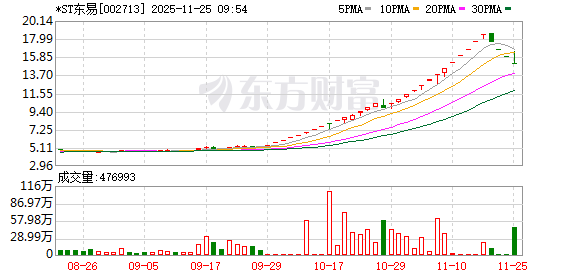
Core Viewpoint - *ST Dongyi has experienced a significant surge in stock price, achieving a total increase of 21.66% over the past four trading days, indicating strong market interest and potential investor confidence [2] Group 1: Stock Performance - The stock reached a price of 6.29 yuan with a trading volume of 757,400 shares and a turnover amount of 4.764 million yuan as of 9:25 AM [2] - The stock has recorded a cumulative turnover rate of 1.88% during the consecutive trading days of price increase [2] - The stock's limit-up order amount reached 231 million yuan, reflecting strong buying interest [2] Group 2: Market Capitalization - The total market capitalization of the stock in the A-share market is 2.639 billion yuan, with a circulating market capitalization of 2.588 billion yuan [2] Group 3: Trading Data - The stock has been listed on the Dragon and Tiger List due to a cumulative price deviation of 12% over three consecutive trading days [2] - Institutional investors have net sold 2.7362 million yuan, while total net selling from brokerage seats amounted to 1.6383 million yuan [2] Group 4: Company Background - Dongyi Risheng Home Decoration Group Co., Ltd. was established on November 28, 1996, with a registered capital of 419.53698 million yuan [2]
【9日资金路线图】两市主力资金净流出超250亿元 有色金属等行业实现净流入
证券时报· 2025-10-09 14:34
Market Overview - The A-share market indices performed strongly today, with the Shanghai Composite Index rising by 1.32%, the Shenzhen Component increasing by 1.47%, and the ChiNext Index up by 0.73%. The total trading volume reached 2.67 trillion yuan, compared to 2.2 trillion yuan in the previous trading day [1]. Capital Flow - The net outflow of main funds from the Shanghai and Shenzhen markets exceeded 255.37 billion yuan today, with an opening net outflow of 96.89 billion yuan and a closing net outflow of 65.82 billion yuan [2][3]. - The CSI 300 index saw a net outflow of 137.82 billion yuan, while the ChiNext index experienced a net outflow of 121.83 billion yuan [2][4]. Sector Performance - The non-ferrous metals sector led the market with a net inflow of 143.63 billion yuan and a price increase of 5.23%. Other sectors with significant inflows included computers (70.68 billion yuan) and public utilities (68.68 billion yuan) [5]. - Conversely, the automotive sector faced a net outflow of 45.52 billion yuan, with a slight decline of 0.26%. The pharmaceutical and media sectors also saw outflows of 34.69 billion yuan and 32.29 billion yuan, respectively [5]. Institutional Activity - Notable institutional buying included Ganfeng Lithium, which saw a net purchase of 52.11 million yuan, and Tianji Co., with a net purchase of 44.19 million yuan. Other significant purchases were made in companies like Canxin Technology and Meili Technology [7][8].
海鸥住工:累计回购公司股份2723500股
Zheng Quan Ri Bao Wang· 2025-10-09 13:46
证券日报网讯 10月9日晚间,海鸥住工(002084)发布公告称,截至2025年9月30日,公司通过股票回 购专用证券账户以集中竞价交易方式实施回购股份,累计回购公司股份数量2,723,500股,约占公司 目前总股本的0.4216%。 ...
9.06亿元主力资金今日抢筹钢铁板块
Core Viewpoint - The Shanghai Composite Index rose by 1.32% on October 9, with 23 industries experiencing gains, particularly in non-ferrous metals and steel, which increased by 7.60% and 3.38% respectively [1] Industry Summary Non-Ferrous Metals - The non-ferrous metals industry saw the highest net inflow of funds, totaling 5.36 billion yuan, contributing to its 7.60% increase [1] Steel Industry - The steel industry increased by 3.38%, with a net inflow of 906 million yuan. Out of 44 stocks in this sector, 38 rose, and 2 hit the daily limit [2] - The top three stocks by net inflow were: - Baogang Co., with an inflow of 880 million yuan and a rise of 8.40% - Hebei Steel Resources, with an inflow of 92.96 million yuan and a rise of 9.99% - Jiuli Special Materials, with an inflow of 59.17 million yuan and a rise of 8.04% [2][3] - The steel industry had 19 stocks with net outflows, with the largest being: - Hangang Co., with an outflow of 165 million yuan - Maanshan Steel, with an outflow of 29.82 million yuan - Shougang Co., with an outflow of 29.49 million yuan [2][3]
10月9日主力资金流向日报
Market Overview - On October 9, the Shanghai Composite Index rose by 1.32%, the Shenzhen Component Index increased by 1.47%, the ChiNext Index went up by 0.73%, and the CSI 300 Index gained 1.48% [1] - Among the tradable A-shares, 3,115 stocks rose, accounting for 57.48%, while 2,186 stocks declined [1] Capital Flow - The main capital saw a net outflow of 19.966 billion yuan throughout the day [1] - The ChiNext experienced a net outflow of 11.198 billion yuan, while the STAR Market had a net outflow of 4.835 billion yuan, and the CSI 300 constituents saw a net outflow of 9.622 billion yuan [1] Industry Performance - Out of the 23 first-level industries classified by Shenwan, the top-performing sectors were non-ferrous metals and steel, with increases of 7.60% and 3.38%, respectively [1] - The sectors with the largest declines were media and real estate, which fell by 1.43% and 1.39% [1] Industry Capital Inflow - Twelve industries saw net inflows of main capital, with the non-ferrous metals sector leading at a net inflow of 5.361 billion yuan and a daily increase of 7.60% [1] - The construction and decoration industry followed with a daily increase of 2.17% and a net inflow of 1.868 billion yuan [1] Industry Capital Outflow - Nineteen industries experienced net outflows, with the non-bank financial sector leading at a net outflow of 6.725 billion yuan, despite a slight increase of 0.10% [1] - The automotive sector had a decline of 0.39% and a net outflow of 4.325 billion yuan, with significant outflows also seen in media, electronics, and banking sectors [1] Individual Stock Performance - A total of 2,264 stocks saw net inflows, with 913 stocks having inflows exceeding 10 million yuan, and 153 stocks with inflows over 100 million yuan [2] - The stock with the highest net inflow was ZTE Corporation, which rose by 9.51% with a net inflow of 3.753 billion yuan, followed by Northern Rare Earth and Hikvision with net inflows of 2.969 billion yuan and 1.417 billion yuan, respectively [2] - Stocks with net outflows exceeding 100 million yuan included Sailis, CITIC Securities, and SMIC, with outflows of 2.351 billion yuan, 2.197 billion yuan, and 2.053 billion yuan, respectively [2]