
金属

Search documents
招金黄金(000506)9月10日主力资金净卖出4367.53万元
Sou Hu Cai Jing· 2025-09-10 07:42
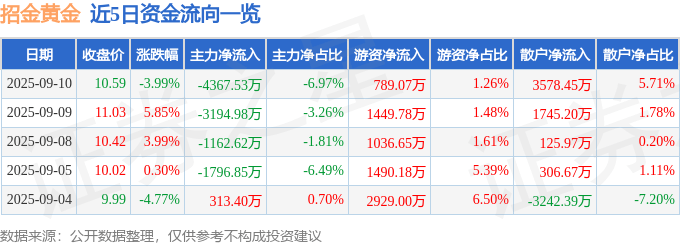
Group 1 - The stock of Zhaojin Gold (000506) closed at 10.59 yuan on September 10, 2025, down 3.99% with a turnover rate of 6.4% and a trading volume of 594,400 hands, resulting in a transaction amount of 626 million yuan [1] - On September 10, the net outflow of main funds was 43.68 million yuan, accounting for 6.97% of the total transaction amount, while retail investors saw a net inflow of 35.78 million yuan, accounting for 5.71% [1][2] - The company's main business includes gold mining and real estate development, sales, and rental of self-owned properties [3] Group 2 - Zhaojin Gold's total market value is 9.838 billion yuan, with a net profit of 44.69 million yuan, and a net asset value of 619 million yuan [3] - The company's revenue for the first half of 2025 was 196 million yuan, a year-on-year increase of 98.27%, while the net profit increased by 181.36% [3] - The company's gross profit margin stands at 43.67%, significantly higher than the industry average of 28.16% [3]


五矿期货文字早评-20250908
Wu Kuang Qi Huo· 2025-09-08 02:13
Report Industry Investment Ratings No relevant content provided. Core Views - The overall market shows a complex situation with different trends in various sectors. In the macro - financial field, the Fed's expected interest rate cuts have a significant impact on multiple asset classes. In the commodity market, different industries are affected by factors such as supply - demand relationships, policies, and seasonal factors [2][3][4]. - For the black building materials sector, the focus is on the verification of real - end demand, and there is a risk of price pressure due to the possible mismatch between peak - season demand and high supply [33]. - In the energy - chemical sector, different products have different supply - demand and price trends, and investment strategies vary accordingly [44][46][47]. - In the agricultural products sector, each product's price is affected by factors such as supply, demand, and policies, and trading strategies are also different [58][59][60]. Summaries by Catalogs Macro - Financial Index Futures - News includes Shenzhen's property market new policy, the record - high price of spot gold, the "Deep - space Economy" concept framework, and the weak US non - farm payroll data [2]. - The basis ratios of IF, IC, IM, and IH are provided. After the previous continuous rise, high - level hot sectors like AI have diverged, and funds have flowed to low - level sectors. The short - term index faces adjustment pressure, but the medium - and long - term strategy is to go long on dips [3]. Treasury Bonds - On Friday, the main contracts of TL, T, TF, and TS all declined. The weak US non - farm payroll data strengthened the market's expectation of the Fed's interest rate cut in September, and spot gold hit a record high. China's foreign exchange reserves increased in August. The central bank had a net withdrawal of funds on Friday [4]. - Fundamentally, the manufacturing PMI improved in August but remained below the boom - bust line. The central bank is expected to maintain loose funds. Interest rates are expected to decline in the long run, but the bond market may be volatile in the short term [5]. Precious Metals - The prices of domestic and foreign gold and silver showed different trends. The weak US labor market data strengthened the market's expectation of the Fed's interest rate cuts. Silver is expected to have stronger upward momentum than gold during the Fed's monetary policy easing process. It is recommended to go long on precious metals on dips, especially focusing on the rise of silver prices [6][7]. Non - ferrous Metals Copper - Last week, copper prices rose first and then fell. The inventories of the three major exchanges increased, and the spot import was slightly profitable. Given the weak US employment data and the domestic situation of reduced production and improved consumption, copper prices are expected to be strongly supported [9]. Aluminum - On Friday, aluminum prices rose first and then fell. The domestic inventory decreased, and the external inventory increased. Aluminum prices will fluctuate between macro - expectations and fundamental realities. The key is to focus on the peak - season demand and inventory trends [10]. Zinc - Zinc ore and zinc ingots are in a state of surplus, with inventory accumulation. The domestic supply is loose, and the downstream demand is weak. The LME market has low inventory and high spreads. The short - term price is expected to be in a low - level shock pattern [11]. Lead - The lead industry shows a pattern of weak supply and demand. The shortage of raw materials restricts production, and the downstream consumption is weak. With the high expectation of the Fed's interest rate cut, lead prices have some support, but there is also a large downward risk if the market sentiment weakens [12]. Nickel - The macro - environment is positive, and the demand for nickel - iron is expected to increase. Although the supply of refined nickel is in surplus, the long - term support for nickel prices is strong. It is recommended to go long on dips [14]. Tin - The supply of tin is expected to decrease significantly in the short term due to the slow resumption of production in Myanmar and the planned maintenance of domestic smelters. The demand is in the off - season. Tin prices are expected to be in a short - term shock pattern [16]. Carbonate Lithium - The spot price of carbonate lithium was stable on Friday, and the futures price rose slightly. The supply - demand relationship has improved, and the inventory has decreased. The positive sentiment in the equity market may drive the futures price to stabilize and rebound [17]. Alumina - The alumina index rose on September 5. Overseas ore supply is improving, and the smelting capacity is in surplus. With the high expectation of the Fed's interest rate cut, it is recommended to wait and see in the short term [18]. Stainless Steel - The price of stainless steel decreased on Friday. The end of the Indonesian riot and the slow recovery of downstream demand have suppressed the price. The market has entered a consolidation phase [21]. Casting Aluminum Alloy - The price of casting aluminum alloy rose on Friday. The downstream is transitioning from the off - season to the peak - season, and the cost is strongly supported. The price is expected to remain high in the short term [22]. Black Building Materials Steel - The prices of rebar and hot - rolled coil rose on Friday. The overall commodity market atmosphere is good, but the demand for steel is weak, and the inventory is accumulating. The price is under pressure, and the focus is on the recovery of terminal demand and the support of the cost side [24][25]. Iron Ore - The price of iron ore decreased slightly on Friday. The overseas shipment increased, and the demand decreased. The inventory of ports increased, and the inventory of steel mills decreased. The short - term price is expected to be in a shock pattern, and the key is to observe the recovery of demand and the speed of inventory reduction [26][27]. Glass and Soda Ash - The price of glass was stable, and the inventory increased slightly. The price of soda ash rose slightly, and the inventory decreased slightly. The glass price adjustment space is limited, and the soda ash price is expected to be in a shock pattern in the short term and may rise in the long term [28][29]. Manganese Silicon and Ferrosilicon - Affected by the "anti - involution" rumor, the prices of manganese silicon and ferrosilicon rose on September 5. Their fundamentals are not ideal, and they are likely to follow the black - sector sentiment, especially the situation of coking coal. It is recommended to wait and see [30][33]. Industrial Silicon and Polysilicon - The price of industrial silicon rose on Friday. The supply and demand increased in August, and it is in a "weak reality" pattern. In September, it may be affected by downstream capacity integration and "anti - involution" sentiment [34][35]. - The price of polysilicon rose strongly on Friday. It is in a "weak reality, strong expectation" pattern. The focus is on capacity integration and downstream price - passing progress. The price is expected to be highly volatile in September [36][37]. Energy - Chemical Rubber - NR and RU are in a strong shock. The heavy rain in Thailand may cause the rubber price to rise. The mid - term strategy is to be bullish, and the short - term strategy is to be slightly bullish [39][43]. Crude Oil - The price of INE crude oil futures decreased on Friday. The European ARA data shows different trends in refined - oil inventories. The oil price is considered undervalued, and it is recommended to be long on crude oil, but not to chase the high price [44][45]. Methanol - The price of methanol rose on September 5. The domestic supply pressure is large, and the overseas import pressure exists. The demand is improving. It is recommended to go long on dips and consider the 1 - 5 positive spread [46]. Urea - The price of urea decreased on September 5. The supply pressure has eased, but the demand is weak. The price is expected to be in a range - bound operation, and it is recommended to go long on dips [47]. Styrene - The spot price of styrene was stable, and the futures price decreased. The BZN spread is expected to repair. The supply is increasing, and the demand is decreasing. The price may rebound after the inventory reduction [48][50]. PVC - The price of PVC rose on September 5. The supply is strong, the demand is weak, and the export expectation is weak. It is recommended to short on rallies, but beware of the impact of "anti - involution" sentiment [51]. Ethylene Glycol - The price of ethylene glycol decreased on September 5. The supply is high, and the short - term port inventory is expected to be low, but it may accumulate in the fourth quarter. The valuation is high in the short term and may decline in the medium term [52]. PTA - The price of PTA rose on September 5. The supply is expected to decrease, and the demand is improving. The processing fee is under pressure. It is recommended to go long on dips following PX [53]. p - Xylene - The price of p - xylene rose on September 5. The load is high, and the downstream PTA has many unexpected maintenance. The inventory accumulation is not significant. It is recommended to go long on dips following crude oil [54]. Polyethylene (PE) - The futures price of PE rose. The market expects favorable policies, and the cost is supportive. The supply is limited, and the demand is expected to increase. The price is expected to rise in a shock pattern [55]. Polypropylene (PP) - The futures price of PP rose. The supply pressure is large, and the demand is recovering seasonally. The inventory pressure is high. It is recommended to go long on the LL - PP2601 contract on dips [56]. Agricultural Products Hogs - The domestic hog price fell over the weekend. The supply in September is expected to be high, but there are potential supporting factors. The spot price may be in a narrow - range adjustment, and the trading strategy is to pay attention to the rebound and short - sell after the rebound [58]. Eggs - The domestic egg price rose over the weekend. The egg price may rise in the early ten - day period but may fall after the mid - ten - day period. It is recommended to short - sell on rallies [59]. Soybean and Rapeseed Meal - The price of US soybeans fell slightly on Friday, and the domestic soybean meal price rebounded slightly. The US soybean production decreased, but the global protein raw material supply is in surplus. The soybean meal price is expected to be in a range - bound operation, and it is recommended to go long on dips [60][61]. Oils and Fats - The prices of domestic three major oils fell on Friday. The export of Malaysian palm oil increased, and the production decreased. The demand is stable, and the inventory is low. The oil price is expected to be strong in the medium term, and it is recommended to buy on dips after the price decline [62][64]. Sugar - The price of Zhengzhou sugar futures fell on Friday. The domestic and foreign markets are generally bearish. The sugar price is expected to decline, and the downward space depends on the Brazilian production [65][66]. Cotton - The price of Zhengzhou cotton futures fell slightly on Friday. The global cotton production and inventory are expected to decrease. The domestic consumption is average, and the inventory is low. The cotton price is expected to be in a high - level shock in the short term [67][69].
宏观与大类资产周报:弱美元交易或暂时延续-20250907
CMS· 2025-09-07 14:32
Domestic Insights - The August PMI manufacturing price index increased, likely due to the upward shift in upstream commodity prices, which may hinder future corporate profit recovery[2] - The current domestic market is in a new bull market phase, with wealth effects expected to boost service consumption as a highlight for Q4 economic growth[2] - September is a critical observation window for RMB appreciation, especially if US-China negotiations show substantial progress[2] Overseas Insights - In August, non-farm payrolls added only 22,000 jobs, significantly below the expected 75,000, indicating a moderate slowdown in employment rather than a rapid decline[15] - The unemployment rate rose to 4.3% in August from 4.2% in July, reinforcing concerns about employment risks discussed at the Jackson Hole meeting[15] - The weak non-farm data suggests the Federal Reserve may lower interest rates by 75 basis points this year, with weak dollar trading likely to continue in the coming weeks[15] Liquidity and Market Trends - The overall liquidity tightened this week, with the benchmark interest rate down approximately 7.412 basis points[19] - The average daily transaction volume in the interbank pledged repo market increased by about 2417.16 billion CNY, reaching 73138.95 billion CNY[20] - Government bond issuance pressure decreased, with a net repayment of 1184.54 billion CNY and a planned issuance of 8376.7 billion CNY next week[21] Asset Performance - The Shanghai Composite Index fell by 1.18% this week, while the Shenzhen Component Index decreased by 0.83%[39] - Gold prices showed an upward trend, while international crude oil prices experienced a downward trend[37] - The US 10-year Treasury yield declined, reflecting a mixed performance in European bond yields[39]
关税,突发!美国宣布:豁免!
券商中国· 2025-09-06 10:44
Core Viewpoint - The article discusses significant adjustments in the U.S. tariff policy, including exemptions for certain metals and the inclusion of silicon products in the tax list, which will have a substantial impact on trade dynamics and manufacturing sectors in the U.S. [2][4] Tariff Adjustments - President Trump announced exemptions for metals such as graphite, tungsten, uranium, and gold bars from global tariffs, while silicon products will be taxed [2][4] - The new tariff policy will take effect next Monday and includes various key product categories, such as aircraft parts, pharmaceuticals, and specialty spices that cannot be produced domestically [4][6] Trade Deficit and Import Surge - In July, the U.S. trade deficit widened to $78.3 billion, a 33% increase month-over-month, marking the highest level in four months [9] - The surge in imports was primarily driven by industrial goods, with gold imports reaching a record high of $10.5 billion [9][10] - The increase in imports is attributed to businesses stockpiling goods ahead of anticipated tariff hikes, leading to a significant rise in overall import volumes [9][10] Manufacturing Sector Challenges - The U.S. manufacturing sector has contracted for six consecutive months, with the PMI rising slightly to 48.7 in August, still below the neutral mark of 50 [12] - Many manufacturers report that the current business environment is worse than during the 2007-2009 recession, largely due to the uncertainties created by the tariff policies [12][13] - The automotive industry is particularly affected, with companies facing high tariffs on imported steel and aluminum, leading to significant profit impacts, such as Ford's projected $2 billion loss due to tariffs [13][14]

特朗普调整全球关税政策 黄金、钨、铀等关键商品获豁免
Hua Er Jie Jian Wen· 2025-09-06 08:59
Group 1 - The core viewpoint of the news is that President Trump signed an executive order to exempt various metals and graphite from the global tariff system while adding silicon products to the tax list [1][2] - The new policy will officially take effect on the following Monday and includes tariff adjustments for several key product categories [1][2] - Notably, gold bars have been confirmed to be exempt from tariffs, addressing previous concerns that they might face import taxes [1][2] Group 2 - Key materials such as graphite and tungsten, which are essential for high-tech and critical industries, have received tariff exemptions [2] - Various pharmaceuticals, including antibiotics, have also been granted new tariff reductions, despite being subjects of an ongoing trade investigation by the U.S. Department of Commerce [2] - The executive order introduces a procedural change aimed at improving the efficiency of trade agreement enforcement, allowing the U.S. Trade Representative and the Department of Commerce to act directly without needing individual executive orders from Trump [2]
工业金属半年报|白银有色、华峰铝业、云南铜业、锌业股份、北方同业、豫光金铅存货占总资产比重超30%
Xin Lang Zheng Quan· 2025-09-05 08:09
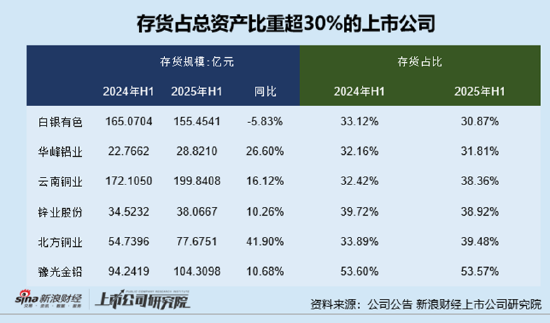
Group 1 - The core viewpoint of the articles highlights the inventory status analysis of 58 representative industrial metal companies for the first half of 2025, indicating significant changes in inventory scale and turnover efficiency [1][2][5] Group 2 - In terms of inventory scale, most industrial metal companies experienced growth in inventory during the first half of 2025, with Ningbo Fubon showing the highest year-on-year increase of 699.13%, reaching an inventory scale of 177 million [1][2] - The inventory turnover efficiency varied among companies, with Huayu Mining having the lowest turnover days at 194 days, followed by Hongxing Co. at 177 days and Shengda Resources at 137 days [5] Group 3 - From the perspective of inventory as a proportion of total assets, several companies had high inventory ratios in 2024, including Yuguang Gold Lead at 53.57%, Northern Copper at 39.48%, and Zinc Industry Co. at 38.92% [2][3] - The inventory scale and proportion of total assets for key companies in 2024 and 2025 were detailed, showing fluctuations such as a decrease in Baiyin Nonferrous's inventory scale by 5.83% to 15.545 billion, while Huafeng Aluminum's inventory increased by 26.6% to 2.882 billion [3]


工业金属半年报|豫光金铅存货占总资产的53.57%居首 华豫矿业存货周转效率垫底、周转天数高达194天
Xin Lang Zheng Quan· 2025-09-05 08:09
Core Viewpoint - The analysis focuses on the inventory status of 58 representative industrial metal companies as of the first half of 2025, highlighting significant changes in inventory scale and turnover efficiency. Group 1: Inventory Scale - In the first half of 2025, most industrial metal companies experienced an increase in inventory scale, with Ningbo Fubon showing the highest growth rate at 1.77 billion yuan, a year-on-year increase of 699.13% [1] - Xinyuan Intelligent Manufacturing also saw a substantial increase in inventory scale, reaching 0.6 billion yuan, which is a year-on-year growth of 122.43% [1] Group 2: Inventory as a Percentage of Total Assets - In 2024, several companies had a high inventory-to-total-assets ratio, with Yuguang Gold Lead at 53.57%, Northern Copper at 39.48%, and Zinc Industry Co. at 38.92% [2][3] - Yuguang Gold Lead's inventory scale was 10.43 billion yuan, reflecting a year-on-year increase of 10.68% [2] - Other notable companies include Yunnan Copper with an inventory scale of 19.98 billion yuan, a year-on-year increase of 16.12%, and Huafeng Aluminum with an inventory scale of 2.88 billion yuan, a year-on-year increase of 26.6% [2][3] Group 3: Inventory Turnover Efficiency - Most companies reported inventory turnover days below 90 days, indicating efficient inventory management [5] - The companies with the lowest inventory turnover efficiency were Huayu Mining, Hongxing Co., and Shengda Resources, with turnover days of 194, 177, and 137 days, respectively [5]

工业金属板块9月4日跌4.23%,华钰矿业领跌,主力资金净流出36.87亿元
Zheng Xing Xing Ye Ri Bao· 2025-09-04 08:50
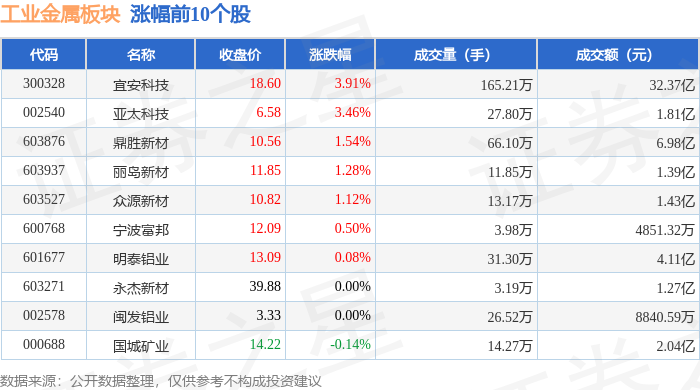
Market Overview - On September 4, the industrial metals sector fell by 4.23%, with Huayu Mining leading the decline [1] - The Shanghai Composite Index closed at 3765.88, down 1.25%, while the Shenzhen Component Index closed at 12118.7, down 2.83% [1] Individual Stock Performance - Notable gainers included: - Yian Technology (300328) with a closing price of 18.60, up 3.91% [1] - Asia Pacific Technology (002540) at 6.58, up 3.46% [1] - Significant decliners included: - Huayu Mining (601020) at 24.65, down 10.00% [2] - Baiyin Nonferrous (601212) at 3.82, down 9.69% [2] - Luoyang Jiyie (603993) at 12.44, down 8.86% [2] Trading Volume and Capital Flow - The industrial metals sector experienced a net outflow of 3.687 billion yuan from main funds, while retail investors saw a net inflow of 2.769 billion yuan [2][3] - The trading volume for individual stocks varied, with notable figures such as: - Huayu Mining with a trading volume of 796,900 shares [2] - Baiyin Nonferrous with 4,925,700 shares [2] Capital Inflow Analysis - Key stocks with significant main fund inflows included: - Nanshan Aluminum (600219) with a net inflow of 71.11 million yuan [3] - Tianshan Aluminum (002532) with a net inflow of 34.90 million yuan [3] - Conversely, stocks like Tianshan Aluminum saw a retail net outflow of 56.38 million yuan [3]


商品期货早班车-20250904
Zhao Shang Qi Huo· 2025-09-04 01:47
Group 1: Investment Ratings - There is no information provided regarding the industry investment ratings in the reports [1][2][3] Group 2: Core Views - The reports cover various commodity futures markets including precious metals, base metals, black industries, agricultural products, and energy chemicals. Each market has its own unique market performance, fundamentals, and trading strategies based on factors such as supply - demand dynamics, policy changes, and macro - economic conditions [1][2][3] Group 3: Summary by Commodity Categories Precious Metals - **Gold**: Market remains strong with London gold price approaching $3600. Fed officials signal potential rate cuts, US job vacancies are lower than expected. Gold ETFs see capital inflows. Suggested to go long on gold due to increased likelihood of Fed rate cuts and growing避险需求 [1] - **Silver**: Follows gold's rally. With a threat of increased tariffs as it enters the US critical minerals list, there are short - term long opportunities [1] Base Metals - **Aluminum**: Electrolytic aluminum supply is stable, demand downstream is improving, but inventory accumulation suppresses prices. Expected to continue in a volatile pattern, recommended to go long on dips [2] - **Alumina**: Spot prices are declining, but the decline may slow as some short - selling institutions take profits. Suggested to wait and see [2] - **Industrial Silicon**: Supply has increased with new furnaces opened, and there is a slight reduction in inventory. Policy expectations and news about storage plans and production limits cause market fluctuations. The market is expected to oscillate weakly in the 8200 - 9100 range, advised to wait and see [2][3] - **Lithium Carbonate**: Short - term sentiment has cooled, and the intraday long - short battle is intense. The market is under pressure. However, potential supply impacts from mine closures may trigger upward movement later. Suggested to wait and see [3] - **Polysilicon**: The market has a pattern of strong supply and weak demand. Policy expectations lead to intense market games. Without new definite negative news, the market is expected to oscillate at a high level. Advised to wait and see [3] Black Industries - **Rebar**: Steel supply - demand is seasonally weak with obvious structural differentiation. The rebar futures discount is slightly high. Recommended to re - enter short positions on the rebar 2601 contract in the 3060 - 3140 range [4] - **Iron Ore**: Supply and demand are moderately strong but slightly weakening at the margin. The market is expected to accumulate inventory slower than the seasonal pattern. Valuation is moderately high. Advised to wait and see [4] - **Coking Coal**: Supply and demand are generally loose but improving. The futures premium is high. Recommended to exit short positions on the coking coal 2601 contract [5] Agricultural Products - **Soybean Meal**: Near - term US soybean production is contracting, while South American production is expected to increase in the long - term. The short - term US soybean market is in an oscillating range, and the domestic market may oscillate after removing risk premiums. The medium - term trend depends on tariff policies [5] - **Corn**: Wheat prices and increased import grain auctions suppress corn prices. New - crop corn costs are lower, and the spot price is expected to be weak. The futures market is expected to oscillate weakly. Advised to wait and see [5] - **Sugar**: Brazilian production is the main factor affecting the international sugar market. The domestic market may oscillate weakly. Recommended to go short in the futures market and sell call options [5] - **Cotton**: International cotton has some production - related issues, and the domestic market is oscillating. Recommended to go long at low prices in the 13800 - 14500 yuan/ton range [5] - **Palm Oil**: The supply is in a seasonal increase cycle, and demand is improving. The market is expected to be in a phased consolidation and bullish in the medium - term. Attention should be paid to production in the producing areas and bio - diesel policies [6] - **Eggs**: Demand is increasing seasonally due to school openings and festivals, but supply is also sufficient. The futures market is expected to oscillate. Advised to wait and see [6] - **Pork**: Consumption is recovering, but supply is also increasing. The pig price may stop falling and stabilize in the short - term. The futures market is advised to wait and see [6] - **Apples**: The price of early - maturing apples is falling, but farmers' expectations for late - maturing apples support the market. The market is expected to oscillate. Advised to wait and see [6] Energy Chemicals - **LLDPE**: In the short - term, the market is expected to oscillate. In the long - term, as new devices are put into operation, the supply - demand pattern will become looser. Recommended to short far - month contracts or conduct month - spread reverse arbitrage at high prices [7] - **PVC**: Supply is increasing, demand is weak, but the downside is limited. Advised to wait and see [8] - **Rubber**: Inventory is decreasing, raw material prices are supportive, and the spot market is strong. Recommended to hold long positions with high - selling and low - buying strategies and be cautious about chasing high prices [8] - **Glass**: Supply - demand is weak, but inventory is decreasing. Valuation is low. Advised to wait and see [8] - **PP**: In the short - term, the market is expected to oscillate weakly. In the long - term, as new devices are put into operation, the supply - demand pattern will become looser. Recommended to short far - month contracts or conduct month - spread reverse arbitrage at high prices [8] - **Crude Oil**: Supply is increasing, demand is weakening, and there is a potential surplus in Q4. Recommended to go short at high prices [8][9] - **Styrene**: Supply is expected to increase, and demand is still weak. The market is expected to oscillate weakly in the short - term. In the long - term, as supply increases, the supply - demand pattern will become looser. Recommended to short far - month contracts or short styrene profit at high prices [9] - **Soda Ash**: Supply is large, prices are falling. Advised to wait for macro - level guidance [9]
2025年8月下旬流通领域重要生产资料市场价格变动情况
Guo Jia Tong Ji Ju· 2025-09-04 01:30
Core Viewpoint - The monitoring of market prices for 50 important production materials across nine categories indicates a mixed trend, with 17 products experiencing price increases, 28 seeing declines, and 5 remaining stable in late August 2025 compared to mid-August 2025 [1]. Price Changes Summary 1. Black Metals - Rebar (Φ20mm, HRB400E) decreased by 42.8 yuan to 3218.2 yuan, a drop of 1.3% - Wire rod (Φ8-10mm, HPB300) fell by 48.9 yuan to 3356.5 yuan, down 1.4% - Ordinary medium plate (20mm, Q235) decreased by 15.5 yuan to 3525.8 yuan, a decline of 0.4% - Hot-rolled ordinary plate (4.75-11.5mm, Q235) dropped by 37.4 yuan to 3444.9 yuan, down 1.1% - Seamless steel pipe (219*6, 20) fell by 10.0 yuan to 4162.5 yuan, a decrease of 0.2% - Angle steel (5) decreased by 17.1 yuan to 3531.4 yuan, down 0.5% [3]. 2. Non-Ferrous Metals - Electrolytic copper (1) increased by 59.6 yuan to 79237.1 yuan, up 0.1% - Aluminum ingot (A00) rose by 107.6 yuan to 20741.4 yuan, an increase of 0.5% - Lead ingot (1) increased by 38.8 yuan to 16735.7 yuan, up 0.2% - Zinc ingot (0) decreased by 201.3 yuan to 22200.0 yuan, down 0.9% [3]. 3. Chemical Products - Sulfuric acid (98%) fell by 1.2 yuan to 717.2 yuan, a decrease of 0.2% - Caustic soda (liquid, 32%) increased by 26.4 yuan to 896.1 yuan, up 3.0% - Methanol (first grade) decreased by 37.2 yuan to 2228.8 yuan, down 1.6% - Pure benzene (industrial grade) fell by 90.7 yuan to 6047.6 yuan, down 1.5% - Styrene (first grade) decreased by 7.7 yuan to 7277.9 yuan, down 0.1% - Polyethylene (LLDPE) increased by 24.9 yuan to 7467.6 yuan, up 0.3% - Polypropylene (fiber grade) decreased by 56.1 yuan to 6953.1 yuan, down 0.8% - Polyvinyl chloride (SG5) fell by 67.0 yuan to 4809.5 yuan, down 1.4% - Styrene-butadiene rubber (BR9000) increased by 118.4 yuan to 11697.6 yuan, up 1.0% - Polyester filament (POY150D/48F) rose by 108.9 yuan to 6871.4 yuan, up 1.6% [3]. 4. Oil and Natural Gas - Liquefied natural gas (LNG) decreased by 90.7 yuan to 3951.6 yuan, down 2.2% - Liquefied petroleum gas (LPG) increased by 67.0 yuan to 4433.8 yuan, up 1.5% - Gasoline (95 National VI) fell by 40.2 yuan to 8469.3 yuan, down 0.5% - Gasoline (92 National VI) decreased by 43.8 yuan to 8192.8 yuan, down 0.5% - Diesel (0 National VI) fell by 37.5 yuan to 7047.8 yuan, down 0.5% - Paraffin (58 half) remained unchanged at 7672.5 yuan [3]. 5. Coal - Anthracite (washed lump) decreased by 17.0 yuan to 853.0 yuan, down 2.0% - Common mixed coal (4500 kcal) fell by 7.1 yuan to 557.4 yuan, down 1.3% - Shanxi large mixed coal (5000 kcal) decreased by 4.2 yuan to 625.3 yuan, down 0.7% - Shanxi superior mixed coal (5500 kcal) increased by 6.6 yuan to 701.7 yuan, up 0.9% - Datong mixed coal (5800 kcal) rose by 6.3 yuan to 739.7 yuan, up 0.9% - Coking coal (main coking coal) remained unchanged at 1425.0 yuan - Coke (quasi-first-grade metallurgical coke) increased by 61.6 yuan to 1439.3 yuan, up 4.5% [3]. 6. Non-Metallic Building Materials - Ordinary Portland cement (P.O 42.5 bagged) decreased by 2.6 yuan to 346.0 yuan, down 0.7% - Ordinary Portland cement (P.O 42.5 bulk) increased by 0.4 yuan to 272.8 yuan, up 0.1% - Float glass (4.8/5mm) fell by 25.4 yuan to 1190.8 yuan, down 2.1% [3]. 7. Agricultural Products - Rice (glutinous rice) remained unchanged at 4037.0 yuan - Wheat (national standard grade three) decreased by 4.9 yuan to 2420.7 yuan, down 0.2% - Corn (yellow corn grade two) fell by 16.8 yuan to 2300.9 yuan, down 0.7% - Cotton (lint, white cotton grade three) increased by 141.9 yuan to 14756.3 yuan, up 1.0% - Live pigs (external three yuan) decreased by 0.1 yuan to 13.7 yuan per kilogram, down 0.7% - Soybeans (yellow soybeans) fell by 20.4 yuan to 4422.7 yuan, down 0.5% - Soybean meal (crude protein content ≥43%) increased by 1.8 yuan to 3051.1 yuan, up 0.1% - Peanuts (oil peanuts) decreased by 2.4 yuan to 7564.3 yuan, unchanged [4]. 8. Agricultural Production Materials - Urea (medium and small particles) decreased by 6.3 yuan to 1759.9 yuan, down 0.4% - Compound fertilizer (potassium sulfate compound fertilizer, nitrogen, phosphorus, and potassium content 45%) remained unchanged at 3180.0 yuan - Pesticides (glyphosate, 95% raw material) increased by 110.7 yuan to 27085.7 yuan, up 0.4% [4]. 9. Forest Products - Natural rubber (standard rubber SCRWF) increased by 128.0 yuan to 14790.5 yuan, up 0.9% - Pulp (imported needle leaf pulp) decreased by 90.3 yuan to 5677.6 yuan, down 1.6% - Corrugated paper (AA grade 120g) increased by 63.8 yuan to 2704.5 yuan, up 2.4% [4].