
金属

Search documents
花旗:中期看涨情绪增强,2026年底铜价预计突破11000美元
Wen Hua Cai Jing· 2025-09-04 00:48
Group 1 - Citi has a bullish outlook for copper, predicting prices will exceed $11,000 per ton by the end of 2026 [1] - The bank has raised its long-term aluminum price forecast from $3,000 per ton to $3,500 per ton by 2027 [1] - Silver prices are expected to rise to $43 per ounce in the coming months [1] Group 2 - Citi maintains its Henry Hub natural gas price target at $3.8 per million British thermal units for the next 0-3 months [1] - The average price forecast for Brent crude oil in 2026 has been slightly lowered from $65 per barrel to $62 per barrel [1] Group 3 - China, as the world's largest copper consumer, faces three major challenges: increasing dependence on foreign resources, overcapacity in the midstream processing sector, and downstream demand being suppressed by high copper prices [1] - Shanghai Nonferrous Metals Network is collaborating with copper industry chain enterprises to compile a bilingual distribution map of the Chinese copper industry chain for 2026 [1]


工业金属板块9月3日跌0.33%,新威凌领跌,主力资金净流出17.96亿元
Zheng Xing Xing Ye Ri Bao· 2025-09-03 08:39
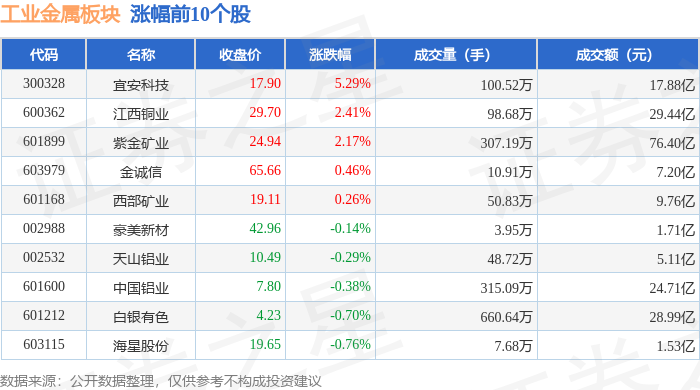
Market Overview - On September 3, the industrial metals sector declined by 0.33% compared to the previous trading day, with Xinweiling leading the drop [1] - The Shanghai Composite Index closed at 3813.56, down 1.16%, while the Shenzhen Component Index closed at 12472.0, down 0.65% [1] Stock Performance - Notable gainers included: - Yian Technology (300328) with a closing price of 17.90, up 5.29% and a trading volume of 1,005,200 shares, totaling a transaction value of 1.788 billion [1] - Jiangxi Copper (600362) closed at 29.70, up 2.41% with a trading volume of 986,800 shares, totaling 2.944 billion [1] - Significant losers included: - Xinweiling (871634) with a closing price of 29.60, down 6.09% and a trading volume of 51,500 shares, totaling 159 million [2] - Electric Alloy (300697) closed at 14.81, down 5.97% with a trading volume of 210,000 shares, totaling 324 million [2] Capital Flow - The industrial metals sector experienced a net outflow of 1.796 billion from institutional investors, while retail investors saw a net inflow of 1.349 billion [2] - The overall capital flow indicates a mixed sentiment, with institutional investors pulling back while retail investors increased their positions [2] Individual Stock Capital Flow - Key stocks with significant capital flow include: - Zijin Mining (668109) with a net inflow of 137 million from institutional investors, but a net outflow of 42.95 million from retail investors [3] - China Aluminum (601600) had a net inflow of 1.26 billion from institutional investors, but a significant net outflow of 1.46 billion from retail investors [3] - Yian Technology (300328) saw a net inflow of 79.39 million from institutional investors, while retail investors experienced a net outflow of 68.59 million [3]
宝城期货资讯早班车-20250903
Bao Cheng Qi Huo· 2025-09-03 01:22
投资咨询业务资格:证监许可【2011】1778 号 资讯早班车 资讯早班车-2025-09-03 一、 宏观数据速览 | 发布日期 | 指标日期 | 指标名称 | 单位 | 当期值 | 上期值 | 去年同期值 | | --- | --- | --- | --- | --- | --- | --- | | 20250715 | 2025/06 | GDP:不变价:当季同比 | % | 5.20 | 5.40 | 4.70 | | 20250831 | 2025/08 | 制造业 PMI | % | 49.40 | 49.30 | 49.10 | | 20250831 | 2025/08 | 非制造业 PMI:商务活 动 | % | 50.30 | 50.10 | 50.30 | | 20250814 | 2025/07 | 社会融资规模增量:当 | 亿元 | | 11320.00 42251.00 | 7707.00 | | | | 月值 | | | | | | 20250813 | 2025/07 | M0(流通中的现金):同 比 | % | 11.80 | 12.00 | 12.00 | | 2025081 ...
工业金属板块9月2日涨0.13%,白银有色领涨,主力资金净流出34.25亿元
Zheng Xing Xing Ye Ri Bao· 2025-09-02 08:55
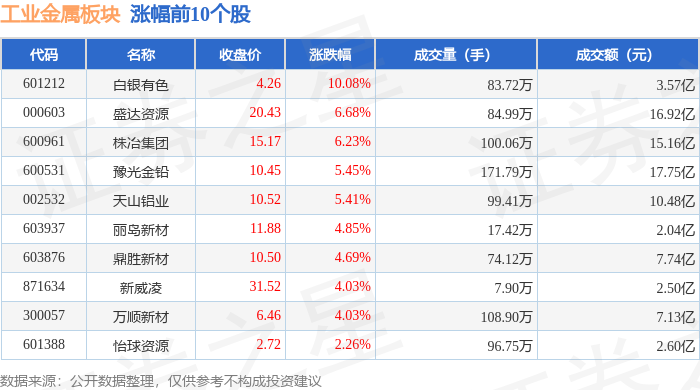
Group 1: Market Performance - On September 2, the industrial metals sector rose by 0.13%, with Silver Holdings leading the gains [1] - The Shanghai Composite Index closed at 3858.13, down 0.45%, while the Shenzhen Component Index closed at 12553.84, down 2.14% [1] Group 2: Individual Stock Performance - Silver Holdings (601212) closed at 4.26, up 10.08% with a trading volume of 837,200 shares and a transaction value of 357 million [1] - Shengda Resources (000603) closed at 20.43, up 6.68% with a trading volume of 849,900 shares and a transaction value of 1.692 billion [1] - Zhuozhi Group (600961) closed at 15.17, up 6.23% with a trading volume of 1,000,600 shares and a transaction value of 1.516 billion [1] - Yuguang Gold Lead (600531) closed at 10.45, up 5.45% with a trading volume of 1,717,900 shares and a transaction value of 1.775 billion [1] - Tianshan Aluminum (002532) closed at 10.52, up 5.41% with a trading volume of 994,100 shares and a transaction value of 1.048 billion [1] Group 3: Fund Flow Analysis - The industrial metals sector experienced a net outflow of 3.425 billion from main funds, while retail funds saw a net inflow of 1.723 billion [2] - Silver Holdings (601212) had a main fund net inflow of 77.0865 million, but a net outflow from retail funds of 38.1897 million [2] - Shengda Resources (000603) had a main fund net inflow of 33.2902 million, with a net outflow from retail funds of 80.5410 million [2]


南向资金持续加仓中信股份(00267):低估值+高分红,双轮驱动彰显龙头韧性
智通财经网· 2025-09-02 07:41
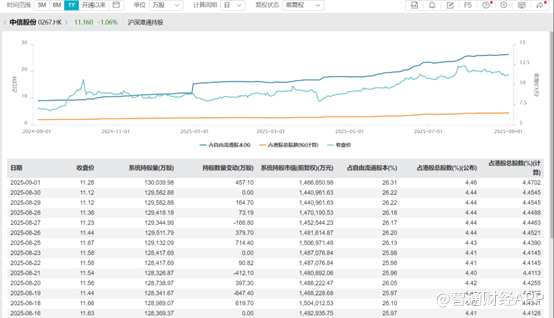
Core Viewpoint - The continuous inflow of southbound funds into Hong Kong stocks, particularly high-dividend stocks like CITIC Limited, reflects a strong market recognition of the company's low valuation and high dividend policy, indicating a reassessment of its profitability and growth potential [1][3][17] Group 1: Southbound Fund Inflows - Southbound funds have significantly increased their holdings in CITIC Limited, with a total inflow of approximately HKD 990.9 billion year-to-date as of September 1 [1] - The number of shares held by southbound funds in CITIC Limited reached 1.295 billion, accounting for 26.31% of the free float and 4.46% of the total share capital, a substantial increase from 760 million shares at the beginning of the year [1][3] Group 2: Dividend Policy and Valuation - CITIC Limited has a benchmark dividend policy, with cumulative dividends exceeding RMB 140 billion over ten years and a rolling dividend yield of 5.44%, significantly above the market average [4] - The actual dividend payout ratio for 2024 is set to increase to 27.5%, with plans to exceed 30% by 2026, demonstrating a strong commitment to returning cash to shareholders [6] Group 3: Financial Performance - For the first half of the year, CITIC Limited reported revenue of RMB 368.8 billion and a net profit attributable to shareholders of RMB 31.2 billion, reflecting a stable operational performance despite a challenging environment [6] - The company's price-to-book ratio is only 0.39 and the price-to-earnings ratio (TTM) is 5.2, both significantly lower than the industry median, indicating substantial room for valuation recovery [6] Group 4: Business Structure and Growth - The comprehensive financial services segment remains a cornerstone for CITIC Limited, contributing RMB 139.8 billion in revenue, which is 37.9% of total revenue, and 90.97% of net profit [8] - CITIC Bank has shown resilience with a net profit of RMB 36.5 billion, growing 2.8% year-on-year, supported by fee income growth and effective cost management [8] Group 5: Internationalization and Global Strategy - CITIC Limited's international revenue reached RMB 65.8 billion, a 15% increase year-on-year, with overseas income accounting for 17.9% of total revenue [13] - The company has actively engaged in cross-border financial services, achieving significant growth in bond underwriting and cross-border loans, contributing to the internationalization of the Renminbi [13][14] Group 6: Innovation and Technology - The company has invested heavily in technology innovation, establishing a "2+4+N" innovation matrix to enhance its research and development capabilities [12] - CITIC Limited's focus on new industries, including digital technology and intelligent manufacturing, has opened new growth avenues, showcasing its strategic adaptability [11][12]

钒钛股份:与特斯拉不存在业务联系
Mei Ri Jing Ji Xin Wen· 2025-09-02 04:21
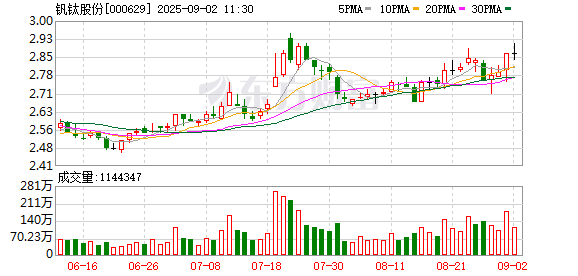
Core Viewpoint - The company, Vanadium Titanium Co., Ltd. (钒钛股份), confirmed that it has no business relationship with Tesla despite inquiries about the potential future of humanoid robots and the use of titanium in Tesla's robot joints [2] Group 1 - Investors inquired about the future direction of humanoid robots and the use of titanium in Tesla's robot joints [2] - Vanadium Titanium Co., Ltd. stated on the investor interaction platform that there is no business connection with Tesla [2]

中信期货晨报:国内商品期货涨跌参半,新能源材料涨幅居前-20250902
Zhong Xin Qi Huo· 2025-09-02 03:12
Report Industry Investment Rating No relevant content provided. Core Views of the Report - Overseas: The US macro - fundamentals are stable, but political pressure on the Fed has raised market expectations of interest rate cuts. The dovish stance of Powell at the global central bank annual meeting and Trump's dismissal of a hawkish Fed governor have pushed up these expectations. However, service inflation stickiness, tariff shocks, and concerns about Fed independence are tail - risks. The overseas liquidity is expected to expand in the next 1 - 2 quarters, entering a "loose expectation + weak dollar" repair channel, which may support the recovery of total demand [7]. - Domestic: Market expectations for corporate profit margins have improved, and the "anti - involution" has promoted the continued improvement of mid - stream profits in July. Recent demand - side policies in first - tier cities may increase trading volume, but the sustainability needs to be observed. After the important events in early September, China may enter the verification period of the seasonal peak of fixed - asset investment and consumption, and the fundamentals may play a more important role in asset pricing, especially for short - duration commodity assets [7]. Summary by Relevant Catalogs 1. Macro Highlights - **Overseas Macro**: The US macro - fundamentals are stable. Political pressure on the Fed has reached a new high, increasing market expectations of interest rate cuts. The dovishness of Powell at the August global central bank annual meeting and Trump's dismissal of a hawkish Fed governor on August 25 have further pushed up these expectations. US consumers' willingness to buy real estate, cars, and household durables is fluctuating at a low level, and real wage growth is flat. Service inflation stickiness, tariff shocks, and concerns about Fed independence are tail - risks [7]. - **Domestic Macro**: Market expectations for corporate profit margins have improved. The "anti - involution" has led to better mid - stream profits in July. From January to July, the year - on - year decline in the profits of industrial enterprises above the designated size has narrowed to - 1.7%. First - tier cities have introduced demand - side policies, but the overall policy strength is relatively weak, with more relaxation for new houses in suburban areas of core cities [7]. - **Asset Views**: Short - term market volatility may increase in early September in China. After important events, China may enter the verification period of the seasonal peak of fixed - asset investment and consumption, and the fundamentals may have a greater impact on asset pricing. Overseas, liquidity is expected to expand in the next 1 - 2 quarters, entering a "loose expectation + weak dollar" repair channel, which may support non - dollar assets [7]. 2. View Highlights Financial - **Stock Index Futures**: V - shaped rebound and high - level oscillation. The short - term judgment is oscillatory upward, with attention to the decline of incremental funds [8]. - **Stock Index Options**: Hold bull spreads following the market. The short - term judgment is oscillatory upward, with attention to the deterioration of option market liquidity [8]. - **Treasury Bond Futures**: The yield curve steepens. The short - term judgment is oscillatory, with attention to unexpected tariff changes, supply, and monetary easing [8]. Precious Metals - **Gold/Silver**: The US interest rate cut cycle may restart in September, but the impact of market risk appetite needs to be considered. The short - term judgment is oscillatory upward, with attention to US fundamentals, Fed monetary policy, and global equity market trends [8]. Shipping - **Container Shipping to Europe**: The peak season in the third quarter is fading, and there is a lack of upward drivers. The short - term judgment is oscillatory, with attention to the rate of freight decline in September [8]. Black Building Materials - **Steel**: Supply - demand contradictions are accumulating, and the futures market is weak. The short - term judgment is oscillatory, with attention to the progress of special bond issuance, steel exports, and hot metal production [8]. - **Iron Ore**: Hot metal production is decreasing, and inventory is being depleted. The short - term judgment is oscillatory, with attention to overseas mine production and shipping, domestic hot metal production, weather, port inventory, and policy dynamics [8]. - **Coke**: The eighth - round negotiation continues, and supply is tightening. The short - term judgment is oscillatory, with attention to steel mill production, coking costs, and macro sentiment [8]. - **Coking Coal**: Supply is tightening, and there is no inventory pressure. The short - term judgment is oscillatory, with attention to steel mill production, coal mine safety inspections, and macro sentiment [8]. - **Silicon Iron**: Supply and demand are becoming more relaxed, and attention is paid to cost adjustments. The short - term judgment is oscillatory, with attention to raw material costs and steel procurement [8]. - **Manganese Silicon**: Supply pressure is accumulating, and the futures market is under pressure. The short - term judgment is oscillatory, with attention to cost prices and overseas quotes [8]. - **Glass**: Supply is still increasing, and peak - season demand needs to be verified. The short - term judgment is oscillatory, with attention to spot sales [8]. - **Soda Ash**: Supply fluctuates slightly, and the expectation of oversupply remains. The short - term judgment is oscillatory, with attention to soda ash inventory [8]. Non - ferrous Metals and New Materials - **Copper**: The suspension of tariffs between China and the US has been extended, and copper prices are oscillating at a high level. The short - term judgment is oscillatory, with attention to supply disruptions, unexpected domestic policies, less - than - expected dovishness of the Fed, and less - than - expected recovery of domestic demand [8]. - **Alumina**: The spot market is weakly stable, and warehouse receipts are increasing. Alumina prices are under pressure and oscillating. The short - term judgment is oscillatory, with attention to unexpected delays in ore复产 and unexpected increases in electrolytic aluminum复产 [8]. - **Aluminum**: Social inventory is slightly accumulating, and aluminum prices are oscillating at a high level. The short - term judgment is oscillatory, with attention to macro risks, supply disruptions, and less - than - expected demand [8]. - **Zinc**: The decline in black - series prices has led to a decline in zinc prices. The short - term judgment is oscillatory downward, with attention to macro - turning risks and unexpected increases in zinc ore supply [8]. - **Lead**: Consumption is still unclear, and lead prices are oscillating downward. The short - term judgment is oscillatory, with attention to supply - side disruptions and slowdown in battery exports [8]. - **Nickel**: Market sentiment is fluctuating, and nickel prices are oscillating widely. The short - term judgment is oscillatory, with attention to unexpected macro and geopolitical changes, Indonesian policy risks, and unexpected delays in supply release [8]. - **Stainless Steel**: The continuous increase in nickel - iron prices has led to a correction in the stainless - steel futures market. The short - term judgment is oscillatory, with attention to Indonesian policy risks and unexpected increases in demand [8]. - **Tin**: Raw material supply is still tight, and tin prices are oscillating at a high level. The short - term judgment is oscillatory, with attention to the expected复产 in Wa State and changes in demand improvement expectations [8]. - **Industrial Silicon**: Coal prices are fluctuating, and silicon prices are continuously changing. The short - term judgment is oscillatory upward, with attention to unexpected production cuts on the supply side and unexpected increases in photovoltaic installations [8]. - **Lithium Carbonate**: The multi - empty game continues, and prices are oscillating widely. The short - term judgment is oscillatory, with attention to less - than - expected demand, supply disruptions, and new technological breakthroughs [8]. Energy and Chemicals - **Crude Oil**: Supply pressure continues, and the sustainability of the rebound is expected to be limited. The short - term judgment is oscillatory downward, with attention to OPEC+ production policies and the geopolitical situation in the Middle East [10]. - **LPG**: The cracking spread is stabilizing, and attention is paid to cost - side guidance. The short - term judgment is oscillatory, with attention to the progress of cost - side factors such as crude oil and overseas propane [10]. - **Asphalt**: Shandong spot prices have declined, and asphalt futures prices are oscillating. The short - term judgment is downward, with attention to sanctions and supply disruptions [10]. - **High - Sulfur Fuel Oil**: Geopolitical tensions have met with an increase in warehouse receipts, and fuel oil prices first rose and then fell. The short - term judgment is downward, with attention to geopolitical factors and crude oil prices [10]. - **Low - Sulfur Fuel Oil**: Low - sulfur fuel oil futures prices are following crude oil prices and oscillating downward. The short - term judgment is downward, with attention to crude oil prices [10]. - **Methanol**: Port inventory is accumulating, and olefin prices are falling. Methanol prices are oscillating downward. The short - term judgment is oscillatory, with attention to macro - energy and upstream and downstream device dynamics [10]. - **Urea**: Domestic supply and demand are mainly loose, waiting for the recovery of autumn demand and the release of exports. The short - term judgment is oscillatory, with attention to the actual implementation of exports [10]. - **Ethylene Glycol**: The low - inventory fundamentals are competing with macro sentiment, and the downward support is relatively strong. The short - term judgment is oscillatory, with attention to coal and oil price fluctuations, port inventory rhythm, and unexpected device shutdowns [10]. - **PX**: The market atmosphere has cooled, and there is insufficient upward support. The short - term judgment is oscillatory, with attention to significant crude oil price fluctuations, macro - level changes, and less - than - expected peak seasons [10]. - **PTA**: The terminal market atmosphere has cooled slightly, but the tight supply - demand situation still supports prices. The short - term judgment is oscillatory, with attention to significant crude oil price fluctuations, macro - level changes, and less - than - expected peak seasons [10]. - **Short - Fiber**: The downstream is in a wait - and - see mood, and the peak - season performance needs to be verified. The short - term judgment is oscillatory, with attention to the downstream yarn - mill purchasing rhythm and unexpected device load reduction [10]. - **Bottle Chip**: Mainstream large - scale manufacturers continue to reduce production, and there is a possibility of further reduction. The short - term judgment is oscillatory, with attention to unexpected increases in bottle - chip enterprise production and a surge in overseas export orders [10]. - **Propylene**: It mainly follows PP fluctuations in the short term. The short - term judgment is oscillatory, with attention to oil prices and the domestic macro - situation [10]. - **PP**: The pressure of new production capacity is increasing, and PP prices are oscillating weakly. The short - term judgment is oscillatory, with attention to oil prices and domestic and overseas macro - situations [10]. - **Plastic**: The fundamental support is limited, and plastic prices are oscillating downward. The short - term judgment is oscillatory, with attention to oil prices and domestic and overseas macro - situations [10]. - **Styrene**: The commodity sentiment has improved, and attention is paid to the implementation of policy details. The short - term judgment is oscillatory, with attention to oil prices, macro - policies, and device dynamics [10]. - **PVC**: The weak reality is suppressing, and PVC prices are running weakly. The short - term judgment is oscillatory, with attention to expectations, costs, and supply [10]. - **Caustic Soda**: The spot price rebound has slowed down, and caustic soda prices are oscillating temporarily. The short - term judgment is oscillatory, with attention to market sentiment, production start - up, and demand [10]. Agriculture - **Oils and Fats**: There may still be a need for short - term adjustment, and attention is paid to the effectiveness of the lower - level technical support. The short - term judgment is oscillatory, with attention to US soybean weather and Malaysian palm oil production and demand data [10]. - **Protein Meal**: The release of state reserves has pushed down soybean meal prices, and point - price trading is expected to keep prices oscillating within a range. The short - term judgment is oscillatory, with attention to US soybean weather, domestic demand, the macro - situation, and Sino - US and Sino - Canadian trade wars [10]. - **Corn/Starch**: Traders are pre - stocking, and sentiment should not be overly pessimistic. The short - term judgment is oscillatory, with attention to less - than - expected demand, the macro - situation, and weather [10]. - **Pig**: The supply is expected to be abundant, and futures prices are oscillating at a low level. The short - term judgment is oscillatory, with attention to breeding sentiment, epidemics, and policies [10]. - **Rubber**: The overall trend is relatively strong. The short - term judgment is oscillatory upward, with attention to production - area weather, raw material prices, and macro - changes [10]. - **Synthetic Rubber**: It has rebounded to the previous high and is following the trend. The short - term judgment is oscillatory upward, with attention to significant crude oil price fluctuations [10]. - **Pulp**: There is a differentiation between near - and far - term contracts, and the main pulp contract is weak. The short - term judgment is oscillatory, with attention to macro - economic changes and fluctuations in US dollar - based quotes [10]. - **Cotton**: Zhengzhou cotton has significantly reduced positions, and cotton prices have declined within a range. The short - term judgment is oscillatory, with attention to demand and inventory [10]. - **Sugar**: The driving force is downward, but the short - term downward space is limited. The short - term judgment is oscillatory, with attention to imports [10]. - **Log**: The delivery pressure is still large, and log prices are weakly adjusting. The short - term judgment is oscillatory downward, with attention to shipment volume and shipping volume [10].
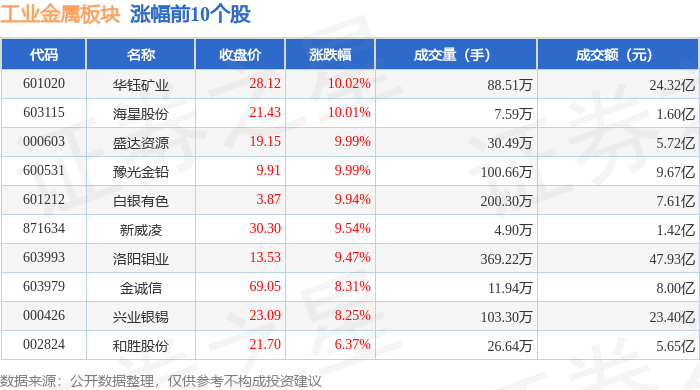
工业金属板块9月1日涨4.08%,华钰矿业领涨,主力资金净流入6.96亿元
Zheng Xing Xing Ye Ri Bao· 2025-09-01 08:40
Group 1 - The industrial metal sector experienced a significant increase of 4.08% on September 1, with Huayu Mining leading the gains [1] - The Shanghai Composite Index closed at 3875.53, up 0.46%, while the Shenzhen Component Index closed at 12828.95, up 1.05% [1] - Notable performers in the industrial metal sector included Huayu Mining, which rose by 10.02% to a closing price of 28.12, and Haixing Co., which increased by 10.01% to 21.43 [1] Group 2 - The industrial metal sector saw a net inflow of 696 million yuan from institutional investors, while retail investors experienced a net outflow of 613 million yuan [2] - The top stocks by net inflow from institutional investors included Jiangxi Copper with a net inflow of 223 million yuan and Huayu Mining with 178 million yuan [3] - Conversely, retail investors showed significant outflows from stocks like Huayu Mining and Yuguang Jin Lead, with outflows of 9425.62 million yuan and 9490.63 million yuan respectively [3]


宝钢股份(600019):2022半年报业绩点评:2025H1产量同比微降,吨毛利同比改善
GUOTAI HAITONG SECURITIES· 2025-08-29 09:34
Investment Rating - The investment rating for the company is "Accumulate" with a target price of 8.70 CNY [6][13]. Core Insights - In the first half of 2025, the company's production and sales volume slightly decreased year-on-year, while the gross profit per ton of steel significantly improved. This improvement is attributed to a greater decline in raw material prices compared to steel prices, alongside the company's ongoing cost control efforts and product structure optimization [3][13]. - The company reported a revenue of 151.37 billion CNY in the first half of 2025, a year-on-year decrease of 7.28%, while the net profit attributable to shareholders was 4.879 billion CNY, an increase of 7.36% year-on-year. The forecast for net profit for 2025-2026 is maintained at 10.286 billion CNY and 12.147 billion CNY, respectively [13][16]. Financial Summary - The total revenue for 2025 is projected to be 313.423 billion CNY, reflecting a decrease of 2.7% from the previous year. The net profit attributable to shareholders is expected to rise to 10.286 billion CNY, a 39.7% increase compared to 2024 [5][15]. - The average selling price of steel in the first half of 2025 was 4,293 CNY per ton, down 8.7% year-on-year, while the gross profit per ton of steel was 270.64 CNY, up 56.49% year-on-year [13][5]. Product Structure Optimization - The sales volume of differentiated products under the "2+2+N" strategy reached 16.58 million tons in the first half of 2025, a year-on-year increase of 9.9%, accounting for approximately 66% of total sales [13][3]. - The company is expanding its high-grade silicon steel production capacity, with an expected addition of 738,000 tons per year of non-oriented silicon steel and 440,000 tons per year of oriented silicon steel [13][3]. Dividend Policy - The company has committed to a minimum annual dividend of 0.20 CNY per share from 2024 to 2026. In the first half of 2025, it plans to distribute a cash dividend of 0.12 CNY per share, with a payout ratio of 52.58% [13][3].

实业韧性凸显!中信股份(00267)中期净利598亿 传统产业升级+新兴赛道布局双线突破
智通财经网· 2025-08-29 08:50
Group 1 - The core viewpoint of the article highlights the strong performance of CITIC Limited in the first half of 2025, with revenue reaching 368.8 billion RMB and net profit at 59.8 billion RMB, indicating a robust growth trajectory [1] - The company proposed an interim dividend of 0.20 RMB per share, representing a year-on-year increase of 5.3%, with a total dividend payout of 5.818 billion RMB, reflecting a steady improvement in dividend levels [1] - CITIC's industrial business has shown significant resilience, focusing on key areas such as integrated die-casting, special robots, scarce resources, and biological breeding, while accelerating technological iteration and capital empowerment [1] Group 2 - In emerging and future industries, the company is actively conducting research on industrial mergers and acquisitions in areas like digital technology, low-altitude economy, and embodied intelligence, successfully completing key project reserves [2] - CITIC Hai Zhi has successfully conducted the world's first 2-ton eVTOL marine oil platform test flight, integrating into regional low-altitude economic development [2]