
煤炭开采

Search documents
淮河能源跌2.02%,成交额1.24亿元,主力资金净流出331.15万元
Xin Lang Cai Jing· 2025-12-30 05:31
Core Viewpoint - Huaihe Energy's stock has experienced a decline of 14.61% this year, with a recent drop of 2.02% on December 30, 2023, reflecting ongoing challenges in the coal and energy sector [1][2]. Company Overview - Huaihe Energy (Group) Co., Ltd. is located in Huainan City, Anhui Province, and was established on November 29, 2000. The company was listed on March 28, 2003. Its main business activities include railway transportation, coal trading, thermal power generation, and electricity sales [1]. - The revenue composition of Huaihe Energy is as follows: logistics trade 68.73%, electricity 22.26%, coal sales 5.75%, railway transportation 2.61%, and others 0.65% [1]. Financial Performance - For the period from January to September 2025, Huaihe Energy reported an operating income of 21.303 billion yuan, a year-on-year decrease of 9.71%. The net profit attributable to shareholders was 752 million yuan, down 10.69% year-on-year [2]. - The company has distributed a total of 1.099 billion yuan in dividends since its A-share listing, with 466 million yuan distributed over the past three years [3]. Shareholder Information - As of December 20, 2023, Huaihe Energy had 58,300 shareholders, a decrease of 0.75% from the previous period. The average number of circulating shares per shareholder increased by 0.76% to 66,615 shares [2]. - The top ten circulating shareholders include Hong Kong Central Clearing Limited, holding 16.3387 million shares, and Southern CSI 1000 ETF, holding 14.1953 million shares, with changes in their holdings noted [3]. Market Activity - On December 30, 2023, Huaihe Energy's stock price was 3.39 yuan per share, with a trading volume of 124 million yuan and a turnover rate of 0.93%. The total market capitalization was 24.295 billion yuan [1]. - The stock has appeared on the "Dragon and Tiger List" twice this year, with the most recent instance on May 9, where it recorded a net purchase of 67.0857 million yuan [1].

中孚实业股价跌1.79%,民生加银基金旗下1只基金重仓,持有41.22万股浮亏损失5.77万元
Xin Lang Cai Jing· 2025-12-30 01:37
Group 1 - The core point of the news is that Zhongfu Industrial's stock price decreased by 1.79% to 7.66 CNY per share, with a total market capitalization of 30.701 billion CNY as of the report date [1] - Zhongfu Industrial, established on January 28, 1997, and listed on June 26, 2002, is primarily engaged in coal mining, thermal power generation, electrolytic aluminum, and deep processing of aluminum products [1] - The revenue composition of Zhongfu Industrial is as follows: non-ferrous metals account for 94.76%, electricity for 9.96%, coal for 2.71%, and other businesses for 0.47% [1] Group 2 - Minsheng Jianyin Fund holds a significant position in Zhongfu Industrial through its fund Minsheng Jianyin Cycle Optimal Mixed A (011888), which held 412,200 shares, representing 3.81% of the fund's net value [2] - The fund has experienced a year-to-date return of 67.56%, ranking 488 out of 8,087 in its category, and a one-year return of 65.26%, ranking 454 out of 8,085 [2] - The fund manager, Rui Dingkun, has been in position for 4 years and 26 days, with the fund's total asset size at 492 million CNY [2]

山东能源梁家煤矿:“158”工程为安全高效发展蓄能加码
Qi Lu Wan Bao· 2025-12-30 01:20
Core Viewpoint - The "158" project at Shandong Energy LUXI Mining's Liangjia Coal Mine is a significant initiative aimed at enhancing safety production standardization through innovative technologies and management practices [4]. Group 1: Project Implementation and Innovations - The "158" project includes a comprehensive framework with "1 concept, 5 paths, and 8 standards" to improve safety production standardization [4]. - The introduction of an automatic supply device for spraying has reduced rebound rates by 5-10% and is expected to save over 100,000 yuan annually in material waste [2]. - The use of a permanent magnet drum belt system enhances energy efficiency and safety, with a 10% improvement in the quality of tunnel formation due to precise laser positioning [3]. Group 2: Safety and Efficiency Enhancements - The mine has implemented a full lifecycle management approach for equipment, resulting in a 10% reduction in downtime due to equipment failures [5]. - Dust concentration in the mine has decreased by 30% due to the installation of automatic purification systems and spray devices on coal mining machines [5]. - The mine has successfully created 12 "158" boutique projects across various specialties, achieving dynamic and precise standards in underground operations [4]. Group 3: Management and Future Directions - The mine's management emphasizes a structured process for safety improvements, including monthly submissions of enhancement plans and quarterly selections of projects for excellence [4]. - The recent site promotion meeting served as a motivation for the entire mine to adopt advanced practices and address shortcomings in safety and efficiency [5].
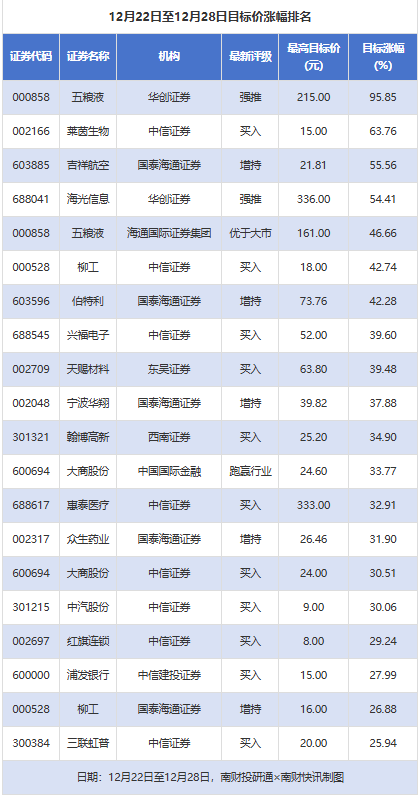
五粮液目标价涨幅超95%;177股获推荐
2 1 Shi Ji Jing Ji Bao Dao· 2025-12-29 22:20
Group 1 - The core viewpoint of the news highlights the target price increases for several listed companies, with Wuliangye (000858) leading with a target price increase of 95.85% [1][2] - The companies with the highest target price increases include Wuliangye (95.85%), Lain Biotechnology (63.76%), and Juneyao Airlines (55.56%), representing the liquor, chemical products, and aviation industries respectively [1][2] - A total of 177 listed companies received broker recommendations during the period from December 22 to December 28, with Lingyi iTech (002600) and China Shenhua (601088) receiving the most recommendations at four each [3][4] Group 2 - The companies with the highest number of broker recommendations include Lingyi iTech (4 recommendations), China Shenhua (4 recommendations), and Dashang Co. (600694) with 3 recommendations [3][4] - Five companies had their ratings upgraded during the same period, including Beijing Junzheng (300223) from "Hold" to "Buy" by Zhongyou Securities [5] - A total of 80 first-time coverage ratings were issued, with notable mentions including Zhongqi Co. (301215) receiving a "Buy" rating from CITIC Securities and Yanzhong Energy (600188) also receiving a "Buy" rating from Western Securities [6]


股市必读:山西焦煤(000983)12月29日董秘有最新回复
Sou Hu Cai Jing· 2025-12-29 19:16
Group 1 - The closing price of Shanxi Coking Coal (000983) on December 29, 2025, was 6.52 yuan, reflecting an increase of 0.46% with a turnover rate of 0.59% and a trading volume of 275,100 shares, amounting to a transaction value of 180 million yuan [1] Group 2 - The company secretary responded to an investor inquiry regarding the compensation standards for external directors, stating that the standards are based on regulations from the China Securities Regulatory Commission and the company's articles of association, considering industry benchmarks, regional economic conditions, and the company's actual situation [2] - The company does not provide social insurance for independent directors [2] Group 3 - On December 29, the net inflow of funds from major investors was 4.0554 million yuan, while speculative funds saw a net inflow of 5.2242 million yuan, and retail investors experienced a net outflow of 9.2797 million yuan [2][2]

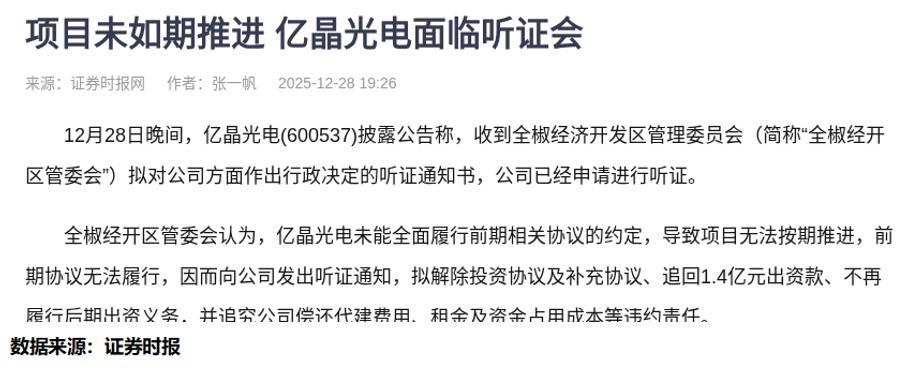
亿晶光电遇1.4亿追责:资金共识藏在交易里?
Sou Hu Cai Jing· 2025-12-29 16:14
Group 1 - Yichin Photovoltaic announced that the Qianjiao Economic Development Zone Management Committee intends to terminate a previous investment agreement for a photovoltaic project and recover 140 million yuan, citing that the project did not progress as agreed [1] - The company had promised to build a 10GW battery, slicing, and component project by 2022 but only completed 7.5GW of battery capacity, leading to a production halt [1] - The company has applied for a hearing regarding this matter, and the outcome is still pending, causing concern among minority shareholders about the potential impact on their investments [1] Group 2 - The article emphasizes that market reactions to news are often driven by the consensus of funds rather than the news itself, highlighting the importance of understanding fund behavior [2][3] - Investors should focus on whether institutional and retail investors are actively buying or selling stocks, as this behavior is a key indicator of stock price movements [3] - The article suggests that stocks that are in demand by both institutional and retail investors are more likely to perform well, indicating a "buying rush" [4][9] Group 3 - The concept of "stock accumulation" is introduced, where funds quietly buy shares without drawing attention, which can lead to significant price increases later [10][14] - The article argues that waiting for funds to reach a consensus is not a waste of time, as it can lead to better investment outcomes [15][18] - Data analysis can reveal whether funds are accumulating or rushing to buy, helping investors make informed decisions [19]

能源矿产 | 2025年全球煤炭上市公司财报解码:周期之巅与价值重塑
Sou Hu Cai Jing· 2025-12-29 10:16
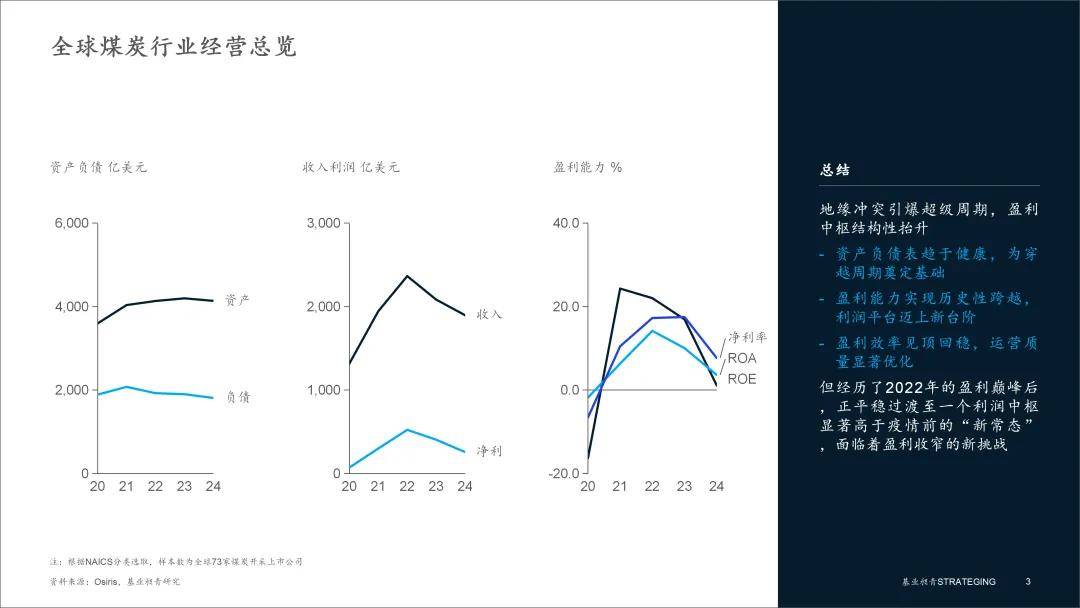
Core Insights - The global coal industry has transitioned from a peak profit phase to a new normal characterized by value reconstruction, where profit elasticity and capital operations have become key to success in a differentiated landscape [1][2]. Industry Overview - The global coal mining industry is experiencing a significant economic cycle driven by external shocks and supply-demand mismatches from 2020 to 2024, with a notable profit center established above pre-pandemic levels, despite facing new challenges of profit contraction [2]. - The industry reached a record profit peak of $52.4 billion in 2022, driven by geopolitical conflicts and a surge in international coal prices, following a brief downturn in 2020 due to the pandemic [2][3]. - The average net profit margin improved dramatically from a loss of $7.2 billion in 2020 to a peak of 17.27% in 2022, indicating a fundamental reversal in profitability [3]. Profitability and Efficiency - The coal industry's net profit is projected to normalize at $25.7 billion in 2024, still significantly higher than pre-pandemic levels, reflecting a structural elevation in overall profitability [3]. - The average net profit margin is expected to decline to 7.66% by 2024, indicating a departure from the peak profit phase and highlighting the cyclical nature of profitability [5]. Global Landscape - Asia, particularly China, India, and Indonesia, dominates the global coal industry, with these countries playing pivotal roles in shaping the market dynamics [8]. - China serves as the largest producer and consumer, ensuring energy security with stable profitability, while India experiences robust domestic demand growth, achieving an average net profit margin of 26.69% [8]. - Indonesia and Australia benefit significantly from international coal price surges, with average net profit margins of 19.05% and 15.64%, respectively [8]. Company Comparisons - Major players like China Shenhua and Indian Coal exhibit strong integrated advantages, showcasing resilience and stable profitability amid cyclical fluctuations [11]. - Emerging companies, such as Stanmore in Australia, have capitalized on acquisition opportunities during the cycle, achieving a remarkable compound annual growth rate of 118.56% [11]. - Export-oriented firms in Indonesia, like Golden Energy, have maximized profits from price elasticity, with average returns on equity reaching 71.67% [11]. Strategic Recommendations - The coal industry must transition from being mere fuel suppliers to comprehensive energy service providers, focusing on enhancing energy security and integrating renewable energy solutions [17][20]. - Companies should extend their value chains by developing high-end coal chemical products and exploring synergies with renewable energy projects [20]. - Emphasizing ESG management can transform perceived costs into competitive advantages, enabling firms to secure lower financing costs and enhance their public image [21]. - Maintaining prudent capital discipline is essential, focusing investments on core business areas and ensuring a healthy balance sheet to navigate future economic cycles [22].

煤炭开采板块12月29日涨0.2%,华阳股份领涨,主力资金净流出7268.7万元
Zheng Xing Xing Ye Ri Bao· 2025-12-29 09:02
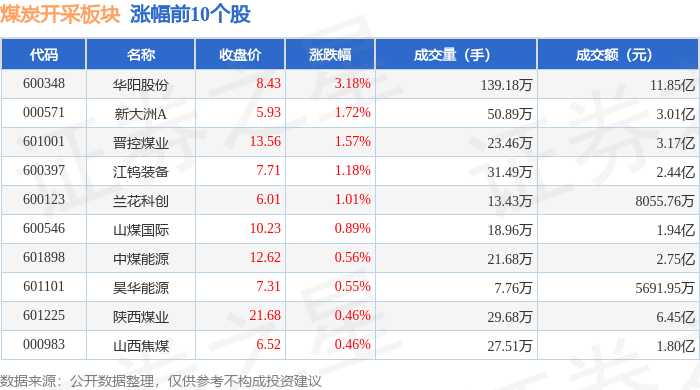
Group 1 - The coal mining sector increased by 0.2% compared to the previous trading day, with Huayang Co. leading the gains [1] - The Shanghai Composite Index closed at 3965.28, up 0.04%, while the Shenzhen Component Index closed at 13537.1, down 0.49% [1] - Key stocks in the coal mining sector showed varied performance, with Huayang Co. closing at 8.43, up 3.18%, and other notable stocks like Xinda Zhou A and Jinkong Coal Industry also showing positive gains [1] Group 2 - The coal mining sector experienced a net outflow of 72.687 million yuan from main funds, while retail investors saw a net inflow of 21.4726 million yuan [2] - Major stocks like Shanxi Coal and Electricity and China Shenhua saw significant net inflows from retail investors, while others like Huaihe Energy experienced net outflows [3] - The data indicates a mixed sentiment among investors, with some stocks attracting retail interest while others faced selling pressure from main funds [3]


煤炭长协与市场价倒挂,底部区间或再确认 | 投研报告
Zhong Guo Neng Yuan Wang· 2025-12-29 03:02
Core Viewpoint - The coal mining industry is experiencing a decline in capacity utilization for both thermal and coking coal, indicating potential shifts in supply and demand dynamics [1][3]. Group 1: Capacity Utilization - As of December 26, the capacity utilization rate for sample thermal coal mines is 86.4%, down 4.0 percentage points week-on-week [1][3]. - The capacity utilization rate for sample coking coal mines is 84.21%, down 2.4 percentage points week-on-week [1][3]. Group 2: Price Trends - Thermal coal prices at Qinhuangdao port (Q5500) are reported at 677 RMB/ton, a decrease of 34 RMB/ton week-on-week [2]. - The price of thermal coal in Shanxi (Q6000) is 765 RMB/ton, an increase of 5.0 RMB/ton week-on-week [2]. - International thermal coal prices have also seen declines, with Newcastle (NEWC5500) at 74.0 USD/ton, down 0.5 USD/ton week-on-week [2]. Group 3: Demand and Consumption - Daily coal consumption in coastal provinces has increased by 11.30 thousand tons/day, a rise of 5.53% week-on-week [4]. - Daily coal consumption in inland provinces has increased by 20.90 thousand tons/day, a rise of 5.56% week-on-week [4]. - Chemical coal consumption has decreased by 2.57 thousand tons/day, down 0.35% week-on-week [4]. Group 4: Investment Outlook - The current phase is viewed as the early stage of a new upward cycle in the coal economy, with a recommendation for low-cost allocation in the coal sector [5]. - The coal market is expected to maintain a weak operational trend due to high port inventories and above-average temperatures [5]. - The investment logic of coal capacity shortages remains unchanged, with expectations for price stabilization and potential valuation increases [6][7]. Group 5: Recommendations - Focus on stable and high-performing companies such as China Shenhua, Shaanxi Coal, and China Coal Energy, as well as those with high elasticity like Yanzhou Coal and Guohua Energy [7]. - Attention should also be given to high-quality metallurgical coal companies due to their unique resource scarcity [7].
陕西煤业涨2.04%,成交额3.01亿元,主力资金净流入2230.80万元
Xin Lang Cai Jing· 2025-12-29 02:54
Core Viewpoint - Shaanxi Coal Industry's stock price has shown slight fluctuations, with a recent increase of 2.04%, and the company is experiencing a mixed financial performance in terms of revenue and profit [1][2]. Group 1: Stock Performance - As of December 29, Shaanxi Coal's stock price is 22.02 CNY per share, with a trading volume of 3.01 billion CNY and a market capitalization of 213.48 billion CNY [1]. - Year-to-date, the stock price has increased by 0.17%, with a 0.14% rise over the last five trading days, a 3.80% decline over the last 20 days, and an 8.37% increase over the last 60 days [1]. Group 2: Financial Performance - For the period from January to September 2025, Shaanxi Coal reported a revenue of 118.08 billion CNY, a year-on-year decrease of 5.86%, and a net profit attributable to shareholders of 12.71 billion CNY, down 20.26% year-on-year [2]. - The company has distributed a total of 81.65 billion CNY in dividends since its A-share listing, with 47.33 billion CNY distributed over the last three years [3]. Group 3: Shareholder Information - As of September 30, 2025, the number of shareholders has increased to 105,000, a rise of 2.07%, while the average circulating shares per person decreased by 2.02% to 92,312 shares [2]. - Among the top ten circulating shareholders, China Securities Finance Corporation holds 195 million shares, unchanged from the previous period, while Hong Kong Central Clearing Limited has reduced its holdings by 10.7 million shares to 133 million shares [3].
