
信息技术

Search documents
美股上周下跌,估值仍处高位,扩表释放流动性
Xin Lang Cai Jing· 2025-12-17 07:59
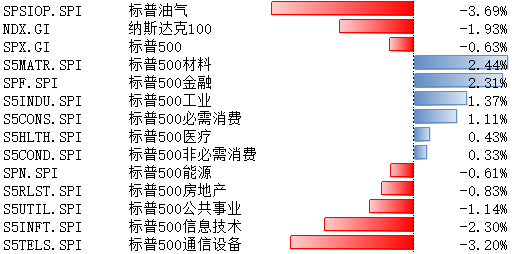
Macroeconomic Overview - In October, the JOLTS job openings in the U.S. unexpectedly increased to 7.67 million, surpassing the expected 7.12 million and the previous value of 7.66 million, primarily driven by a significant rise in the retail sector [1] - The NFIB small business optimism index for November rose to 99%, above the expected 98.3% and the previous 98.2%, indicating a recovery in sales expectations and hiring demand [1] - The Sentix investor confidence index for December increased to 9.7, up from 4.0 in the previous month, reflecting improved investor sentiment [1] Major Index Performance - For the week of December 8-12, the S&P Oil & Gas index fell by 3.69%, the Nasdaq 100 index decreased by 1.93%, and the S&P 500 index declined by 0.63% [2][15] - Among the 11 sectors covered by the S&P 500, 6 sectors saw gains, with the S&P 500 Materials sector leading with a rise of 2.44%, while the S&P 500 Communication Services sector lagged with a drop of 3.20% [2][15] Federal Reserve Insights - The Federal Reserve's decision to lower interest rates was accompanied by an unexpected expansion of its balance sheet, which is beneficial for market liquidity [16][17] - Internal divisions within the Federal Reserve were noted, with some members advocating for a more significant rate cut of 50 basis points, while others preferred to maintain the current rates [17] - The market's expectations for future rate cuts have adjusted, with projections for 2026 decreasing from 3 times to 2.2 times [16][17] Investment Products - The Bosera S&P 500 ETF (513500) is designed to track the S&P 500 index, which includes over 500 representative companies across 11 sectors, accounting for approximately 80% of the total market capitalization of U.S. stocks [17] - The Bosera Nasdaq 100 ETF (513390) tracks the Nasdaq 100 index, with a significant portion (57.87%) of its composition in the Information Technology sector, alongside exposure to Consumer Services, Consumer Goods, and Healthcare sectors [18]

指数的新质生产力属性增强
Qi Huo Ri Bao· 2025-12-17 02:40
Group 1 - The A-share market regularly adjusts index constituents in June and December to maintain representativeness and investability [1] - The CSI 300 index replaced 11 constituents, adding companies like Huadian New Energy and Dongshan Precision, with increases in the information technology and communication services sectors [1] - The average P/E ratio of removed constituents from the CSI 300 was approximately 25.95 times, while the average P/E ratio of added constituents was about 35.23 times [1] Group 2 - The CSI 500 index replaced 50 constituents, adding companies such as Zhongtung High-tech and Huahong Semiconductor, with an increase in the industrial sector [2] - The average P/E ratio of removed constituents from the CSI 500 was around 27.17 times, while the average P/E ratio of added constituents was approximately 34.30 times [2] - The CSI 1000 index replaced 100 constituents, adding companies like Shijia Photon and Yongding Co., with increases in the communication services and industrial sectors [2] Group 3 - The adjustments across indices generally increased the sample size and weight of sectors like information technology, communication services, and industrial, enhancing the indices' productivity attributes [3] - The overall market capitalization coverage of the CSI 300, CSI 500, and CSI 1000 indices remains significant, indicating strong market representation and influence on market sentiment [3] - The adjustments will lead to corresponding changes in ETFs and other funds tracking these indices, significantly impacting the prices of related stocks [3] Group 4 - Newly included stocks typically experience price increases and higher trading volumes, while excluded stocks often see price declines and reduced trading volumes [4] - Historical data suggests that index adjustments lead to short-term positive performance due to increased attention and capital influx, but the long-term impact on index trends is limited [4]
今日A股市场重要快讯汇总|2025年12月17日
Xin Lang Cai Jing· 2025-12-17 00:32
Macroeconomic and Market Analysis - The central economic work conference emphasizes that expanding domestic demand is the top priority for next year [1][4] - Domestic demand has remained stable this year, contributing 71% to economic growth in the first three quarters, with effective consumption policies showing significant results [1][4] - However, there has been a recent slowdown in consumption and investment growth, indicating the need for continued efforts to boost domestic demand [1][4] Important Announcements from Listed Companies - Vanke announced a proposal to extend the principal repayment date of its fourth tranche of medium-term notes for 2022 by 12 months to December 15, 2026, with interest of 60 million yuan due on December 15, 2025, to be paid within a grace period [2][5] - During the grace period, unpaid principal will accrue interest at 3.00%, while unpaid interest will not accrue additional interest, and the coupon rate will remain unchanged at 3.00% [2][5] - After the market close on December 16, several companies disclosed shareholding changes, with some increasing their holdings and others, including Ningbo Color Masterbatch and Huashu Co., announcing reductions [2][5] Peripheral Markets and Related Assets - On Tuesday, U.S. stock indices showed mixed results, with the Dow Jones down 0.62%, the Nasdaq up 0.23%, and the S&P 500 down 0.24% [3][6] - Major tech stocks mostly rose, with Tesla gaining 3.07% and reaching a new closing high, while Qualcomm fell over 1% [3][6] - The Nasdaq Golden Dragon China Index fell 0.34%, with notable declines in companies like Zhongjin Medical and Kandi Technologies [7] - International oil prices saw WTI crude oil drop 3% to below $55 per barrel, currently at $54.97, while Brent crude fell 2.58% below $59 per barrel [7]



上海索辰信息科技股份有限公司第二届董事会第二十二次会议决议公告
Shang Hai Zheng Quan Bao· 2025-12-16 21:09
Group 1 - The company held its 22nd meeting of the second board on December 16, 2025, where all 7 attending directors approved the agenda [2][4] - The board approved the adjustment of internal investment structure and the postponement of the "Research and Development Center Construction Project" and "Annual Production of 260 DEMX Underwater Noise Testers Project" [3][12] - The deadline for the "Research and Development Center Construction Project" to reach the intended usable state has been postponed from April 2026 to April 2028 [3][10] Group 2 - The company raised a total of RMB 253,746.97 million from the public offering of 10,333,400 shares at a price of RMB 245.56 per share, with a net amount of RMB 231,574.91 million after deducting fees [7][8] - As of June 30, 2025, the company has invested a total of RMB 50,446.40 million of the raised funds [8] - The adjustments in the internal investment structure are based on the actual construction progress and strategic development needs, ensuring that the project implementation subject, total investment, and fund usage remain unchanged [6][11] Group 3 - The adjustments in the investment structure include increasing the investment in equipment and rental for the "Research and Development Center Construction Project" while reducing personnel costs [9] - For the "Annual Production of 260 DEMX Underwater Noise Testers Project," the company has increased fixed asset investment while reducing working capital [9] - The postponement is due to the complexity of the CAE products requiring highly skilled professionals, leading to a more cautious approach in fund utilization [10][11] Group 4 - The board's decision on the adjustments and postponement is within its approval authority and does not require shareholder meeting approval [6][12] - The sponsor institution, Guotai Junan Securities, has provided a clear verification opinion on the matter [7][13] - The adjustments will not adversely affect the company's normal operations or long-term development plans [11]

科技方向集体回调,资金逆势加仓,成长ETF(159259)全天获3000万份净申购
Sou Hu Cai Jing· 2025-12-16 10:22
Core Viewpoint - The technology sector experienced a pullback today, with popular concepts such as CPO, optical chips, and optical communication collectively declining over 3%. Despite this, there was a counter trend in funding, with the Growth ETF (159259) seeing a net subscription of 30 million shares throughout the day [1]. Group 1: Index Performance - The National Securities Value 100 Index fell by 0.9% [1]. - The National Securities Free Cash Flow Index decreased by 1.2% [1]. - The National Securities Growth 100 Index dropped by 2.1% [1]. Group 2: Growth ETF Details - The Growth ETF (159259) tracks the National Securities Growth 100 Index, which focuses on A-share stocks with prominent growth styles [3]. - Over 70% of the index's weight is concentrated in the electronics, communication, and computer sectors, aligning with the core aspects of AI computing power [1][3]. - The Growth ETF is the only product that tracks this index, providing investors with opportunities to capitalize on growth-style investments [1].

3332项科技成果“上架”科交会 首日签约额超亿元
Nan Fang Ri Bao Wang Luo Ban· 2025-12-16 09:33
Core Insights - The 2025 Higher Education Technology Achievement Trading Fair (referred to as "Tech Fair") commenced in Guangzhou, showcasing 3,332 technology achievements from 638 universities across the country [1] - The fair aims to facilitate the transformation of scientific achievements from "shelves" to "market" by clearly labeling each technology with a market "price tag" for enterprises to reference [2] - A total of 1.22 billion RMB was signed in contracts on the first day, with projects from fields such as biomedicine, artificial intelligence, and new information technology [1] Group 1: Technology Showcase - The "supermarket" area featured various technology achievements with clear pricing, such as Guangdong Medical University’s rice germ nutrition granules priced between 510,000 to 1 million RMB and Zhongshan University's outdoor intelligent grabbing robot priced over 20 million RMB [2] - The fair included a demonstration area for cutting-edge industries, showcasing innovations like the "Zero Dragon" indoor inspection drone, which attracted attention from security and operation maintenance companies [3] Group 2: Bridging the Gap - Technical managers played a crucial role in connecting universities with enterprises, acting as "translators" to convert complex technical language into understandable solutions for businesses [4] - The fair featured a series of roadshow activities covering various fields, allowing technology holders to present their innovations directly to potential partners [5] Group 3: Student Innovations - A dedicated area for student entrepreneurial teams was established, highlighting projects from universities like Beihang University and Nanjing University, aiming to attract industry investment [6] - Notable projects included a dual-use flying car developed by a team from Beihang University, which garnered significant interest from enterprises [6]
中国信通院建设的人工智能产品安全漏洞专业库(CAIVD)正式上线运行
Zheng Quan Shi Bao Wang· 2025-12-16 06:09
人民财讯12月16日电,2025年12月12日,在工业和信息化部网络安全管理局指导下,中国信息通信研究 院(简称"中国信通院")建设的人工智能产品安全漏洞专业库(简称CAIVD,网址:ai.nvdb.org.cn)正式上 线运行。 ...
港股市场估值周报:2025.12.08-2025.12.14-20251216
Zhe Shang Guo Ji Jin Rong Kong Gu· 2025-12-16 05:59
Valuation of Hong Kong Stock Market - The Hang Seng Composite Index (HSCI) and Hang Seng Index (HSI) are key indicators of market valuation[8][12] - The Hang Seng Technology Index (HSTECH) reflects the valuation trends in the tech sector[16][18] Industry Valuation Levels - The PE (TTM) valuation shows that the utilities sector is undervalued, with a percentile below 20%[23] - Consumer discretionary, consumer staples, healthcare, information technology, and utilities are below the 50th percentile in PE valuation[23] - High valuation sectors (above 50%) include energy, materials, industrials, financials, and telecommunications[23] - No sectors are currently undervalued based on PB (LF) valuation, with consumer staples, information technology, utilities, and real estate below the 50th percentile[27] - Energy, materials, industrials, consumer discretionary, healthcare, financials, and telecommunications are above the 50th percentile in PB valuation[27] AH Share Premium/Discount Levels - The Hang Seng AH Share Premium Index shows fluctuations in premium levels over time, with historical averages and standard deviations noted[33]
中国经济观测点丨11月新注册经营主体数环比回升明显 融资规模缩小
Xin Hua Cai Jing· 2025-12-16 05:18
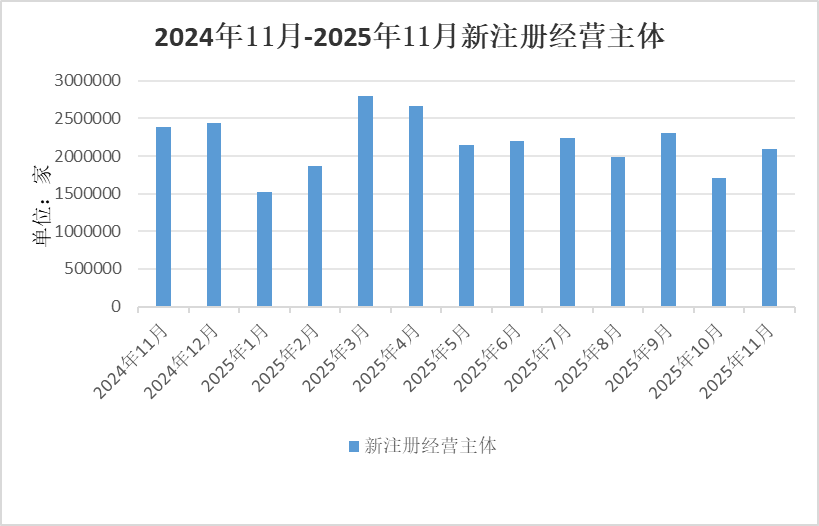
Group 1: National Overview - In November 2025, a total of 2.0875 million new business entities were registered nationwide, showing a month-on-month increase of 22.72% but a year-on-year decrease of 12.38% [1] - The top ten provinces accounted for 62.7% of the new registrations, with Guangdong leading at 261,919 new entities, representing 12.55% of the national total [3][4] Group 2: Provincial Insights - Guangdong province registered 261,919 new business entities in November, an increase of 52,500 from the previous month, maintaining its position as the top province for new registrations [3] - Hubei and Zhejiang followed with 157,111 and 149,064 new registrations, respectively, indicating strong activity in these regions [4] Group 3: Growth Trends - Nine provinces and cities experienced positive growth in new registrations in November, with Beijing leading at a growth rate of 28.3% [6] - The top ten provinces by growth rate included Beijing, Hainan, Guangdong, and Zhejiang, reflecting a broader recovery in business registrations [6] Group 4: Industry Analysis - The retail sector saw the highest number of new registrations in November, totaling 233,100, with a year-on-year growth of 29.88% [8] - The technology promotion and application services industry had the fastest growth rate, with 119,600 new registrations, marking a year-on-year increase of 53.29% [8] Group 5: Financing Activity - In November 2025, there were 331 financing events, a decrease of 112 from the previous month, with a total financing scale of 65.671 billion yuan, down by 24.203 billion yuan [10] - The information technology sector led in financing events with 133 occurrences, followed by the manufacturing sector with 71 events [10][13]
合肥木棠科技有限公司成立 注册资本30万人民币
Sou Hu Cai Jing· 2025-12-16 03:48
Group 1 - Hefei Mutang Technology Co., Ltd. has been established with a registered capital of 300,000 RMB [1] - The legal representative of the company is Jin Shenglin [1] - The business scope includes technology services, development, consulting, and promotion, as well as various sales and advertising services [1] Group 2 - The company is involved in the Internet sales of non-licensed goods and domestic trade agency [1] - It also offers services related to brand management and enterprise management consulting [1] - The company is permitted to operate legally in areas not prohibited or restricted by laws and regulations [1]