
咖啡茶饮

Search documents
海外中国资产中报季的高潮和重估:海外中国资产中报季的高潮和重估
SINOLINK SECURITIES· 2025-08-17 12:25
Investment Rating - The report maintains a positive outlook on overseas Chinese assets, particularly in the context of the ongoing earnings season and the revaluation of these assets [3][11]. Core Views - The enthusiasm for the revaluation of overseas Chinese assets continues, with the Hong Kong stock market showing a sustained profit effect, driving up risk appetite for these assets. Many companies have reported earnings that exceeded expectations, and this trend is expected to continue in the coming weeks. The overflow of dollar liquidity and rising expectations for interest rate cuts are clearly beneficial for overseas Chinese assets [3][17]. - The report expresses a continued positive outlook on blockchain and virtual asset-related sectors, noting a clear upward trend in these areas. Despite a recent cooling in sentiment in the Greater China region, the underlying industry trends remain strong, particularly for BTC/ETH and asset trading platforms [3][17]. Industry Situation Tracking 1. Education - The Chinese education index rose by 0.76% during the period from August 11 to August 15, underperforming compared to major indices. Notable performers included Dongfang Zhenxuan, which rose by 39.61%, and NetEase Youdao, which increased by 14.46% [12][23]. 2. Luxury Goods - The S&P Global Luxury Goods Index increased by 1.92%, while the MSCI Europe Luxury Goods and Apparel Index rose by 0.32%. Key luxury stocks such as Samsonite and Prada saw increases of 6.43% and 2.62%, respectively [23][27]. 3. Coffee and Tea Beverages - The Hang Seng Non-Essential Consumer Index showed a cumulative increase of 1.08%. Key stocks in this sector included Dashi Holdings (+4.92%) and Luckin Coffee (+1.08%) [28][30]. 4. E-commerce and Internet - The Hang Seng Internet Technology Index rose by 1.52%, with notable stock performances from Vipshop (+10.56%) and Tencent Holdings (+5.53%) [32][36]. 5. Streaming Platforms - The Hang Seng Media Index increased by 1.6%, with Tencent Music and NetEase Cloud Music showing significant gains of 15.32% and 4.95%, respectively [38][40]. 6. Virtual Assets and Internet Brokers - As of August 15, the global cryptocurrency market capitalization reached $404.37 billion, with Bitcoin and Ethereum prices at $117,340 and $4,431, reflecting increases of 0.6% and 10.4%, respectively [43][46].


关税引爆咖啡茶饮价格 美国小商家陷生存危机
智通财经网· 2025-08-14 06:32
Core Insights - The article highlights the inflationary pressures on certain tariff-sensitive food products, particularly coffee, specialty teas, and spices, which are causing concern among small businesses in the U.S. [1][2] Group 1: Price Increases and Consumer Impact - The July Consumer Price Index (CPI) report indicates that while overall food prices remained stable month-over-month, they are still 2.9% higher compared to the same time last year [1] - Coffee prices have seen a significant year-over-year increase of 14.5%, with the average retail price for ground coffee reaching $8.41 per pound [1] - Small businesses, such as Bethany's Coffee in Lincoln, Nebraska, have raised coffee prices by 18% to 25% since January, reflecting the rapid changes in costs [1] Group 2: Tariff Implications - Approximately 74% of U.S. food imports, valued at around $163 billion, are subject to tariffs, impacting the cost structure for companies reliant on imported goods [1] - Companies like Anjali's Cup, which sources nearly all its coffee and spice ingredients from overseas, face challenges in adjusting to higher tariffs, particularly a 50% tariff on Indian tea [2][3] - The imposition of tariffs is expected to force small businesses to choose between maintaining product quality and staying operational, potentially leading to market exits [3] Group 3: Broader Market Effects - The impact of tariffs is anticipated to extend beyond individual businesses, affecting grocery stores and the overall product variety available to consumers [3] - Changes in supply sources due to tariffs may lead to a shift in the types of products available year-round, as noted by industry experts [3] - The global trade tensions are viewed as detrimental to the vitality of the U.S. market, particularly for unique and high-quality products [4]
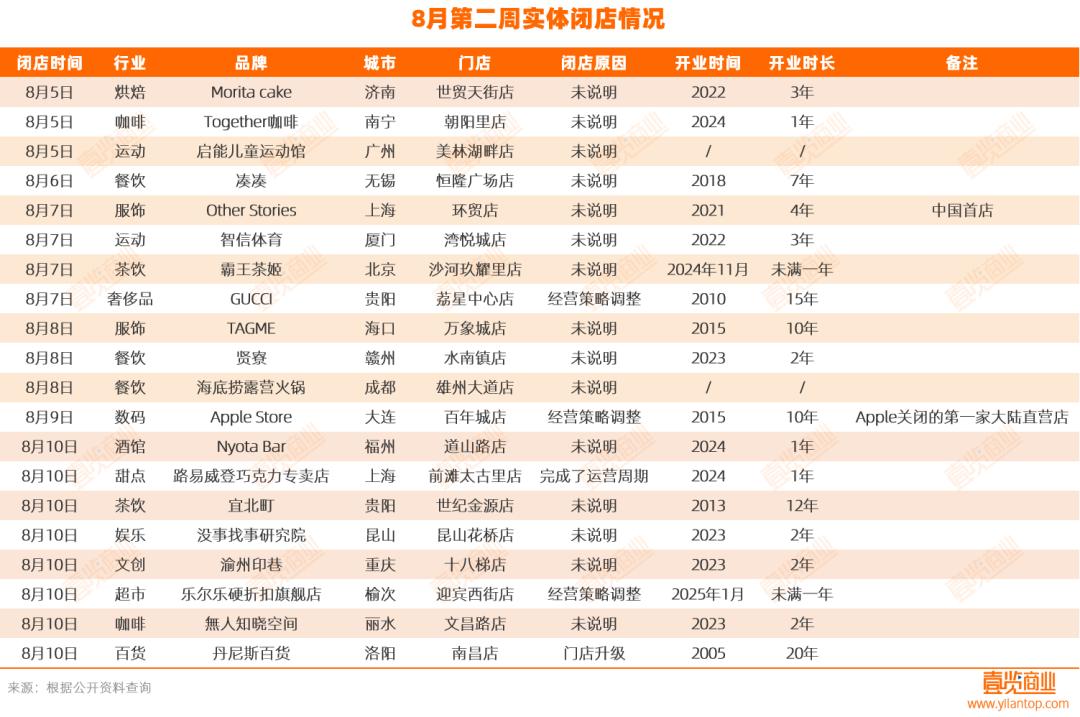
一周关闭20家门店,霸王茶姬、丹尼斯百货、海底捞持续调整
3 6 Ke· 2025-08-11 11:41
Core Insights - In the second week of August, a total of 20 chain brands closed at least 20 stores across various industries [1] Industry Summary - **Restaurant Sector**: 10 restaurant stores closed, including 2 coffee shops and 2 tea shops [3] - **Fashion Sector**: 2 fashion stores closed, specifically Other Stories and TAGME [3] - **Sports Sector**: 2 sports stores closed, both targeting the children's market, potentially impacted by declining birth rates [3] - **Luxury Goods**: The GUCCI store in Guiyang closed due to strategic adjustments, following a trend of luxury brands exiting the market [3][6] Company-Specific Summary - **Apple Store**: The Apple Store in Dalian closed on August 9, marking the first closure of an Apple retail store in mainland China. The closure was attributed to the departure of multiple retailers from the Dalian Century Plaza shopping center [4][5] - **GUCCI**: The GUCCI store in Guiyang closed, following the exit of other luxury brands from the same shopping center, indicating a potential chain reaction affecting secondary brands [6][7] - **Economic Context**: Guiyang's GDP has been steadily increasing, reaching 577.741 billion yuan in 2022, with a growth rate of 6%. However, the affluent consumer base remains limited, with only about 3,600 households having a net worth of over 6 million yuan, which constrains high-end consumption [8]



库迪咖啡官宣杨幂为全球品牌代言人 打造全时段咖啡茶饮消费新体验
Yang Guang Wang· 2025-08-06 07:13
Group 1 - Kudi Coffee officially announced Yang Mi as its global brand ambassador on August 4, following the announcement of Wang Yibo as another global brand ambassador, highlighting the company's strategy to enhance its brand image through influential figures [1][3] - Yang Mi is a well-known actress in China, recognized for her diverse roles and significant influence across various sectors including film, fashion, and business, aligning with Kudi Coffee's commitment to quality [1] - The partnership aims to elevate Kudi Coffee's brand image to reflect "youthful, fashionable, professional, and high-quality" attributes, leveraging Yang Mi's international fashion influence [1] Group 2 - From August 4 to September 30, Kudi Coffee will launch a "Milk Tea Season" marketing campaign, offering unlimited tea drinks at 6.9 yuan after 3 PM daily, emphasizing high cost-performance and quality [3] - Kudi Coffee is a leading global coffee brand with operations in 28 countries and regions, boasting over 15,000 stores and ranking third globally [3] - The company focuses on technology-driven transformation and adheres to the brand philosophy that "good coffee comes from good ingredients," aiming to provide high-quality, cost-effective, and convenient products [3] - Kudi Coffee is the global sponsor of the Argentina national football team and has won multiple awards at the IIAC International Coffee Tasting Competition, including 7 gold awards in 2024 and 8 gold awards in 2025, marking its third consecutive year of accolades since its establishment in October 2022 [3]

吃到外卖商战红利,瑞幸干出了两个“星巴克”
Guo Ji Jin Rong Bao· 2025-07-31 13:08
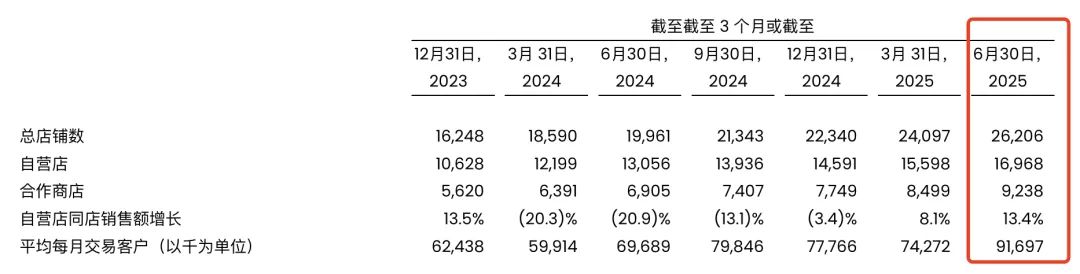
Core Viewpoint - Luckin Coffee reported a record high total net revenue of 12.359 billion yuan for Q2 2025, marking a year-on-year growth of 47.1% and achieving a net profit of 1.251 billion yuan, up 43.6% year-on-year, with a net profit margin of 10.1% [1] Financial Performance - The total net revenue for Q2 2025 reached 12.359 billion yuan, a significant increase of 47.1% year-on-year, and the first time quarterly revenue exceeded 10 billion yuan [1] - Net profit for the same period was 1.251 billion yuan, reflecting a year-on-year growth of 43.6%, with a net profit margin of 10.1% [1] - Compared to Starbucks China, which reported revenue of approximately 5.68 billion yuan for the same period, Luckin's revenue was more than double [2] Market Position and Expansion - As of the end of Q2 2025, Luckin Coffee operated 26,206 stores, with approximately 65% being self-operated and 35% franchised [3] - The company added over 3,800 stores in the first half of the year, exceeding initial expansion plans [4] - Monthly average transaction customers reached a record high of 91.7 million, a year-on-year increase of 31.6% [6] Competitive Landscape - The competitive environment in the tea and coffee market is intensifying, with major platforms like JD, Taobao, and Meituan launching significant subsidy campaigns [6][8] - Luckin Coffee's gross merchandise volume (GMV) for the quarter was 14.179 billion yuan, surpassing the total revenue of a competitor for the previous year [2] International Expansion - Luckin Coffee has accelerated its international expansion, with a total of 89 overseas stores, including 24 new stores in Q2 2025, marking the fastest growth since its international operations began [9] - The company opened two stores in the U.S. in June 2025, which attracted market attention due to the competitive nature of the U.S. coffee market [10] Product Development - Despite the introduction of over 100 new products annually, the company has struggled to create standout products in the current market, with recent launches lacking competitive strength [12][13] - Notable new products include light jasmine tea and a collaboration with Duolingo, but they have not achieved the same level of market impact as previous successful offerings [13]

咖啡茶饮品牌,都被瑞幸“骗”了
盐财经· 2025-07-31 12:47
Core Viewpoint - The article discusses the evolution of the Chinese consumer market over the past decade, highlighting the shift from rapid growth strategies to a focus on sustainable, value-driven growth, exemplified by Luckin Coffee's success in the ready-to-drink beverage sector [2][4][30]. Group 1: Market Dynamics - The past decade has been characterized by rapid growth and competition in the Chinese consumer market, with brands leveraging quick expansion and innovative marketing strategies [3]. - As the market matured, the initial growth strategies became less effective, leading to a more rational consumer behavior and a slowdown in brand growth [4][5]. - Companies that previously thrived on speed began to face challenges, revealing weaknesses such as product homogeneity and fragile profit models [7]. Group 2: Muscle Growth Concept - The concept of "muscle growth," as proposed by management expert Peter Drucker, emphasizes growth driven by internal value accumulation rather than superficial scale expansion [8]. - This growth model focuses on customer asset retention, efficiency optimization, and building competitive barriers [8][31]. Group 3: Luckin Coffee's Performance - Luckin Coffee's Q2 2025 financial report shows a total net revenue of 12.358 billion yuan, a year-on-year increase of 47.1%, with operating profit rising 62% to 1.7 billion yuan and an operating profit margin of 13.8% [9]. - In comparison, Starbucks China reported a net revenue of approximately 5.68 billion yuan for Q3 2025, which is less than half of Luckin's revenue for the same period, with a same-store sales growth of only 2% [9]. Group 4: Strategic Pillars of Luckin Coffee - Luckin Coffee's growth strategy is built on four pillars: product innovation, brand strength, operational efficiency, and supply chain stability [13]. - The company has successfully launched innovative products, such as the "Chang'an Lychee" series, achieving sales of 8.5 million cups in the first week [16]. - Luckin's brand strategy includes frequent collaborations with popular brands, enhancing brand recall and emotional connection with consumers [20][22]. Group 5: Operational Excellence - Luckin Coffee's operational efficiency is a key differentiator, with a closed-loop system connecting demand insights, product development, supply chain responsiveness, and user feedback [25]. - The company has achieved a same-store sales growth rate of 13.4% and opened 2,109 new stores in the last three months, bringing the total to 26,206 stores [27]. Group 6: Supply Chain Resilience - A robust supply chain is crucial for long-term sustainability, and Luckin has invested significantly in establishing stable relationships with global coffee suppliers [29]. - The construction of a new production base in Xiamen, with an annual roasting capacity of 55,000 tons, is set to enhance Luckin's supply chain capabilities [29]. Group 7: Industry Implications - Luckin Coffee's success illustrates that true industry leaders are not just the fastest but also the most stable and resilient [30]. - Other companies focusing solely on rapid expansion may find themselves trapped in a cycle of opening and closing stores, leading to unsustainable growth [30].

库迪咖啡李颖波:AI赋能 9.9元咖啡也赚钱
2 1 Shi Ji Jing Ji Bao Dao· 2025-07-28 14:39
Core Insights - The rapid increase in delivery orders for Kudi Coffee is accompanied by a significant drop in product prices, with coffee priced at 9.9 yuan potentially being subsidized to 5-6 yuan, highlighting the competitive pricing strategy in the current delivery market [1][5] - AI technology is being leveraged to enhance cost efficiency and product quality across Kudi Coffee's supply chain and store operations, indicating a strong integration of technology in traditional coffee retail [2][3] Group 1: Business Performance - Kudi Coffee achieved over 100 million sales on the JD platform by early June, becoming the first brand on the platform to surpass this milestone [4] - The coffee industry has a high frequency of consumer demand, making it a key focus for delivery platforms in terms of subsidies [4] Group 2: AI Integration - AI capabilities such as big data, cloud computing, model learning, and image recognition are utilized in the supply chain to optimize production strategies, inventory management, and logistics [2] - In-store operations benefit from AI through automated design generation, inventory management, and quality control, ensuring operational efficiency and consistency in product quality [2][3] Group 3: Future Strategy - Kudi Coffee aims to expand its store network to ensure accessibility for consumers while maintaining a focus on high cost-performance ratios [5] - The company emphasizes the importance of competitive pricing that allows profitability while being attractive to consumers, with AI applications aimed at optimizing cost efficiency [5]
传媒互联网产业行业周报:海外中国资产财报季开启-20250727
SINOLINK SECURITIES· 2025-07-27 09:59
Investment Rating - The report maintains an optimistic outlook on the Hong Kong stock market, particularly in sectors such as stablecoins, new consumption, and innovative pharmaceuticals [3][10]. Core Views - The overseas Chinese asset earnings season has begun, with a significant increase in risk appetite for Hong Kong and US-listed Chinese stocks, as active funds seek undervalued stocks with low price-to-book ratios [3][10]. - There is a sustained bullish outlook on virtual assets, including stablecoins, with traditional virtual asset exchanges expected to enter the traditional capital markets through IPOs, reverse mergers, and acquisitions [3][10]. - The potential risks for overseas Chinese assets remain, particularly concerning US-China tariff issues, necessitating close monitoring of global tariff negotiations [3][10]. Industry Situation Tracking Education - The Chinese education index fell by 0.82% during the period from July 21 to July 25, underperforming compared to major indices [11][21]. - Notable stock performances include Oriental Selection rising by 13.67% and New Oriental falling by 10.03% [11][21]. Luxury Goods - The S&P Global Luxury Goods Index increased by 2.75%, while the MSCI European Luxury Goods and Apparel Index rose by 2.52% during the same period [22][25]. - Key luxury stocks showed mixed results, with Samsonite up by 3.16% and Prada down by 1.94% [22][25]. Coffee and Tea - The Hang Seng Non-Essential Consumer Index rose by 1.30%, outperforming the Hang Seng Index [27][30]. - Notable stock performances include Haidilao up by 4.31% and various tea brands experiencing declines [27][30]. E-commerce - The Hang Seng Internet Technology Index increased by 1.86%, with Pinduoduo rising by 8.67% and Alibaba declining by 0.17% [30][31]. - The competitive landscape remains intense, with significant investments in logistics and marketing by leading platforms [30][31]. Streaming Platforms - The Hang Seng Media Index fell by 1.2%, underperforming compared to other indices [35][39]. - Key stocks like iQIYI and Tencent Music experienced varied performance, with iQIYI up by 2.04% and Tencent Music down by 4.45% [35][39]. Virtual Assets & Internet Brokers - As of July 25, the global cryptocurrency market cap reached $393.75 billion, with Bitcoin and Ethereum prices at $117,482 and $3,765, respectively [41][42]. - The report highlights the ongoing development of regulatory frameworks for virtual assets, with significant movements in the market [41][42]. Automotive Services - The Hang Seng Composite Index rose by 2.45%, with notable performances from companies like Zhongsheng Holdings up by 17.27% [49][50]. - The automotive service sector is witnessing growth, with new partnerships and service offerings emerging [49][50].


传媒互联网产业行业周报:稳定币法案落地后的新增投资路径-20250720
SINOLINK SECURITIES· 2025-07-20 09:56
Investment Rating - The report maintains an optimistic outlook on the Hong Kong stock market, particularly regarding new IPOs and sectors such as stablecoins, new consumption, and innovative pharmaceuticals [3][10]. Core Insights - The report highlights new investment paths following the implementation of stablecoin legislation, emphasizing the positive sentiment towards Hong Kong and U.S. Chinese stocks, with a notable shift towards new concepts and small-cap stocks [3][10]. - There is a sustained bullish view on virtual assets, including stablecoins, with recommendations for traditional virtual asset companies and infrastructure assets related to blockchain technology [3][10]. - The report identifies potential risks associated with overseas Chinese assets, particularly concerning U.S.-China tariff issues, and suggests monitoring the progress of global tariff negotiations [3][10]. Industry Situation Tracking Education - The Chinese education index increased by 2.10% from July 14 to July 18, outperforming the CSI 300 and SSE 50 indices, while underperforming the Hang Seng Tech Index [11]. - Notable stock performances include a 25.09% increase for Fenbi and a 14.37% increase for Dongfang Zhenxuan, while New Oriental saw a decline of 3.39% [11][19]. Luxury Goods - The luxury goods sector faced slight pressure, with a 6% year-on-year decline in Burberry's sales revenue for Q1 of FY2026, although the decline was less severe than previous periods [25]. - The report notes that the jewelry segment remains a growth driver, with Richemont's jewelry sales increasing by 11% year-on-year [31]. Coffee and Tea Beverages - The coffee sector maintains high growth, while the tea beverage sector shows signs of recovery, benefiting from summer demand and delivery subsidies [5][28]. E-commerce - The e-commerce sector is experiencing slight pressure, with a slowdown in overall growth and intensified competition among platforms [5][34]. - The report highlights a 742.95 billion yuan online retail sales figure for the first half of 2025, reflecting an 8.5% year-on-year growth [37]. Streaming Platforms - The streaming media index rose by 7.8%, outperforming both the Hang Seng Index and the Hang Seng Tech Index [38]. - Notable stock performances include a 12.08% increase for NetEase Cloud Music and an 11.37% increase for Tencent Music [38]. Virtual Assets & Internet Brokers - The global cryptocurrency market capitalization reached $392.19 billion, with Bitcoin and Ethereum prices increasing by 0.4% and 19.9%, respectively [40][43]. - The report emphasizes the positive trend in virtual assets following the passage of the GENIUS Act in the U.S., which establishes a regulatory framework for stablecoins [49].


解读蚂蚁邀约收购耀才,补充海外中国资产选什么
2025-07-16 06:13
Summary of Conference Call Company and Industry Involved - The discussion primarily revolves around **Yao Cai Securities**, a traditional Hong Kong brokerage firm, and its acquisition by **Ant Group**. The broader context includes the **Hong Kong brokerage industry** and its competitive landscape. Core Points and Arguments 1. **Acquisition Details**: Ant Group has signed an agreement to acquire approximately **50.55%** of Yao Cai Securities, involving **8.58 billion shares** at a price of **3.28 HKD per share**, totaling **28.14 billion HKD** with a **10% deposit** already paid [4][5]. 2. **Financial Performance**: Yao Cai Securities reported a net profit of **613 million HKD**, reflecting a **10% year-on-year growth**. As of March this year, the total customer base reached **587,000**, a **4% increase** year-on-year [6]. 3. **Market Position**: The Hong Kong brokerage market is highly competitive with over **500 participants**. Yao Cai's market share in the overall trading volume is only about **1%** [7]. 4. **Comparison with Competitors**: Yao Cai Securities has a significantly lower customer base and asset quality compared to competitors like **Futu** and **Tiger Brokers**, which poses challenges for Yao Cai in capturing market share [8]. 5. **High Dividend Yield**: Yao Cai has historically maintained a high dividend payout ratio, exceeding **100%** in previous years, making it an attractive investment despite its low valuation [11]. 6. **Strategic Intent of Ant Group**: The acquisition aligns with Ant Group's strategy to expand its footprint in Hong Kong's financial services sector, leveraging its existing platforms to enhance service offerings [9][10]. 7. **Regulatory Environment**: The discussion highlights the complexities of operating in both domestic and international markets, emphasizing the differences in regulatory frameworks and market dynamics [10][14]. 8. **Investment Recommendations**: There is a suggestion to consider Yao Cai as a potential investment opportunity if its stock price continues to decline, given its current valuation of around **10 times earnings** [15]. Other Important but Possibly Overlooked Content 1. **Long-term Viability**: The call notes that while many firms hold licenses in Hong Kong, few have successfully navigated the market, indicating a challenging environment for new entrants [12]. 2. **Market Sentiment**: The overall sentiment in the market is cautious, with a focus on observing the performance of related sectors, including e-commerce and financial services [17]. 3. **Emerging Trends**: The discussion touches on the evolving landscape of online financial services and the potential for new entrants to disrupt traditional brokerage models [13][14]. 4. **Future Outlook**: Analysts express confidence in the long-term prospects of Yao Cai, especially if it can adapt to changing market conditions and leverage Ant Group's resources [15][16].