新能源汽车等

Search documents
“中国科技创新之路越走越宽广”(人民网)
Ren Min Wang· 2025-10-24 03:21
Core Insights - China's high-tech manufacturing industry has shown significant growth, with the value-added output increasing at a rate faster than the overall industrial growth, particularly in information transmission, software, and IT services, which grew by 11.7% year-on-year [1] - The "14th Five-Year Plan" period has seen China achieve major breakthroughs in various fields such as quantum technology, life sciences, and space science, enhancing its technological innovation capabilities [1][2] - China has entered the top ten of the Global Innovation Index for the first time, reflecting a vibrant innovation ecosystem that supports modernization [3] Group 1: Technological Advancements - The launch of China's first domestically produced aircraft carrier and the operation of the world's first fourth-generation nuclear power plant signify major technological milestones [2] - The integration of technology and industry has accelerated the growth of emerging industries, particularly in robotics, with significant international collaboration [2] - The establishment of a "robot valley" in Shenzhen, housing over 74,000 robotics-related companies, showcases the successful transformation of technological achievements into productive forces [4] Group 2: Global Collaboration - China has established scientific cooperation with over 160 countries and regions, participating in numerous international scientific projects and initiatives [7] - The country is actively promoting its technological advancements to benefit other nations, exemplified by its contributions to smart grid operations in Brazil and AI applications in Singapore [7] - China's commitment to global scientific governance is evident through initiatives like the Global Artificial Intelligence Governance Initiative and the establishment of international technology transfer centers [8] Group 3: Societal Impact - The application of digital technologies has significantly improved public services and governance in China, making them more accessible and efficient for citizens [5] - Innovations in technology have enhanced daily life for the Chinese populace, aligning with their aspirations for a better quality of life [5] - The integration of smart technologies in various sectors is driving the modernization of traditional industries, providing valuable lessons for other countries [4][5]

湖南培育5个国家先进制造业集群 居中西部第一
Zhong Guo Xin Wen Wang· 2025-10-22 11:26
Group 1 - Hunan has cultivated five national advanced manufacturing clusters, ranking fifth nationwide and first in Central and Western China [1] - The province has added one new billion-level enterprise, bringing the total to four, and 24 new hundred-million-level enterprises, totaling 53 [1] - The total number of large-scale industrial enterprises in Hunan exceeds 20,000, with a continuous enhancement in the vitality and competitiveness of small and medium-sized enterprises [1] Group 2 - Hunan's high-tech manufacturing and equipment manufacturing industries have seen average annual growth rates of 13.9% and 10.2%, respectively, with their proportions in the scale of industry increasing to 14.1% and 32.3% [2] - The production of new energy vehicles in Hunan has surged from 52,000 units in 2020 to an expected 771,000 units in 2024, marking a growth of 1,380% [2] - The province has implemented the "Smart Empowerment for Ten Thousand Enterprises" initiative, promoting digital transformation across 90,700 enterprises [2]
能源早新闻丨全球首个!落地内蒙古
中国能源报· 2025-10-20 22:33
News Focus - The National Energy Administration is accelerating the construction of a credit system in the energy sector, aiming for a more complete regulatory framework and improved credit information sharing by the end of 2027 [2] - The Ministry of Transport has launched the "International Green Shipping Corridor Cooperation Initiative," proposing seven measures to promote international cooperation in green shipping [2] Domestic News - The National Energy Administration approved the safety registration of 19 hydropower station dams, including the Wengden Pumped Storage Power Station [3] - As of September 30, 2025, the total number of electric vehicle charging facilities in China reached 18.063 million, a year-on-year increase of 54.5% [3] - In September, the industrial power generation in China was 826.2 billion kWh, showing a year-on-year growth of 1.5% [3] - The added value of the lithium-ion battery manufacturing industry increased by 29.8% year-on-year in the first three quarters of 2025 [3] Automotive Industry - In September, the production and sales of new energy vehicles reached a historical high, with production and sales of 1.617 million and 1.604 million units respectively, marking year-on-year increases of 23.7% and 24.6% [4][5] International News - The UK government announced a clean energy job growth plan, aiming to create 400,000 new jobs in the clean energy sector by 2030 [6] - The South African government plans to invest approximately $126.7 billion to advance energy transition and address long-standing electricity supply issues [6] Corporate News - The world's highest voltage level converter station is undergoing annual maintenance, ensuring reliable electricity supply for the Yangtze River Delta region this winter and spring [7]

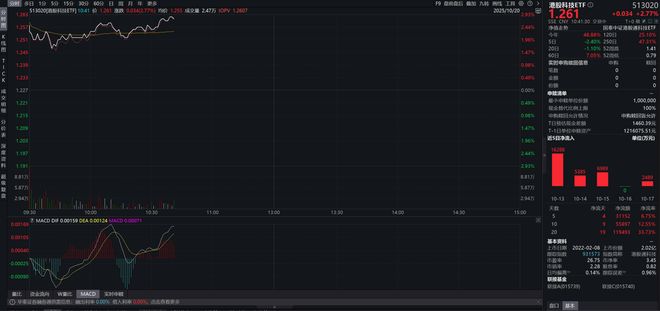
特朗普:“关税冲突不可持续”,港股科技ETF(513020)盘中涨超2.7%
Mei Ri Jing Ji Xin Wen· 2025-10-20 03:14
Core Viewpoint - Recent signals of tariff easing from the Trump administration have positively impacted the Hong Kong stock market, particularly the technology sector, which has seen significant inflows and price increases [1][3]. Group 1: Tariff Easing Signals - On October 17, Trump acknowledged that the 100% tariffs on China are "unsustainable" [1][3]. - Trump has been quietly relaxing several tariff policies, exempting dozens of products from tariffs and indicating a willingness to exclude more items during trade negotiations [3]. - The leaders of China and the U.S. agreed to hold new consultations soon, suggesting potential tariff reductions [3]. Group 2: Performance of Hong Kong Technology Sector - The Hong Kong Technology ETF (513020) has risen over 2.7% in a single day and has gained nearly 50% year-to-date, attracting nearly 1.2 billion yuan in inflows over the past 20 days [1][3]. - The technology sector is characterized by growth-oriented attributes, with a focus on future cash flow discounting, making it sensitive to interest rate environments [3]. - The core drivers of the technology sector have shifted from internet innovation to AI and hard technology innovation, supported by industrial policies and valuation recovery [3]. Group 3: Index Performance - The Hong Kong Technology ETF tracks the CSI Hong Kong Stock Connect Technology Index, which includes popular sectors such as internet, innovative pharmaceuticals, and new energy [4]. - The Hong Kong Stock Connect Technology Index has outperformed both the Hang Seng Technology Index and the Hong Kong Stock Connect Internet Index, with a cumulative increase of 76.06% since 2018 [6][7]. Group 4: Future Outlook - The ongoing Federal Reserve rate cut cycle is expected to enhance the attractiveness of Hong Kong technology stocks, as lower interest rates typically boost valuations in growth sectors [8]. - As the U.S. dollar's appeal diminishes due to rate cuts, international investors may reassess investment values, potentially leading to increased capital inflows into the Hong Kong market [8]. - The combination of renminbi appreciation and sustained expectations of U.S. rate cuts supports a favorable outlook for Hong Kong technology stocks, particularly those focused on AI [8].
我国新一轮国家自主贡献目标迭代升级 为全球气候治理注入强大动力
Jin Rong Shi Bao· 2025-10-14 02:12
Group 1: NDC Goals and Climate Ambitions - The new NDC targets announced by China aim for a 7% to 10% reduction in net greenhouse gas emissions by 2035 compared to peak levels, with non-fossil energy consumption exceeding 30% of total energy consumption [1][2] - The NDC goals reflect a shift from "phase-based reduction" to "systemic transformation" in China's climate governance strategy, marking a significant evolution in its approach [2][3] - The updated NDC includes a broader scope covering all greenhouse gases, moving from relative intensity targets to absolute total emission reduction metrics [3] Group 2: Implementation and Sectoral Changes - To achieve the non-fossil energy consumption target, an annual increase of 0.94 percentage points is required, necessitating a high proportion of renewable energy supply and electrification [4] - The national carbon market is set to expand, with major industries like steel, cement, and aluminum included by 2025, increasing the controlled carbon emissions from 5 billion tons to 8 billion tons [4][6] - Different industries will face varying costs for emission reductions, with sectors like steel and electricity having lower costs compared to aviation and shipping, which may incur significantly higher costs [7] Group 3: International Context and Challenges - The global progress on emission reductions is lagging, with the UN Secretary-General warning of risks to the 1.5°C temperature goal, highlighting the importance of China's NDC commitments in this context [8][9] - The EU aims to reduce greenhouse gas emissions by 66% to 72% by 2035 based on 1990 levels, although the final commitments are still pending [8] - The absence of the U.S. at the climate summit and its historical role as a major emitter complicates international climate cooperation, emphasizing the need for responsible leadership from countries like China [9]
“十四五”以来央企控股上市公司累计现金分红2.5万亿元
Zheng Quan Ri Bao· 2025-09-17 16:13
Group 1 - In 2024, central enterprises' investment in strategic emerging industries will exceed 40% of total investment, with operating revenue approaching 30% [1] - Cumulative investment in strategic emerging industries by central enterprises during the "14th Five-Year Plan" period reached 8.6 trillion yuan, significantly higher than the "13th Five-Year Plan" period [1] - Central enterprises are focusing on nine strategic emerging industries and six future industries, enhancing their capabilities in integrated circuits, biotechnology, and new energy vehicles [1] Group 2 - In 2024, operating revenue from strategic emerging industries surpassed 11 trillion yuan, with an 8 percentage point increase in revenue contribution over the past two years [2] - The "AI+" initiative has accelerated the application of general and industry-specific models, facilitating the digital transformation of traditional industries [2] - Central enterprises have created over 800 application scenarios in 16 key industries, with plans to release 40 high-value scenarios at the 2025 World Artificial Intelligence Conference [2] Group 3 - The quality of listed companies has improved, with central enterprise-controlled listed companies' market value exceeding 22 trillion yuan, a nearly 50% increase since the end of the "13th Five-Year Plan" [3] - Central enterprises have implemented cash dividends totaling 2.5 trillion yuan during the "14th Five-Year Plan," contributing to the stability of the capital market [3] - The State-owned Assets Supervision and Administration Commission (SASAC) aims to strengthen and optimize state-owned capital and enterprises to enhance their role in national economic development [3] Group 4 - During the "14th Five-Year Plan," central enterprises have actively pursued strategic professional restructuring, focusing on strategic security and public service [4] - Six groups of ten enterprises have been restructured through market-oriented methods, and nine new central enterprises have been established [4] - SASAC plans to enhance core functions and competitiveness through systematic and innovative approaches to further improve the efficiency of state-owned capital allocation [4]
“十四五”央企成绩单发布
Di Yi Cai Jing· 2025-09-17 09:22
Core Insights - Since the "14th Five-Year Plan," the total assets of central enterprises have increased from less than 70 trillion yuan to over 90 trillion yuan, with total profits rising from 1.9 trillion yuan to 2.6 trillion yuan, achieving average annual growth rates of 7.3% and 8.3% respectively [2] - The investment in strategic emerging industries has seen an average annual growth rate exceeding 20%, with over 800 application scenarios developed under the "AI+" initiative and the establishment of 1,854 smart factories as part of the digital transformation efforts [2][4] - Central enterprises have contributed over 10 trillion yuan in taxes and transferred 1.2 trillion yuan of state-owned equity to social security funds [2] Group 1: Strategic Emerging Industries - Central enterprises have focused on nine strategic emerging industries and six future industries, with cumulative investments in these sectors reaching 8.6 trillion yuan since the "14th Five-Year Plan," significantly higher than during the "13th Five-Year Plan" [4] - The revenue from strategic emerging industries is projected to exceed 11 trillion yuan in 2024, with contributions from new generation information technology and high-end equipment sectors each surpassing 1 trillion yuan [4] - Central enterprises' installed capacity for renewable energy generation accounts for approximately half of the national total, and the market size for industrial software exceeds 20% of the national market [4] Group 2: Corporate Restructuring and Integration - The State-owned Assets Supervision and Administration Commission (SASAC) has advanced the reform actions and achieved significant results, with six groups of ten enterprises undergoing strategic restructuring and nine new central enterprises being established [7][8] - The restructuring efforts focus on enhancing national security, industry leadership, and public service, with market-oriented approaches being employed to optimize the layout and structure of state-owned enterprises [8][9] - SASAC emphasizes the importance of professional, systematic, legal, and efficient supervision, implementing tailored assessment plans for central enterprises to improve operational efficiency and capital allocation [7][9]

重磅文件定调!增强超大特大城市综合竞争力
第一财经· 2025-08-29 15:02
Core Viewpoint - The article discusses the recent release of the "Opinions on Promoting High-Quality Urban Development" by the Central Committee of the Communist Party of China and the State Council, highlighting the transition of urbanization in China from rapid growth to stable development, focusing on improving existing urban areas rather than expanding them [3]. Group 1: Urban Development Strategy - The "Opinions" emphasize the need to promote the integration of urban clusters and the coordinated development of metropolitan areas, aiming to create a modern urban system with a reasonable layout [5][6]. - Support is given to major urban clusters like Beijing-Tianjin-Hebei, Yangtze River Delta, and Guangdong-Hong Kong-Macau Greater Bay Area to become world-class urban clusters, enhancing regional coordination and industrial collaboration [5][6]. - The article outlines the importance of metropolitan areas, which are led by a central city, in driving high-quality industrial development through innovation and labor force integration [6]. Group 2: Investment Opportunities - The article identifies urban clusters and metropolitan areas as key spaces for increasing investment, particularly in rail transit projects, with significant growth potential in high-speed rail and intercity rail construction [7]. - Recent approvals for new high-speed rail projects, such as the Shanghai-Hangzhou line with an investment of approximately 67.1 billion yuan, indicate ongoing infrastructure development [7]. - The article highlights the role of super-large cities in enhancing comprehensive competitiveness and the need for these cities to innovate and optimize their core functions while controlling their scale [7]. Group 3: Small and Medium Cities - The "Opinions" call for improving the capacity of small and medium-sized cities and county towns, focusing on optimizing infrastructure and public services based on population trends [11]. - The article notes that some small cities and counties have attracted significant populations due to their strong economic performance, with examples of counties achieving GDPs exceeding 1 billion yuan [11][12]. - The development of "super towns" and "super counties" is highlighted, with several towns in Guangdong and Jiangsu having populations exceeding 300,000, showcasing the potential for economic growth in these areas [12].
新华鲜报丨大显身手!“2025中国民营企业500强”发布
Xin Hua Wang· 2025-08-28 16:17
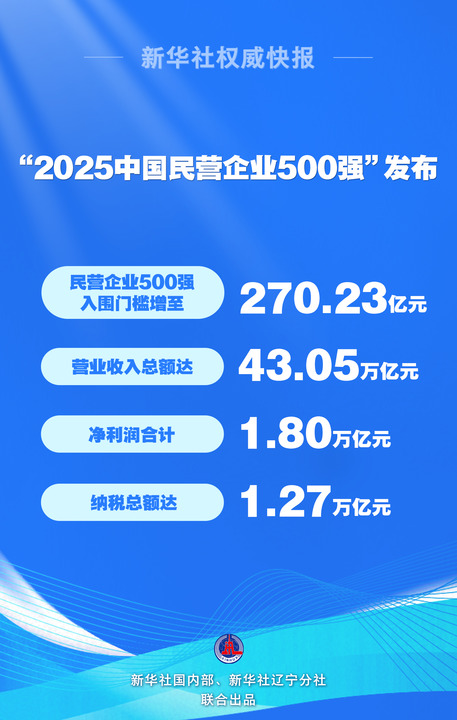
Core Insights - The private economy is a driving force for China's modernization and a crucial foundation for high-quality development [1] - The threshold for entering the "2025 China Private Enterprises Top 500" list has increased to 27.023 billion yuan, with total assets amounting to 51.15 trillion yuan [1] - The total operating income of the top 500 private enterprises reached 4.305 trillion yuan, with an average operating income of 861.02 million yuan, reflecting a year-on-year growth of 2.72% [1] - The total net profit amounted to 1.8 trillion yuan, with an average net profit of 360.5 million yuan, showing a growth of 6.48% [1] Group 1: Growth and Performance - The overall scale of private enterprises continues to rise, and operational efficiency is improving [1] - The number of enterprises with operating income exceeding 1 billion yuan has increased by 8 compared to the previous year [1] - The continuous optimization of the business environment has enabled private enterprises to pursue high-quality development [1] Group 2: Innovation and Transformation - The development approach of private enterprises is continuously transforming, with enhanced innovation vitality [2][3] - Private enterprises are actively investing in strategic emerging industries, with 309 companies reporting 627 projects in key sectors [5] - The total R&D expenditure of the reporting enterprises reached 1.13 trillion yuan, with an average R&D intensity of 2.77% [6] Group 3: Corporate Governance and Social Responsibility - Corporate governance is continuously improving, with efforts to diversify ownership and enhance management levels [7] - The total tax contribution of the top 500 private enterprises reached 1.27 trillion yuan, with total employment at 11.0912 million [8] - A significant percentage (65.40%) of enterprises are involved in rural revitalization and social responsibility initiatives [8]
中金:恒生指数调整扩容 港股通标的调整符合预期
智通财经网· 2025-08-25 03:39
Core Viewpoint - The Hang Seng Index Company announced its semi-annual index adjustment results, including the addition of China Telecom, JD Logistics, and Pop Mart to the Hang Seng Index, with Pop Mart also being included in the Hang Seng China Enterprises Index. The Hang Seng Technology Index remained unchanged [1][2]. Group 1: Index Adjustments - The Hang Seng Index will include China Telecom, JD Logistics, and Pop Mart with respective weights of 1.44%, 0.51%, and 0.22%, increasing the total number of constituent stocks to 88 [2]. - Pop Mart will be included in the Hang Seng China Enterprises Index with a weight of 2.10%, maintaining the total number of constituent stocks at 50 [2]. - The Hang Seng Technology Index will not have any additions or removals, keeping its total at 30 constituent stocks [2]. Group 2: Fund Flows - The expected fund inflows from the additions are approximately $160 million for China Telecom, $68.74 million for JD Logistics, and $45 million for Pop Mart, with respective inflow durations of 4.4 days, 3.5 days, and 1.0 day [2]. - For the Hang Seng China Enterprises Index, Pop Mart is expected to bring in $150 million with an inflow duration of about 0.3 days [3]. - The Hang Seng Technology Index is projected to see significant inflows for Horizon Robotics and BYD, estimated at $560 million and $500 million, with inflow durations of 3.4 days and 0.9 days respectively [3]. Group 3: Stock Connect Adjustments - A total of 20 stocks are expected to be added to the Stock Connect, with 19 stocks being removed, aligning closely with previous predictions [4]. - The potential new additions to the Stock Connect include companies such as China Foods, Cao Cao Travel, and others [4]. - Companies like CATL, Heng Rui Medicine, and Sanhua Intelligent Control, which are already listed in both A and H shares, will enter the Stock Connect after their price stabilization period ends [4]. Group 4: Implementation Timeline - The index adjustments will be implemented on September 5 and will officially take effect on September 8 [5]. - The official announcement regarding the Stock Connect adjustments will be published on September 5, with trading commencing on September 8 [5]. Group 5: Market Reactions - Active funds may engage in preemptive buying or selling for arbitrage, while passive funds will adjust their holdings at the end of the trading day on September 5, leading to significant trading volume for related stocks [6].