智能手机

Search documents
最短命机皇诞生,三星首款三折叠停售:行业巨头也顶不住供应链飙涨
36氪· 2026-03-19 09:38
Core Viewpoint - Samsung's Galaxy Z TriFold, despite being a high-demand product, is entering the discontinuation process due to high production costs and supply chain issues, potentially making it the shortest-lived phone in Samsung's history [4][6][10]. Group 1: Product Overview - The Galaxy Z TriFold features a unique three-fold design with a 10-inch inner screen and a 6.5-inch outer screen, powered by a customized Qualcomm Snapdragon 8 chip, a 200MP main camera, and a 5600mAh battery [8][10]. - The pricing for the Galaxy Z TriFold is set at 19,999 yuan in China and approximately 17,300 yuan in South Korea, making it one of the most expensive smartphones on the market [10]. Group 2: Market Dynamics - The discontinuation of the Galaxy Z TriFold is attributed to rising costs of storage chips and logistical disruptions caused by geopolitical conflicts, which have negatively impacted Samsung's mobile division's financial performance [8][10]. - Other smartphone brands, including OPPO and vivo, are also experiencing similar cost pressures, leading to price increases for their models [11]. Group 3: Competitive Landscape - Huawei has successfully launched its own three-fold phone, the Mate XT, which has seen better market performance, achieving nearly 500,000 units sold within a year of its release [15][17]. - Huawei's strategy focuses on a clear market positioning for its three-fold devices, targeting high-end users and ensuring a robust production plan, which contrasts with Samsung's approach [19]. Group 4: Future Trends - The foldable smartphone market is expected to grow, with projections indicating an increase in sales from 1 million units in 2019 to nearly 20 million units by 2025, despite a slowdown in overall smartphone sales [23]. - Apple's upcoming entry into the foldable market with the iPhone Fold is anticipated to shift market dynamics, although it is expected to adopt a dual-fold design rather than a three-fold approach [27][30].


意外!2025中国TOP5手机 苹果全包揽!
是说芯语· 2026-03-19 05:31
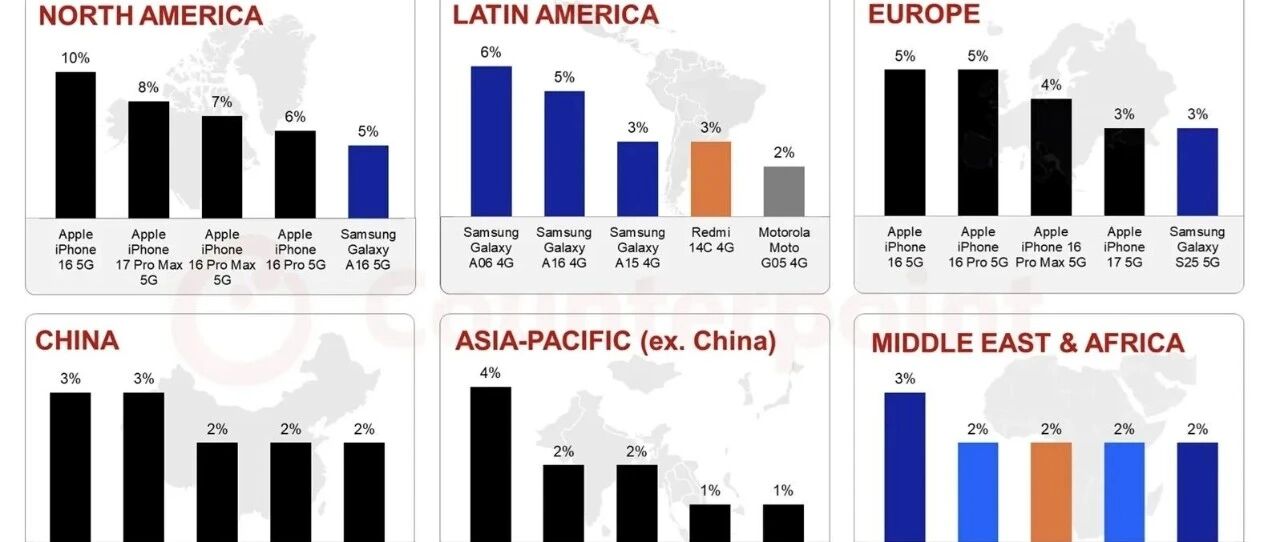
Core Insights - Apple and Samsung dominate the global smartphone shipment rankings in 2025, with both brands holding the top two positions in major markets [1] - The high-end models lead in North America, Europe, and the Asia-Pacific region, while entry to mid-range models are favored in Latin America, the Middle East, and Africa [1] Regional Market Summaries - In North America, Apple occupies four out of the top five positions, with the iPhone 16 5G leading the market, while Samsung's Galaxy A16 5G is the only Android model in the top five, primarily driven by the prepaid market [1] - In China, Apple models occupy all top five positions, with the iPhone 16 Pro Max 5G leading, reflecting a strong preference for high-end models among consumers [1] - The Asia-Pacific region (excluding China) sees growth driven by markets like Japan and India, with the iPhone 16e entering the top five due to strong sales in Japan [2] - In Latin America and the Middle East, the top five models are all 4G smartphones, with Samsung's A series leading in both markets, and Xiaomi's Redmi 14C also making the top five due to its cost-effectiveness [2] - In Europe, the iPhone and Samsung Galaxy S series dominate the top five, indicating a strong preference for high-end models, which account for over 60% of total smartphone shipments in the region [2]
存储价格飙升引发智能手机BOM结构转变
Counterpoint Research· 2026-03-19 04:45
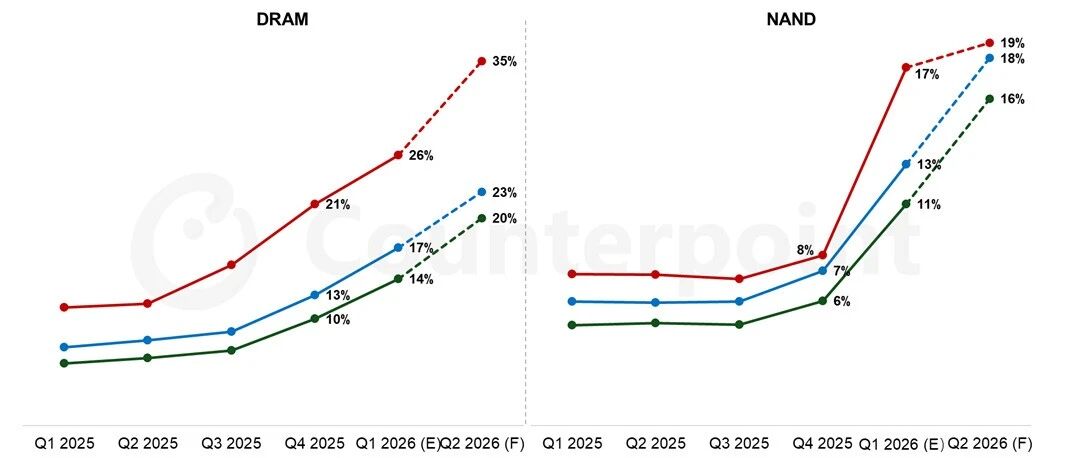
Core Insights - The article discusses the significant impact of rising memory prices on the cost structure of smartphone bill of materials (BOM) [4][5][9] - It highlights that by Q1 2026, DRAM prices are expected to increase by over 50% and NAND prices by over 90% [5] - The article emphasizes the challenges smartphone manufacturers will face in balancing costs, gross margins, and shipment targets due to these rising costs [7] Cost Structure Changes - In the low-end segment (wholesale price below $200), the BOM cost is projected to increase by 25% due to rising storage prices, with storage devices accounting for 43% of the total BOM [5] - For the mid-range segment (wholesale price between $400 and $600), the cost share of DRAM and NAND is expected to rise to 20% and 16% respectively by Q2 2026 [5] - In the flagship segment (wholesale price above $800), BOM costs are anticipated to increase by $100 to $150, with DRAM and NAND making up 23% and 18% of total costs by Q2 2026 [6] Manufacturer Strategies - To mitigate cost pressures, smartphone manufacturers are simplifying product lines and lowering shipment expectations for low-end models [7][9] - Manufacturers are also optimizing specifications by controlling hardware configurations and reducing non-core specifications to offset rising costs [7] - The article predicts that retail prices for smartphones will inevitably rise, with low-end models increasing by approximately $30 and high-end flagship models by $150 to $200 [7]
苹果将挑战三星折叠屏领先地位:2026年市场预计增长20%
Counterpoint Research· 2026-03-19 04:45
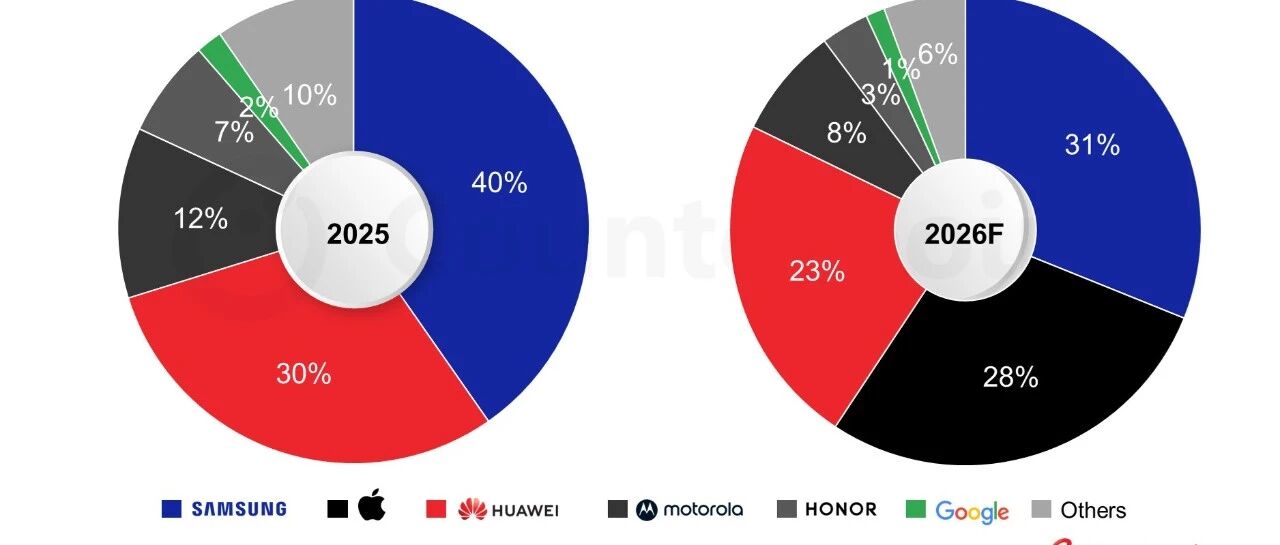
Core Insights - The global foldable smartphone market is expected to grow by 20% in 2026, driven by Apple's anticipated entry, the ongoing premiumization of the smartphone market, and increased OEM participation [4][8] - Apple's first foldable iPhone is projected to capture 28% market share by 2026, significantly reshaping the competitive landscape [4][8] - The competition in the foldable smartphone market is expected to intensify, particularly with a focus on book-type devices that offer larger displays suitable for multitasking and media consumption [5][9] Market Dynamics - The foldable smartphone segment currently represents only 1.6% of the overall smartphone market in 2025, but its importance is rising as manufacturers seek high-margin models to counteract pricing pressures in the entry and mid-range markets [9] - Major Android OEMs are accelerating updates to their foldable product lines to solidify their positions in the premium market, with new book-type devices expected to launch throughout the year [8][12] Competitive Landscape - Samsung is preparing to update its foldable product line with the new Galaxy Z Fold and Z Flip series expected to launch in Q3 2026, adjusting its lineup to directly compete with Apple's anticipated book-type device [12] - Motorola is adopting an aggressive pricing strategy with its Razr series in the clamshell foldable segment and plans to release its first book-type device, Razr Fold, in Q2 2026 [12] - Google is expected to refresh its foldable product line with a new generation Pixel Fold in Q4 2026, targeting the ultra-premium price segment with improved design features [12]
为何停售初代小米SU7?雷军:不想背刺老车主;AI大厂月薪3w疯抢文科生!网友:拯救了文科就业率;周鸿祎:将启动360安全龙虾全国巡装计划
雷峰网· 2026-03-18 00:31
Key Points - Xiaomi's CEO Lei Jun announced the discontinuation of the first-generation SU7 to avoid undermining existing customers, despite the impact on initial sales [4] - The new generation SU7 features significant upgrades in safety, power, and chassis, including a 10% increase in strength of the embedded roll cage and a maximum power output of 690 horsepower [5] - Huawei faced a large-scale account suspension issue affecting adult players, attributed to a potential error in their account verification system, raising concerns about user experience [10] - AI companies are increasingly hiring liberal arts graduates, with salaries for positions like AI trainers and ethical researchers reaching up to 30,000 yuan per month, indicating a shift in job market demand [12][13] - 360 Group's founder announced a nationwide installation plan for their AI product, following a security incident that raised concerns about user data safety [15] - Horizon Robotics is reportedly facing leadership changes with the departure of its chip development head, which could impact its competitive position in the market [17] - Alibaba is implementing an internal plan to provide employees with token allowances to encourage the use of AI tools in their work [20] - Dell announced a significant layoff plan affecting 11,000 employees, reflecting ongoing trends in the tech industry to reduce costs and optimize operations [37][38] - The global automotive industry has suffered over $35.4 billion in losses due to U.S. tariffs, with Toyota being the most affected company, facing an estimated cost of $9.1 billion [40][41]




大行评级丨招银国际:预期比亚迪电子去年下半年业绩受压,目标价降至39.69港元
Ge Long Hui· 2026-03-17 03:19
Core Viewpoint - The report from CMB International estimates BYD Electronics' revenue and net profit for the second half of 2025 to be 96.3 billion and 2.53 billion respectively, indicating a year-on-year decrease of 3% and 7% in Q4 revenue and profit due to adverse factors in the smartphone and automotive industries, despite an improvement in gross margin [1] Group 1 - The forecast for 2026 anticipates stronger revenue growth driven by the iPhone Fold, penetration of new energy vehicle products, and orders for AI servers, although this growth may be partially offset by rising memory costs leading to weak Android demand [1] - The company has revised down its earnings per share forecast for 2025 to 2027 by 1% to 13% to account for adverse factors in the smartphone and automotive sectors in 2026 [1] - The outlook for BYD Electronics' new energy vehicle product mass production and AI server products for 2026 to 2027 remains positive [1] Group 2 - The target price for BYD Electronics has been lowered from HKD 43.54 to HKD 39.69, while maintaining a "Buy" rating [1]

8点1氪:西贝获95亿元身家富豪入股;机票买贵可免费退,三大航司发布公告;“刘文祥”麻辣烫发文致歉
36氪· 2026-03-17 00:10
Group 1 - Lin Lairong, a billionaire with a net worth of 9.5 billion, has acquired shares in Inner Mongolia Xibei Catering Group, increasing the company's registered capital from approximately 102 million RMB to about 104 million RMB [3][4] - Inner Mongolia Xibei Catering Group was established in October 2017 and is involved in various sectors including catering services, food production, and food internet sales [4] - Lin Lairong is the founder of Zhongxing Group and the actual controller of Dazhong Mining, and he ranked 2025 on the Hurun Global Rich List with a wealth of 95 billion RMB [4] Group 2 - Alibaba has established a new business group called Alibaba Token Hub, focusing on the creation, delivery, and application of tokens [6][7] - The iPhone will support split-screen functionality for the first time, specifically for the upcoming iPhone Fold, which is expected to be released in September 2026 [7][8] - Vivo and iQOO announced price increases for some products due to rising global semiconductor and storage costs, with specific models already seeing price hikes [8] Group 3 - China’s three major airlines, Air China, China Eastern Airlines, and China Southern Airlines, have announced a joint initiative to protect passenger ticket purchasing rights, allowing for refunds in cases of price increases or itinerary changes by third-party platforms [5] - A recent investigation revealed that "Liu Wenxiang" hot pot chain was selling duck meat labeled as pork and beef, leading to a public apology and a commitment to rectify the issue [5][6] Group 4 - Emirates Airlines has suspended operations following a fire incident near Dubai International Airport, leading to the cancellation of several flights [9] - The Abu Dhabi National Oil Company has been forced to implement widespread production cuts, resulting in a significant decrease in daily crude oil output [11] Group 5 - WanHua Chemical reported a net profit of 12.527 billion RMB for 2025, a year-on-year decrease of 3.88%, despite a revenue increase of 11.62% to 203.235 billion RMB [23] - Leap Motor announced a net profit of 540 million RMB for 2025, recovering from a loss of 282 million RMB in the previous year, with revenues reaching 64.73 billion RMB [24]




睿郡董承非年度思考畅聊智能汽车:大概率会是一门好生意,未来头部企业一定是披着汽车外衣的AI公司……
聪明投资者· 2026-03-17 00:03
Group 1: Core Insights - The article emphasizes the transformation of the automotive industry through AI, suggesting that smart cars will redefine the sector and potentially turn it into a profitable business [6][101][104] - The future of the smart automotive industry is expected to see a significant reduction in the number of players, with a focus on software and ecosystem competition as consumers are liberated from driving [6][94][96][100] - The article draws parallels between the evolution of smartphones and the automotive industry, indicating that smart cars will shift consumer focus from hardware to software and user experience [34][51][94] Group 2: Automotive Industry Analysis - The automotive industry is currently in the L2 assisted driving phase, with a transition to L3 expected to shift driving responsibility from the driver to the system [32][55] - The article highlights that the electric vehicle era has lowered manufacturing barriers, leading to increased competition and reduced profit margins [29][70] - It is noted that the integration of AI in vehicles will require a significant shift in organizational structure and talent acquisition within automotive companies, posing challenges for traditional manufacturers [66][70][76] Group 3: Market Dynamics and Investment Opportunities - The article suggests that the smart automotive sector will likely experience increased market concentration due to the high barriers to entry created by the integration of hardware, software, and algorithms [77][78] - It predicts that companies capable of innovating and meeting future consumer demands will thrive, similar to how Apple created demand through supply [97][100] - The potential for recurring revenue models in the automotive industry is discussed, with the possibility of vehicles generating ongoing income through services rather than just one-time sales [100][102][104] Group 4: Real Estate Sector Insights - The article discusses the real estate sector, predicting that 2024 will be the last year of economic drag from real estate, with a recovery expected thereafter [106][114] - It highlights the significant inventory reduction in the real estate market, with ongoing efforts to clear unsold properties [108][109] - Investment strategies are suggested, including direct investment in real estate stocks and focusing on the real estate supply chain, which may benefit from stabilization in the housing market [116][118] Group 5: Market Performance and Historical Context - The article analyzes the current state of the A-share market, noting that many companies have seen significant stock price increases despite lacking strong fundamentals [125][128] - It reflects on past market trends, comparing the current AI wave to previous internet and mobile internet booms, suggesting that more quality companies may emerge this time [146][148] - The article concludes with a positive outlook on the AI wave, emphasizing the potential for Chinese companies to capitalize on this opportunity [147][148]

OPPO后,vivo手机宣布涨价
新华网财经· 2026-03-16 05:57
Group 1 - The core viewpoint of the article highlights that vivo and OPPO are adjusting their retail prices due to significant increases in global semiconductor and storage costs, marking the largest collective price hike in the smartphone market in nearly five years [1] - Vivo announced that the price adjustments will take effect on March 18 at 10:00 AM, following OPPO's price increase that started on March 16 at midnight [1] - Counterpoint Research forecasts that the price of mobile-grade LPDDR4/5 will reach nearly three times the level of Q3 2025 by Q2 2026, while global smartphone shipments are expected to decline by 12% year-on-year in 2026, falling below 1.1 billion units, the lowest level since 2013 [1]

彭博:做空小米者获客观收益!小米面临双重打击盈利前景降温!
美股IPO· 2026-03-15 05:00
Core Viewpoint - Xiaomi's stock has dropped 44% from its peak in September last year, significantly impacting the Hang Seng Tech Index, raising concerns about its profitability due to rising chip costs and declining demand for its electric vehicles [2][4][5]. Group 1: Stock Performance and Market Sentiment - Xiaomi's stock is the worst-performing component of the Hang Seng Tech Index, with a 44% decline since September [2]. - Short sellers have gained approximately $1.8 billion from this decline, indicating a bearish sentiment towards the stock [3]. - Investor sentiment remains cautious ahead of Xiaomi's earnings report, with concerns about high chip costs affecting profit margins [4]. Group 2: Business Challenges - The shortage of storage chips is pressuring Xiaomi's core businesses, particularly in the low-margin smartphone and IoT sectors [5][7]. - The competitive landscape for electric vehicles has worsened, with new entrants impacting Xiaomi's order fulfillment for new models [5]. - Xiaomi's short interest has increased from 2% in September to 7.5% of free-floating shares, indicating heightened bearish sentiment [5]. Group 3: Financial Projections - Xiaomi is expected to report a 23% year-on-year decline in net profit and a sales growth slowdown to 7.5%, the lowest in over two years [9]. - The company's price-to-earnings ratio is currently around 18 times future earnings, below the five-year average of 21 times, reflecting a downward adjustment in market expectations [9]. - Analysts have reduced their consensus earnings per share forecast for the next 12 months by approximately 20% since last October [9].