锂矿

Search documents
锂电板块,大爆发
财联社· 2026-03-27 03:45
Market Overview - The A-share market opened lower but rebounded, with all three major indices turning positive. The half-day trading volume in the Shanghai and Shenzhen markets was 1.14 trillion, a decrease of 84.3 billion compared to the previous trading day [1]. Stock Performance - Over 3,700 stocks in the market rose, indicating a broad-based rally [2]. Sector Highlights - The lithium mining sector saw significant gains, with Rongjie Co. achieving a four-day consecutive rise, while Jiangte Electric, Jinyuan Co., and Shengxin Lithium Energy hit the daily limit [3]. - The pharmaceutical sector also performed strongly, with Keta Bio reaching the daily limit, Meinuohua achieving five gains in six days, and Wanbangde recording three gains in four days. Lianhuan Pharmaceutical and Shuanglu Pharmaceutical also hit the daily limit [3]. - The chemical sector was active, with Sully Co., Lubai Chemical, and Jinzheng all reaching the daily limit [3]. Declines - In contrast, several stocks in the green energy sector experienced declines, with Liaoning Energy hitting the daily limit down, and both Jieneng Wind Power and Haili Wind Power seeing significant drops [4]. Closing Summary - By the end of the trading session, the Shanghai Composite Index rose by 0.26%, the Shenzhen Component Index increased by 0.93%, and the ChiNext Index was up by 0.83% [5].



多只锂矿概念股涨停
第一财经· 2026-03-27 03:11
Core Viewpoint - Lithium mining concept stocks experienced a significant surge on March 27, with multiple stocks hitting the daily limit up, indicating strong market interest and potential investment opportunities in the lithium sector [1]. Group 1: Stock Performance - Tianhua New Energy saw a price increase of 10.01%, reaching 62.32 [2] - Jiangte Electric rose by 10.05%, with a current price of 10.29 [2] - Shengxin Lithium Energy increased by 10.00%, now priced at 42.23 [2] - Rongjie Co., Ltd. also rose by 10.00%, reaching 78.00 [2] - Yongxing Materials experienced a 10.00% increase, with a price of 81.21 [2] - Jinyuan Co. saw a rise of 9.98%, priced at 6.61 [2] - Tibet Cheng Investment increased by 7.95%, now at 19.69 [2] - Dazhong Mining rose by 7.79%, with a current price of 43.98 [2] - Guocheng Mining increased by 7.60%, priced at 42.48 [2] - Yongshan Lithium Industry rose by 7.42%, now at 11.44 [2] - Zhongkuang Resources increased by 7.01%, priced at 73.00 [2] - Ganfeng Lithium saw a rise of 6.79%, with a current price of 77.35 [2]




碳酸锂期货早报-20260327
Da Yue Qi Huo· 2026-03-27 03:01
1. Report Industry Investment Rating - Not provided in the report 2. Core Viewpoints of the Report - Supply side: Last week, lithium carbonate production was 24,186 tons, a 3.24% week-on-week increase, higher than the historical average. In February 2026, lithium carbonate production was 83,090 physical tons, and next month's production is forecasted to be 106,390 tons, a 28.04% increase. The import volume in February was 21,800 physical tons, and next month's import is forecasted to be 26,000 tons, a 19.27% increase [8][9]. - Demand side: Last week, the inventory of lithium iron phosphate sample enterprises was 106,718 tons, a 0.89% week-on-week increase, and the inventory of ternary material sample enterprises was 18,992 tons, a 3.08% week-on-week increase. Next month's demand is expected to strengthen, and inventory may be depleted [8][9]. - Cost side: The daily CIF price of 6% concentrate increased week-on-week, lower than the historical average. The demand - led situation has weakened. Lithium carbonate 2605 will fluctuate in the range of 153,080 - 163,520 [9]. - Expectations: The cost of purchased spodumene concentrate is 148,927 yuan/ton, with no daily change, resulting in a loss of 3,259 yuan/ton. The cost of purchased lepidolite is 141,044 yuan/ton, with no daily change, resulting in a profit of 5,594 yuan/ton. The production cost of the recycling end is generally higher than that of the ore end, with negative production income and low production enthusiasm. The quarterly cash production cost of the salt lake end is 32,231 yuan/ton, significantly lower than the ore end, with sufficient profit margins and strong production motivation [10]. - Overall judgment: The fundamentals are bullish; the basis is neutral; the inventory situation is generally bullish; the disk is neutral; the main position is bearish. The main logic is the emotional shock caused by news under the tight supply - demand balance [10][13]. 3. Summaries by Relevant Catalogs 3.1 Daily Viewpoints - Supply: Last week's lithium carbonate production was 24,186 tons, up 3.24% week - on - week. In February 2026, production was 83,090 tons, and next month's forecast is 106,390 tons, up 28.04%. The import volume in February was 21,800 tons, and next month's forecast is 26,000 tons, up 19.27% [8][9]. - Demand: Last week, the inventory of lithium iron phosphate sample enterprises was 106,718 tons, up 0.89% week - on - week, and the inventory of ternary material sample enterprises was 18,992 tons, up 3.08% week - on - week. Next month's demand is expected to strengthen, and inventory may be depleted [8][9]. - Cost: The daily CIF price of 6% concentrate increased week - on - week, lower than the historical average. The demand - led situation has weakened. Lithium carbonate 2605 will fluctuate in the range of 153,080 - 163,520 [9]. - Expectations: The cost of purchased spodumene concentrate is 148,927 yuan/ton, with no daily change, resulting in a loss of 3,259 yuan/ton. The cost of purchased lepidolite is 141,044 yuan/ton, with no daily change, resulting in a profit of 5,594 yuan/ton. The production cost of the recycling end is generally higher than that of the ore end, with negative production income and low production enthusiasm. The quarterly cash production cost of the salt lake end is 32,231 yuan/ton, significantly lower than the ore end, with sufficient profit margins and strong production motivation [10]. - Bullish factors: Lepidolite manufacturers' production cut plans and a week - on - week decline in lithium carbonate imports from Chile [11]. - Bearish factors: High - level supply from ore/salt lake ends with limited decline [12]. - Main logic: Emotional shock caused by news under the tight supply - demand balance [13]. 3.2 Fundamental/Position Data - **Supply - side data**: The weekly operating rate was 73.46%, unchanged from the previous week. The daily production cost of spodumene was 148,927 yuan/ton, unchanged. The monthly processing cost of spodumene was 20,800 yuan/ton, down 0.72%. The daily production profit of spodumene was - 3,259 yuan/ton, down 303.43%. The daily production cost of lepidolite was 141,044 yuan/ton, unchanged. The monthly processing cost of lepidolite was 34,890 yuan/ton, down 0.51%. The daily production profit of lepidolite was 5,594 yuan/ton, down 11.05%. The total weekly inventory was 98,873 tons, down 0.09%. The smelter inventory was 16,608 tons, up 1.94%. The downstream inventory was 46,105 tons, up 1.00%. Other inventory was 36,160 tons, down 2.32%. The monthly total production was 83,090 tons, down 15.13%. The monthly import volume of lithium concentrate was 438,336 tons, down 31.07%. The monthly import volume of lithium carbonate was 26,426.79 tons, down 1.61% [19]. - **Demand - side data**: The monthly operating rate of lithium iron phosphate was 65%, down 7.14%. The monthly production was 300,250 tons, down 7.67%. The monthly operating rate of lithium iron phosphate was 60%, down 11.76%. The monthly production was 348,200 tons, down 12.20%. The monthly export was 6,529,967 kg, up 14.83%. The weekly inventory was 106,718 tons, up 0.89%. The monthly operating rate of ternary precursor was 63.23%, unchanged. The monthly production was 70,720 tons, down 12.77%. The monthly total vehicle loading volume of power batteries was 26,300 GWh, down 37.38%. The vehicle loading volume of lithium iron phosphate was 5,700 GWh, down 39.36%. The vehicle loading volume of ternary batteries was 20,600 GWh, down 37.00% [19]. 3.3 Lithium Ore Supply - **Price**: The price of 6% CIF lithium ore is presented in the report, showing its historical trend [26]. - **Production**: The production of Chinese sample spodumene mines and domestic lepidolite is presented, showing their historical trends [26]. - **Import**: The monthly import volume of lithium concentrate is presented, including imports from Australia and other regions [26]. - **Self - sufficiency rate**: The self - sufficiency rates of spodumene, lithium ore, and lepidolite are presented [26]. - **Inventory**: The weekly inventory of port traders and unsold lithium ore is presented, showing its historical trend [26]. 3.4 Lithium Carbonate Supply - **Operating rate**: The weekly operating rates of lithium carbonate production from different sources (spodumene, lepidolite, salt lake, and recycled materials) are presented, showing their historical trends [31]. - **Production**: The weekly and monthly production of lithium carbonate from different sources and by different grades are presented, showing their historical trends [31]. - **Import**: The monthly import volume of lithium carbonate from different regions (Chile, Argentina, etc.) is presented, showing its historical trend [31]. - **Recycling**: The monthly recycling volume of waste lithium batteries is presented, including the recycling of lithium iron phosphate and ternary materials [33]. 3.5 Lithium Hydroxide Supply - **Capacity utilization rate**: The weekly capacity utilization rate of domestic lithium hydroxide is presented, showing its historical trend [39]. - **Operating rate**: The monthly operating rates of lithium hydroxide production from different sources (causticization and smelting) are presented, showing their historical trends [39]. - **Capacity**: The smelting capacity of lithium hydroxide is presented, including causticization and smelting capacities [39]. - **Production**: The production of lithium hydroxide from different sources is presented, showing its historical trend [39]. - **Export**: The export volume of Chinese lithium hydroxide is presented, showing its historical trend [39]. 3.6 Lithium Compound Cost and Profit - **Spodumene concentrate**: The cost and profit of purchasing spodumene concentrate for production are presented, showing their historical trends [45]. - **Lepidolite concentrate**: The cost and profit of purchasing lepidolite concentrate for production are presented, showing their historical trends [45]. - **Recycling**: The cost and profit of recycling different types of waste lithium battery materials (lithium iron phosphate battery black powder, ternary pole piece black powder, etc.) to produce lithium carbonate are presented, showing their historical trends [48]. - **Purification and conversion**: The profit of purifying industrial - grade lithium carbonate, converting lithium hydroxide to lithium carbonate, and other processes are presented, showing their historical trends [48][51]. 3.7 Inventory - **Lithium carbonate**: The weekly and monthly inventories of lithium carbonate, including smelter, downstream, and other inventories, are presented, showing their historical trends [53]. - **Lithium hydroxide**: The monthly inventory of lithium hydroxide, including smelter and downstream inventories, is presented, showing its historical trend [53]. 3.8 Demand - Lithium Battery - Power Battery - **Price**: The price trends of different types of power batteries (523 square, power - type square lithium iron phosphate, etc.) are presented [56]. - **Production**: The monthly production of power battery cells (power ternary and power lithium iron phosphate) is presented, showing its historical trend [56]. - **Vehicle loading volume**: The monthly vehicle loading volume of power batteries (lithium iron phosphate and ternary materials) is presented, showing its historical trend [56]. - **Export**: The export volume of lithium batteries is presented, showing its historical trend [56]. 3.9 Demand - Lithium Battery - Energy Storage - **Inventory**: The inventory of lithium battery cells (power ternary, power lithium iron phosphate, and energy - storage batteries) is presented, showing its historical trend [58]. - **Bidding**: The energy - storage system EPC and other equipment EPC bidding prices and the average bidding price are presented, showing their historical trends [58]. - **Operating rate**: The operating rate of the energy - storage battery industry is presented, showing its historical trend [58]. - **Production and shipment**: The monthly production and shipment trends of energy - storage battery cells (household and industrial and commercial, grid - side) are presented, showing their historical trends [58]. 3.10 Demand - Ternary Precursor - **Price**: The prices of different types of ternary precursors (5 - series, 6 - series, 8 - series) are presented, showing their historical trends [61]. - **Cost and profit**: The cost and profit of the 523 (polycrystalline/consumer) ternary precursor are presented, showing their historical trends [61]. - **Processing fee**: The processing fees of different types of ternary precursors (523 polycrystalline, 622 polycrystalline, 811 polycrystalline) are presented, showing their historical trends [61]. - **Capacity utilization rate**: The capacity utilization rate of ternary precursors is presented, showing its historical trend [61]. - **Capacity and production**: The capacity and monthly production of ternary precursors are presented, showing their historical trends [61]. 3.11 Demand - Ternary Material - **Price**: The prices of different types of ternary materials (5 - series, 6 - series) are presented, showing their historical trends [67]. - **Cost and profit**: The cost and profit of the 523 (polycrystalline/consumer) ternary material are presented, showing their historical trends [67]. - **Operating rate**: The weekly operating rate of ternary materials is presented, showing its historical trend [67]. - **Capacity and production**: The capacity and production of ternary materials are presented, showing their historical trends [67]. - **Export and import**: The export and import volumes of ternary materials are presented, showing their historical trends [70]. - **Inventory**: The weekly inventory of ternary materials is presented, showing its historical trend [70]. 3.12 Demand - Iron Phosphate/Iron Phosphate Lithium - **Price**: The prices of iron phosphate and iron phosphate lithium (power - type, low - end energy - storage type, mid - and high - end energy - storage type) are presented, showing their historical trends [71]. - **Cost and profit**: The production cost of iron phosphate and the cost - profit trend of iron phosphate lithium are presented, showing their historical trends [71]. - **Capacity and production**: The capacity and monthly production of iron phosphate and iron phosphate lithium are presented, showing their historical trends [71][74]. - **Export**: The monthly export volume of iron phosphate lithium is presented, showing its historical trend [74]. - **Inventory**: The weekly inventory of iron phosphate lithium is presented, showing its historical trend [76]. 3.13 Demand - New Energy Vehicle - **Production**: The production of new energy vehicles (plug - in hybrid and pure - electric) is presented, showing its historical trend [79]. - **Export**: The export volume of new energy vehicles is presented, showing its historical trend [79]. - **Sales**: The sales of new energy vehicles (plug - in hybrid, pure - electric, and total sales) are presented, showing their historical trends [79]. - **Penetration rate**: The sales penetration rate of new energy vehicles is presented, showing its historical trend [80]. - **Retail - to - wholesale ratio**: The retail - to - wholesale ratios of hybrid and pure - electric new energy vehicles are presented, showing their historical trends [83]. - **Inventory index**: The monthly dealer inventory warning index and inventory index of new energy vehicles are presented, showing their historical trends [83].
赣锋锂业获小摩增持约174.89万股 每股作价约58.11港元
Xin Lang Cai Jing· 2026-03-27 00:12
Core Viewpoint - JPMorgan has increased its stake in Ganfeng Lithium (01772) by acquiring 1.748863 million shares at a price of HKD 58.1093 per share, totaling approximately HKD 102 million, resulting in a new holding of about 25.1512 million shares, representing a 5.2% ownership stake [2][4]. Summary by Category - **Share Acquisition** - JPMorgan acquired 1.748863 million shares of Ganfeng Lithium at HKD 58.1093 per share [2][4] - The total investment amounts to approximately HKD 102 million [2][4] - **Ownership Details** - After the acquisition, JPMorgan's total shareholding in Ganfeng Lithium is approximately 25.1512 million shares [2][4] - The new ownership percentage stands at 5.2% [2][4]
小摩增持赣锋锂业约174.89万股 每股作价约58.11港元
Zhi Tong Cai Jing· 2026-03-26 20:57
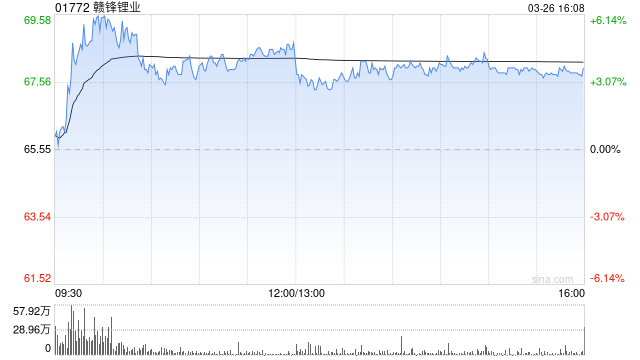
Group 1 - The core viewpoint of the news is that JPMorgan has increased its stake in Ganfeng Lithium, acquiring approximately 174,886.3 shares at a price of 58.1093 HKD per share, totaling around 102 million HKD [2] - After the acquisition, JPMorgan's total shareholding in Ganfeng Lithium is approximately 25.1512 million shares, representing a holding percentage of 5.2% [2] Group 2 - Ganfeng Lithium's stock price showed a slight increase of 2.55% on the day, with a trading range observed in the intraday chart [1] - The trading volume for Ganfeng Lithium reached 650,000 shares during the trading session [1]
锂-应地缘格局之变-谋锂战略之局
2026-03-26 13:20
Summary of Lithium Industry Conference Call Industry Overview - The lithium industry is experiencing persistent supply disruptions, particularly due to tightened export policies in Zimbabwe and the implementation of the new Environmental Code in China, which will significantly increase compliance costs and restrict capacity release [1][4]. - In 2026, a sharp supply-demand imbalance is expected, with demand estimated at approximately 2 million tons, leading to a potential supply shortfall exacerbated by the bullwhip effect [1][6]. - After 2027, the market is anticipated to maintain a tight balance, as new projects will require high price sustainability (13-15 million CNY/ton), making it difficult to continue the previous capital expenditure cycle [1][6]. Demand Dynamics - Demand remains robust, driven by increased energy capacity in electric vehicles and rapid expansion in the energy storage market, with an expected growth rate exceeding 30% this year [1][2]. - The inventory levels have dropped below 100,000 tons, indicating a fragile state in terms of absolute demand and inventory turnover days [2]. Supply Chain and Pricing Mechanisms - The price transmission mechanism within the industry is gradually improving, with rising processing fees for lithium iron phosphate and adjustments in energy storage cell pricing contributing to a more optimized profit distribution [1][5]. - The average valuation of the lithium sector is currently around 15 times earnings, based on a lithium price assumption of 150,000 CNY/ton, which is considered historically low [1][6]. Key Risks and Regulatory Environment - Zimbabwe's export policy is a focal point, with current supply estimated at 120,000 to 150,000 tons. The likelihood of a quick recovery in exports is diminishing, especially with the government's strong stance on requiring processed products for export by 2027 [3][4]. - Domestic environmental regulations are tightening, which will increase compliance costs and complicate the resumption of production in regions like Ningde and Jiangxi [4]. Investment Strategy - The investment strategy prioritizes domestic lithium and salt lake resources (e.g., Guocheng Mining, Salt Lake Co.) over companies with full industry chain layouts (e.g., Ganfeng Lithium) and those with overseas processing advantages or undervalued stocks [1][8]. - The market's main divergence lies in the skepticism regarding the sustainability of energy storage demand, with some analysts fearing a sharp decline in growth after a high-growth phase [6][8]. Conclusion - The lithium sector is positioned for a recovery in fundamentals and valuation, driven by geopolitical factors, resource scarcity, and rising prices in traditional energy sectors, which may enhance the market's acceptance of lithium price increases [8].
锂矿板块重要个股梳理
2026-03-26 13:20
Summary of Key Points from Lithium Mining Sector Conference Call Industry Overview - The lithium mining sector is experiencing a shift in supply and demand dynamics, with expectations of reduced supply and increased demand in the second quarter of 2023, particularly from May to June [2][2][2]. Company-Specific Insights Yongxin Materials - Yongxin Materials plans to complete its annual mining target of 3 million tons by May 2023 and will then voluntarily halt production for certification and expansion procedures, ensuring compliance with regulations [3][3][3]. - The company has a strong environmental compliance record, having received necessary approvals for its operations and waste management [4][4][4]. - Cost control is a highlight, with projected costs decreasing to approximately 45,000 yuan per ton by 2026 due to by-product price increases [5][5][5]. - Profit forecasts indicate 21 billion yuan from lithium operations in 2023, with total profits expected to reach 25 billion yuan, 32 billion yuan, and 39 billion yuan in 2024, 2025, and 2026 respectively [5][5][5]. Dazhong Mining - Dazhong Mining's Hunan project is set to commence production in September 2023, with a planned capacity of 80,000 tons by 2025 [6][6][6]. - The company aims to maintain production costs around 40,000 yuan per ton through innovative processing methods [6][6][6]. - Total expected production is projected to exceed 10,000 tons by 2026, with stable profits from iron ore operations contributing an additional 8-10 billion yuan annually [6][6][6]. Guocheng Mining - Guocheng Mining is expanding its Danba lithium mine from 1 million tons to 5 million tons, with expected production of 2 million tons in 2023 and 4 million tons in 2024 [7][7][7]. - The projected cost for lithium production is around 50,000 yuan per ton, with profits expected to reach 7 billion yuan in 2023 and 15 billion yuan in 2024 [7][7][7]. Rongjie Co., Ltd. - Rongjie Co., Ltd. reported a lithium concentrate production of 180,000 tons, exceeding market expectations due to a new agreement allowing external processing [9][9][9]. - The company anticipates achieving full production capacity of 1.05 million tons in 2025, with a projected cost of 40,000 to 45,000 yuan per ton for lithium carbonate [9][9][9]. - Expected annual profits are around 20 billion yuan, with the company currently being one of the lowest-valued stocks in the sector [9][9][9]. Additional Insights - The overall supply from Zimbabwe is declining, potentially reducing global supply by 30,000 to 50,000 tons in 2023 [2][2][2]. - Tax policies are expected to increase, further impacting the supply dynamics in the lithium sector [2][2][2].

锂矿板块供给再梳理-把握住确定性
2026-03-26 13:20
Summary of Key Points from the Conference Call Industry Overview - The lithium mining sector is facing significant supply adjustments for 2026, with a potential reduction of 80,000 to 100,000 tons due to various factors including production halts in Zimbabwe and Nigeria, as well as delays in projects from CATL in Jiangxi [1][7]. Core Insights and Arguments - **Zimbabwe Supply Risks**: Zimbabwe's lithium supply is under threat due to collective production halts by major mining companies, which could impact monthly supply by approximately 15,000 tons. If the halt lasts for 1-2 months, it could directly affect global supply by 30,000 to 50,000 tons for 2026 [2][7]. - **Nigeria's Supply Downward Revision**: Nigeria's lithium supply forecast has been downgraded from 100,000 tons to 50,000 tons due to political instability and lack of transparency in mining operations [2][3]. - **African Region's Shift**: The African region, previously expected to contribute significantly to lithium supply, is now seen as a potential source of reduction due to issues in Zimbabwe and Nigeria [3][7]. - **Australia's Supply Constraints**: Australia, particularly the Greenbushes project, is expected to contribute an additional 20,000 tons, but faces risks related to diesel supply shortages that could impact overall production [3][4]. - **South America Contributions**: Chile and Argentina are expected to provide stable supply increases, while Brazil's Sigma Lithium project is unlikely to meet its production targets, leading to a net reduction in expected supply from the region [5][6]. - **Domestic Supply in China**: China is projected to be a key source of supply increase, particularly from Qinghai and Sichuan, with expected contributions of 50,000 to 80,000 tons from various projects [6][7]. Potential Market Impacts - A supply-demand imbalance of approximately 200,000 tons could arise if demand increases by 5% while supply is reduced by 80,000 to 100,000 tons. This could lead to significant price increases in lithium, with expectations of price rises starting from late March 2026 [7][8]. - The current lithium price of 150,000 CNY per ton is considered to have a safety margin, making it a favorable time to invest in the lithium sector [8][9]. Investment Strategy Recommendations - The investment strategy should prioritize domestic resource companies, with a focus on Yongxing Materials, followed by other companies like Salt Lake Co., Dazhong Mining, and Rongjie Co. After the situation in Zimbabwe stabilizes, investments can shift towards overseas resource-related companies [8][9].

需求高增叠加供给约束,锂行业有望长期景气上行
Minmetals Securities· 2026-03-26 08:46
Investment Rating - The industry investment rating is "Positive" [2] Core Insights - The lithium industry is expected to experience a long-term upward trend due to sustained high demand and supply constraints. The demand from the electric vehicle sector remains the core driver, with the domestic market entering a phase of stable growth while the overseas market presents significant opportunities. The energy storage sector, currently at a penetration rate of only 7.7%, is projected to rise to around 70% over the next decade, with an annual compound growth rate of 21.0% from 2024 to 2035, becoming a second growth curve for lithium demand. Emerging fields such as humanoid robots and eVTOL are also expected to contribute to significant hidden demand growth in the long term [1][10][26]. Summary by Sections Demand Side - The electric vehicle sector is the primary base for lithium demand, with a projected sales volume of 16.44 million units in China by 2025, reflecting a year-on-year growth of 28% and a penetration rate of 48% [10]. The overseas market is anticipated to become a core source of incremental demand as Chinese automakers expand their global presence [12]. Supply Side - The supply of lithium is constrained by capital expenditure cycles and unexpected policy changes. The expansion cycle for lithium mines typically lasts 3-4 years, and the current downturn in lithium prices has led many leading companies to significantly reduce capital expenditures, resulting in slower project completion rates. Recent policy changes in key lithium-producing countries, such as Nigeria and Zimbabwe, have further increased supply uncertainty [21][24][23]. Future Outlook - By 2026, the lithium supply-demand balance is expected to shift towards tight equilibrium, with demand driven by both electric vehicles and energy storage. The energy storage sector is projected to have a significant growth potential, with a nearly 11-fold increase in installed capacity anticipated. The demand from humanoid robots and low-altitude economy applications is also expected to create additional lithium consumption [26][27].
600396,9连板!两大板块,逆势活跃!
证券时报· 2026-03-26 04:18
Market Overview - The A-share market experienced an overall adjustment on March 26, with major indices declining slightly. The Shanghai Composite Index fell by 0.58%, the Shenzhen Component Index by 0.38%, the ChiNext Index by 0.07%, and the Sci-Tech Innovation Index by 0.96% [4] - The Hong Kong stock market also saw a decline, with the Hang Seng Index dropping below the 25,000-point mark, experiencing a decline of over 1% [11] Active Sectors - The lithium mining and electric power sectors were notably active during the morning session of the A-share market, standing out as key highlights [2][4] - In the electric power sector, Huadian Liaoning Energy (600396) achieved a consecutive nine trading days of涨停 (trading limit up), along with nearly ten other stocks such as Huitian Thermal Power and Guangxi Energy also hitting涨停 [6] - The lithium mining sector saw significant gains, with Rongjie Co. hitting涨停 for the third consecutive trading day. Other lithium stocks like Zhongmin Resources and Shengxin Lithium Energy rose by over 6% [8] Notable Stock Performances - In the A-share market, the non-bank financial sector led the decline, with a drop of over 2%. Stocks such as China Life and Ruida Futures saw declines of over 5% and nearly 6%, respectively [4] - The environmental protection sector also faced declines, with a drop close to 2%. Notable declines included Xuelang Environment down by 12.01% and Haixia Environmental hitting the limit down [5] - In the Hong Kong market, Kuaishou-W led the decline among Hang Seng Index constituents, with a drop of over 13% following its earnings announcement [11] Earnings Announcements - Kuaishou reported a total revenue of RMB 142.8 billion for 2025, reflecting a year-on-year growth of 12.5%, and an adjusted net profit of RMB 20.6 billion, up 16.5% [11] - Bubble Mart's 2025 financial report indicated a revenue of RMB 37.12 billion, a significant year-on-year increase of 184.7%, and an adjusted net profit of RMB 13.08 billion, up 284.5% [12] - Kingsoft's 2025 revenue was RMB 9.683 billion, a decrease of 6% from the previous year, with its office software and services contributing 61% to total revenue [14]