外卖

Search documents
百亿利润没了,外卖大战的残酷账本
吴晓波频道· 2025-11-30 00:21
Core Insights - The article discusses the intense competition in the food delivery market among Meituan, Alibaba, and JD, revealing significant financial losses and market share dynamics as a result of aggressive subsidy strategies [2][3][5][7][9]. Market Share and Financial Performance - Meituan leads the market with a daily order volume of 71 million, capturing 50% of the market share, followed by Alibaba at 42% and JD at 8% [2][9]. - Meituan reported a loss of 14.1 billion RMB in its core local business, a stark contrast to a profit of 14.5 billion RMB in the same period last year, contributing to an overall loss of 16 billion RMB for the quarter [3][9]. - JD's new business segment, which includes food delivery, incurred a loss of 15.7 billion RMB in Q3, totaling 31.8 billion RMB in losses over nine months [5][6]. - Alibaba's operating profit related to the food delivery battle fell to 5.37 billion RMB, down 85% year-on-year, with a net profit of 20.61 billion RMB, a 53% decline [7][9]. User Engagement and Growth - Despite financial losses, user engagement has increased significantly, with Meituan's active user base surpassing 800 million and JD's reaching over 700 million [9]. - The competition has led to a surge in active users for all platforms, with Meituan's daily active users growing over 20% year-on-year [9][34]. Competitive Strategies and Market Dynamics - The article highlights the shift from a subsidy war to a focus on operational efficiency as companies adapt to market pressures and regulatory scrutiny [23][49]. - Meituan's CEO emphasized the company's commitment to maintaining its market position and creating long-term value through strategic investments [19][51]. - The competition has also led to a blurring of business boundaries among the three platforms, increasing user overlap and engagement [34]. Impact on Delivery Workforce - The number of active delivery riders has surged, with a 140% increase in monthly active riders by July, reflecting the growing demand for delivery services [37][41]. - The profile of delivery riders is evolving, with more young and female workers entering the field, indicating a shift in the labor market dynamics [41][42]. Conclusion - The article concludes that the ongoing competition in the food delivery sector is reshaping the market landscape, with significant implications for business models and consumer behavior, ultimately paving the way for a new era in local commerce [52].



利润减少数百亿,外卖大战还打吗?
财联社· 2025-11-29 14:45
Core Viewpoint - The intense competition in the food delivery sector has significantly impacted the profits of major platforms like Meituan, Alibaba, and JD.com, leading to a shift towards refined operations in the ongoing battle for market share [1][2][5]. Financial Performance - In Q3, Meituan's core local business segment reported a loss of 14.1 billion yuan, down from a profit of 14.6 billion yuan in the same period last year, with a profit margin decline from 21% to -20.9% [2]. - Alibaba's e-commerce group adjusted EBITA was 10.497 billion yuan, a decrease of 33.83 billion yuan year-on-year [2]. - JD.com reported a loss of 15.736 billion yuan in new business operations, an increase in losses by 15.121 billion yuan compared to the previous year [2]. Market Dynamics - The three major platforms collectively saw a reduction of over 77 billion yuan in operating profits from food delivery and related businesses compared to last year [3]. - Meituan's shift from profit to loss in its core local business is attributed to declining gross margins and increased spending on user incentives and advertising to maintain market position amid fierce competition [3]. - Both Meituan and Alibaba's management emphasized that the price war is unsustainable and does not create real value for the industry [3][4]. Strategic Shifts - The food delivery battle is expected to evolve into a long-term engagement, with intensified competition between Alibaba and Meituan, impacting JD.com, Douyin, and Pinduoduo significantly [5]. - Meituan is focusing on enhancing cooperation with brand merchants and expanding its "brand officer flag lightning warehouse" for 24-hour delivery services [6]. - JD.com is witnessing an increasing conversion rate of new users from food delivery to other services, with nearly 50% of early food delivery users transitioning to other business areas [6]. Future Outlook - The future competition among food delivery platforms will shift towards refined operations, focusing on unit economic efficiency and multi-business collaboration [7]. - Instant retail is set to become the main battleground, with platforms like Meituan and Alibaba enhancing their operational efficiencies and expanding their service offerings [7]. - A recent report from JPMorgan highlights that platforms may shift subsidies towards higher-ticket lunch and late-night orders, which could improve profitability per order [7].

外卖三国杀新阶段:不想打,但也停不下
Di Yi Cai Jing· 2025-11-29 13:41
Core Insights - The recent earnings reports from JD, Alibaba, and Meituan reflect the impact of the intense competition in the food delivery sector, indicating a shift in strategy as companies reassess their investments and profitability boundaries [1][3][5] Group 1: Company Strategies - Meituan's CEO Wang Xing firmly opposes price wars in the food delivery sector, stating that they do not create value for the industry [1] - Alibaba's e-commerce CEO Jiang Fan highlighted improvements in unit economics for instant retail, indicating a significant reduction in short-term losses and a notable decrease in overall investment in flash purchase business for the next quarter [1][3] - JD has quietly reduced its investment in food delivery services in the third quarter, signaling a strategic retreat from aggressive competition [1][3] Group 2: Market Dynamics - The food delivery market is entering a more complex phase where companies express a desire to avoid price wars but feel compelled to continue competing [2][5] - The competitive landscape has shifted, with Meituan capturing 47.1% of the market share, Alibaba at 42.3%, and JD at 8.4%, indicating a significant change from previous perceptions of a more balanced market [5] - The reduction in subsidies has led to a noticeable decline in order volumes for both consumers and merchants, with reports of a 20% drop in sales for some businesses [4][5] Group 3: Consumer Behavior - Consumers have adjusted their habits, with many now favoring Meituan and Alibaba's flash purchase services, noting that flash purchase prices are often lower while Meituan offers more reliable delivery speeds [3][4] - The decrease in subsidies has been felt by consumers, with many reporting a reduction in the frequency of low-priced promotions [3][4] Group 4: Future Outlook - The next phase of competition will focus on efficiency rather than capital expenditure, with companies expected to adapt their strategies based on market dynamics [6][8] - Both Meituan and Alibaba are exploring new strategies, such as Meituan's focus on high-value orders and Alibaba's emphasis on "explosive product groups" to enhance customer engagement and reduce decision-making time [7][8] - The ongoing challenges from previous low-price competition will require platforms to innovate in supply chain and operations to emerge successfully from the current market conditions [8]

“五分钟社会救援圈”破解急救痛点取得重大成效
Ren Min Wang· 2025-11-29 13:32
Core Insights - The article discusses the "Five-Minute Social Rescue Circle" project, which aims to enhance emergency rescue efficiency in China through social collaboration and technology empowerment [1][2] - The project addresses challenges in China's pre-hospital emergency system, including low public first aid skills and inadequate automatic external defibrillator (AED) availability [1][2] - The initiative has successfully implemented 51,511 emergency rescues, with 352 successful resuscitations of cardiac arrest patients by October 2025 [1][2] Group 1: Project Overview - The project is centered around the "Penguin Rescue" smart platform, which integrates various technologies for comprehensive digital management of emergency responses [2] - A support system comprising "equipment + training + assurance" has been established, resulting in the addition of 4,327 AEDs and over 568,000 first aid training sessions [2] - The platform has registered 823,000 emergency volunteers and 12.68 million users, showcasing significant community engagement [2] Group 2: Impact and Evaluation - The project has notably increased the survival rate of cardiac arrest patients in Suzhou from 3.2% to 23.8% [2] - Experts have praised the project's innovative value and societal significance, emphasizing its role in enhancing public first aid literacy and social trust [3] - The initiative is seen as a model for corporate participation in social value creation, with suggestions for further development focusing on data standardization and service efficiency [3] Group 3: Future Directions - The project initiators plan to deepen collaboration with national health and education departments, aiming to expand the model to more cities and integrate first aid training into basic education [4] - Future efforts will include the establishment of AED industry standards and mandatory first aid training for key populations [4]

外卖三国杀新阶段:不想打,但也停不下
第一财经· 2025-11-29 13:14
Core Insights - The article discusses the recent developments in the food delivery industry, particularly focusing on the financial reports of major players like JD.com, Alibaba, and Meituan, highlighting the impact of the "delivery war" on their business strategies and financial performance [2][3]. Group 1: Industry Dynamics - The food delivery battle has led to significant financial strain, prompting companies to reconsider their investment strategies and operational efficiency [2][7]. - Meituan's CEO Wang Xing emphasized the unsustainable nature of the price war, indicating a shift towards efficiency-driven competition rather than capital-driven growth [7][9]. - The market share dynamics have shifted, with Meituan holding 47.1%, Alibaba at 42.3%, and JD.com at 8.4% as of Q3 2025, indicating a significant change from previous perceptions of market distribution [6]. Group 2: Financial Performance and Strategy Adjustments - Alibaba's CFO Xu Hong noted that Q3 represented a peak in investment for flash purchase services, with expectations for significant reductions in the following quarter [3][5]. - Meituan and JD.com have already begun to reduce their subsidies, with Meituan's delivery volume and rider earnings declining as a result of the reduced promotional activities [4][6]. - The article highlights a trend where consumers are noticing a decrease in delivery subsidies, impacting their purchasing behavior and the overall market dynamics [4][5]. Group 3: Future Outlook and Strategic Shifts - The next phase of competition will focus on operational efficiency and innovation, with companies like Alibaba and Meituan exploring new strategies such as "explosive product groups" and "meal sharing" to attract consumers [10][11]. - Both companies are adjusting their focus towards higher-value orders, with Meituan reporting that over 70% of its orders exceed 30 yuan, indicating a strategic pivot towards more profitable segments [10][11]. - The article concludes that the ability to innovate and enhance supply chain operations will be crucial for companies to navigate the post-subsidy landscape and emerge successfully from the current market challenges [12].

外卖行业竞争持续加剧,美团Q3核心本地商业承压明显
Zhong Guo Qing Nian Bao· 2025-11-29 12:42
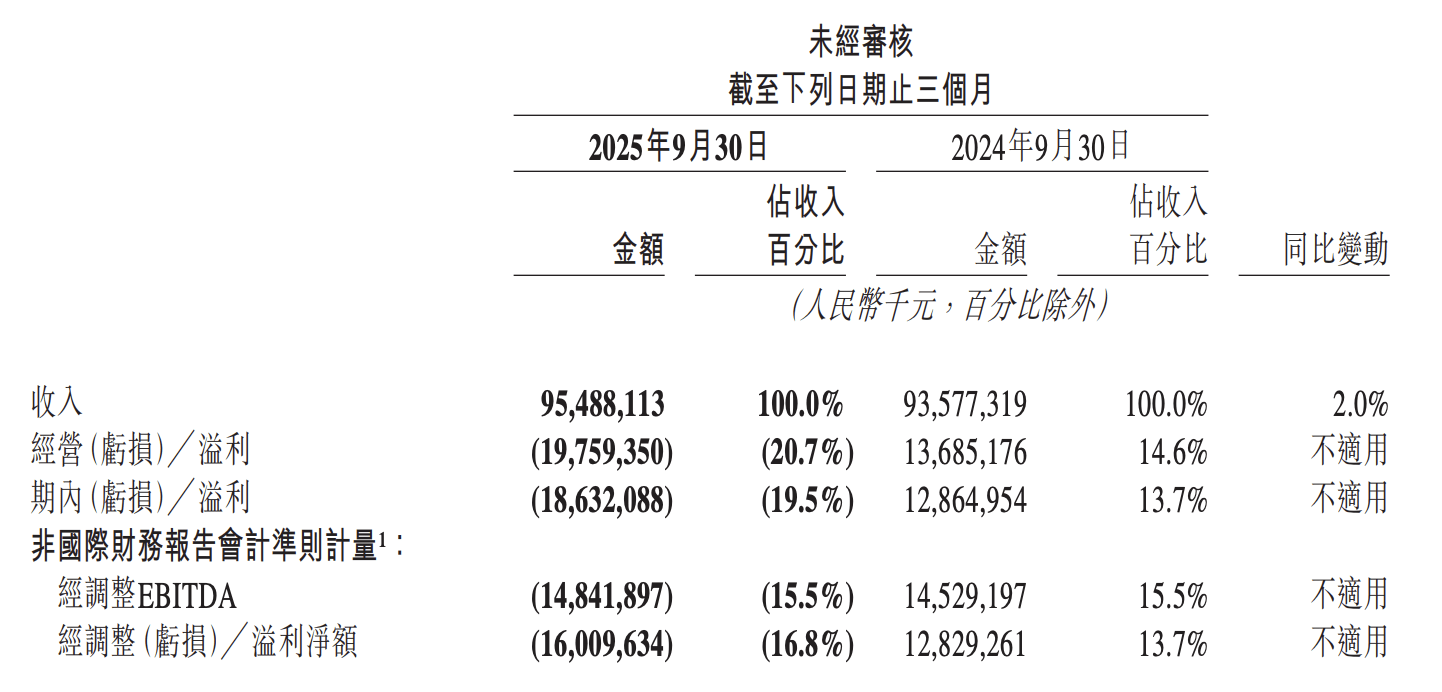
Core Insights - Meituan reported a revenue of 95.5 billion yuan for Q3 2025, representing a year-on-year growth of 2% [1] - The core local commerce segment, which includes the food delivery business, experienced a significant operating loss of 14.1 billion yuan due to intensified industry competition [1] - Adjusted net loss for Q3 reached 16.01 billion yuan, compared to a profit of 12.83 billion yuan in the same period last year [1] Financial Performance - Revenue for Q3 2025 was 95.5 billion yuan, a 2% increase year-on-year [1] - The adjusted net loss was 16.01 billion yuan, a stark contrast to the profit of 12.83 billion yuan from the previous year [1] - Operating loss in the core local commerce segment was 14.1 billion yuan, with a significant decline in operating profit year-on-year [1] Business Strategy - To counteract the "involution" competition in the industry, Meituan increased its investment, leading to a more than 20% year-on-year growth in daily active users (DAU) [1] - The number of monthly active users for food delivery reached a historical high [1] - R&D investment for Q3 was 6.9 billion yuan, marking a 31% increase year-on-year [1] Future Outlook - Meituan anticipates that the trend of operating losses in the core local commerce segment and overall company will continue into Q4 [1] - CEO Wang Xing emphasized the commitment to enhancing core competitiveness through continuous product and service iterations to better meet user needs [1]
美团没有被彻底拖住
36氪未来消费· 2025-11-29 12:23
Core Insights - The article highlights the intense competition in the food delivery sector, indicating that there are no clear winners in the ongoing battle, particularly in Q3 2025, where major players like Alibaba, Meituan, and JD.com are facing significant challenges and losses [3][5][8]. Summary by Sections Food Delivery Battle - Alibaba's aggressive strategy led to a profit drop of approximately 30 billion yuan, gaining market share but lacking evidence of successful e-commerce synergy [3][8]. - Meituan experienced a decline in market share and reported an operating loss of 14.1 billion yuan, marking its first loss since Q4 2022 [3][5]. - JD.com has reduced its investment in food delivery, focusing on user experience optimization instead [3]. Financial Performance - Meituan's core local business saw a significant shift, with operating profit dropping from 14.6 billion yuan to a loss of 14.1 billion yuan due to increased user incentives and marketing expenses [7]. - Meituan's sales costs rose by 23.7%, and marketing expenses surged by 90.9%, indicating a heavy reliance on subsidies to maintain market share [7]. - Alibaba's total profit dropped by 30 billion yuan in Q3, with a substantial portion of its planned 50 billion yuan subsidy nearly exhausted [8]. Market Dynamics - The competition has led to a significant change in market dynamics, with Alibaba and Meituan nearly equal in market share, while JD.com has lost about 8% [8]. - Both platforms are now focusing on high-value orders, with Meituan holding over 70% market share for orders above 30 yuan [8]. - The article notes that the intense competition has led to a temporary decrease in subsidy levels, allowing Meituan to regain some market share [8]. New Business Ventures - Meituan's new business segment reported a 15.9% revenue increase to 28 billion yuan, despite a 24.5% rise in operating losses [15]. - The company is expanding its offline retail efforts, with new stores like Xiaoxiang Supermarket and the discount store Happy Monkey [15]. - Meituan's overseas expansion continues, with Keeta achieving profitability in Hong Kong and launching operations in Brazil [16][18]. Future Outlook - Meituan's management expresses confidence in maintaining efficiency and market share despite ongoing losses [5][13]. - The company is preparing for a winter campaign to boost various metrics, including new store openings and promotional activities [12]. - The article concludes that while the core local business faces challenges, Meituan is committed to exploring new opportunities and maintaining its operational rhythm [18].

外卖三国杀:补贴已退潮,战事能否休矣?
Di Yi Cai Jing· 2025-11-29 11:37
Core Insights - The food delivery battle is entering a more complex phase where companies are reluctant to continue but feel unable to stop [1][3] - Major players like Meituan, Alibaba, and JD have reported significant impacts on their financials due to investments in food delivery services [2] Group 1: Company Strategies - Meituan's CEO Wang Xing firmly opposes price wars in food delivery, stating they do not create value for the industry [2] - Alibaba's e-commerce CEO Jiang Fan highlighted improvements in unit economic efficiency (UE) for instant retail, indicating a significant reduction in short-term losses and a notable decrease in investment for flash purchase services in the next quarter [2][4] - JD has quietly reduced its investment in food delivery services in the third quarter [2] Group 2: Market Dynamics - The food delivery market is experiencing a "tide retreat," with companies signaling a shift in strategy [4] - Consumers have noticed a decrease in subsidies since November, affecting their purchasing habits [4][6] - The competitive landscape has changed, with Meituan holding a 47.1% market share in instant transactions, Alibaba at 42.3%, and JD at 8.4% as of Q3 2025 [6] Group 3: Operational Changes - Merchants are feeling the impact of reduced subsidies, with some reporting a 20% decline in order volume and revenue [5][6] - JD was the first to reduce subsidies, with a significant drop in its market share from 30% to below 2% in certain categories [6] - Alibaba's flash purchase subsidies have also decreased, although they remain more robust compared to Meituan [6] Group 4: Future Outlook - The next phase of competition will focus on efficiency rather than capital-driven growth, with companies adjusting their strategies based on competitive dynamics [7][9] - Meituan plans to maintain necessary investments to retain its leading position while avoiding price wars [9] - The emphasis on high-value orders is increasing, with Meituan reporting that over 70% of orders exceed 30 yuan [11]

滴滴出海,与“中国制造”共赢
Sou Hu Cai Jing· 2025-11-29 08:45
Core Insights - Didi's Q3 2025 financial report shows a total gross transaction value (GTV) of 115.82 billion yuan, a year-on-year increase of 14.8%, marking five consecutive quarters of GTV exceeding 100 billion yuan [2] - The total order volume reached 4.69 billion, up 13.8% year-on-year, with daily orders surpassing 50 million for the first time [2] - Net profit for the quarter was 1.46 billion yuan, reflecting a 57% year-on-year growth [2] Domestic Business Performance - Didi's domestic ride-hailing business GTV was 86.02 billion yuan, a 10.1% increase year-on-year, with order volume at 3.52 billion, up 10.7% [2] - The domestic business continues to show stable growth amidst a recovering market [10] International Business Growth - Didi's international business GTV surged 31% year-on-year to 29.8 billion yuan, with order volume increasing 24.3% to 1.16 billion [2] - The international segment has achieved healthy and sustainable growth, with adjusted EBITDA turning profitable in the first three quarters [2] - Didi's food delivery service, 99Food, has been relaunched in over 30 cities in Brazil, with plans to expand to 100 cities by mid-2026 [8] Strategic International Expansion - Didi's internationalization began in 2015, focusing on strategic investments in regional ride-hailing platforms to understand local markets [5] - The company has made significant moves in Latin America, including acquiring Brazil's largest ride-hailing company, 99, and entering multiple countries in the region [5] - Didi emphasizes a strategy of "cooperation and win-win" and "localization" in its international operations, aiming to develop alongside local markets [9] Future Growth Potential - The overseas market for ride-hailing and food delivery is still in a rapid growth phase, with significant room for penetration compared to developed markets [9] - Didi's promotion of electric vehicle fleets in Mexico positions it as a leader in sustainable transportation in Latin America [9] - The company is expected to transition from a focus on scale to profitability as its international business matures and diversifies into financial technology and other services [10]

净损160亿!美团的护城河,被淘宝闪购“挖穿”
Sou Hu Cai Jing· 2025-11-29 06:07
Core Viewpoint - Meituan's competitive moat has been severely eroded, as evidenced by its disappointing Q3 2025 earnings report, which showed a revenue of 95.5 billion RMB, a 2% year-on-year increase, falling short of Bloomberg's expected 4% growth, and an adjusted net loss of 16.01 billion RMB, exceeding the expected 13.8 billion RMB loss [1][2][3] Financial Performance - In Q3 2025, Meituan reported a revenue of 95.5 billion RMB, with a year-on-year increase of 2% [2] - The adjusted net loss for the quarter was 16.01 billion RMB, significantly higher than the previous year's adjusted net profit of 12.8 billion RMB, indicating a nearly 30 billion RMB impact on net profit [2][3] - Operating loss for the core local business segment reached 14.1 billion RMB, with an operating loss margin of 20.9% [8] Cost and Investment Analysis - Meituan's sales costs and marketing expenses increased by 29.8 billion RMB compared to the same quarter last year, aligning closely with the 30 billion RMB decrease in profit [3] - The core local business segment's revenue decreased by 2.8%, indicating challenges in maintaining market share despite increased spending [8] Market Share and Competition - Meituan's market share in food delivery has dropped from over 75% at the beginning of the year to approximately 50% as of November, according to estimates from JPMorgan [3][12] - The competitive landscape has intensified, with Alibaba's market share rising to 42%, while Meituan's share has declined [12] Strategic Responses - Meituan's CEO expressed optimism about the long-term sustainability of the business model, despite acknowledging ongoing losses due to competition [4][19] - The company plans to invest an additional 2.8 billion RMB to support merchant development and enhance service quality [18] Market Sentiment - The market has reacted negatively to Meituan's Q3 results, with the company's stock price under pressure, reflecting a year-to-date decline of over 32% [6][16] - Analysts predict that Meituan's stock will continue to face downward pressure following the earnings report [7][16]