银行业

Search documents
单日净投放3095亿元 流动性保持合理充裕
Zhong Guo Zheng Quan Bao· 2026-02-25 22:34
Core Viewpoint - The People's Bank of China (PBOC) is actively managing liquidity through various monetary policy tools, including reverse repos and medium-term lending facilities (MLF), to maintain a stable funding environment amid recent liquidity fluctuations [1][2][3]. Group 1: Monetary Policy Actions - On February 25, the PBOC conducted a 409.5 billion yuan 7-day reverse repo operation and a 600 billion yuan MLF operation, resulting in a net liquidity injection of 309.5 billion yuan [1]. - The MLF operation in February marked the 12th consecutive month of increased liquidity, with a net injection of 300 billion yuan, although the increase was smaller than the previous month's 700 billion yuan [1]. - Cumulatively, the PBOC's operations in February resulted in a net liquidity injection of 900 billion yuan, combining reverse repos and MLF [2]. Group 2: Future Outlook and Market Conditions - Despite a slight decrease in the net liquidity injection compared to the previous month, the level remains relatively high, supported by early issuance of local government bonds and expected credit growth in the first quarter [2]. - Analysts suggest that the PBOC will continue to utilize MLF and reverse repos to stabilize liquidity, especially during periods of significant government bond supply [4]. - The overall liquidity environment is expected to remain stable, aided by factors such as reduced net government bond payments and limited tax payment impacts [3].
货币政策适度宽松更重精准协同
Xin Lang Cai Jing· 2026-02-25 22:05
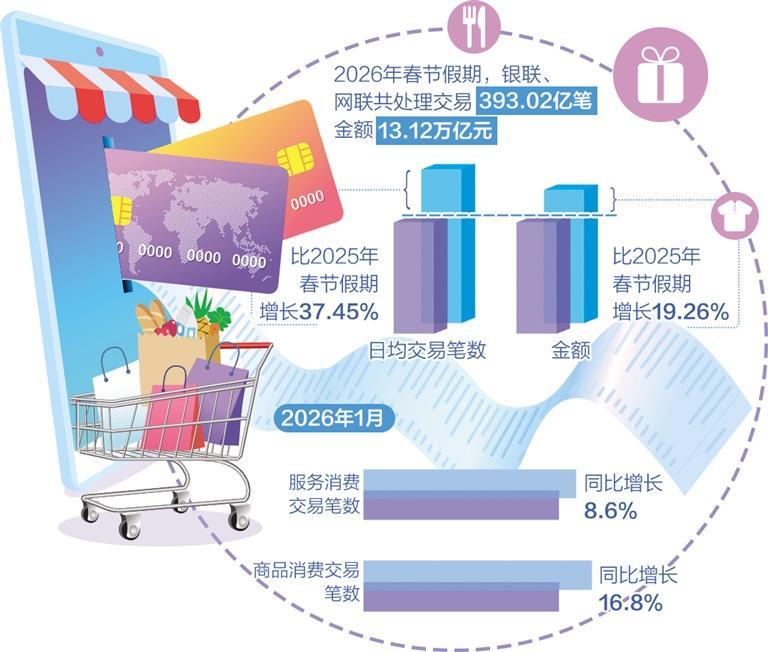
Core Insights - The data from the People's Bank of China indicates a significant increase in mobile payment transactions during the 2026 Spring Festival, with a total of 39.302 billion transactions amounting to 13.12 trillion yuan, reflecting a year-on-year growth of 37.45% in transaction volume and 19.26% in transaction value compared to the 2025 Spring Festival [2] - The supportive monetary policies implemented at the beginning of 2026 are aimed at enhancing the real economy, particularly in key areas such as private sector support, technological innovation, green initiatives, and consumption [2][4] - The overall trend in service consumption is positive, with offline transactions in travel and entertainment exceeding a 20% year-on-year increase during the Spring Festival period [3] Monetary Policy and Economic Support - The People's Bank of China has maintained a supportive monetary policy stance, with broad money supply (M2) and social financing growth rates remaining high, indicating a stable economic start for 2026 [2][4] - The central bank has established a 500 billion yuan re-lending program to support service consumption and elderly care, encouraging financial institutions to innovate consumer finance products [3][4] - The focus on expanding the support areas for service consumption and elderly care re-lending will include the health industry once recognized standards are established [5] Credit Growth and Structure - By the end of 2025, the balance of consumer loans (excluding personal housing loans) reached 21.2 trillion yuan, with a notable increase in loans to enterprises, particularly in long-term loans [4][7] - The financial sector has shown resilience in credit growth, with a total loan balance of 271.91 trillion yuan by the end of 2025, reflecting a year-on-year growth of 6.4% [6][7] - Loans directed towards high-quality development sectors, such as technology and green initiatives, have consistently outpaced overall loan growth, indicating a shift in credit resource allocation [6][7] Policy Coordination and Effectiveness - Recent government meetings have emphasized the need for coordination between fiscal and monetary policies to enhance their effectiveness in promoting consumption and investment [8][9] - The combination of re-lending and fiscal subsidy policies aims to alleviate financing difficulties for small and micro enterprises, thereby stimulating private investment [9][10] - The central bank's future policy direction will focus on structural support for specific sectors, enhancing financial backing for areas like technology innovation and small enterprises [10]

爱泼斯坦案冲击美国学界,前财长萨默斯辞去哈佛教职、半世纪学术关系终结
Hua Er Jie Jian Wen· 2026-02-25 20:49
Core Viewpoint - The release of documents related to the Epstein case by the U.S. Department of Justice is reshaping the power dynamics within the academic community in the U.S., leading to significant resignations and investigations at prestigious institutions like Harvard University [1]. Group 1: Resignation of Key Figures - Former Harvard University President and U.S. Treasury Secretary Lawrence Summers announced his resignation from all teaching positions at Harvard, marking a significant exit amid the Epstein scandal [1]. - Summers will officially step down at the end of the academic year, relinquishing his title as "University Professor" and his role as co-director of the Mossavar-Rahmani Center for Business and Government [1]. - In his statement, Summers expressed gratitude for his 50 years at Harvard and indicated a shift in focus towards research and commentary on global economic issues [1]. Group 2: Details of Summers' Relationship with Epstein - Summers' relationship with Epstein was revealed through a large volume of emails released by the Department of Justice, showing communication spanning at least seven years, including discussions on personal matters [2]. - He was listed as a successor executor in Epstein's 2014 will, which he claimed he was unaware of [2]. - Following the initial revelations, Summers announced a pause on all public engagements and resigned from various positions, including the board of OpenAI [2]. Group 3: Institutional Responses and Investigations - Harvard University has initiated a formal investigation into Summers' connections with Epstein, as part of a broader review of the university's historical ties to Epstein [3]. - The Kennedy School's Dean has accepted Summers' resignation from his co-director position, and both the Trump administration and Harvard have indicated they will investigate Summers [3]. Group 4: Broader Impact on Academic Institutions - The fallout from the Epstein case is prompting other prestigious universities to conduct their own reviews, with notable resignations occurring at institutions like Columbia University and Yale University [4]. - Richard Axel from Columbia University resigned from his position, citing his past association with Epstein as a "serious lapse in judgment" [5]. - Yale University has suspended a professor pending an investigation into his communications with Epstein [5]. Group 5: Global Implications - The release of Epstein-related documents has implications beyond academia, affecting various sectors including politics and finance, with notable figures being scrutinized [6]. - The U.S. Department of Justice has completed the review of related documents, which total over 3 million pages, including videos and images [6].
单日净投放3095亿元流动性保持合理充裕
Zhong Guo Zheng Quan Bao· 2026-02-25 20:22
Group 1 - The People's Bank of China (PBOC) conducted a 7-day reverse repurchase operation of 409.5 billion yuan and a Medium-term Lending Facility (MLF) operation of 600 billion yuan on February 25, resulting in a net liquidity injection of 309.5 billion yuan [1] - The MLF operation in February marked the 12th consecutive month of increased liquidity, with a net injection of 300 billion yuan, although the increase was smaller than the previous month's 700 billion yuan [1] - The total net liquidity injection through reverse repos and MLF operations in February reached 900 billion yuan, indicating a proactive approach by the PBOC to maintain stable liquidity levels [1] Group 2 - Despite a slight decrease in the net liquidity injection compared to the previous month, the scale remains relatively high, supported by early issuance of local government bonds and expected large-scale credit issuance in the first quarter [2] - The PBOC's continued MLF operations are aimed at countering potential liquidity tightening effects, ensuring a stable and ample funding environment while supporting government bond issuance [2] - Factors such as the concentration of liquidity due to the Spring Festival holiday and upcoming tax payments are expected to create short-term fluctuations, but overall liquidity is projected to remain stable [3]
人民币破6.9关口,美元风险加剧,财富布局要变了
Sou Hu Cai Jing· 2026-02-25 19:16
再看英国这一步,2026年2月9日,中国人民银行授权中行伦敦分行担任英国人民币清算行,别小看这个 动作,伦敦是全球许多大宗商品尤其是黄金的定价中心,很多交易在这里形成价格再到美国市场去流 通,伦敦出现人民币清算,这意味着人民币的国际支付通道在传统金融枢纽铺开,世界货币体系开始松 动,现实在改变规则,不是政策夸夸其谈,而是清算网络在落地,这是硬实力的表现。 第二点,西方高层排队访华,看似政要走亲访友,实际上是围绕贸易与货币互换的务实往来,别被表象 的外交礼节迷惑,这背后是大宗商品流通、巨额交易、货币互换与市场渗透在推动;法国、加拿大、英 国、德国,这些老牌强国的接触,不只是握手合照,更是金融互换与支付通道的重构;别忘了数字—— 中欧、中英以及与加拿大澳大利亚的本币互换都在数千亿级别,人民银行与境外央行签署的双边本币互 换协议规模截至2026年2月约4.16万亿元人民币,这些钱不只是数据,是流动的购买力,是直接在国际 市场上增加人民币使用频次的工具。 第三点,世界货币体系在动摇,美元在重置,所谓"重置"不是立刻崩盘,而是权力平衡的再配置,国际 资本因此变得高度敏感,谁都怕把所有鸡蛋放在一个篮子里;于是黄金、人民币 ...
美联储:政府债券吸引力萎缩导致“自然利率”上升
Sou Hu Cai Jing· 2026-02-25 18:56
Core Insights - The global "natural rate of interest" has statistically increased by approximately 1 percentage point since 2019 in the U.S. and other developed economies [1] - The decline in the attractiveness of government bonds' "safety" and "liquidity" accounts for about 50% of the rise in interest rates [1] - Key factors contributing to the increase in interest rates include the diminished appeal of government bonds, AI-driven productivity growth prospects, and the surge in government debt-to-GDP ratios [1] - The shift in the natural rate of interest will significantly influence the interest rate decisions of the Federal Reserve and global central banks [1]
黑龙江天有为电子股份有限公司关于使用部分闲置募集资金进行现金管理到期赎回的公告
Shang Hai Zheng Quan Bao· 2026-02-25 18:15
Group 1 - The company has approved the use of up to RMB 2.8 billion of idle raised funds and up to RMB 2 billion of idle self-owned funds for cash management, focusing on safe and liquid principal-protected financial products [2] - The cash management authorization is valid from the date of approval at the 2024 annual shareholders' meeting until the 2025 annual shareholders' meeting [2] - The supervisory board and the sponsor, CITIC Securities Co., Ltd., have expressed their agreement on this cash management plan [2] Group 2 - On November 17, 2025, the company purchased RMB 600 million in fixed-term deposits from China Merchants Bank [3] - The company also invested in various financial products, including RMB 300 million in "Call Option 906" from CITIC Securities, RMB 220 million in "Galaxy Jinshan" from China Galaxy Securities, and RMB 180 million in "Step-Up Interest 4205" from CITIC Securities [3] - As of the announcement date, the company has redeemed these investments, recovering a total principal of RMB 1.3 billion and earning RMB 4.6461 million in interest, all of which has been returned to the fundraising account [3] Group 3 - As of the announcement date, the company has RMB 430 million of temporarily idle raised funds still under cash management [4] - The highest daily balance and the duration of the cash management have not exceeded the limits authorized by the board and the shareholders' meeting [4] - There are no overdue amounts for the financial products purchased with idle raised funds [4]
申万菱信基金管理有限公司关于旗下部分基金调整长期停牌股票估值方法的公告
Xin Lang Cai Jing· 2026-02-25 17:54
Group 1 - The core point of the announcement is that Shenwan Hongyuan Fund Management Co., Ltd. will adopt the "index income method" for valuing its funds holding "Dongyangguang" (stock code: 600673) starting from February 25, 2026, excluding ETF funds [1] - The valuation method will revert to using the closing price on the day of trading once the stock resumes trading and exhibits active market trading characteristics [1] - Investors are advised to pay attention to this change in valuation method [1] Group 2 - The fund management company has announced a second notice regarding the convening of a fund holders' meeting for the Shenwan Hongyuan Quantitative Hedge Strategy Flexible Allocation Mixed Fund [2] - The meeting will be held via communication methods, and the voting period will be from February 28, 2026, to March 30, 2026 [3][10] - The rights registration date for this meeting is set for February 27, 2026, meaning all fund holders registered by the end of trading on that day are eligible to participate [5] Group 3 - Voting can be conducted through various methods including paper ballots, telephone voting, and online voting via the official WeChat mini-program "Shenxiaogu" [12][13] - Specific instructions for filling out and submitting voting ballots are provided, including requirements for personal and institutional investors [6][7] - The validity of votes will be determined based on the completeness and clarity of the submitted ballots and adherence to the submission timeline [16][18] Group 4 - The meeting's resolutions will be effective if at least half of the fund shares held by participants are represented in the voting [20] - If the required quorum is not met, the fund management company may reconvene the meeting within three to six months [20] - The meeting will be supervised by authorized personnel from the fund custodian, Agricultural Bank of China, and the counting process will be notarized [14][21]


央行上海总部:一次性信用修复政策在沪平稳有效实施
Zhong Guo Xin Wen Wang· 2026-02-25 14:28
Core Viewpoint - The People's Bank of China (PBOC) Shanghai Headquarters has effectively implemented a one-time credit repair policy, demonstrating a commitment to addressing urgent public concerns and enhancing financial services for the populace [1][2]. Group 1: Policy Implementation - The PBOC announced the one-time credit repair policy on December 22, 2025, as a practical measure reflecting the political and people-oriented nature of financial work [1]. - The Shanghai Headquarters has established an emergency leadership group and a specialized working group to ensure the smooth implementation of the policy, including the development of emergency plans and implementation schemes [1]. Group 2: Service Enhancement - Multiple measures have been taken to improve service levels and ensure that the rights of information subjects are protected, including the opening of additional query windows and increasing service supply [2]. - Continuous inspections of service points have been conducted to ensure efficient and smooth query channels since the policy's announcement [2]. Group 3: Public Communication - The PBOC Shanghai Headquarters has utilized its WeChat account to disseminate policy Q&A and interpretations, aiming to clarify and guide public expectations [2]. - A comprehensive policy communication mechanism has been established, combining online and offline channels to ensure clear and accurate policy explanations [2].
国泰海通 · 宏观聚焦|中国居民财富:第三次历史“大迁徙”——“居民财富何处流”研究二
国泰海通证券研究· 2026-02-25 14:22
Core Viewpoint - Chinese residents' wealth has undergone two historical migrations, with the third migration currently underway, characterized by a shift towards "savings+" as the main trend, influenced by low interest rates and inflation expectations [2][6]. Group 1: First Historical Migration: "Savings Move" (1998–2018) - The period from 1990 to 1998 marked the initial stage of wealth accumulation and allocation, primarily through savings, with low exposure to risk assets [3][8]. - The housing reform in 1998 initiated the first migration, directing savings towards real estate and related assets, establishing real estate as a core component of residents' asset allocation [10][11]. - This migration can be divided into two phases: 1. From 1998 to 2008, real estate gained central importance in residents' balance sheets, driven by price appreciation expectations and the rise of related financial products [11][12]. 2. From 2008 to 2018, the rapid expansion of the asset management industry accelerated the flow of funds into real estate and related financial assets [3][12]. Group 2: Second Historical Migration: "Savings Return Home" (2018–2023) - The second migration began in 2018 as the real estate market entered a downturn, leading to a return of wealth from real estate and related financial products back to savings [4][17]. - During this period, annual new savings averaged approximately 12 trillion yuan, significantly higher than the previous norm of 4-5 trillion yuan [17]. - The decline in real estate prices and regulatory changes in the asset management sector contributed to the increased attractiveness of savings over real estate investments [18][17]. Group 3: Third Historical Migration: "Savings+" Era (Since 2023) - Since 2023, the growth of new savings has noticeably declined, with new savings dropping to 16.7 trillion yuan, indicating a loosening of the concentration in savings allocation [23][27]. - The driving factors include a relative decline in the attractiveness of savings rates and improvements in the relative returns of other risk assets, such as bonds and equities [26][27]. - The current migration reflects a structural rebalancing around actual returns, with "savings+" representing a broader wealth allocation concept that emphasizes stable returns while controlling for capital loss [27][28].