
计算机

Search documents
金龙稀土拟北交所上市,董事长等多名董监高还在厦门钨业任职
Sou Hu Cai Jing· 2026-02-05 01:13
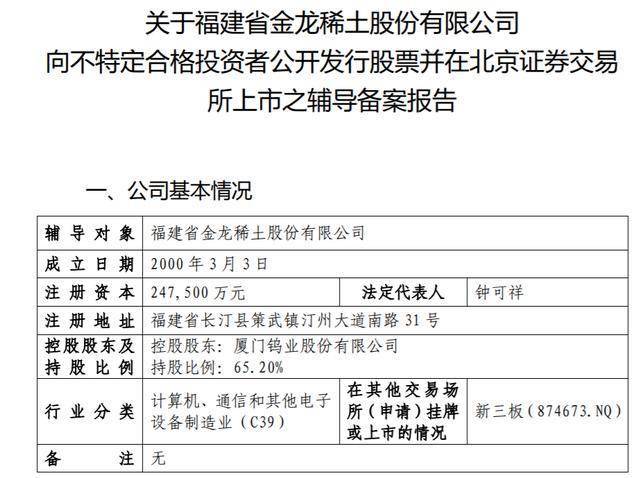
Company Overview - Fujian Jinlong Rare Earth Co., Ltd. (hereinafter referred to as "Jinlong Rare Earth") was established on March 3, 2000, with a registered capital of 2.475 billion yuan [2] - The legal representative is Zhong Kexiang, and the controlling shareholder is Xiamen Tungsten Co., Ltd., holding a 65.20% stake [2][3] - The company is classified under the manufacturing industry of computer, communication, and other electronic equipment [1] IPO and Market Position - Jinlong Rare Earth has initiated IPO guidance with the Fujian Regulatory Bureau, aiming for listing on the Beijing Stock Exchange, with Huatai United Securities as the advisory institution [1] - The company focuses on providing products and services in rare earth oxides, rare earth metals, magnetic materials, and luminescent materials, which are widely used in various sectors including permanent magnet materials, wind power generation, automotive industry, non-ferrous metals, industrial motors, energy-saving appliances, and chemical lighting [1] Financial Performance - In the first half of 2025, Jinlong Rare Earth achieved an operating income of 2.72 billion yuan, representing a year-on-year increase of 33.97% [3][4] - The net profit attributable to shareholders of the listed company was 120.16 million yuan, showing a year-on-year growth of 7.01% [3][4] - The net profit after deducting non-recurring gains and losses was 114.48 million yuan, which is a significant increase of 110.74% compared to the previous year [4] Management and Governance - Several executives of Jinlong Rare Earth also hold positions at the controlling shareholder, Xiamen Tungsten [5] - Key management includes: - Chairman Zhong Kexiang, who also serves as a director and executive vice president at Xiamen Tungsten [5][6] - General Manager Chen Dakun, who has held various roles within Xiamen Tungsten before his current position [6] - Financial Director Zhou Bin, who has a background in accounting and finance within Xiamen Tungsten [7]


A股市场大势研判:大盘探底回升,沪指重返4100点
Dongguan Securities· 2026-02-04 23:30
Market Overview - The market experienced a rebound with the Shanghai Composite Index returning to 4100 points, closing at 4102.20, up by 0.85% [2][4] - The Shenzhen Component Index closed at 14156.27, up by 0.21%, while the ChiNext Index fell by 0.40% to 3311.51 [2][4] - The total trading volume in the Shanghai and Shenzhen markets was 2.48 trillion yuan, a decrease of 633 billion yuan from the previous trading day [6] Sector Performance - The top-performing sectors included coal (up 7.58%), building materials (up 3.48%), and real estate (up 2.97%) [3][4] - Conversely, sectors such as media (-3.12%), telecommunications (-2.73%), and computing (-1.70%) underperformed [3][4] - Concept indices showed strong performance in coal, TOPCON batteries, and BC batteries, while concepts like Kuaishou and cloud gaming lagged behind [3][4] Future Outlook - The report indicates that the market is expected to stabilize with a focus on consumption policies and infrastructure development [6] - Short-term volatility is anticipated due to profit-taking pressures after a rapid rise in stock prices over the past two months [6] - Long-term, the market is expected to transition from a valuation-driven rally to one driven by earnings, with a focus on strategic resource products and technology growth [6] News Highlights - The central government's No. 1 document emphasizes the integration of AI with agriculture and the development of new agricultural production capabilities [5] - The People's Bank of China announced an 800 billion yuan reverse repurchase operation to maintain liquidity in the banking system [5] - In January 2026, A-share new accounts reached 4.9158 million, a 213% increase year-on-year [5]
最新!全国城市GDP20强来了
Sou Hu Cai Jing· 2026-02-04 15:06
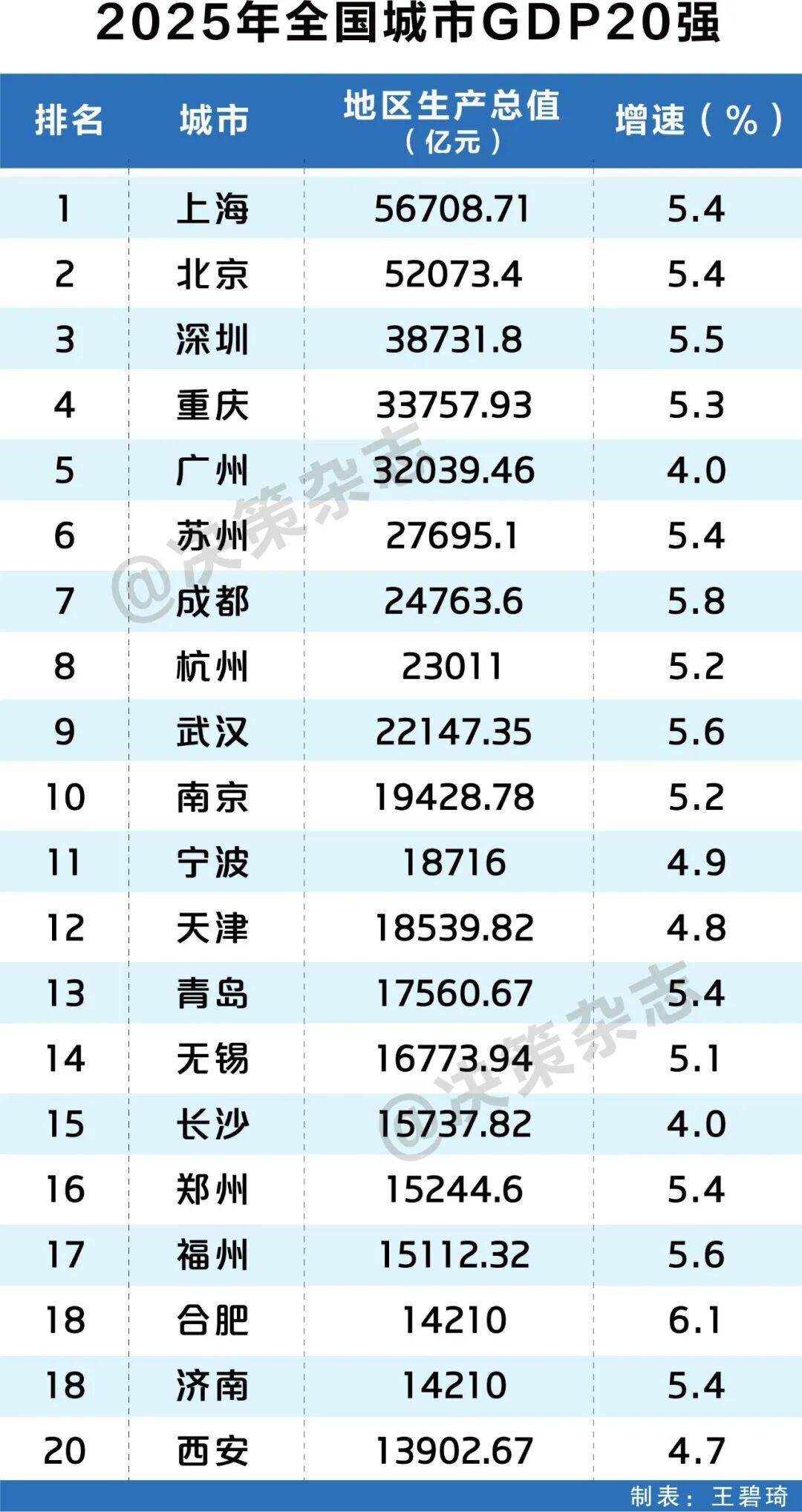
Core Insights - The latest GDP rankings reveal that Shanghai maintains its leading position with an economic total of 56,708.71 billion yuan, while Beijing becomes China's second city to surpass the 50 trillion yuan mark [1][4] - Hefei has made significant progress, ranking 18th in the top 20 cities and achieving a growth rate of 6.1%, the highest among these cities [1][12] GDP Rankings and Growth Rates - Shanghai: 56,708.71 billion yuan, growth rate 5.4% [2] - Beijing: 52,073.4 billion yuan, growth rate 5.4% [2] - Shenzhen: 38,731.8 billion yuan, growth rate 5.5% [2] - Chongqing: 33,757.93 billion yuan, growth rate 5.3% [2] - Guangzhou: 32,039.46 billion yuan, growth rate 4.0% [2] - Hefei: 14,210 billion yuan, growth rate 6.1% [3][12] Economic Structure and Key Industries - In Shanghai, the integrated circuit, biomedicine, and artificial intelligence sectors are projected to grow by 9.6%, with total output surpassing 2 trillion yuan [3] - Beijing's GDP is supported by key industries such as information transmission, software, IT services, finance, and industrial value-added, which together account for 51.8% of its GDP [4] - Shenzhen's new industries contribute significantly, with emerging sectors accounting for 43.0% of its GDP [5] - Chongqing's new energy vehicle sector shows a growth of 13.4%, contributing 60.9% to its industrial economy [5] Consumption and Market Dynamics - Cities with GDPs over 20 trillion yuan typically exhibit strong manufacturing bases, high-income populations, and large populations, which support rising consumption [9] - The consumption market in cities like Chengdu continues to grow, with retail sales reaching 1.14 trillion yuan [6] - The distinction of being a "trillion consumption city" is evident, with cities like Shanghai, Beijing, and Shenzhen leading the way [9] Hefei's Economic Performance - Hefei's industrial value-added grew by 17.6%, with significant contributions from sectors like computer and communication equipment manufacturing [14] - The city's total import and export volume reached 455.18 billion yuan, growing by 20.2% [15] - Fixed asset investments in advanced manufacturing and high-tech services are also on the rise, indicating a shift towards higher efficiency and growth [15]
泉州2025年GDP公布!
Xin Lang Cai Jing· 2026-02-04 12:19
Economic Overview - In 2025, the GDP of Quanzhou reached 13778.34 billion yuan, growing by 5.3% year-on-year, with a three-industry structure of 2.0:50.5:47.5 [1][16][17] Agricultural Sector - The total output value of agriculture, forestry, animal husbandry, and fishery was 494.94 billion yuan, an increase of 3.6% from the previous year [2][18] - Agricultural output value rose to 210.48 billion yuan, up 5.5%, with grain production at 52.91 million tons, increasing by 2.5% [2][18] - The fishery sector saw a production value of 178.36 billion yuan, growing by 4.7%, with significant increases in abalone (23.2%) and shrimp (18.8%) production [4][20] Industrial Sector - The industrial added value for large-scale enterprises increased by 7.0%, with key industries showing strong growth, such as paper and printing (13.4%) and machinery (11.0%) [5][21] - Private industrial enterprises saw an added value growth of 7.8%, outpacing the average growth rate [5][21] - High-tech industries also experienced growth, with electronic information increasing by 6.7% and resource recycling by 18.7% [5][21] Tertiary Sector - The added value of the tertiary industry grew by 4.7%, accounting for 47.5% of GDP, a historical high [6][22] - The wholesale and retail sector contributed significantly, with a growth of 6.1%, boosting the tertiary sector's growth by 2.2 percentage points [6][22] - Tourism thrived, with total visitors reaching 112.28 million, an increase of 11.1%, and total tourism spending rising by 11.3% [7][22] Consumer Market - The total retail sales of consumer goods reached 6416.07 billion yuan, growing by 4.1% [8][24] - Online retail sales surged by 17.8%, with significant growth in essential goods and cultural products [8][24] Investment and Construction - Fixed asset investment grew by 1.1%, with a notable increase in government infrastructure investment by 10.2% [9][25] - Private investment also rose by 5.6%, contributing positively to overall investment growth [10][26] Foreign Trade - The total foreign trade volume decreased by 12.9% to 2363.79 billion yuan, with exports down by 16.9% [11][27] - The export of mechanical and electrical products reached 307.09 billion yuan, accounting for 18.6% of total exports [11][27] Fiscal and Financial Overview - The total public budget revenue was 991.60 billion yuan, increasing by 1.7%, with a focus on social welfare spending [13][28] - Financial institutions reported a growth in loans by 6.4%, with significant increases in sectors like leasing and business services [13][28] Income and Prices - The per capita disposable income reached 54858 yuan, growing by 5.1%, with rural income growth outpacing urban [14][29] - Consumer prices rose by 1.0%, with most categories experiencing price increases [15][30]
联想申请信息处理方法专利,实现不同维度特征向语言模型的有效输入
Jin Rong Jie· 2026-02-04 11:38
Group 1 - Lenovo (Beijing) Co., Ltd. has applied for a patent titled "An Information Processing Method, Module Determination Method, and Information Processing Device," with publication number CN121457525A, and the application date is October 2025 [1] - The patent abstract reveals a method that includes obtaining a first input feature, which can be one of text, image, video, or audio features, with dimensions differing from the first language model [1] - The method involves converting the first input feature into first probability information, which represents the probability distribution of vectors in a predefined vector set, and then determining a second input feature based on this probability information [1] Group 2 - Lenovo (Beijing) Co., Ltd. was established in 1992 and is located in Beijing, primarily engaged in the manufacturing of computers, communications, and other electronic devices [2] - The company has a registered capital of 565 million HKD and has invested in 108 enterprises, participated in 5,000 bidding projects, and holds 1,743 trademark records and 5,000 patent records [2] - Additionally, the company possesses 238 administrative licenses [2]

博时市场点评2月4日:两市涨跌不一,沪指重返4100点
Xin Lang Cai Jing· 2026-02-04 08:13
Market Overview - The Shanghai Composite Index closed at 4102.20 points, up 0.85%, while the Shenzhen Component Index rose 0.21% to 14156.27 points. The ChiNext Index fell 0.40% to 3311.51 points, and the Sci-Tech Innovation 100 Index decreased by 0.92% to 1620.23 points [4][11] - The total market turnover was 25,034.79 billion, a decrease from the previous trading day [6][12] - In the Shenwan first-level industry classification, coal, building materials, and real estate sectors led the gains, increasing by 7.58%, 3.48%, and 2.97% respectively, while media, communication, and computer sectors saw declines of 3.12%, 2.73%, and 1.70% respectively [4][11] Economic Indicators - The ISM Manufacturing Index in the U.S. unexpectedly rose from 47.9 to 52.6 in January, marking the first time in nearly a year that it entered the expansion zone, significantly exceeding market expectations [3][9] - This strong rebound may reflect a combination of inventory replenishment, demand recovery, and supply chain improvements, although its sustainability requires further data validation [3][9] Policy Developments - The Central Committee of the Communist Party of China and the State Council released the 2026 Central No. 1 Document, emphasizing the importance of food security and agricultural technology, with a target of stabilizing grain production at around 1.4 trillion jin [2][8] - The document highlights the integration of artificial intelligence with agriculture, promoting applications such as drones, IoT, and robotics, which is expected to benefit traditional agricultural sectors and open growth opportunities in agricultural technology and smart machinery [2][8] Monetary Policy - The People's Bank of China conducted a 3-month reverse repurchase operation of 800 billion, resulting in a net injection of 100 billion, marking the first increase in four months [2][9] - This action aims to maintain ample liquidity in the banking system and signals a continued supportive monetary policy stance, which may stabilize market expectations and encourage financial institutions to increase credit issuance [3][9]
融资融券周报:主要指数全部震荡调整,两融余额小幅下降-20260204
BOHAI SECURITIES· 2026-02-04 08:10
- The report does not contain any quantitative models or factors for analysis[1][3][4]





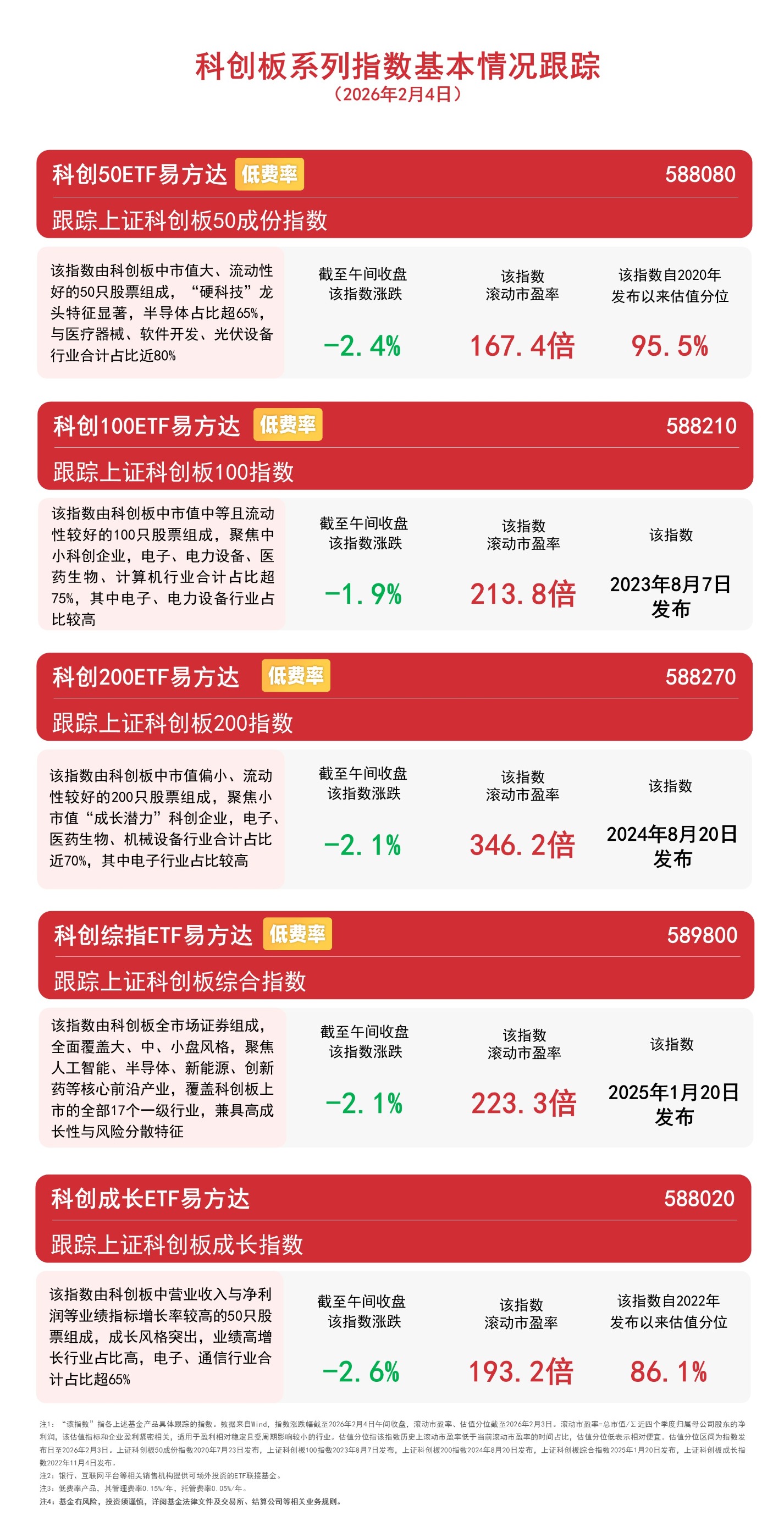
硬科技板块震荡回调,关注科创200ETF易方达(588270)、科创50ETF易方达(588080)等布局机会
Mei Ri Jing Ji Xin Wen· 2026-02-04 05:47
Group 1 - The article discusses the performance and characteristics of various ETFs tracking the STAR Market indices, highlighting their focus on high-tech sectors such as semiconductors, medical devices, and software development [2][3] - The STAR 50 ETF tracks the STAR 50 Index, which consists of 50 stocks with large market capitalization and good liquidity, with over 65% of its composition in semiconductors and nearly 80% in hard technology sectors [2] - The STAR 100 ETF focuses on 100 medium-cap stocks, with over 75% of its composition in electronics, power equipment, and pharmaceutical industries [2] - The STAR 200 ETF targets 200 small-cap stocks, emphasizing growth potential, with significant representation from electronics, biomedical, and machinery sectors [2] - The STAR Composite Index ETF covers all market segments and focuses on core industries such as artificial intelligence, semiconductors, and innovative pharmaceuticals, encompassing all 17 primary industries listed on the STAR Market [3] - The STAR Growth ETF includes 50 stocks with high growth rates in revenue and net profit, with over 65% of its composition in the electronics and communications sectors [3] Group 2 - As of the midday close on February 4, 2026, the STAR 50 Index showed a decline, while the STAR 100 Index had a rolling P/E ratio of 213.8 times, and the STAR 200 Index had a rolling P/E ratio of 167.4 times [2] - The STAR Composite Index had a rolling P/E ratio of 223.3 times, and the STAR Growth Index had a rolling P/E ratio of 193.2 times, indicating varying levels of valuation across these indices [3] - The article notes that the STAR Market indices have been established at different times, with the STAR 50 Index launched on July 23, 2020, the STAR 100 Index on August 7, 2023, the STAR 200 Index on August 20, 2024, and the STAR Composite Index on November 4, 2022 [3]
重要!一边是“煤飞色舞”,一边是“科技退潮”,发生了什么?
Sou Hu Cai Jing· 2026-02-04 04:54
Core Viewpoint - The A-share market is experiencing a classic structural market scenario driven by policy guidance, capital preferences, and market sentiment, with a clear divergence between sectors [1] Market Overview - The Shanghai Composite Index closed flat at 4067.67 points, while the Shenzhen Component Index fell by 0.92%, the ChiNext Index dropped by 1.74%, and the STAR 50 Index plummeted by 2.44%, indicating a "strong Shanghai, weak Shenzhen" pattern [1] - Total trading volume reached 1.62 trillion yuan, showing a slight increase, reflecting significant divergence between bulls and bears at current levels [1] Sector Performance - The gainers were predominantly traditional cyclical and stable growth sectors: coal (+6.32%), transportation (+2.34%), real estate (+1.76%), and building materials (+1.75%) [1] - The decliners were entirely from the technology growth sector: media (-3.70%), telecommunications (-3.19%), computers (-2.61%), and electronics (-2.32%) [1] Driving Factors of Market Divergence - **Policy Catalysts**: The central government's focus on "energy security" and "modern industrial construction" has boosted the coal sector, while local governments' commitment to growth has positively impacted the real estate and transportation sectors [2] - **Capital Flows**: There is a clear trend of "risk aversion" and "seeking stability," with new and existing funds moving towards high dividend, stable performance sectors benefiting from policy support, such as coal [2] - **External Market Influence**: The decline of the Hang Seng Tech Index by 2.29% has affected A-shares, particularly in the TMT sector, due to global concerns over AI technology disrupting traditional business models [3] Coal Sector Insights - The rise of the coal sector is not merely a rebound from oversold conditions; it reflects a strategic shift towards being a "stabilizer" and "modern industrial foundation" under the "energy security" framework, potentially leading to a revaluation of the sector [3] - The coal sector's low valuation and high cash flow characteristics make it a preferred defensive allocation in an uncertain market, with today's surge reflecting market premium on this "certainty" [3] Future Market Outlook - The current divergence in the market is unlikely to end quickly, with a shift from a broad-based "beta market" to a focus on individual stocks and niche sectors, indicating an "alpha market" approach [3] Investment Opportunities - Two areas to focus on include sectors driven by "policy bottom" and "dividend yield," such as energy and core infrastructure operators, which offer good safety margins [4] - Additionally, sectors with confirmed industry trends and recent policy details, like aerospace and hydrogen energy, may emerge as leading growth stocks [4]
京东方取得显示控制电路专利实现细腻降频操作
Sou Hu Cai Jing· 2026-02-04 03:42
Group 1 - The core point of the article is that BOE Technology Group Co., Ltd. has obtained a patent for "Display Control Circuit, Method, Display Panel, and Display Device," with the authorization announcement number CN116504181B, and the application date is February 2023 [1] Group 2 - BOE Technology Group Co., Ltd. was established in 1993 and is located in Beijing, primarily engaged in the manufacturing of computers, communications, and other electronic devices. The registered capital is approximately 37.41 billion RMB [1] - The company has invested in 73 enterprises and participated in 303 bidding projects. It holds 775 trademark records and 5,000 patent records, along with 47 administrative licenses [1] Group 3 - Chengdu BOE Optoelectronics Technology Co., Ltd. was established in 2007 and is located in Chengdu, primarily engaged in the manufacturing of instruments and meters. The registered capital is approximately 2.5 billion RMB [1] - Chengdu BOE has participated in 922 bidding projects and holds 5,000 patent records, along with 524 administrative licenses [1]
