半导体

Search documents
美光盈利远超预期,但股价大跌
半导体芯闻· 2026-03-19 10:19
Core Viewpoint - Micron Technology's latest quarterly revenue nearly tripled, significantly exceeding analyst expectations, yet its stock price fell over 4% in after-hours trading [1] Group 1: Financial Performance - The company's non-GAAP earnings per share reached $12.20, surpassing Wall Street's expectation of $9.31 [1] - Revenue grew by 194% to $23.86 billion, exceeding the market's forecast of $20.7 billion [1] - Net profit for the quarter was $13.78 billion, compared to $1.58 billion in the same period last year [1] Group 2: Market Demand and Supply - The surge in demand for memory chips, particularly for AI workloads driven by NVIDIA's GPUs, has significantly boosted Micron's performance [1][2] - Micron is one of only three memory chip manufacturers globally, with the other two being Samsung and SK Hynix [2] - The company anticipates continued benefits from strong market demand, projecting earnings per share of $19.15 and revenue of $33.5 billion for the current quarter, well above previous forecasts [2] Group 3: Product and Technology Focus - Micron has shifted much of its production capacity towards high-bandwidth memory (HBM) products, which are primarily used in AI servers [3] - The gross margin increased from 37% in the same quarter last year to 74% this quarter, reflecting a 56% quarter-over-quarter growth [3] - Micron's cloud storage revenue surged by 160% to $7.75 billion, while its mobile and client segment revenue grew from $2.24 billion to $7.71 billion [3] Group 4: Strategic Contracts and Future Outlook - Traditionally viewed as a commodity, memory chip manufacturers like Micron are now signing longer-term contracts to secure supply amid shortages [4] - The CEO emphasized that as AI evolves, computing architectures will increasingly rely on memory, positioning Micron as a key beneficiary in the AI sector [4] Group 5: Capital Expenditure and Expansion Plans - Micron began mass production of its latest HBM4 memory products and plans to increase production of the next-generation HBM4e by 2027 [5] - The company expects significant growth in capital expenditures, with over $10 billion allocated for new manufacturing facilities to meet AI demand [5] - New manufacturing plants are under construction in Idaho and New York, with the New York facility projected to cost $100 billion and begin operations around 2028 [5]


马斯克建晶圆厂,将豪掷450亿美元
半导体芯闻· 2026-03-19 10:19
如果您希望可以时常见面,欢迎标星收藏哦~ 特斯拉(Tesla Inc.)首席执行官马斯克(Elon Musk、见图)再度抛出震撼弹,上周末预告7天内将启 动名为「Terafab」的晶圆厂兴建计划。业界传出,为确保自驾计程车与人型机器人「Optimus」 的芯片供应无虞,马斯克有意打破业界与晶圆代工厂合作的惯例,挑战「自行建置」晶圆厂。分析 师警告,这项艰巨的任务恐耗资最多450亿美元。 Barron`s 、 Sherwood News 报 导 , 摩 根 士 丹 利 (Morgan Stanley 、 通 称 大 摩 ) 分 析 师 Andrew Percoco 16 日 发 布 报 告 指 出 , 根 据 团 队 最 近 跟 公 司 的 对 话 , Terafab 计 划 的 核 心 跟 地 缘 政 治 与 Optimus有关。随着特斯拉冲刺Optimus机器人(长期目标年产逾1亿台),对芯片的需求将从目前的 水平喷涨50倍以上,每年需要超过2亿颗芯片。 Percoco指出,马斯克倾向「内部自行制造」而非委外代工,主要是因为地缘政治风险及对AI算力 瓶颈的担忧。管理层预期,AI运算能力可能在未来3~4年内面 ...

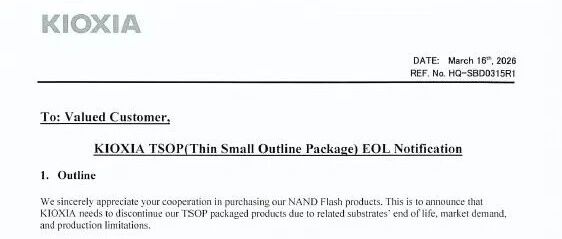
突发!铠侠发布停产通知!
是说芯语· 2026-03-19 09:53
Core Viewpoint - Kioxia has announced the discontinuation of Thin Small Outline Package (TSOP) products, primarily affecting low-capacity MLC NAND flash, indicating a strategic shift away from MLC production due to economic inefficiencies [2][6]. Group 1: Production and Supply Chain - Kioxia's TSOP products, which include low-capacity MLC NAND, will cease production due to limitations in manufacturing capacity and materials [6]. - The last time buy forecast is set for May 30, 2026, with final orders due by September 15, 2026, and last shipments expected by March 15, 2027 [4][6]. - The company is focusing resources on more profitable NAND types like TLC and QLC, leading to a significant reduction in MLC production [6]. Group 2: Market Impact and Trends - The global MLC NAND flash capacity is projected to decrease by 41.7% in 2026, exacerbating supply-demand imbalances [7]. - As major manufacturers exit the MLC market, prices for low-capacity eMMC are expected to rise sharply, driven by reduced supply [7]. - If Kioxia stops low-capacity MLC production, Winbond may become the sole supplier of low-capacity eMMC after 2028, with expectations of a 36-fold increase in MLC/TLC shipments from 2025 to 2027 and a 7.5-fold increase in average selling price per gigabyte [7].
一纸决议,带崩全球!
格隆汇APP· 2026-03-19 09:37
Core Viewpoint - The article discusses the implications of the recent Federal Reserve meeting, highlighting a shift in market expectations regarding interest rates and inflation, which could lead to significant impacts on various asset classes, particularly in the context of geopolitical tensions and economic uncertainty [2][7][10]. Group 1: Federal Reserve Decisions - The Federal Reserve's decision to maintain interest rates has been perceived as hawkish, with a notable increase in inflation expectations [10][11]. - The median projection indicates one potential rate cut of 25 basis points this year, but seven officials predict no cuts, reflecting a significant shift in market sentiment [12][14]. - The PCE inflation forecast for 2026 has been raised from 2.4% to 2.7%, influenced by geopolitical factors and previous tariff policies, indicating a structural rather than temporary inflation [16][17]. Group 2: Market Reactions - Following the Fed's decision, major indices in Asia experienced declines, with the Hang Seng Index dropping by 2.05% and the Nikkei 225 falling by 3.38% [6]. - The high interest rates are expected to pressure high-valuation tech stocks, particularly those in the AI sector, as their discounted cash flow models become less favorable [22][24]. - The anticipated liquidity boost from potential rate cuts has been replaced by a tightening environment, leading to a prolonged period of market correction and differentiation among asset classes [26][27]. Group 3: Asset Class Implications - The strong dollar is likely to regain its status as a safe haven, with the DXY index rising above 100, driven by prolonged high interest rates in the U.S. compared to other currencies [30][32]. - Gold prices have seen a short-term decline due to rising real interest rates, although long-term geopolitical tensions may provide a support base for gold as a safe-haven asset [34][35]. - Oil prices have surged above $110 due to escalating tensions in the Middle East, which could further entrench inflation expectations and create a challenging economic environment reminiscent of the 1970s stagflation [36][39]. Group 4: Investment Strategies - Investors are advised to focus on defensive strategies amid liquidity contraction and macroeconomic volatility, prioritizing assets with strong cash flows and dividends [42][48]. - High-growth tech stocks, particularly those lacking earnings support, should be avoided, as they are likely to face significant valuation corrections [45]. - The article emphasizes the importance of maintaining a rational mindset during periods of market turmoil, suggesting that patience and discipline are crucial for navigating the current investment landscape [49][50].

太空AI芯片或迎来突破
财联社· 2026-03-19 08:56
Core Viewpoint - A South Korean research team has confirmed the potential application value of a key component called "synaptic transistor" for next-generation AI chips in high-radiation space environments, marking a significant advancement in semiconductor technology for extreme conditions [3][4]. Group 1: Research and Development - The research project was a collaboration between the Korea Atomic Energy Research Institute, Chungbuk National University, and Belgium's IMEC, funded by the South Korean Ministry of Science and ICT [3]. - The project achieved breakthrough progress by using indium gallium zinc oxide (IGZO) to manufacture the synaptic transistor, which was tested with a proton accelerator [3]. Group 2: Testing and Results - The synaptic transistor withstood irradiation from a 33 MeV high-energy proton beam, equivalent to the radiation exposure of 20 years in space, surpassing the typical lifespan of low Earth orbit satellites (5 to 15 years) [3]. - Despite some performance degradation, such as reduced drive current, the core functions of switching operation and synaptic plasticity remained stable [3][4]. Group 3: Implications and Future Development - The results confirm the feasibility of applying this technology to space-grade AI semiconductors, representing the first verification of such technology globally [4]. - The South Korean Ministry of Science and ICT stated that this achievement indicates the reliability of AI systems operating in extreme environments, and they will continue to develop core technologies for AI chips designed for the aerospace industry to enhance Korea's technological independence [5].
AI的Memory时刻9:GTC存储原厂集中展示新品,存储景气预期再升温
GF SECURITIES· 2026-03-19 08:44
Investment Rating - The report provides a "Buy" rating for the industry, indicating an expectation of stock performance exceeding the market by more than 10% over the next 12 months [31]. Core Insights - The storage manufacturers showcased new products at GTC, enhancing the positive outlook for the storage industry. Micron, SK Hynix, Samsung, and Kioxia presented advanced AI memory solutions, indicating a strong demand driven by AI applications [3][25]. - The industry cycle outlook is increasingly optimistic, with expectations of storage shortages continuing until 2030, potentially exceeding a 20% gap due to sustained AI demand [3][21]. - The report emphasizes the growing importance of upstream infrastructure related to AI memory, suggesting that investors should focus on key beneficiaries within the industry chain [3][25]. Summary by Sections 1. New Product Lineup from Storage Manufacturers - Micron began mass shipments of 36GB 12Hi HBM4 for Vera Rubin in Q1 2026, supporting 11Gb/s pin speeds and over 2.8TB/s bandwidth. They also showcased 48GB 16Hi HBM4 samples and mass production of PCIe Gen6 SSDs optimized for AI workloads [3][11]. - SK Hynix displayed HBM4, HBM3E, and SOCAMM2 solutions, along with a liquid-cooled eSSD developed in collaboration with NVIDIA [3][14]. - Samsung introduced HBM4 and HBM4E, with the latter supporting 16Gb/s pin speeds and 4.0TB/s bandwidth, indicating advancements in AI storage solutions [3][19]. - Kioxia presented the GP Series Super High IOPS SSD for NVIDIA Storage-Next architecture, with samples expected by the end of 2026 [3][25]. 2. Industry Cycle Outlook - The outlook for the industry is becoming more positive, with SK Group's chairman indicating that storage shortages driven by AI demand are expected to persist until 2030, reinforcing the view of a tight supply situation [3][21]. 3. Investment Recommendations - The report suggests that as AI memory continues to expand the capabilities of models and applications, the value and importance of related upstream infrastructure will increase. Investors are advised to focus on key beneficiaries within the industry chain [3][25].
腾讯、快手、阿里、百度,集体大跌
Di Yi Cai Jing· 2026-03-19 08:37
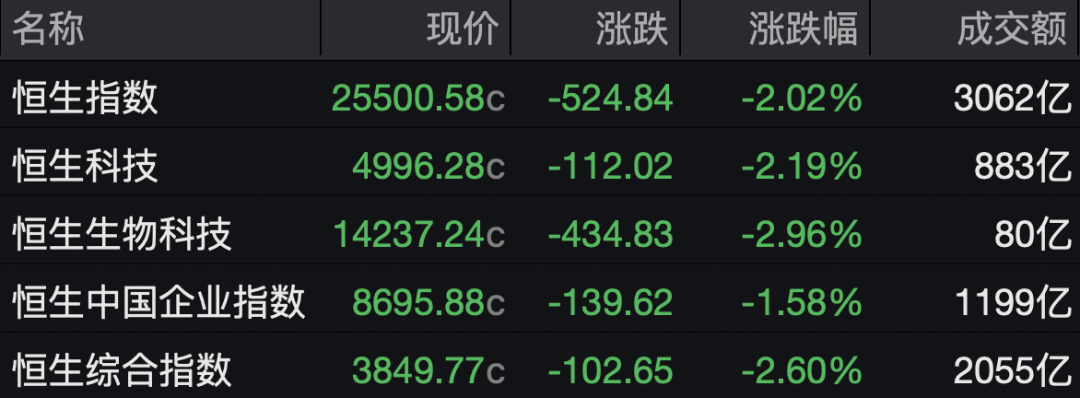
Market Overview - The Hong Kong stock market experienced a significant decline on March 19, with the Hang Seng Index dropping by 2.02% and the Hang Seng Tech Index falling by 2.19% [1][7] - Southbound capital recorded a net inflow of over 26 billion HKD [1] Index Performance - Hang Seng Index closed at 25,500.58, down 524.84 points, with a trading volume of 306.2 billion HKD [2][7] - Hang Seng Tech Index ended at 4,996.28, down 112.02 points, with a trading volume of 88.3 billion HKD [2][7] - Hang Seng Biotech Index fell by 2.96%, closing at 14,237.24 with a trading volume of 8 billion HKD [2][7] - Hang Seng China Enterprises Index decreased by 1.58%, closing at 8,695.88 with a trading volume of 119.9 billion HKD [2][7] - Hang Seng Composite Index dropped by 2.60%, closing at 3,849.77 with a trading volume of 205.5 billion HKD [2][7] Major Stock Movements - Major tech stocks saw significant declines, with Tencent Holdings and Kuaishou both dropping over 6%, and Alibaba falling over 4% [2][7] - Other notable declines included Huahong Semiconductor and Bilibili, both down over 5%, and Baidu and SMIC, both down over 3% [2][7] Specific Stock Performance - Tencent Music fell by 8.05% to 41.12 HKD [3][8] - Tencent Holdings decreased by 6.81% to 513.00 HKD [3][8] - Kuaishou dropped by 6.19% to 55.35 HKD [3][8] - Alibaba fell by 4.14% to 132.00 HKD [3][8] - MiniMax saw a significant drop of 13.89% to 1,066.00 HKD, while Zhiyuan fell by 11.25% to 659.00 HKD [4][9] Sector Performance - The large model concept stocks experienced a pullback, with MiniMax and Zhiyuan leading the declines [4][9] - The non-ferrous metal sector also faced substantial losses, with the WanGuo Gold Group dropping over 19% [5][10] - Other companies in the non-ferrous metal sector, such as Lingbao Gold and Long Resources, also saw declines exceeding 10% [5][10] New Listings - Lantu Automotive's stock fell by 13.2% on its first trading day, closing at 6.51 HKD per share [6][11]

美光科技:指引FY26Q3毛利率将超80%-20260319
SINOLINK SECURITIES· 2026-03-19 08:24
Investment Rating - The report maintains a "Buy" rating for the company, indicating a positive outlook for the stock over the next 6-12 months [5]. Core Insights - The company reported significant revenue growth in FY26Q2, achieving $23.86 billion, a year-over-year increase of 196% and a quarter-over-quarter increase of 75% [2]. - The GAAP gross margin for FY26Q2 was 74.4%, reflecting a year-over-year increase of 37.6 percentage points and a quarter-over-quarter increase of 18.4 percentage points [2]. - The company expects FY26Q3 revenue to be approximately $33.5 billion, with gross margins around 81% [2]. - The demand for data center storage is rapidly increasing, with expectations that by the end of 2026, data center DRAM and NAND demand will exceed 50% of the total market [3]. - The company is increasing its capital expenditures, projecting over $25 billion for FY26, with further increases expected in FY27 to support HBM and DRAM capacity investments [4]. Summary by Sections Performance Review - FY26Q2 revenue reached $23.86 billion, with GAAP net profit of $13.78 billion, marking a year-over-year increase of 771% [2]. - Non-GAAP net profit for FY26Q2 was $14.02 billion, up 686% year-over-year [2]. Operational Analysis - DRAM revenue for FY26Q2 was $18.8 billion, up 207% year-over-year, with prices increasing approximately 65% quarter-over-quarter [3]. - NAND revenue was $5 billion, reflecting a 169% year-over-year increase, with prices rising 75-80% quarter-over-quarter [3]. - The company is making progress with HBM products, with HBM4 expected to ramp up production in 2027 [3]. Profit Forecast and Valuation - The company is projected to achieve GAAP net profits of $60.71 billion, $128.37 billion, and $171.06 billion for FY26, FY27, and FY28, respectively [5]. - The expected revenue growth rates for FY26 to FY28 are 195.7%, 81.9%, and 27.9% [10].
美光FY26Q2跟踪报告:FY26Q2业绩超预期,上修FY26Capex至超250亿美元
CMS· 2026-03-19 07:21
Investment Rating - The report maintains a positive investment rating for the semiconductor industry, particularly highlighting Micron's strong performance and growth potential in the memory and storage sectors. Core Insights - Micron's FY26Q2 results exceeded expectations with revenue of $23.86 billion, a year-over-year increase of 196% and a quarter-over-quarter increase of 75%. The gross margin reached 74.9%, up 37 percentage points year-over-year and 18.1 percentage points quarter-over-quarter, driven by rising product prices and improved product mix [1][2][3]. Summary by Sections Financial Performance - Micron's revenue for FY26Q2 was $23.86 billion, significantly above the previous guidance of $18.3-19.1 billion. The operating profit margin was 69.0%, reflecting a 44 percentage point increase year-over-year and a 22 percentage point increase quarter-over-quarter [2][3]. - The company reported a record free cash flow and reduced debt levels, with a net cash position reaching an all-time high [31][42]. Product Segmentation - DRAM revenue was $18.8 billion, up 207% year-over-year and 74% quarter-over-quarter, while NAND revenue was $5 billion, up 169% year-over-year and 82% quarter-over-quarter. Both segments benefited from tight supply conditions and improved pricing [3][32]. - The cloud storage segment (CMBU) generated $7.749 billion, the core data center segment (CDBU) generated $5.687 billion, and the mobile and client segment (MCBU) generated $7.711 billion, all achieving record revenues [3][34]. Future Guidance - For FY26Q3, Micron expects revenue to be approximately $33.5 billion, with a gross margin of around 81%. This guidance reflects a year-over-year increase of 260% and a quarter-over-quarter increase of 40% [4][44]. - The company has raised its FY26 capital expenditure forecast to exceed $25 billion, primarily driven by investments in cleanroom facilities [4][30]. Strategic Developments - Micron has signed its first five-year Strategic Customer Agreement (SCA), enhancing business visibility and stability. This agreement differs from traditional long-term agreements by including multi-year commitments [5][16]. - The company is advancing its technology with the successful production of HBM4 and plans to increase R&D investments significantly in FY27 to capitalize on AI-driven demand [5][17][20]. Market Outlook - The total addressable market (TAM) for data center DRAM and NAND is expected to exceed 50% of the overall industry TAM in 2026, driven by AI demand [19][26]. - Micron anticipates that DRAM and NAND bit shipments will grow by low double digits and approximately 20%, respectively, in 2026, despite supply constraints [26][28].
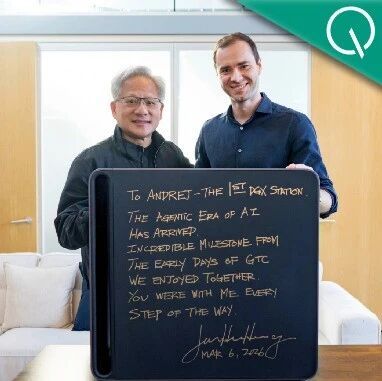
英伟达首台DGX GB300,老黄亲自登门送给他
量子位· 2026-03-19 07:09
Core Viewpoint - The article discusses the significance of NVIDIA's CEO Jensen Huang personally delivering the first DGX Station (GB300) to Andrej Karpathy, highlighting the rise of individual developers in the AI era and the importance of computational power in the ongoing AI model competition [1][9][58]. Group 1: Delivery of DGX Station - Huang's delivery of the DGX Station to Karpathy symbolizes a milestone in the AI era, marking the emergence of personal developers as key players [1][9]. - This event is reminiscent of Huang's previous deliveries, such as the first DGX-1 to OpenAI, which played a crucial role in the deep learning revolution [8][39]. - The DGX Station (GB300) is designed for individual developers, providing data center-level AI computing power in a compact form [28][30]. Group 2: Significance of Individual Developers - Karpathy is recognized as a representative of individual developers, transforming AI from a corporate domain to a system manageable by individuals [17][19]. - His recent work focuses on creating systems that allow a single person to complete the entire process from idea to product [18][19]. - The choice of Karpathy for this delivery underscores the shift towards distributed computing and the importance of individual contributions in the AI landscape [58][61]. Group 3: Technical Specifications of DGX Station - The DGX Station (GB300) features 748GB of unified memory and 20 PFLOPS of computing power, enabling the execution of large-scale AI models [30]. - It allows seamless migration of local projects to cloud environments, addressing the need for continuous AI operation [31][32]. - The system is tailored for developing and running AI agents, reflecting the growing trend of personal AI applications [24][34]. Group 4: Broader Implications for the Industry - Huang's actions signal a strategic move by NVIDIA to position itself as a foundational supplier in the AI model competition, emphasizing the necessity of computational resources [50][56]. - The article suggests that the future of AI development will increasingly rely on individual developers rather than large organizations, as computational power becomes more accessible [58][61]. - NVIDIA is also enhancing its infrastructure for AI agents, indicating a comprehensive approach to support developers from hardware to software [34][36].