生猪养殖

Search documents
天域生物科技股份有限公司 关于2025年度为合作养殖农户提供担保预计的进展公告
Zhong Guo Zheng Quan Bao - Zhong Zheng Wang· 2025-12-17 23:37
登录新浪财经APP 搜索【信披】查看更多考评等级 本公司董事会及全体董事保证本公告内容不存在任何虚假记载、误导性陈述或者重大遗漏,并对其内容 的真实性、准确性和完整性承担法律责任。 重要内容提示: 2022年12月,公司与湖北枝江农村商业银行股份有限公司(以下简称"枝江农商行")签署《最高额保证 合同》,为养殖农户冯应良、刘以梅与枝江农商行截止2026年1月前连续签订的借款合同提供连带责任 保证担保。现上述信贷业务即将到期,为满足优质养殖农户开展合作养殖经营性资金需要,公司拟继续 为养殖农户冯应良、刘以梅与枝江农商行连续签订的借款合同下所形成的债务提供连带责任保证担保, 担保债权最高额为人民币240.00万元,担保债权发生期间为2025年12月17日至2028年12月17日,担保期 间自主合同项下的借款期限届满或借款展期后届满之次日起三年。 近日,公司与枝江农商行续签了《最高额保证合同》。本保证合同项下养殖农户冯应良、刘以梅通过公 司担保获得的贷款资金专款专用,专项用于支付公司控股子公司保证金。 (二)内部决策程序 公司分别于2025年01月06日、01月22日召开第四届董事会第三十五次会议和2025年第一次 ...

2026年农林牧渔年度策略:时机等待,攻守并进
2025-12-17 15:50
Summary of Conference Call Records Industry Overview - The agricultural sector has shown a slight increase above the CSI 300 index from the beginning of the year to mid-November 2025, ranking 13th among 31 primary industries in the Shenwan classification, an improvement from 2024 [2][20] - The performance of sub-industries is mixed, with animal health and agricultural product processing performing well, while breeding, feed, and planting lag behind [1][3] Key Investment Focus for 2026 - The primary investment focus remains on the pig farming and pet food sectors. The pig farming sector's opportunities arise from changes in production capacity affecting pig price expectations, while the pet food sector benefits from growing market demand and increased market share [1][5] - The expected average price for pigs in 2026 is projected to decline to 13.5 yuan per kilogram due to increased supply pressure and potential fluctuations in prices during January and February [1][7][10] Sub-Industry Performance Pig Farming Sector - The pig farming sector experienced a low-level rebound followed by a plateau in 2025, with an overall index increase of approximately 14.4%. Most listed pig companies turned profitable from Q2 2024 and maintained profitability in Q3 2025, although some may incur losses in Q4 [6] - The market share of listed pig companies reached 26.8%, an increase of 5.6 percentage points year-on-year [6] - The forecast for 2026 indicates an annual pig output increase, with the breeding sow capacity expected to decrease by 430,000 heads [6][7] Pet Food Sector - The pet food sector is experiencing a transition towards emotional and anthropomorphic pet ownership, with the market size in China reaching 300 billion yuan, where pet food accounts for 53% [3][11][13] - The growth of domestic mid-to-high-end brands is outpacing that of imported brands, driven by rational consumption [3][13] - The online sales channel for pet food has grown significantly, with projections indicating it will reach 72% market share by 2026 [15] Market Dynamics and Trends - The pet food market is characterized by low concentration, with the top five companies holding only 25.4% market share, indicating significant room for growth for domestic brands [14] - The online sales of domestic brands have increased, with brands like Mai Fu Di showing substantial growth in market share [17] - The export growth of pet food remains a critical performance driver, despite challenges from tariffs [8][11][12] Future Outlook - The agricultural sector is expected to enter a plateau phase after a period of low-level fluctuations, with valuations still at historical lows [20] - The pig farming sector will focus on balancing risks and opportunities, while the pet food sector will need to wait for performance growth to capture new investment opportunities [20]
资产配置日报:坚守的回报-20251217
HUAXI Securities· 2025-12-17 15:26
Market Performance - On December 17, both stock and bond markets experienced significant gains, with the CSI A500 and CSI 300 indices seeing substantial inflows[1] - The total trading volume for the entire A-share market reached 1.83 trillion yuan, an increase of 86.3 billion yuan compared to December 16[1] - The Hang Seng Index rose by 0.92%, while the Hang Seng Tech Index increased by 1.03%[1] ETF Activity - Stock ETFs saw a notable increase in trading volume, with a total of 94.2 billion yuan traded, up by 12.3 billion yuan from the previous day[2] - ETFs tracking the CSI A500 led the volume increase with 7.8 billion yuan, followed by CSI 300 and ChiNext ETFs with 2 billion yuan and 1.1 billion yuan respectively[2] Market Sentiment - The market sentiment improved significantly, supported by policy signals aimed at stabilizing market expectations[2] - The strong market rebound confirmed the effectiveness of the belief in market resilience, suggesting that stability measures will continue to positively impact the market[2] Bond Market Dynamics - The bond market showed a strong recovery, with long-term and ultra-long-term interest rates declining, driven by clearer supply expectations for 2026[4] - By the end of the day, the yields on 10-year and 30-year government bonds fell by 1.7 basis points and 4.6 basis points, respectively, to 1.84% and 2.23%[4] Capital Flows - Southbound capital inflows into Hong Kong stocks reached a new high for December, totaling 7.9 billion HKD, indicating increased interest in Hong Kong equities[3] - The inflow was particularly strong in Xiaomi and Meituan, with net inflows of 1.063 billion HKD and 751 million HKD, respectively[1] Commodity Market Trends - Precious metals and new energy sectors led the commodity market recovery, with gold and silver prices rising by 0.42% and 5.05% respectively[6] - Lithium carbonate surged by 7.61%, driven by policy news and supply-side expectations, while polysilicon also saw an increase of 4.36%[7] Risk Considerations - The report highlights potential risks, including unexpected adjustments in monetary policy and liquidity changes that could impact market stability[9] - Investors are advised to remain cautious of regulatory risks and profit-taking in the context of heightened market volatility[8]
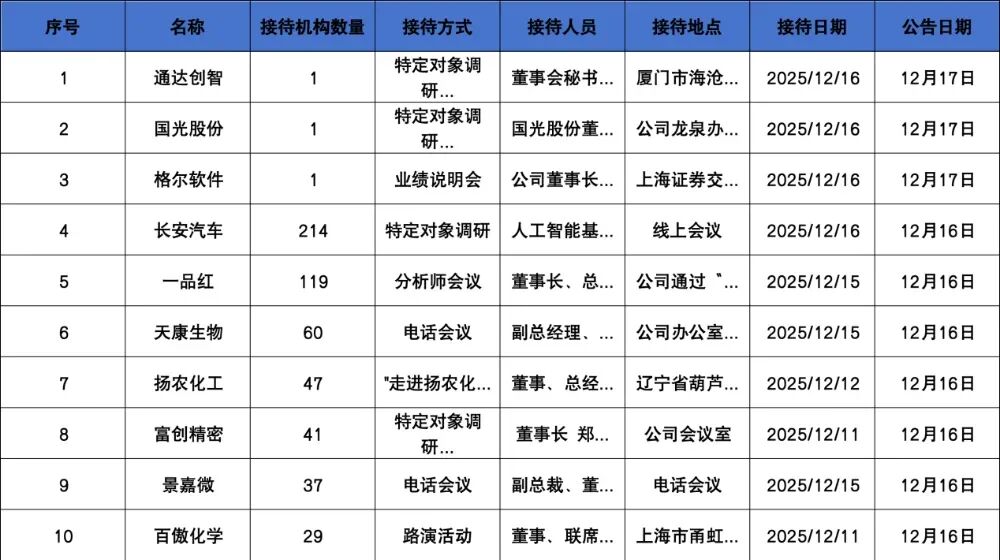
调研汇总:易方达、中欧、富国基金等214家明星机构调研长安汽车!
Xin Lang Cai Jing· 2025-12-17 14:20
| 序号 | 名称 | 接待机构数量 | 接待方式 | 接待人员 | 接待地点 | 接待日期 | 公告日期 | | --- | --- | --- | --- | --- | --- | --- | --- | | 1 | 通达创智 | 1 | 特定对象调 研 ... | 董事会秘书 ... | 厦门市海沧 ... | 2025/12/16 | 12月17日 | | 2 | 国光股份 | 1 | 特定对象调 | 国光股份董 ... | 公司龙泉办 ... | 2025/12/16 | 12月17日 | | | | | 研 ... | | | | | | 3 | 格尔软件 | 1 | 业绩说明会 | 公司董事长 ... | 上海证券交 ... | 2025/12/16 | 12月17日 | | 4 | 长安汽车 | 214 | 特定对象调研 | 人工智能基 ... | 线上会议 | 2025/12/16 | 12月16日 | | 5 | 一品红 | 119 | 分析师会议 | 董事长、总 ... | 公司通过" ... | 2025/12/15 | 12月16日 | | 6 | 天康生物 | 60 | 电话会议 ...


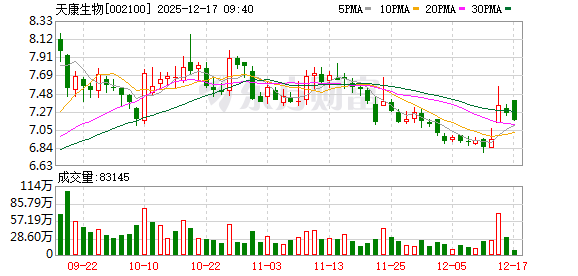
天康生物(002100):新疆农牧全产业链企业,养殖扩张降本中,饲料动保稳发展
Shenwan Hongyuan Securities· 2025-12-17 12:14
Investment Rating - The report initiates coverage with a "Buy" rating for the company [1][7]. Core Views - The company is a key player in the agricultural and animal husbandry industry in Xinjiang, with a comprehensive business model covering feed production, animal health, pig farming, and protein oil processing. It ranks among the top 20 in pig farming and feed production in China [4][17]. - Despite a downturn in the pig farming industry, the company managed to achieve a revenue of 13.61 billion yuan in the first three quarters of 2025, reflecting a year-on-year growth of 4%, and a net profit of 412 million yuan [4][24]. - The report emphasizes the dual catalysts of fundamental and policy factors driving the pig farming sector, suggesting a left-side investment opportunity as the industry undergoes capacity adjustments [6][32]. Summary by Sections 1. Company Overview - The company is a state-owned enterprise under the Xinjiang Production and Construction Corps, established in 1993, and has expanded its operations to include various segments of the agricultural industry [17][18]. - It has a strong market position, being one of the eight designated producers of foot-and-mouth disease vaccines in China [4][17]. 2. Pig Farming Sector - The report notes that the pig farming sector is experiencing a decline in profitability, with the average price of pigs dropping from 15-16 yuan/kg at the beginning of 2025 to around 11-12 yuan/kg by December 2025 [32][39]. - The company is expected to face further losses in the coming quarters due to ongoing supply pressures and market conditions [41][42]. 3. Business Growth and Cost Optimization - The company is focusing on both internal growth through cost optimization and external growth via acquisitions, such as the recent purchase of Qiangdu Livestock [6][55]. - The report highlights that the company’s pig output has been steadily increasing, with a projected output of 302.85 million pigs in 2024, reflecting a year-on-year growth of 7.6% [56][60]. 4. Financial Projections and Valuation - The company is projected to achieve revenues of 17.50 billion yuan in 2025, with a net profit of 660 million yuan, and further growth expected in subsequent years [5][7]. - The report estimates a target market value of 13.68 billion yuan, indicating a potential upside of approximately 38.3% from the current market capitalization [7][29]. 5. Industry Dynamics - The report discusses the broader industry context, noting that the current cycle of capacity reduction in pig farming is expected to be more pronounced than in previous years, which may lead to a stabilization of prices in the future [9][47]. - The company’s strategic positioning and operational efficiencies are expected to enhance its competitive edge in a challenging market environment [9][55].

成本护城河筑牢底气,牧原股份开启增长新周期
Mei Ri Jing Ji Xin Wen· 2025-12-17 11:29
Core Insights - The article highlights the rapid growth and competitive advantage of the company, Muyuan Foods, which has become the world's largest pig farming group over the past decade [1] - Despite a prolonged price downturn in the pig market, the company is expected to benefit from the accelerated elimination of outdated production capacity, further enhancing its cost advantages [1] Group 1: Financial Performance - In the first three quarters of 2025, Muyuan Foods sold 57.32 million pigs, a year-on-year increase of 27% [1] - The company's total breeding cost decreased to 11.6 yuan/kg by September 2025, down 1.5 yuan/kg from January [1] - The company achieved a profit in its slaughtering business in Q3 2025, with a slaughter volume of 19.16 million pigs, a 140% increase year-on-year, and an 88% capacity utilization rate [1] Group 2: Competitive Advantages - Muyuan Foods reported an average profit of 234 yuan per pig, with breeding business profits exceeding 4.8 billion yuan, showcasing its ability to remain profitable amid market challenges [2] - Key production metrics include a survival rate of 87% for pigs, a weaning-to-market survival rate of 93%, and an average of 29 weaned piglets per sow per year, all of which are industry-leading figures [2] - The company's cost advantages and comprehensive industry chain layout position it as a core investment target amid cyclical fluctuations [2] Group 3: International Expansion - Muyuan Foods has updated its Hong Kong listing application, aiming for an "A+H" dual listing to accelerate its internationalization process [3] - The company plans to establish a high-tech breeding project in Vietnam with a total investment of 3.2 billion yuan, expected to provide 1.6 million quality pigs annually [3] - The shift from technology export to physical breeding operations marks a significant step in the company's international expansion strategy [3]

华西证券:欧盟进口猪肉反倾销裁定落地 继续推荐生猪养殖板块
智通财经网· 2025-12-17 08:51
华西证券主要观点如下: 事件 商务部2025年12月16日公布对原产于欧盟的进口相关猪肉及猪副产品反倾销调查的最终裁定,最终认定 原产于欧盟的进口相关猪肉及猪副产品存在倾销,国务院关税税则委员会根据商务部的建议作出决定, 自2025年12月17日起,对原产于欧盟的进口相关猪肉及猪副产品征收反倾销税。反倾销税率为 4.9%-19.8%。 欧盟为我国重要的猪肉进口来源,前三季度进口占比超过50% 2025年前十个月,中国进口相关猪肉及猪副产品193万吨,其中从欧盟进口99万吨,占比51%,欧盟成 员国西班牙为我国第一大猪肉及副产品进口国,前十个月进口46万吨,占比24%。前三季度我国猪肉产 量4368万吨,猪肉及副产品进口量176万吨,占产量比例4%,欧盟进口91万吨,进口占比51.49%,总产 量占比2.08%,反倾销裁定落地有望部分程度缓解国内猪肉供应压力。 智通财经APP获悉,华西证券发布研报称,反倾销税落地有望部分程度缓解国内供应压力,叠加亏损推 动的主动去产能和政策引导的被动去产能同时进行,看好产能去化带来的价格反转,继续推荐生猪养殖 板块,具体标的选择方面,推荐关注成本低、低负债且有成长性的优质标的, ...

巨头刹车、散户离场,谁在“操控”猪周期?
Xin Lang Cai Jing· 2025-12-17 07:29
文|红餐网 2020年,20元/斤的猪肉令人咋舌,但到了2025年,一斤猪肉想卖到10块钱以上都很难。 今年以来,天康生物、神农集团、天邦食品已先后表示中止养猪项目,邦基科技终止了筹划中的重大资 产重组事项。而在此之前,牧原、温氏、唐人神、金新农、东瑞股份等也已宣布终止多个生猪养殖项 目。 2025年第三季度财报数据则显示,上市猪企的整体资产负债率出现回升,行业现金流压力加剧。包括牧 原、温氏、新希望六和、天邦食品等头部猪企纷纷通过降低出栏均重、禁止商品猪流入二次育肥环节、 关停猪场等方式调整产能。 相比这些养猪规模企业,传统中小养猪户的生存处境更不容乐观。由于采购体量小,散户在饲料、疫 苗、兽药等投入方面缺乏议价权,导致养殖成本更高。 湛江科技学院生猪产业研究所曾统计,2010年养一头111公斤左右的生猪,散户需要花费1250元,大规 模养殖户的成本为1164元,相差64元。到了2021年,散户的生猪出栏重量是126公斤,成本为2709元, 大规模养殖户的生猪长到了129公斤,成本却只需要2387元,每斤成本比散户低了近14%。 几年里,猪肉价格好比坐上了过山车。几倍的价差背后,其实都是猪周期在作祟。 自2 ...

欧盟进口猪肉反倾销裁定落地,推荐生猪养殖
HUAXI Securities· 2025-12-17 06:35
Investment Rating - The industry rating for pig farming is "Recommended" [1] Core Insights - The final ruling on anti-dumping duties on EU pork imports is expected to alleviate domestic supply pressure to some extent, with anti-dumping tax rates set between 4.9% and 19.8% [2][5] - The EU is a significant source of pork imports for China, accounting for over 50% of imports in the first three quarters of 2025, with Spain being the largest supplier [3] - Domestic pig prices have been persistently low, leading to increased losses for farmers, with self-breeding farmers experiencing losses for 13 consecutive weeks as of mid-December 2025 [4] Summary by Sections Event Overview - The Ministry of Commerce announced the final ruling on anti-dumping investigations against EU pork imports, confirming the existence of dumping practices [2] Analysis and Judgment - In the first ten months of 2025, China imported 1.93 million tons of pork, with 990,000 tons from the EU, representing 51% of total imports [3] - The domestic pig farming sector is undergoing both active and passive capacity reduction due to ongoing losses and policy guidance, with the number of breeding sows decreasing to below 40 million [4] Investment Recommendations - The report recommends focusing on pig farming stocks, particularly those with low costs and strong growth potential, such as: 1. Lihua Co., which has seen a continuous decline in costs since 2024, with a target cost of 12 yuan/kg by year-end [5] 2. Muyuan Foods, which maintains profitability despite low pig prices and has a strong integrated business model [5] 3. Shuanghui Development, benefiting from stable meat product sales and expected cost advantages in 2025 [5]
天康生物2026年累计生猪出栏有望突破500万头 70余家机构参加收购羌都畜牧线上交流会
Zheng Quan Shi Bao Wang· 2025-12-17 01:40
Core Viewpoint - TianKang Biological plans to acquire 51% of Qiangdu Livestock for 1.275 billion yuan, aiming for absolute control and flexible long-term development, with Qiangdu becoming a subsidiary post-acquisition [1] Group 1: Acquisition Details - The acquisition will bind the interests of the original controlling shareholder and includes a profit commitment of at least 837 million yuan over three years [1] - Qiangdu Livestock has a strong profitability record, with 1.36 million pigs expected to be sold in 2024 and over 1.5 million in 2025, maintaining profitability even during low price periods [1] Group 2: Future Projections - From 2026 to 2028, Qiangdu Livestock is projected to reach sales of 1.5 million, 1.58 million, and 1.61 million pigs respectively, with TianKang's total pig sales expected to exceed 3.2 million in 2025 [2] - Post-acquisition, TianKang's total pig sales could surpass 4 million, aiming for a target of 5 million, potentially moving from the 20th to the top 10 in national rankings [2] Group 3: Strategic Benefits - The acquisition aligns with national policies and enhances TianKang's competitive strength by integrating Qiangdu's established breeding base and technical team [3] - The merger will leverage TianKang's resources in feed research, animal vaccines, and breeding, while benefiting from Qiangdu's scale and reputation, facilitating a collaborative upgrade in operations [3] - The consolidation is expected to significantly boost TianKang's revenue and profit levels, supporting its strategic development in the pig farming industry [3]