玩具

Search documents
活力广交 | 第138届广交会第三期“美好生活”三大温度看点
Shang Wu Bu Wang Zhan· 2025-11-10 16:51
Core Insights - The 138th Canton Fair's third phase focuses on "Beautiful Life," featuring five major sectors: fashion, home textiles, toys and baby products, stationery, and health and leisure, with a total exhibition area of 515,000 square meters and approximately 25,000 booths, creating a global trade event that combines cultural care and fashion trends [1] Group 1: Consumer Demand and Trends - The event addresses deep consumer needs, covering diverse scenarios from personal to pet products, and from basic functionality to emotional value, catering to global buyers' demand for high-quality products [2] - Key exhibition categories such as clothing, footwear, bags, and stationery exceed global counterparts in exhibition area, highlighting strong international competitiveness [2] - Emerging themes like pet supplies, camping leisure, and new consumption for the elderly are focal points, responding accurately to global consumption upgrade trends [2] Group 2: Industry Participation and Innovation - Over 12,000 participating companies are present, with more than 200 new additions compared to the previous session, including over 2,900 high-quality enterprises such as national high-tech firms and specialized "little giants," showcasing the fair's strong industrial aggregation effect [3] - A number of "invisible champions" in niche markets are present, leveraging technological innovation across the supply chain to maintain industry leadership [3] Group 3: New Supply Trends - Companies are reshaping lifestyles through intelligence, sustainability, and personalization, with each exhibit representing an innovative proposal for a better life [4] - Smart products like customizable treadmills and intelligent surgical robots are highlighted, integrating technology with traditional health management practices [5] - Eco-friendly products such as biodegradable toys and recycled ski suits demonstrate a commitment to green manufacturing, with a 40% carbon reduction achieved through fluorine-free processes [6] - Innovative designs, including pet protective gear and 3D-printed shoes, showcase technology's role in meeting specific needs while enhancing personalization and functionality [7]

从“一个人赢”到“一群人赢”,直播电商激活玩具消费新生态
Xin Hua Ri Bao· 2025-11-10 09:06
Core Insights - Douyin e-commerce is becoming a significant driver for interest-based product sales, successfully reaching millions of consumers and contributing to the recovery and expansion of the interest consumption market [1] Group 1: Company Performance - The founder of "Ming Chuang You Qu" reported that the company faced severe challenges due to product homogeneity and intense competition before joining Douyin, which marked a turning point for the business [2] - The company has achieved an annual sales volume of 1 million units, significantly improving its performance through a new sales model based on user demand [2] - Another plush toy company on Douyin has sold over 400,000 plush toys in just over a year, benefiting from the platform's unique advantages [3] Group 2: Platform Support - Douyin's "Xiao Er" team has played a crucial role in enhancing sales by providing proactive support and insights into market trends, which has led to significant sales achievements for brands [4] - The platform has enabled a positive cycle of brand exposure, engagement, and sales conversion, greatly enhancing brand influence for participating companies [4] Group 3: Industry Collaboration - The founder of "Ming Chuang You Qu" has initiated a model of helping other traditional businesses by conducting weekly live streams, which has led to substantial sales for those companies [6] - Douyin aims to continue supporting interest-based businesses through traffic allocation, policy incentives, and digital tools to foster a sustainable commercial ecosystem [6]
港股收盘|恒指涨1.55% 消费股领涨
Xin Lang Cai Jing· 2025-11-10 08:29
恒指报收26649.06点,涨1.55%,恒生科技指数报收5915.56点,涨1.34%,消费股领涨,白酒、旅游、 零售方向齐上涨;石油化工、黄金行业涨幅居前。个股方面,泡泡玛特涨逾8%,中海油涨近6%,比亚 迪股份涨近4%。(AI生成) 来源:第一财经 ...
视频丨探馆进博会 解锁品质生活+“中西合璧”创意
Yang Shi Xin Wen Ke Hu Duan· 2025-11-10 06:37
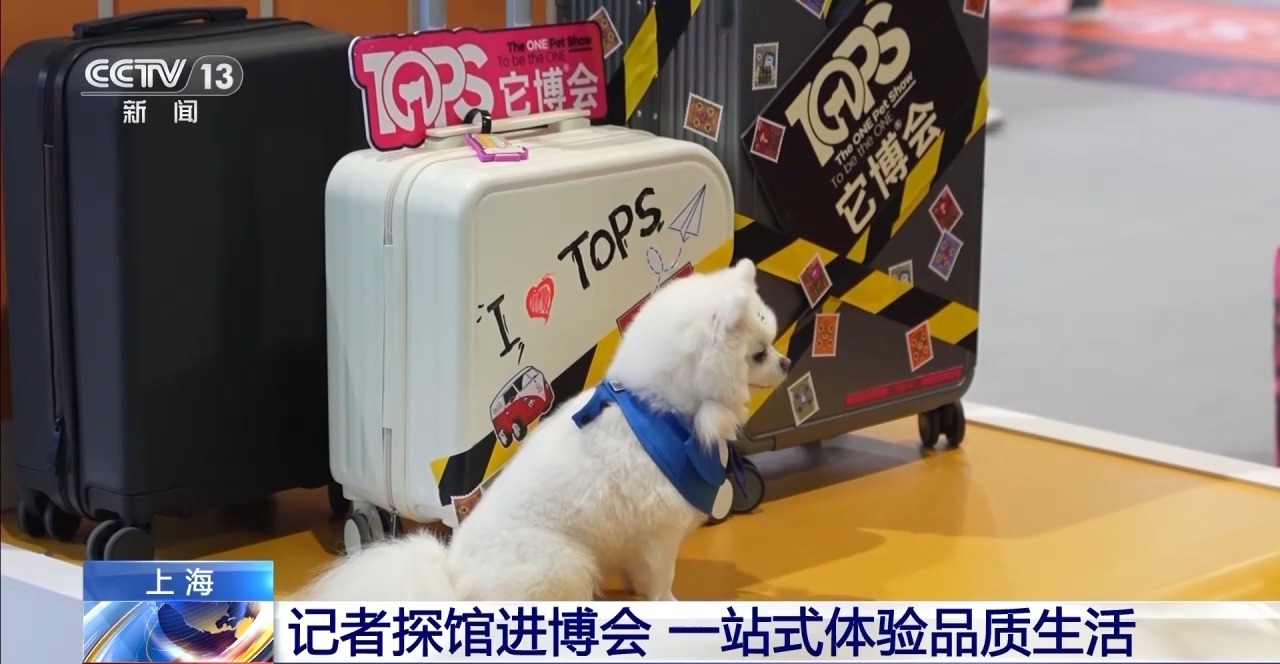
Core Viewpoint - The eighth China International Import Expo (CIIE) showcases innovative interactive exhibition areas, including sports and pet-themed zones, highlighting trends in consumer goods and sustainable living [1][11]. Group 1: Sports and Interactive Experiences - The expo features an outdoor sports area where attendees can engage in activities like table tennis and basketball, as well as experience winter sports through a VR skiing simulator [3]. - The introduction of the "CIIE Sports Park" allows visitors to enjoy sports-related experiences and purchase professional winter sports equipment [3]. Group 2: Pet Economy - A new pet-themed exhibition area, "Pet Expo," presents advanced products for pet care, such as an automatic cat litter box that provides health reports via an app [5][7]. - Smart feeding devices are also showcased, allowing pet owners to schedule feeding times and monitor their pets through built-in cameras [7]. Group 3: Sustainable and Green Consumption - The expo emphasizes sustainable living with various low-carbon consumption displays, including DIY projects using recycled materials [13]. - Exhibitors are promoting green lifestyles, showcasing products that integrate sustainability into everyday life [11]. Group 4: Cultural Integration and Market Engagement - Many international exhibitors incorporate Chinese cultural elements into their products, enhancing emotional connections with Chinese consumers [14]. - Notable brands, such as a Danish toy company, are launching products that reflect Chinese traditions, indicating a strategic approach to market entry [15]. Group 5: Long-term Participation and Brand Commitment - A significant number of exhibitors, including 170 companies and 27 institutions, have participated in all eight editions of the expo, demonstrating their commitment to the Chinese market [16]. - The event serves as a platform for brands to unveil new products, engage with partners, and explore future trends, reinforcing their investment in the Chinese market [15].
港股午评|恒生指数早盘涨0.61% 中国中免大涨超13%
智通财经网· 2025-11-10 04:04
Group 1: Market Overview - The Hang Seng Index rose by 0.61%, gaining 161 points to close at 26,406 points, while the Hang Seng Tech Index increased by 0.12%. The morning trading volume in Hong Kong was HKD 114.1 billion [1]. Group 2: Company Highlights - China Duty Free Group (01880) saw a rise of over 13% as the new duty-free policy in Hainan shows early positive effects, with institutions suggesting a potential industry turning point [1]. - Pop Mart (09992) increased by over 6% due to gradual capacity expansion, with management expecting stronger sales performance in Q4 [1]. - Dongyang Sunshine Pharmaceutical (06887) rose by over 4% as flu activity is on the rise, and institutions are optimistic about the company's innovative pipeline development [1]. - China Liansu (02128) increased by over 5% as the 14th Five-Year Plan emphasizes pipeline network renovation, which the company is expected to benefit significantly from [2]. - Shanghai Auntie (02589) rose by over 8% as the company proposed adopting an H-share incentive plan and successfully entered the "10,000-store club" [3]. - Education stocks performed well, with overall positive performance in the education sector, driven by AI+ education enhancing valuation space. China Education Group (00839) rose by 8%, Thinking Academy (01769) by 3.3%, and New Oriental-S (09901) by 3.25% [3]. - Ruipu Lanjun (00666) increased by over 6% due to a favorable global demand for energy storage, with the company reporting over 50 GWh of energy storage battery shipments in the first three quarters [4]. - Gilead Sciences-B (01672) rose by over 6% after being included in the MSCI Global Small Cap Index, with significant weight loss effects from ASC30 [5]. Group 3: Market Declines - Goldwind Technology (02208) fell by over 5% as a shareholder, Harmony Health, plans to further reduce its stake by up to 1%, following a previous reduction at the end of last month [6]. - Robotics concept stocks declined, with DCH Holdings (00179) dropping over 4% and Sanhua Intelligent Control (02050) falling over 3% [7].

(第八届进博会)熊猫巧克力、积木财神 外企进博秀场突出“中国元素”
Zhong Guo Xin Wen Wang· 2025-11-10 02:06
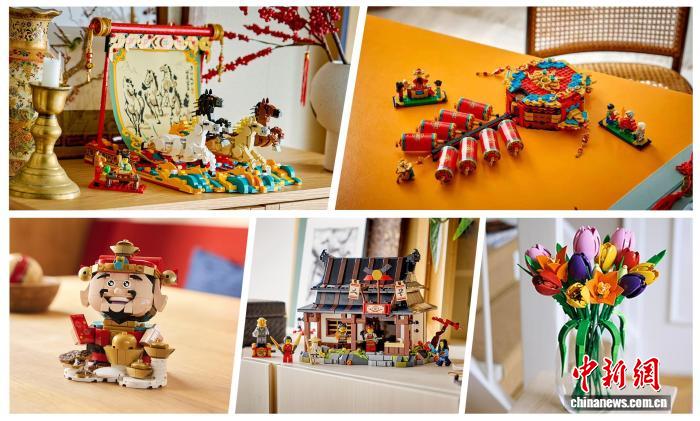
Core Insights - The article highlights how foreign companies at the China International Import Expo are increasingly incorporating Chinese cultural elements into their products and marketing strategies to resonate with local consumers [1][4][6] Group 1: Company Strategies - Hennessy has launched a new zodiac series of cognac, emphasizing its connection to Chinese culture by collaborating with local artists since 2018 [1] - LEGO has introduced 29 new products inspired by Chinese culture since its first participation in the expo, with two-thirds of these designs reflecting traditional customs and festivals [3] - Swiss brand Lindt has created panda-themed chocolates to celebrate the 75th anniversary of Sino-Swiss diplomatic relations, aiming to build a cultural bridge [1][3] Group 2: Market Trends - The article notes a shift in competition among multinational companies in China, moving from price and channel competition to a focus on cultural understanding and emotional resonance with consumers [5][6] - The rise of cultural confidence among Chinese consumers is driving demand for brands that acknowledge and respond to their cultural identity, leading to a deeper integration of "Chinese elements" in product offerings [5] - Companies are transitioning from superficial cultural symbols to a more profound understanding of Chinese culture, indicating a long-term commitment to local market engagement [5][6]
滉达富控股(01348)股东将股票由花旗银行转入高诚证券 转仓市值1322.11万港元
智通财经网· 2025-11-10 00:27
Core Viewpoint - The recent performance report of Huan Da Fu Holdings (01348) indicates significant revenue decline, primarily due to reduced sales to major clients in the toy segment, although this was partially offset by growth in the financial services division [1] Financial Performance - For the fiscal year ending March 31, 2025, Huan Da Fu Holdings reported a revenue of HKD 71.93 million, representing a year-on-year decrease of 59.4% [1] - The loss attributable to shareholders was HKD 17.87 million, which shows a year-on-year improvement of 75.8% [1] - The basic loss per share was reported at HKD 0.0121 [1] Segment Analysis - The toy segment experienced a revenue decline of approximately HKD 114.4 million, or 68.7%, primarily due to decreased sales to five major clients [1] - Conversely, the financial services segment saw an increase in revenue of about HKD 9 million, or 83.4%, which helped mitigate the overall revenue decline [1]
滉达富控股股东将股票由花旗银行转入高诚证券 转仓市值1322.11万港元
Zhi Tong Cai Jing· 2025-11-10 00:26
Group 1 - The core viewpoint of the article highlights the significant decline in revenue for Huan Da Fu Holdings, with a reported income of HKD 71.93 million, representing a year-on-year decrease of 59.4% [1] - The company reported a loss attributable to shareholders of HKD 17.87 million, which is a reduction of 75.8% compared to the previous year [1] - Basic loss per share is reported at HKD 0.0121 [1] Group 2 - The decrease in total revenue is primarily attributed to a reduction in sales to five major clients in the toy segment, which saw a decline of approximately HKD 114.4 million or 68.7% [1] - This decline in the toy segment was partially offset by an increase in revenue from the financial services segment, which rose by approximately HKD 9 million or 83.4% [1] - On November 7, shareholders transferred shares from Citibank to Gaocheng Securities, with a market value of HKD 13.22 million, accounting for 6.79% of the total shares [1]
解码福布斯富豪榜:马化腾富了,马云稳了
Sou Hu Cai Jing· 2025-11-09 12:57
Core Insights - The total wealth of billionaires on the Forbes China Rich List increased from $1.03 trillion to $1.35 trillion, marking a 31% growth, driven by a 15% rise in the CSI 300 index [1] - Two-thirds of the listed billionaires saw their wealth increase, with eight new entrants, while the minimum threshold for inclusion rose from $3.9 billion to $4.6 billion [1] - Tencent's stock price surged over 40%, contributing to the wealth increase of its founder, Ma Huateng, whose net worth grew to $62.8 billion, although he dropped from second to third place on the list [1][4] Industry Trends - The rise of AI has become a significant phenomenon, with companies like DeepSeek and Cambricon Technologies seeing substantial increases in valuation and wealth due to their AI-related businesses [7][9] - The easing of US-China trade tensions and the AI boom have positively impacted the Chinese stock market, although the benefits have not been evenly distributed among all internet giants [5] - Traditional internet giants are experiencing slower wealth growth compared to emerging AI companies, indicating a shift in the wealth creation landscape [9] Notable Individuals - Liang Wenfeng, founder of DeepSeek, entered the list with a net worth of $11.5 billion, while Cambricon's CEO Chen Tianshi saw his wealth nearly double to $21 billion [8][9] - Wang Ning, founder of Pop Mart, recorded the highest percentage increase in wealth, growing over threefold to $22.2 billion, propelled by the global popularity of Labubu toys [10][11] - Wang Xing, CEO of Meituan, experienced the most significant wealth decline, with a drop of $6.2 billion, reflecting the impact of intense competition in the food delivery market [13][14] Market Dynamics - The increase in the wealth threshold for the list has resulted in 14 billionaires, including former top billionaire Wang Jianlin, being excluded from this year's rankings [16] - The changes in the Forbes list reflect a broader transformation in the Chinese economy, shifting from a focus on internet and real estate wealth to emerging sectors like AI, new energy, and hard technology [16]



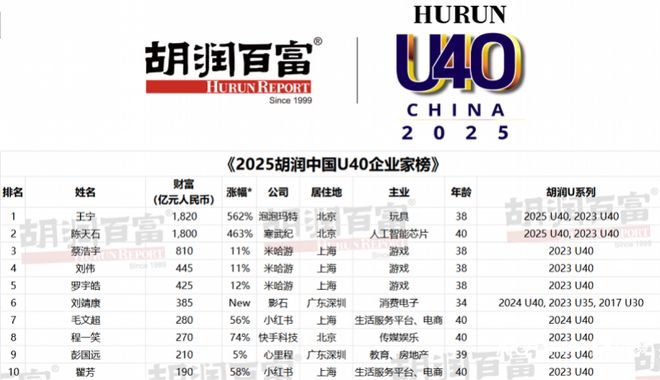
27位深圳青年才俊上榜!《胡润U40中国创业先锋》出炉
Nan Fang Du Shi Bao· 2025-11-09 11:13
Core Insights - The "2025 Hurun U40 China Entrepreneur Pioneers" list features 195 entrepreneurs under 40 years old, with a significant concentration in the entertainment and new consumption sectors, particularly in software and services [1][3] - Major cities attracting these U40 entrepreneurs include Shanghai, Beijing, and Shenzhen, with Shenzhen having 27 representatives on the list [1][3] - The report also highlights 39 U40 entrepreneurs with personal wealth exceeding 5 billion RMB, with a notable presence in the Greater Bay Area [1][4] Group 1: Entrepreneur Demographics - The list includes entrepreneurs from 53 cities, with a gender distribution of 85% male and 15% female [3] - The average age of these entrepreneurs is 37, and they founded their companies at an average age of 28, with an average of 420 employees per company [3] - 34% of these entrepreneurs have successfully listed their companies, and the average total financing is 100 million RMB [3] Group 2: Industry Focus - The highest representation among the entrepreneurs is in the software and services sector, accounting for 28%, while 72% are involved in selling physical products [3] - B2B companies make up 82% of the list, while B2C companies account for 18% [3] - The life and health sector ranks second with a 14% representation among the entrepreneurs [3] Group 3: Notable Entrepreneurs - The top-ranked entrepreneur is Wang Zhong, with a wealth of 1,820 million RMB, followed by Chen Tianshi at 1,800 million RMB, both from Beijing [2] - Liu Jingkang, founder of Ying Shi, is the highest-ranked entrepreneur from Shenzhen, with a wealth of 385 million RMB [4][5] - Other notable entrepreneurs from Shenzhen include Cheng Guoyuan, with a wealth of 210 million RMB, involved in education and high-precision manufacturing [5]