
证券业

Search documents
大绞杀!刚刚,全线暴跌!
券商中国· 2025-11-20 08:41
Core Viewpoint - Japan's government bonds have experienced a significant decline, with the 10-year bond yield rising to 1.825%, the highest level since June 2008, and the 40-year bond yield reaching a record high since 2007 [1][3]. Group 1: Bond Market Dynamics - The yields on Japanese government bonds across various maturities have surged, indicating a market shift [3]. - Japan's total government debt stands at approximately 1,071 trillion yen, with ordinary government bonds accounting for 81.3% of this debt [1]. - Japan is the largest foreign holder of U.S. Treasury bonds, with holdings exceeding $1.189 trillion (approximately 8.46 trillion yuan) [1][7]. Group 2: Economic Implications - Rising bond yields may prompt Japanese investors to reconsider their investment strategies, potentially leading to a repatriation of funds back to Japan and a withdrawal from U.S. dollar assets [1][7]. - The Bank of Japan's committee member, Junko Koeda, emphasized the need to monitor inflation trends and the impact of exchange rates on prices, indicating a cautious approach to policy normalization [5]. - Concerns have been raised about Japan's economic outlook due to external pressures, including U.S. tariff policies and deteriorating Sino-Japanese relations, which could lead to further economic decline [7].


高市早苗的闹剧,让日本经济先中了“回旋镖”
Xin Jing Bao· 2025-11-20 08:17
Core Viewpoint - The recent economic turmoil in Japan, marked by a 1.8% annualized decline in GDP for Q3, is attributed to a combination of internal economic stagnation and external geopolitical tensions, particularly involving China [1][6]. Economic Performance - Japan's Q3 GDP contracted by 1.8%, marking the first decline in six quarters [1]. - The Nikkei 225 index fell by 3.22%, and the yen depreciated to 155.38 against the dollar, the lowest since January [1]. - The 30-year government bond yield rose to 3.28%, the highest level since 1999 [1]. Market Reactions - The Japanese financial market experienced a "triple kill" in stocks, bonds, and currency, leading to significant sell-offs [1]. - The Tokyo stock market indices fell for four consecutive trading days, with a cumulative drop of over 2700 points [1]. Geopolitical Factors - The tensions between Japan and China, exacerbated by Prime Minister Kishi's provocative statements, have led to increased market volatility and investor caution [1][4]. - Japan's reliance on China for imports is significant, with over 50% of certain product categories sourced from China [4]. Investment Climate - The ongoing depreciation of the yen is seen as a result of high fiscal stimulus and military expansion policies under Kishi, which are viewed as contradictory and unsustainable [3]. - International investors have been shorting the yen, taking advantage of the interest rate differentials between Japan and the U.S. [2]. Economic Dependencies - Chinese tourists are crucial to Japan's economy, contributing approximately 30% to tourism revenue; a decline in their visits could significantly impact GDP [5]. - Japan's economic structure is heavily reliant on imports from China, with critical goods such as electronics and fertilizers being predominantly sourced from there [4]. Risk Mitigation - Analysts suggest that Kishi should retract her controversial statements to mitigate economic risks and stabilize market conditions [6]. - The potential for further economic decline in Japan is anticipated in Q4 due to existing structural issues and geopolitical uncertainties [6].
美元的过度特权或已失效——特朗普“对等关税”深度研究
2025-11-20 02:16
Summary of Key Points from Conference Call Records Industry Overview - The discussion revolves around the implications of the U.S. dollar's status as the global reserve currency and the potential for a shift in the global monetary system, particularly in light of the U.S. fiscal challenges and the implementation of Trump's "reciprocal tariff" policy [1][2][3]. Core Insights and Arguments 1. **U.S. Fiscal Challenges**: By 2024, the U.S. is projected to have a negative primary income balance, indicating that asset returns will fall below liability expenditures, potentially leading to a "debt snowball" effect and increasing fiscal pressure [1][2][5]. 2. **Reciprocal Tariff Policy**: The policy was introduced to increase fiscal revenue but has not effectively reduced the trade deficit. Instead, it has primarily served to alleviate long-term deficit issues by generating additional tariff income [1][4][7]. 3. **Market Reactions**: Following the introduction of the reciprocal tariff policy, significant market volatility was observed, particularly on April 10, 2025, when U.S. stock, bond, and currency markets all declined, indicating a loss of confidence in dollar assets [1][7]. 4. **Long-term Dollar Outlook**: The dollar's upward cycle may be ending, with a potential shift to a prolonged downward trend. The trust in the dollar is diminishing, and a "de-dollarization" trend is becoming evident, which could lead to a significant increase in gold prices, potentially reaching $8,000 per ounce in the coming years [3][9]. 5. **Impact on U.S. Stock Market**: The U.S. stock market is currently at historical highs, with U.S. equities representing about 70% of the global market. Any significant changes in the dollar's status could limit further upside potential for U.S. stocks [3][10]. Additional Important Insights 1. **Historical Context of Currency Transition**: Historical patterns suggest that global currency transitions can occur within approximately 20 years, indicating that the current international situation may be ripe for a significant shift in the dollar's status [1][5][11]. 2. **Debt and Global Reserve Currency Status**: The U.S. debt levels are at a historical peak, and as interest payments surpass defense spending, the U.S. may face declining geopolitical influence, which could further jeopardize the dollar's status as the global reserve currency [15][16]. 3. **Future of Global Currency System**: The potential for the Chinese yuan to emerge as a global currency is discussed, with the possibility of a multi-currency system developing, where the U.S. dollar, Chinese yuan, and Euro coexist as major currencies [17][18]. This summary encapsulates the critical points discussed in the conference call, highlighting the challenges facing the U.S. dollar and the broader implications for global financial markets.
华夏基金管理有限公司关于以通讯方式召开华夏中证A100交易型开放式指数证券投资基金基金份额持有人大会的公告
Shang Hai Zheng Quan Bao· 2025-11-19 18:30
Meeting Overview - The meeting for the holders of the 华夏中证A100交易型开放式指数证券投资基金 will be held via communication method to discuss the fund's continuous operation [1][4] - Voting period is from November 26, 2025, to December 22, 2025, with the counting date set for December 23, 2025 [1][6] Voting Process - Fund holders can submit their votes either in person or by mail, with specific addresses provided for both methods [2][12] - Voting rights for the linked fund holders are calculated based on their holdings in the main fund [4][10] Agenda Items - The main agenda item is the proposal regarding the continuous operation of the fund, which has been triggered by the fund's net asset value falling below 50 million yuan for 60 consecutive working days [34][35] Registration and Eligibility - The record date for voting eligibility is November 25, 2025, allowing all registered fund holders to participate [6][29] - Each fund share grants one vote, and the proposal requires at least half of the voting rights to be present for the meeting to proceed [26][10] Authorization and Proxy Voting - Fund holders can authorize others to vote on their behalf, with specific requirements for documentation and submission [9][11] - The deadline for submitting authorization documents is December 19, 2025 [22] Counting and Validity of Votes - Votes will be counted by authorized personnel under supervision, and the validity of votes is determined by adherence to submission guidelines [23][25] - Invalid votes will not be counted towards the total, while valid votes will be included in the overall tally [25][26] Conditions for Resolutions - Resolutions require a majority approval from the participating fund holders, and the results will be reported to the China Securities Regulatory Commission within five days [26][34]

货币市场日报:11月19日
Xin Hua Cai Jing· 2025-11-19 12:37
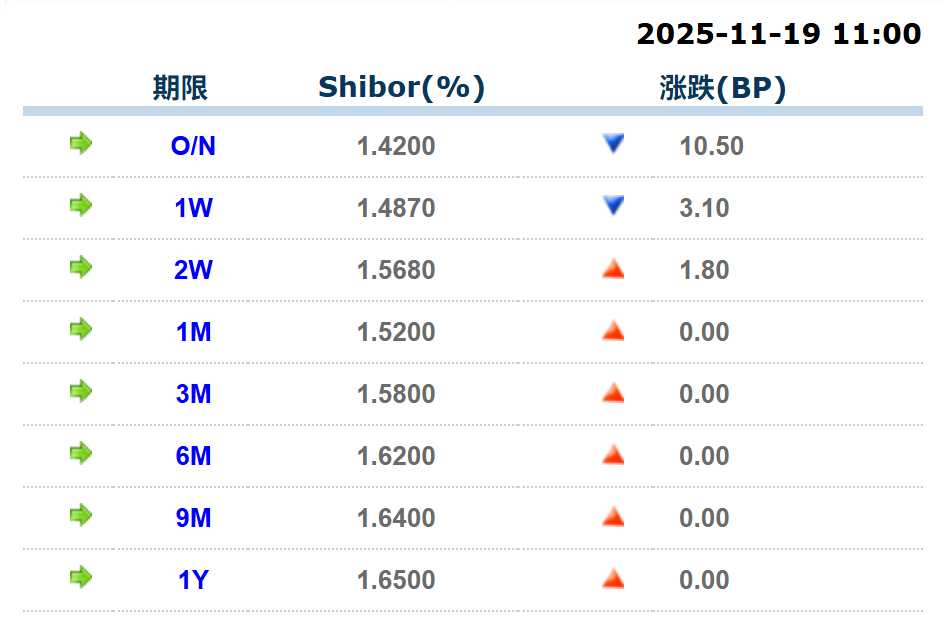
Core Points - The People's Bank of China conducted a 310.5 billion yuan 7-day reverse repo operation at an interest rate of 1.40%, maintaining the previous rate, resulting in a net injection of 115 billion yuan after 195.5 billion yuan of reverse repos matured on the same day [1] - The Shanghai Interbank Offered Rate (Shibor) showed mixed movements, with the overnight rate dropping by 10.50 basis points to 1.4200%, while the 7-day rate decreased by 3.10 basis points to 1.4870%, and the 14-day rate increased by 1.8 basis points to 1.5680% [1][2] - In the interbank pledged repo market, most rates declined, particularly the overnight rates, with DR001 and R001 weighted average rates falling by 10.6 basis points and 8.6 basis points, respectively, while transaction volumes increased significantly [4] Market Conditions - The funding environment showed signs of tightening marginally on November 19, with overnight pledged rates for certificates of deposit ranging from 1.58% to 1.60% and 7-day rates around 1.50% to 1.53% [7] - By the afternoon, the funding conditions became more balanced, with overnight pledged rates dropping to 1.50% and the lowest rates reaching 1.42% by the end of the trading day [7] - On the interbank certificate of deposit front, 66 certificates were issued on November 19, with a total issuance volume of 87 billion yuan, indicating active trading in the secondary market [8] Strategic Developments - A strategic cooperation agreement was signed between the Central National Debt Registration and Settlement Co., Ltd. and Postal Savings Bank of China, aiming to deepen collaboration across various financial sectors [10] - According to a report by Caifutong Securities, the return of funds from the "Double 11" shopping festival and the implementation of reverse repos are expected to reduce friction in the interbank market, with short-term rates likely returning to around 1.31% [10]
美债持仓,新变化
Zhong Guo Ji Jin Bao· 2025-11-19 06:50
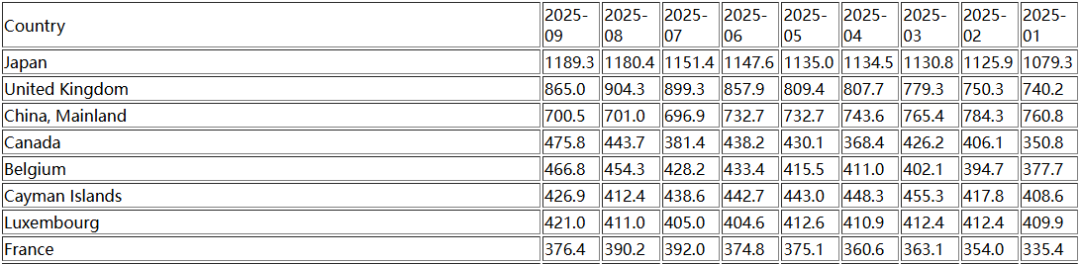
Summary of Key Points Core Viewpoint - Foreign investors' holdings of U.S. Treasury securities decreased to $9.249 trillion in September from $9.2662 trillion in August, with Japan increasing its holdings while China and the UK reduced theirs [1][2]. Group 1: Foreign Holdings of U.S. Treasuries - In September, Japan's holdings of U.S. Treasuries rose by $8.9 billion to $1.189 trillion, following an increase of $29 billion in August [4]. - The UK saw a rare decrease in its U.S. Treasury holdings, dropping by $39.3 billion to $865 billion, maintaining its position as the second-largest holder [4]. - China's holdings slightly decreased from $701 billion in August to $700.5 billion in September [4]. Group 2: Market Dynamics and Influences - The decline in overall foreign holdings reflects net selling of U.S. Treasuries by foreign investors, influenced by the rising Bloomberg U.S. Treasury Index in August and September [3]. - Analysts suggest that the differing strategies of central banks regarding U.S. Treasuries indicate varying external asset allocation directions, with a potential for China to continue reducing its holdings [4]. Group 3: Currency and Economic Factors - The weakening of the Japanese yen against the U.S. dollar has been noted, with the yen hovering at low levels since July [6]. - The Bank of Japan's decision to maintain a 0.5% benchmark interest rate, alongside the Federal Reserve's recent rate cut, has widened the interest rate differential, further contributing to the yen's depreciation [7]. Group 4: Gold Holdings and Trends - China's central bank has been increasing its gold reserves, with holdings reaching 7.406 million ounces (approximately 2303.523 tons) by the end of September, up by 40,000 ounces from August [11]. - The rising gold prices and increased central bank purchases reflect a trend towards diversifying international reserves amid geopolitical risks and a weakening dollar [9][10].
上海科创专项信贷产品创新清单不断拉长
Xin Hua Cai Jing· 2025-11-19 05:30
Core Viewpoint - Shanghai's banking sector is continuously innovating its special credit products to better meet the financing needs of technology enterprises, with a focus on intellectual property pledge financing and supportive policies to maximize patent resource value [1][2]. Group 1: Financing Innovations - Shanghai has introduced various special credit products such as "Science and Technology Innovation Assistance Loan" and "New Quality Loan" to address the financing challenges faced by technology companies [1]. - The city has seen a significant increase in intellectual property pledge financing, with 2,223 registrations and a total scale of 32 billion yuan in 2024, representing year-on-year growth of 62.3% and 40.6% respectively [1]. Group 2: Ecosystem Development - The Shanghai Zhujiao High-tech Zone has developed into a "billion-yuan park," generating over 10 billion yuan in fiscal revenue for three consecutive years, and is home to numerous industry leaders and a vibrant knowledge innovation community [1][2]. - The Zhujiao High-tech Zone has established a comprehensive support system for technology finance, including a "platform + service + ecosystem" model, which has facilitated over 3 billion yuan in credit financing and 30 billion yuan in equity financing for enterprises [2]. Group 3: Financial Advisory and Support - The establishment of a financial advisory system covering all 16 districts in Shanghai aims to provide precise financial service recommendations to enterprises through high-level expert advisors [3]. - Financial advisors from various institutions are engaging with technology enterprises to offer tailored advice on credit loans and risk management strategies, enhancing the financial support for early-stage technology companies [3].
点心债成中资科技企业融资新选择
Zhong Guo Zheng Quan Bao· 2025-11-18 20:05
Core Insights - The offshore RMB bond market, known as "dim sum bonds," is experiencing significant growth, with issuance nearing 1 trillion yuan in 2023, driven by demand from major tech companies like Tencent and Alibaba [1][2] - The diversification of issuers, including sovereign and government entities, is enhancing the market's role in supporting the internationalization of the RMB and solidifying Hong Kong's status as a financial hub [1][2] Group 1: Market Dynamics - As of November 18, 2023, the issuance of dim sum bonds has surpassed 980 billion yuan since 2025, establishing it as a crucial channel for overseas financing for Chinese enterprises [1] - Major tech firms are increasingly utilizing dim sum bonds to fund global expansion and investments in AI, with total issuance exceeding 47 billion yuan and a subscription amount reaching approximately 150 billion yuan, 3.2 times the issuance [2] Group 2: Contributing Factors - The growth of the dim sum bond market is attributed to a combination of policy support, market demand, and improved asset quality, which together drive market expansion [2][3] - The optimization of domestic capital outflow channels, such as the "Southbound Trading" initiative, has broadened the investor base and enhanced market liquidity, stimulating demand for dim sum bonds [2] Group 3: Investment Appeal - Dim sum bonds offer attractive yields compared to onshore credit bonds while remaining lower than offshore USD bonds, appealing to both issuers and investors [3] - The expansion of green and tech-related issuers is improving the asset quality of dim sum bonds, increasing their attractiveness to international investors [3] Group 4: Future Outlook - Analysts are optimistic about the dim sum bond market's prospects, anticipating strong growth driven by local government bonds, foreign financial bonds, and TMT bonds [4] - The ongoing expansion of the "Southbound Trading" initiative is expected to enhance market liquidity, creating a favorable environment for investment opportunities [4]
张瑜:牛市的税收效应
一瑜中的· 2025-11-18 16:04
Core Viewpoint - Recent tax revenue growth has outpaced economic growth, significantly driven by the bull market, which has contributed to substantial tax revenue increases for the government [2][3] Tax Revenue Contributions from the Bull Market - The bull market is estimated to contribute approximately 310 billion in incremental tax revenue this year, equivalent to 2% of the 2024 tax revenue [3][10] - This contribution is expected to come from two main sources: 1. Securities industry tax revenue growth, estimated at around 270 billion 2. Personal capital market-related tax revenue growth, estimated at around 40 billion [3][10] Securities Industry Tax Revenue Growth - The securities industry is projected to see a tax revenue increase of approximately 270 billion, driven by significant growth in brokerage, proprietary trading, and asset management revenues [5][10] - Historical data indicates that the tax revenue from the securities industry has increased by 56.8% year-on-year, validating the strong correlation between market performance and tax revenue [6][12] Personal Capital Market-Related Tax Revenue Growth - Personal capital market-related tax revenue is expected to grow by about 40 billion, primarily due to increased individual income tax from capital market activities [7][15] - Historical trends show that during bull markets, personal income tax from capital market sources has often exceeded economic growth, with significant contributions from dividend income and capital gains [15][16] Other Tax Revenue Sources - The bull market is also expected to drive tax revenue growth from the insurance industry and non-financial corporate investment income, contributing to overall tax revenue increases [22] - For instance, the insurance industry has reported a year-on-year tax revenue growth of 13.3%, while non-financial corporate investment income has historically shown a potential growth of around 20% during bull markets [22]

上市公司买理财产品,有新变化
Zhong Guo Zheng Quan Bao· 2025-11-18 09:03
Core Viewpoint - The scale of listed companies' investments in financial products has decreased this year, with a total subscription amount of approximately 890 billion yuan, which is a 16.5% decline compared to the same period last year [2][3] Group 1: Investment Scale and Trends - As of November 17, 2023, 1,126 listed companies have subscribed to financial products, with a total subscription amount of about 890 billion yuan, down from over 1 trillion yuan in previous years [2][3] - The decline in investment scale is attributed to companies allocating more funds to cash dividends and share buybacks, as well as decreasing interest rates on deposit products [2][3] Group 2: Product Preferences - Listed companies are favoring low-risk financial products with high safety and liquidity, including structured deposits, bank wealth management, and broker wealth management [3][4] - Despite the overall decline, certain product categories such as bank wealth management, broker wealth management, reverse repos, and fund accounts have seen growth [3] Group 3: Market Dynamics - Asset management firms are increasing their focus on the public wealth market, offering diversified products to meet the demand for higher returns while maintaining safety and liquidity [3][4] - Companies are beginning to diversify their investment strategies, gradually increasing their allocation to broker wealth management and public funds [3]