
高技术制造业

Search documents
税收数据显示 前三季度山西新质生产力跑出“加速度”
Sou Hu Cai Jing· 2025-11-12 03:19
Group 1 - The core viewpoint is that Shanxi Province is experiencing significant growth in new productive forces, with sales revenue in related industries increasing by 9.06% year-on-year, outperforming the overall industrial sales growth by 17.75 percentage points [1] - The digital economy is accelerating its industrialization, with core industry sales revenue growing by 7.34% year-on-year and a dramatic increase of 6.6 times in the procurement of digital products by enterprises [1] - High-tech industries are showing strong resilience, with sales revenue increasing by 12.20% year-on-year, including a 17.76% increase in high-tech manufacturing and a 3.86% increase in high-tech services [1] Group 2 - Shanxi Province is focusing on high-quality development by nurturing new productive forces, with a 7.98% year-on-year increase in spending on R&D and technical services, supporting the integration of technological and industrial innovation [1] - The tax authorities in Shanxi will continue to implement tax incentives to reduce the burden on enterprises and stimulate market vitality, aiding companies in increasing R&D investments and moving up the industrial chain [2] - The tax department will enhance economic analysis and monitor regional economic dynamics using tax data to support the cultivation of new productive forces and high-quality development in Shanxi [2]
信用债周策略20251110:地方发展支柱与投资机会
Minsheng Securities· 2025-11-10 06:53
Group 1: Macroeconomic Overview - The macroeconomic environment is characterized by a "slight decline" and "continuous improvement" interwoven, with manufacturing PMI and export growth showing slight decreases in October 2025 compared to the previous month [1][11] - The overall economic situation is improving compared to last year, with state-owned enterprises and listed companies showing signs of better performance, while support for small and medium-sized enterprises (SMEs) needs to be enhanced [1][16] - The production index and new orders index for October were 49.7% and 48.8%, respectively, indicating a slight decline, but large enterprises continue to show expansion with indices above 50 [3][12] Group 2: Industry Development and Policy Support - High-tech manufacturing, equipment manufacturing, and consumer goods industries are crucial for maintaining the overall prosperity of the manufacturing sector, with a focus on supporting SMEs towards "specialized, refined, and innovative" development [4][18] - New application scenarios are expected to emerge in fields such as digital economy, artificial intelligence, clean energy, and biotechnology, providing growth opportunities for related companies [4][18] - The government emphasizes the need for a complete industrial chain in technology innovation and application to enhance the "R&D-application-manufacturing" capabilities across industries [21][22] Group 3: Investment Strategy - Investment focus should be on economically strong provinces with good debt management, such as Guangdong, Jiangsu, and Zhejiang, with a recommended duration of 5 years [5][23] - Areas with significant debt resolution policies or funding support should be considered for shorter durations of 3-5 years, including Chongqing and Tianjin [5][25] - Attention should also be given to cities with strong industrial foundations and financial support, particularly those with important industrial chain positions [5][26]
中央财经委员会办公室原副主任尹艳林:多维度锚定“十五五”经济发展新局面
Zhong Guo Zheng Quan Bao· 2025-11-09 23:58
Group 1: Economic Overview - The overall economic operation in China remains stable during the "14th Five-Year Plan" period, with a solid and steady advancement in high-quality development, showcasing strong resilience and vitality in multiple macro indicators [1][2] - The GDP growth for the first three quarters of 2025 is reported at 5.2% year-on-year, laying a strong foundation for achieving the annual target [1] - New economic drivers, particularly in equipment manufacturing and high-tech manufacturing, have shown robust growth, with significant increases in the production of smart products and green equipment [1] Group 2: Policy Impact - Demand-stimulating policies have effectively driven retail sales growth and facilitated large-scale equipment upgrades, creating a virtuous cycle of policy stimulation leading to increased demand, production growth, and subsequent investment [2] - The A-share market has seen a notable increase in trading volume and investor confidence since the introduction of a comprehensive set of measures on September 24 of the previous year [2] Group 3: Recommendations for the "15th Five-Year Plan" - The recommendations emphasize the importance of coordinated fiscal and monetary policies, enhancing the roles of various policies to promote an economy driven by domestic demand and consumption [2][3] - The focus on smart, green, and integrated development in the real economy aims to maintain a reasonable proportion of manufacturing and build a modern industrial system centered on advanced manufacturing [3] - Regional development strategies are highlighted to enhance the quality of development in key areas such as Beijing-Tianjin-Hebei, the Yangtze River Delta, and the Guangdong-Hong Kong-Macau Greater Bay Area [3]
中央财经委员会办公室原副主任尹艳林: 多维度锚定“十五五”经济发展新局面
Zhong Guo Zheng Quan Bao· 2025-11-09 22:57
Group 1 - The conference highlighted the strong resilience and vitality of China's economy during the "14th Five-Year Plan" period, with GDP growth of 5.2% year-on-year in the first three quarters of 2025, laying a solid foundation for achieving annual targets [1] - New economic drivers, particularly in equipment manufacturing and high-tech manufacturing, have shown robust growth, with significant increases in the production of smart products and green equipment [1][2] - Demand stimulation policies have effectively promoted retail sales and large-scale equipment upgrades, creating a virtuous cycle of policy stimulus leading to increased demand, production growth, and subsequent investment [2] Group 2 - The capital market has been positively impacted, with a notable increase in A-share market trading volume and investor confidence since the introduction of a comprehensive set of measures in September of the previous year [2] - Recommendations for the "15th Five-Year Plan" emphasize a focus on economic construction and high-quality development, highlighting the importance of people-centered principles and the spirit of reform and innovation [2] - In terms of macro policies, there is a call for enhanced coordination between fiscal and monetary policies, promoting an economic development model driven by domestic demand and consumption [2][3] Group 3 - The emphasis on the real economy includes a commitment to intelligent, green, and integrated development, aiming to maintain a reasonable proportion of manufacturing and build a modern industrial system centered on advanced manufacturing [3] - Regional development strategies are to be leveraged to enhance the quality of development in key areas such as Beijing-Tianjin-Hebei, the Yangtze River Delta, and the Guangdong-Hong Kong-Macao Greater Bay Area [3] - The green transition is guided by carbon peak and carbon neutrality goals, promoting a collaborative approach to reducing carbon emissions, pollution, and enhancing green growth [3]
1—9月份全国规上仪器仪表制造业企业实现利润总额756.9亿元
Guo Jia Tong Ji Ju· 2025-11-07 08:41
Core Insights - The total profit of industrial enterprises above designated size in China reached 53,732 billion yuan from January to September 2025, marking a year-on-year increase of 3.2%, the highest growth rate since August of the previous year [1] - The manufacturing sector saw a profit growth of 9.9%, while the electricity, heat, gas, and water production and supply sector grew by 10.3%. Conversely, the mining sector experienced a decline of 29.3%, although the decline was less severe than in previous months [1] - In September alone, profits for industrial enterprises increased by 21.6% year-on-year, accelerating by 1.2 percentage points compared to August [1] Industrial Performance - Among 41 major industrial categories, 23 reported profit growth year-on-year, with 30 industries showing profit increases in September, representing a growth rate of 73.2% [1] - The recovery trend is evident, with 26 industries experiencing either accelerated profit growth or a reduction in profit decline compared to August [1] High-Tech Manufacturing - High-tech manufacturing profits grew by 8.7% year-on-year from January to September, contributing 1.6 percentage points to the overall profit growth of industrial enterprises [2] - In September, high-tech manufacturing profits surged by 26.8%, driving a 6.1 percentage point increase in total industrial profits for that month [2] Equipment Manufacturing - The equipment manufacturing sector's profits increased by 9.4% year-on-year, surpassing the average growth rate of all industrial enterprises by 6.2 percentage points [2] - In September, profits in the equipment manufacturing sector grew by 25.6%, contributing 10.5 percentage points to the overall profit growth of industrial enterprises [2] Sector-Specific Growth - All eight industries within the equipment manufacturing sector reported profit growth from January to September, with notable increases in railways, shipping, aerospace, electronics, and electrical machinery [3] Future Outlook - Relevant authorities are expected to introduce more proactive policies to promote the sustained development of the industrial economy [4]
10月出口数据点评:出口为何超预期转负?
Soochow Securities· 2025-11-07 07:13
Export Data Overview - In October, China's exports (in USD) recorded a year-on-year decline of -1.1%, down from +8.3% in September, marking the first negative growth since March 2025[3] - Exports to the US saw a significant drop of -25.2%, slightly improving from September's -27.0%[3] - Exports to ASEAN maintained resilience with a growth rate of +11.0%, down from +15.6% in September[3] Regional Export Performance - Exports to the EU grew by only +0.9%, a sharp decline from +14.2% in September[3] - Exports to Africa and Latin America still showed positive growth but decreased significantly, from +56.4% and +15.2% in September to +10.5% and +2.1% respectively[3] Product Category Insights - Labor-intensive products like clothing, bags, and footwear experienced substantial declines, with growth rates of -16.0%, -25.7%, and -21.0% respectively[3] - High-tech manufacturing exports remained strong, with mobile phone exports dropping from -1.7% in September to -16.6% in October, while integrated circuits, automobiles, and ships recorded growth rates of +26.9%, +34.0%, and +68.4% respectively[3] Seasonal and Trade Relationship Factors - October's export data reflects seasonal trends, with a historical average month-on-month decline of -3.8% due to the National Day holiday[3] - The easing of US-EU trade tensions has contributed to the decline in exports to the EU, with a month-on-month decrease of -8.6% in October[3] - The phenomenon of "export rush" appears to be waning, impacting growth rates to ASEAN and other emerging markets[3] Future Outlook and Risks - There is a potential risk of further decline in export growth rates in Q4, with the possibility of turning negative due to higher base effects in November and December[3] - Ongoing uncertainties in US-China trade relations and a potential slowdown in global economic growth pose additional risks to export performance[3]
10月制造业PMI为49.0%,高技术制造业仍处于扩张区间 | 高频看宏观
Sou Hu Cai Jing· 2025-11-07 03:58
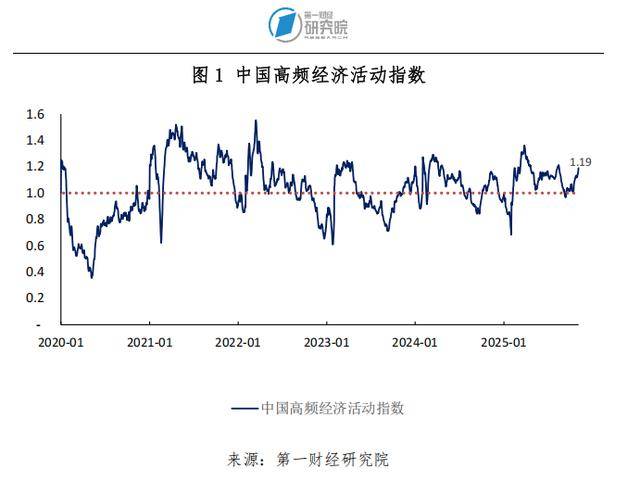
Group 1: Economic Activity Index - The China High-Frequency Economic Activity Index (YHEI) reached 1.19 on November 4, 2025, an increase of 0.07 from October 28 [1][3] - Key contributors to the YHEI increase include the Coastal Coal Freight Index and the Imported Dry Bulk Freight Index, which rose to 1.22 and 1.12, respectively [1][3] - The 30-City Commodity Housing Sales Index fell by 0.06 during the same week [1][3] Group 2: Manufacturing and PMI - The Manufacturing Purchasing Managers' Index (PMI) for October was 49.0%, down 0.8 percentage points from the previous month, indicating a contraction in manufacturing activity [23][24] - High-tech manufacturing, equipment manufacturing, and consumer goods sectors maintained expansion with PMIs of 50.5%, 50.2%, and 50.1%, respectively [23][24] - Large manufacturing enterprises saw a PMI drop to 49.9%, while medium and small enterprises' PMIs decreased to 48.7% and 47.1% [23][24] Group 3: Supply and Demand Indicators - The production index fell to 49.7% in October, influenced by the National Day holiday [24] - New orders and new export orders indices decreased to 48.8% and 45.9%, respectively [24] - The purchasing index dropped to 49.0%, indicating reduced procurement activity amid slowing production [24] Group 4: Non-Manufacturing Sector - The Non-Manufacturing Business Activity Index was 50.1%, slightly up by 0.1 percentage points from the previous month [24] - The construction sector's index fell to 49.1%, while the services sector's index rose to 50.2% [24] Group 5: Monetary Policy and Interest Rates - The central bank's net fund injection was 119.9 billion yuan for the week ending November 4, 2025 [5][6] - The overnight interbank rate decreased by 17 basis points to 1.36%, while the seven-day repo rate fell by 16 basis points to 1.47% [10][11] - One-year and ten-year government bond yields decreased by 3.85 and 1.95 basis points to 1.39% and 1.80%, respectively [10][16] Group 6: Commodity Prices - Steel billet prices decreased by 1.68% over the past week and 6.39% year-on-year [25] - Cement prices increased by 0.12% week-on-week but fell by 22.28% year-on-year [25] - Power coal prices rose by 1.18% month-on-month but decreased by 4.20% year-on-year [25] Group 7: Real Estate Market - New housing transaction areas in first and third-tier cities fell by 20.39% and 26.08%, respectively, while second-tier cities saw a 1.59% increase [35][36] - Second-hand housing transaction areas decreased by 5.24%, 1.75%, and 17.04% in first, second, and third-tier cities, respectively [39] Group 8: Global Economic Indicators - The US Dollar Index rose by 1.49 points to 100.21, while the RMB/USD exchange rate fell by 227 basis points to 7.1233 [45][46] - The Chicago Board Options Exchange VIX Index increased by 2.58 points to 19 [49]

一路领跑,北方最强地级市烟台“开挂”了?
Sou Hu Cai Jing· 2025-11-06 13:29
Core Viewpoint - The economic performance of "trillion-yuan club" cities in China shows a mixed picture, with Yantai leading in GDP growth among these cities, raising discussions about its competition with Jinan for the title of "Shandong's second city" [1][3][5]. Economic Performance - Among the 27 cities with GDP exceeding 1 trillion yuan last year, 8 cities, including Guangzhou and Tianjin, failed to surpass the national average growth rate of 5.2%, while 19 cities met or exceeded this benchmark [1]. - Yantai achieved a remarkable GDP growth rate of 6.4% in the first three quarters, significantly higher than the national average, making it the top performer among "trillion-yuan cities" [3][4]. Industrial Development - Yantai's industrial sector has been a key driver of its economic growth, with the added value of the secondary industry increasing by 8.8%, outperforming the national average by 3.9 percentage points [3][4]. - The city's industrial output value rose by 13.9%, second only to Hefei among "trillion-yuan cities" [4]. Major Projects - Significant industrial transformation projects in Yantai, such as the Longkou Yulong Petrochemical Industrial Park and the Penglai Wanhua New Materials Low-Carbon Industrial Park, are expected to enter a "high output" phase by 2025, contributing to GDP growth [4]. Economic Challenges - Despite strong growth, Yantai's tertiary industry growth rate of 4.7% lags behind national and provincial averages, indicating potential sustainability issues for its economic development [4]. - Fixed asset investment growth has also shown negative trends, raising concerns about future economic stability [4]. Competition Among Cities - The competition among Shandong's major cities is intensifying, with Qingdao leading in total GDP, followed by Jinan and Yantai, which is showing strong growth potential [5][6]. - Historical economic rivalry between Yantai and Jinan has been noted, with Yantai previously surpassing Jinan in total economic output until Jinan regained the lead in 2018 [7][8]. Future Outlook - The economic competition between Yantai and Jinan is expected to continue, with Yantai's high growth rate suggesting the possibility of surpassing Jinan in the future [9]. - The structural differences in industries between the two cities highlight their respective strengths, with Yantai focusing on traditional industries and Jinan on high-tech manufacturing [8]. Regional Economic Strategy - Shandong province is under pressure to enhance its economic vitality and innovation capabilities, with Yantai, Jinan, and Qingdao identified as the "three cores" driving regional growth [10][11]. - The need for differentiated development strategies among these cities is emphasized, with each city focusing on its unique strengths to avoid homogenized competition [12][14].

前三季度内蒙古制造业增加值同比增长8.8%
Nei Meng Gu Ri Bao· 2025-11-05 01:34
Core Viewpoint - The manufacturing sector in Inner Mongolia has shown robust growth in the first three quarters of the year, with a year-on-year increase of 8.8% in value added, surpassing the national average by 2 percentage points [1] Group 1: Manufacturing Growth - The value added of the above-scale manufacturing industry in Inner Mongolia increased by 8.8% year-on-year, which is 2 percentage points higher than the national average [1] - The growth in the manufacturing sector contributed 2.8 percentage points to the overall industrial economic growth in the region [1] Group 2: New Momentum Industries - The value added of the equipment manufacturing industry increased by 21.2% year-on-year, exceeding the overall industrial growth rate by 15.3 percentage points [1] - High-tech manufacturing also saw a significant increase, with a year-on-year growth of 16.5%, which is 10.6 percentage points higher than the overall industrial growth rate [1] Group 3: Traditional Industries - The chemical industry experienced a year-on-year increase of 14.7% in value added [1] - The metallurgy and building materials industry saw a growth of 5.3% year-on-year [1] Group 4: Economic Drivers - The stable growth in manufacturing is attributed to the influence of headquarters economy, leading enterprises in the industry, chain-leading enterprises, and advanced manufacturing [1] - The scale effect of the industry is gradually being released, further stabilizing growth and expectations [1]
10月制造业景气水平有所回落
Zhong Guo Hua Gong Bao· 2025-11-04 02:27
Group 1 - The manufacturing Purchasing Managers' Index (PMI) for October is reported at 49.0%, a decrease of 0.8 percentage points from the previous month, indicating a decline in manufacturing activity [1] - Both production index and new orders index have decreased, with values of 49.7% and 48.8% respectively, reflecting a slowdown in production and market demand [1] - Large enterprises maintain a PMI above the critical point, while small and medium enterprises show varying degrees of decline, with PMIs of 49.9%, 48.7%, and 47.1% respectively [1] Group 2 - Three key sectors, including high-tech manufacturing, equipment manufacturing, and consumer goods, continue to expand with PMIs of 50.5%, 50.2%, and 50.1% respectively, indicating strong support for the overall manufacturing sector [1] - The high-energy-consuming industries have a PMI of 47.3%, which is a decrease of 0.2 percentage points from the previous month, showing a decline in activity [1] - The production and business activity expectation index stands at 52.8%, remaining in the expansion zone, suggesting that most manufacturing enterprises maintain an optimistic outlook on market development [2]