农产品

Search documents
油脂油料早报-20260202
Yong An Qi Huo· 2026-02-02 01:18
Report Summary 1. Report Industry Investment Rating No information provided. 2. Core Viewpoints - As of the week of January 30, the soybean harvest progress in Mato Grosso state in the 2025/26 season reached 24.97% of the sown area, much higher than 12.20% in the same period last year and also exceeding the five - year average. The single - week harvest progress advanced 11.09 percentage points, and the harvest in all regions of the state is accelerating [1]. - Consulting firm Expana raised the forecast of the EU's 2026/27 rapeseed production from the initial estimate of 20.8 million tons at the end of November 2025 to 20.9 million tons, an increase of 0.38%. It is 2% higher than the 20.5 million tons in the previous year due to a significant increase in the sown area [1]. - Indonesia set the reference price of crude palm oil in February at $918.47 per ton, higher than $915.64 per ton in January. The export tariff of crude palm oil in February remains at $74 per ton, and an additional 10% special export tax is also levied [1]. 3. Summary by Related Catalogs Overnight Market Information - **Soybean Harvest in Mato Grosso**: As of January 30, the 2025/26 soybean harvest progress in Mato Grosso was 24.97% of the sown area, with a single - week progress of 11.09 percentage points. The fastest - harvesting regions are the north - central (35.41%) and western (36.70%) parts of the state [1]. - **EU Rapeseed Production Forecast**: Expana raised the EU's 2026/27 rapeseed production forecast to 20.9 million tons. The sown area is expected to increase by 6.6% to 6.5 million hectares, while the yield per hectare is expected to decrease by 5.9% to 3.2 tons per hectare [1]. - **Indonesian Palm Oil**: Indonesia raised the February reference price of crude palm oil to $918.47 per ton, with an export tariff of $74 per ton and an additional 10% special export tax [1]. Spot Prices - The table shows the spot prices of soybean meal in Jiangsu, rapeseed meal in Guangdong, soybean oil in Jiangsu, palm oil in Guangzhou, and rapeseed oil in Jiangsu from January 26 to January 30, 2026 [2]. Protein Meal Basis No detailed information provided [3]. Fat Basis No detailed information provided [6]. Fat and Oil Futures Spread No detailed information provided [8].
【宝鸡】今年谋划项目3000余个
Shan Xi Ri Bao· 2026-02-02 00:27
Group 1 - The core focus of Baoji City in 2023 is on high-quality project construction, planning over 3,000 projects with a total investment exceeding 200 billion yuan, and an annual investment plan of over 58.6 billion yuan for 465 key municipal projects [1] - In the past year, Baoji City achieved a GDP growth of 6%, an industrial added value growth of 10%, and a fixed asset investment growth of 8.6%, successfully completing major goals of the 14th Five-Year Plan [1] - The city secured 4.21 billion yuan in policy funds from central and provincial governments, with completion rates for 47 provincial key projects and 419 municipal key projects reaching 125.29% and 144.54% respectively, leading the province in project commencement and investment completion rates [1] Group 2 - Baoji City plans to enhance high-level opening up, aiming for the completion of the main works of Baoji Airport within the year and the prompt opening of the Huzhou-Mei Expressway [2] - The city is pushing for the inclusion of the Baohan High-Speed Railway in regulations and aims to start the reconstruction of the Longhai Railway in the first half of the year [2] - Efforts will be made to secure import tariff quotas for agricultural products and to operate the China-Europe freight trains at a high quality, alongside accelerating energy-saving and carbon-reduction transformations in key industrial sectors [2]
“路过经济”变“落地经济”
Xin Lang Cai Jing· 2026-02-01 22:23
Core Viewpoint - The recent guidelines issued by the provincial transportation department aim to transform highway service areas from traditional "rest stops" into comprehensive stations that support the high-quality development of county economies [1][2] Group 1: Economic Development - Since the 14th Five-Year Plan, Guizhou has actively cultivated a "road-derived economy" that connects highways and service areas, resulting in service area revenues exceeding 400 million yuan [1] - The "Long March National Cultural Park · Daluo Mountain Service Area" integrates red culture to boost red tourism and consumption [1] - The Xijiang Service Area leverages its proximity to Qianhu Miao Village to create a cultural tourism hub, effectively promoting local employment and rural industry development through a "service area + employment + industry" model [1] - The Dao'an Highway Zheng'an Service Area has become a "guitar culture window" and established a rural revitalization service station to facilitate direct sales of local agricultural products [1] - The Hukun Highway Hot Spring Service Area deeply integrates Miao and Dong cultures, enhancing consumer experiences and stimulating spending [1] Group 2: Infrastructure and Connectivity - The expansion of highway service area functions is a strategic move to enhance the endogenous power of county economies, transforming service areas from "transit points" to "access points" [2] - New connections to local road networks will shorten distances between industrial parks, agricultural bases, and tourist attractions, reducing logistics costs and promoting the export of local products [2] - The ongoing improvement of Guizhou's highway network is expected to accelerate the transition from "road-passing economy" to "landed economy" as service areas evolve into economic interfaces that drive county industries and promote urban-rural integration [2]
品特产寻年味 辽宁农品年货购启幕
Xin Lang Cai Jing· 2026-02-01 15:14
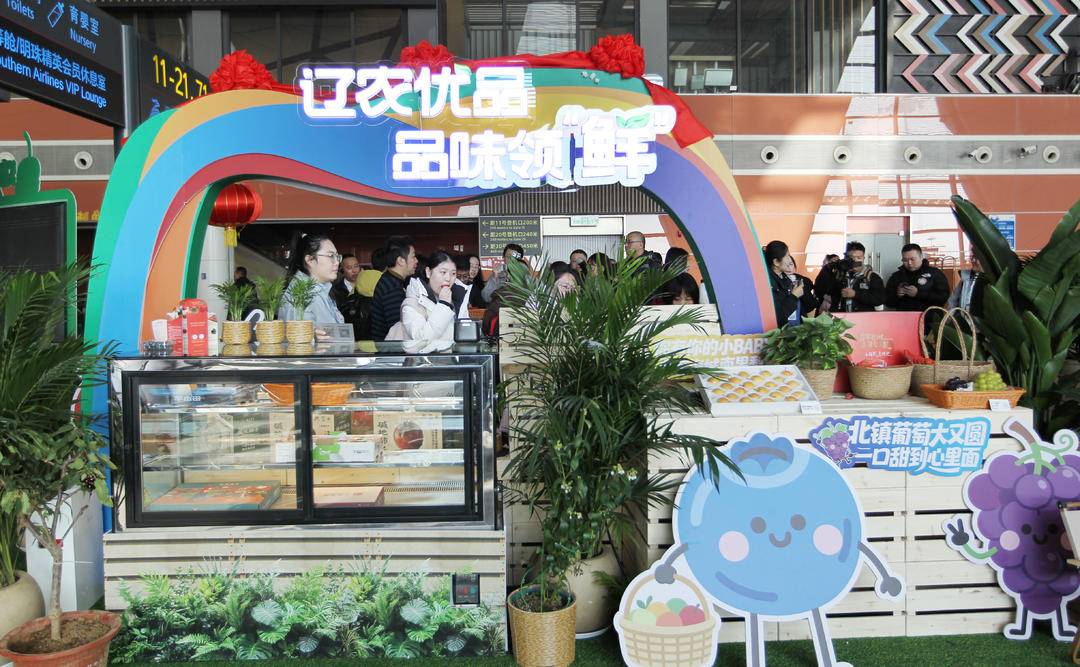
(辽宁日报 记者白琳) 责任编辑:钱炳达 all 72 D ( ( . 80 四级市 考求 -HILL 亚游客服 = 1 / 戏阳加丰农业科技有限 0 AS D (来源:东北新闻网) 春运在即,辽宁农品年货购·"品特产 寻年味"消费促进活动1月31日正式启动。在造化大集,吸引众多市民前来探寻最浓年味、选购特色年货。同时,辽宁 特色农产品首次集中亮相桃仙机场,这种依托交通枢纽宣传推广辽宁特色农产品的方法,旨在借助交通枢纽客群强大辐射力与影响力,为辽宁特色农产品 搭建起一座直通全国市场的展销平台,让更多人领略到辽宁特色农产品的独特魅力。 ...

行业比较周跟踪(20260124-20260130):A 股估值及行业中观景气跟踪周报-20260201
Shenwan Hongyuan Securities· 2026-02-01 14:16
Investment Rating - The report does not explicitly provide an overall investment rating for the industry but includes detailed valuation metrics for various indices and sectors, indicating a mixed outlook based on historical percentiles [2][5][6]. Core Insights - The report highlights significant valuation metrics for various indices, with the CSI All Share (excluding ST) PE at 22.5x and PB at 1.9x, indicating it is at the 83rd and 50th historical percentiles respectively [2][5]. - The report identifies sectors with high PE and PB valuations, such as real estate, automation equipment, and electronics, suggesting potential investment opportunities [2][7]. - The report tracks the mid-cycle economic conditions across various industries, noting price fluctuations in the photovoltaic and battery sectors, as well as trends in consumer electronics and financial services [2][3][6]. Valuation Summary A-Share Valuation - The CSI All Share PE is 22.5x, with a PB of 1.9x, positioned at the 83rd and 50th historical percentiles [2][5]. - The Shanghai Composite Index PE is 11.7x, PB is 1.3x, at the 61st and 41st percentiles [2][5]. - The ChiNext Index PE is 42.6x, PB is 5.7x, at the 41st and 67th percentiles [2][5]. Industry Valuation - Industries with PE valuations above the 85th percentile include real estate, automation equipment, and electronics (semiconductors) [2][7]. - Industries with PB valuations above the 85th percentile include industrial metals and electronics (semiconductors) [2][7]. - The white goods industry is noted for having both PE and PB valuations below the 15th percentile, indicating potential undervaluation [2][7]. Mid-Cycle Economic Tracking - In the new energy sector, the report notes a 9.2% decline in upstream polysilicon futures prices, while downstream battery prices increased by 3.4% [2][3]. - The semiconductor sector shows a 0.5% increase in the Philadelphia Semiconductor Index, indicating positive momentum [3]. - The insurance sector reports a 7.4% year-on-year growth in premium income, although growth has slowed compared to previous months [3]. Sector-Specific Insights - The report details fluctuations in the steel and cement markets, with rebar prices down by 0.2% and cement prices down by 0.6% [3]. - In the consumer sector, pork prices have decreased by 5.2%, reflecting supply pressures ahead of the Spring Festival [3]. - The report also highlights a 50.9% year-on-year increase in new wind power installations, indicating strong growth in renewable energy [2][3].
白银短期风险或依然处于高位
HTSC· 2026-02-01 12:37
Quantitative Models and Construction Methods 1. Model Name: Commodity Term Structure Model - **Model Construction Idea**: This model captures the contango and backwardation states of commodities by utilizing the roll yield factor. It dynamically goes long on commodities with high roll yields and short on those with low roll yields[23] - **Model Construction Process**: The model is based on the roll yield factor, which is calculated as: $ Roll Yield = \frac{F_{t,T} - S_t}{S_t} $ where $ F_{t,T} $ is the futures price at time $ t $ for maturity $ T $, and $ S_t $ is the spot price at time $ t $[23] The portfolio dynamically adjusts positions to go long on commodities with higher roll yields and short on those with lower roll yields[23] - **Model Evaluation**: The model effectively captures the term structure dynamics of commodities, providing a systematic approach to exploit roll yield opportunities[23] 2. Model Name: Commodity Time-Series Momentum Model - **Model Construction Idea**: This model identifies medium- to long-term trends in domestic commodities using multiple technical indicators. It dynamically goes long on assets with upward trends and short on those with downward trends[23] - **Model Construction Process**: The model uses technical indicators such as moving averages and momentum signals to identify trends. Positions are adjusted dynamically based on the direction of these trends[23] - **Model Evaluation**: The model is effective in capturing momentum effects in commodity markets, particularly in trending environments[23] 3. Model Name: Commodity Cross-Sectional Inventory Model - **Model Construction Idea**: This model captures changes in the fundamentals of domestic commodities using inventory factors. It dynamically goes long on assets with declining inventories and short on those with increasing inventories[23] - **Model Construction Process**: The inventory factor is calculated as: $ Inventory Factor = \frac{\Delta Inventory}{Average Inventory} $ where $ \Delta Inventory $ is the change in inventory levels, and $ Average Inventory $ is the average inventory over a specific period[23] Positions are adjusted dynamically based on the direction of inventory changes[23] - **Model Evaluation**: The model provides a systematic approach to exploit inventory-driven price movements, particularly in supply-constrained markets[23] 4. Model Name: Commodity Fusion Strategy - **Model Construction Idea**: This strategy combines the three sub-strategies (term structure, time-series momentum, and cross-sectional inventory) using an equal-weighted approach to achieve diversification and enhance returns[19][23] - **Model Construction Process**: The net value of the fusion strategy is calculated as: $ Net Value = \frac{1}{3} \times (Term Structure + Time-Series Momentum + Cross-Sectional Inventory) $ Each sub-strategy contributes equally to the overall portfolio[19][23] - **Model Evaluation**: The fusion strategy benefits from diversification, reducing the risk of relying on a single factor while maintaining robust performance across different market conditions[19][23] --- Model Backtesting Results 1. Commodity Term Structure Model - **Two-Week Return**: -0.42%[22] - **Year-to-Date Return**: 0.04%[25] 2. Commodity Time-Series Momentum Model - **Two-Week Return**: 1.79%[22] - **Year-to-Date Return**: 2.17%[30] 3. Commodity Cross-Sectional Inventory Model - **Two-Week Return**: -1.11%[22] - **Year-to-Date Return**: -2.15%[35] 4. Commodity Fusion Strategy - **Two-Week Return**: 0.09%[22] - **Year-to-Date Return**: 0.02%[19] --- Quantitative Factors and Construction Methods 1. Factor Name: Roll Yield Factor - **Factor Construction Idea**: Measures the profitability of rolling futures contracts, capturing the contango or backwardation state of the market[23] - **Factor Construction Process**: $ Roll Yield = \frac{F_{t,T} - S_t}{S_t} $ where $ F_{t,T} $ is the futures price at time $ t $ for maturity $ T $, and $ S_t $ is the spot price at time $ t $[23] 2. Factor Name: Momentum Factor - **Factor Construction Idea**: Identifies trends in commodity prices using technical indicators such as moving averages and momentum signals[23] - **Factor Construction Process**: The factor is derived from the slope of the moving average or the momentum signal over a specific period[23] 3. Factor Name: Inventory Factor - **Factor Construction Idea**: Captures changes in commodity fundamentals by analyzing inventory levels[23] - **Factor Construction Process**: $ Inventory Factor = \frac{\Delta Inventory}{Average Inventory} $ where $ \Delta Inventory $ is the change in inventory levels, and $ Average Inventory $ is the average inventory over a specific period[23] --- Factor Backtesting Results 1. Roll Yield Factor - **Two-Week Return Contribution**: Top contributors include zinc (0.12%), rapeseed oil (0.10%), and soybean oil (0.09%)[27][29] 2. Momentum Factor - **Two-Week Return Contribution**: Top contributors include zinc (0.43%), LPG (0.29%), and palm oil (0.28%)[30][33] 3. Inventory Factor - **Two-Week Return Contribution**: Top contributors include crude oil (0.57%), rubber (0.27%), and rapeseed oil (0.26%)[37][39]
国联民生:百年浮沉,商品距离“大牛市”还缺什么?
Xin Lang Cai Jing· 2026-02-01 08:46
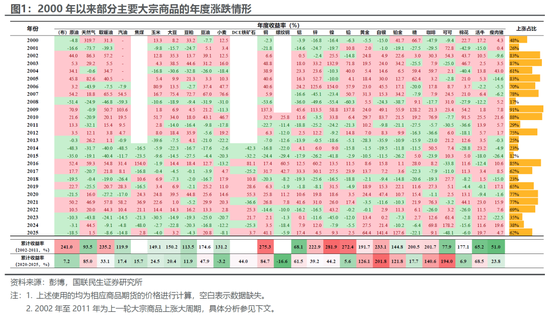
Group 1 - The current commodity price cycle, particularly for precious metals like gold and silver, is facing challenges, and the narrative surrounding the commodity price increase may still have room to develop [1][33] - The recent commodity price increase lacks breadth compared to the previous cycle from 2002 to 2011, where over 60% of major commodities experienced price increases, while the current cycle shows limited upward movement [1][33] - The report suggests that the current commodity price cycle may still be in its early stages, and further time may reveal greater upward potential [1][33] Group 2 - Since 1850, commodities have experienced five distinct upward cycles, with an average duration of approximately 12 years and an average price increase of 79% when adjusted for inflation [3][34] - The last two cycles have seen precious metals outperform, while the earlier cycles were characterized by stronger performances from energy, industrial metals, and agricultural products [5][36] - The report emphasizes the importance of analyzing the structural factors that drive these commodity cycles, including technological advancements and geopolitical tensions [6][18] Group 3 - Energy and industrial metals are considered the most stable and classic commodities, often driven by technological and industrial revolutions, as well as geopolitical conflicts [6][37] - Agricultural products have shown weaker long-term performance compared to other asset classes, often lagging behind inflation, but can excel during periods of significant supply shocks [9][41] - Gold and silver have not always been the primary focus in commodity cycles, with their significant price increases occurring mainly in the last two cycles due to the decoupling of currencies from gold standards [14][43] Group 4 - The report identifies three long-term perspectives that influence commodity cycles: war, technology, and emerging demand, highlighting that conflicts can disrupt supply chains and affect demand differently [18][19] - Technological cycles are noted to have a longer duration and can significantly impact commodity prices during their explosive and transitional phases [22][24] - Emerging demand often coincides with periods of war or technological transformation, driving commodity price increases [27][30]

策略周度思考 20260201:中盘蓝筹系列:大宗涨价的两条主线-20260201
Orient Securities· 2026-02-01 07:02
Group 1: Historical Price Trends - Historical price trends of commodities follow a sequence: precious metals, industrial metals, petrochemicals, and agricultural products[9] - Since 1970, there have been five significant commodity bull markets, defined by a price increase of over 50%[10] - The typical price increase sequence occurs in less than one quarter for precious metals, about two quarters for petrochemicals, and approximately one quarter for agricultural products[12] Group 2: Current Market Dynamics - Current market dynamics are influenced by domestic industrial transformation and global political changes[28] - Commodities closely tied to traditional industries, such as real estate, are expected to perform poorly due to reduced demand elasticity[30] - Emerging economies are expected to drive future demand growth, with a decoupling from developed economies observed[30] Group 3: Price Increase Pathways - The current price increase is characterized by external rather than internal factors, focusing on two main lines: industrialization in emerging economies and geopolitical tensions affecting import prices[43] - The first main line involves price increases driven by industrialization in emerging economies, which is expected to continue due to China's support[44] - The second main line is influenced by geopolitical risks, which can directly threaten commodity prices and create cost transmission effects[44] Group 4: Investment Outlook - The report is optimistic about the price outlook for the chemical and agricultural sectors while being conservative about commodities closely related to the real estate chain[44] - Risks include market performance falling short of expectations, insufficient pricing of geopolitical risks, and potential underperformance in industry development[45]

“红超”点燃韶关农文旅消费热潮
Xin Lang Cai Jing· 2026-02-01 02:48
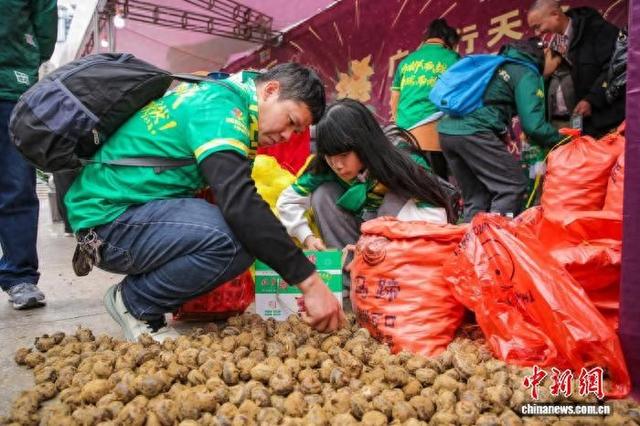
一杯杯暖心姜茶、一缕缕幽兰清香,让冬日的韶城漾起粤湘交融的温情,韶关兰花等农特产品也借着这 场盛会,成为郴州球迷心中的"广货爆款"。 集市里,兰花展区是最亮眼的打卡点。来自"中国兰花第一县"韶关翁源的兰花清香萦绕,株形飘逸的国 兰、色彩明艳的蝴蝶兰引得球迷们纷纷驻足拍照,连声夸赞"韶关兰花又香又美"。 中新网韶关2月1日电 (王坚 熊恬)"向胜利出发,为友谊喝彩"的嘹亮口号31日响彻广东韶关城区,郴州 球迷乘专列赴韶,为当日的2026"英东杯"粤湘赣"红三角"城市足球联赛助威。赛场旁的西河全民健身广 场,"广货行天下兰花进万家"2026年新春韶关年货节也热闹开集。 场。韶关市政府 供图 兰香醉人,韶味更勾人。韶关北乡马蹄摊位前,刚切好的马蹄果肉洁白饱满,球迷们尝上一口,清甜汁 水在舌尖迸发,无渣的脆嫩口感让人赞不绝口。 "我们早就做好攻略了!"郴州球迷杨利春表示,韶关人不仅热情还贴心,这里能一站式购齐年货,打算 多买些马蹄、粉葛和本地大米带回去。 在"马蹄推荐官"杨利春的吆喝下,摊位前瞬间排起长队,摊主忙得分身乏术,直呼"没想到韶关马蹄这 么受郴州朋友欢迎"。从尝鲜到抢购,一枚枚小小的马蹄,成为韶关农特好物的 ...