
教育

Search documents
枫叶教育(01317)12月11日斥资84.28万港元回购221.8万股
智通财经网· 2025-12-11 09:55
智通财经APP讯,枫叶教育(01317)发布公告,于2025年12月11日斥资84.28万港元回购221.8万股。 ...
光控资本:中长期支撑本轮A股上涨的基础并未发生转变
Sou Hu Cai Jing· 2025-12-11 05:18
Group 1: Federal Reserve Actions - The Federal Reserve is expected to lower interest rates by 25 basis points in December, with an increasing number of officials advocating for a pause in further rate cuts, indicating a higher threshold for additional reductions [1] - Powell's statements were not particularly hawkish, and the Fed announced plans to purchase short-term Treasury bills to alleviate market concerns [1] - Given ongoing economic and employment pressures, the Fed may continue to lower rates into 2026, but the pace of cuts is expected to slow due to persistent inflation [1] Group 2: Consumer Price Index (CPI) Insights - CPI has been rising since September, primarily due to increased vegetable prices, rising consumer goods and service prices under domestic demand expansion policies, and higher gold prices affecting jewelry costs [3] - Future CPI increases will depend on the easing of supply constraints as local vegetables come to market and the need for further expansion of national subsidies to support consumer goods and service prices [3] - The "14th Five-Year Plan" emphasizes expanding the supply of quality consumer goods and services as a key support for domestic demand strategy, leading to a cautiously optimistic outlook for future CPI increases [3] Group 3: A-Share Market Performance - The A-share market experienced fluctuations, with the Shanghai Composite Index finding support near 3876 points and showing a slight upward trend in the afternoon [4] - The average price-to-earnings ratios for the Shanghai Composite and ChiNext indices are 16.04 and 49.54, respectively, indicating a suitable environment for medium to long-term investments [4] - The market's upward potential is increasing due to supportive policies and improved liquidity, with expectations for the Shanghai Index to consolidate around the 4000-point mark [4]


早盘直击|今日行情关注
申万宏源证券上海北京西路营业部· 2025-12-11 03:23
Market Overview - The short-term market is characterized by a transitional year-end trend, primarily marked by low trading volume and narrow fluctuations [1] - Following a slight market decline on Tuesday, the market showed resilience with a rebound led by the real estate sector, resulting in a narrowing of losses and a positive close for the Shenzhen Composite Index [1] - Investor expectations for the market in the coming year remain high, with no significant short-selling pressure observed in the short term [1] Sector Performance - The real estate sector has emerged strongly, driven by both a rebound effect and market anticipation of increased policy support for the sector [1] - Other consumer sectors, such as commercial retail and education, have also shown signs of rotation, indicating a higher likelihood of short-term volatility [1] - In contrast, sectors such as power equipment, photovoltaic equipment, and wind power equipment experienced declines after initial gains, reflecting a rotational market behavior [1] Future Outlook - The market is expected to continue its consolidation phase, focusing on stability [1] - Technical indicators show a decrease in trading volume, suggesting an increased atmosphere of caution among investors [1] - Attention is drawn to the upcoming release of macroeconomic data for November and the alignment of market hotspots with trading volume [1]

英大证券晨会纪要-20251211
British Securities· 2025-12-11 03:22
Market Overview - The A-share market experienced volatility with a "V-shaped" reversal on Wednesday, driven by a surge in a leading real estate company's stock, which boosted market sentiment [2][10] - The current market is characterized by technical resistance above and policy support below, indicating a likely path of repeated fluctuations and potential upward movement [2][10] - Recent data from the National Bureau of Statistics shows a 0.7% year-on-year increase in CPI for November, suggesting marginal improvement in domestic demand [2][10] Sector Analysis Precious Metals - The precious metals sector saw significant gains, attributed to factors such as the onset of a Fed rate cut cycle, increased geopolitical tensions, and strong demand from global central banks [6] - The weakening dollar and inflation concerns have led investors to view gold as a hedge against inflation, with rising demand for gold in technology applications further supporting this trend [6] Hainan Free Trade Zone - Stocks related to the Hainan Free Trade Zone were notably active, with multiple stocks hitting the daily limit up. The upcoming full island closure operation on December 18 is expected to enhance market activity [7] - The new policies will allow for freer movement of goods within Hainan while maintaining controlled access from the mainland, which is anticipated to benefit related stocks [7] Real Estate - The real estate sector experienced a rebound, driven by the upcoming discussion on debt restructuring for a leading real estate company and ongoing supportive policies from the government [8] - The industry is expected to see a gradual alleviation of risks, with a focus on high-quality companies that have strong land reserves and are returning to stable growth [8] Investment Strategy - Investors are advised to focus on low-entry opportunities across various sectors, including technology growth (semiconductors, AI themes, robotics), cyclical industries (solar, batteries, chemicals), and dividend stocks (banks, utilities) [3][10] - It is recommended to select stocks with strong earnings support while avoiding high-valuation stocks lacking performance backing [3][10]
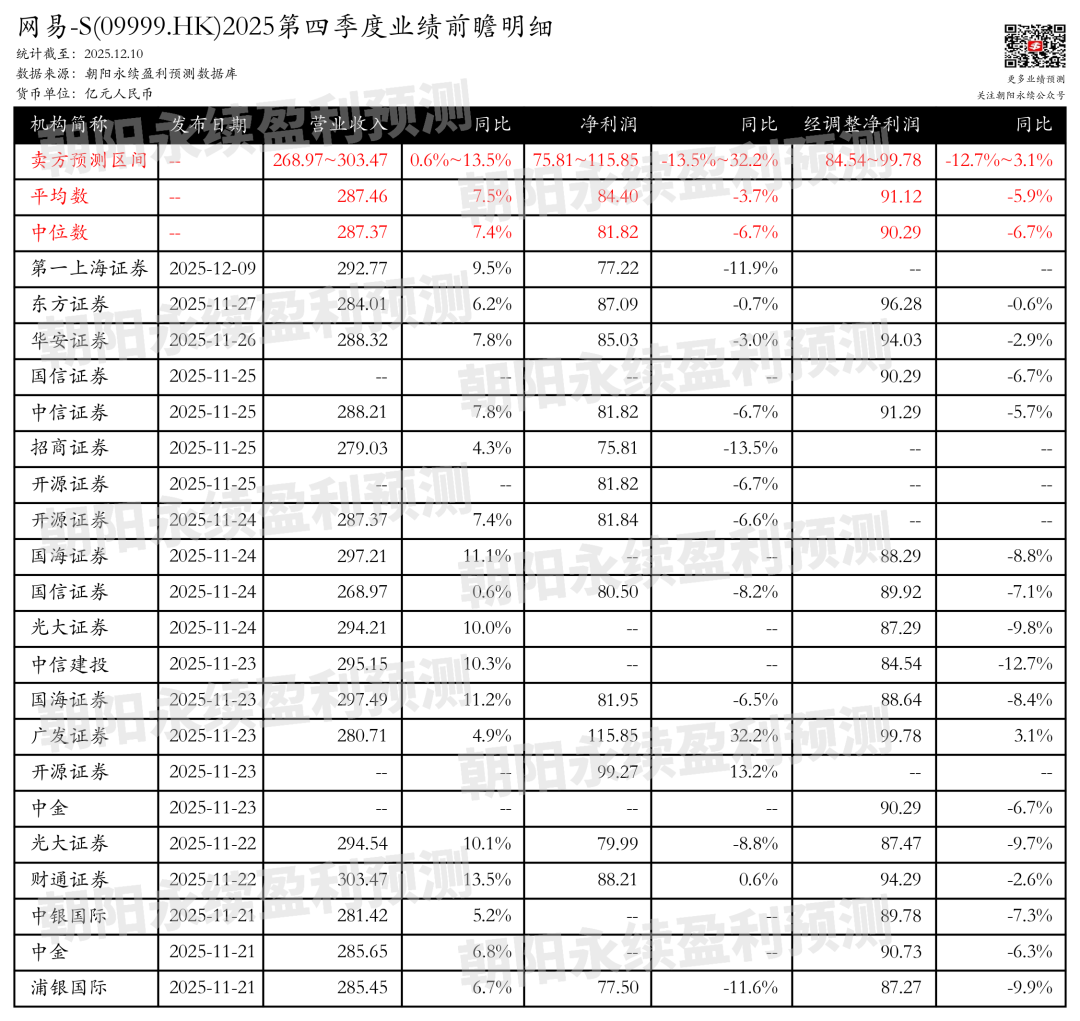
网易-S:AI赋能教育音乐,预测Q4一致预期营收268.97~303.47亿元,同比0.6%~13.5%
Xin Lang Cai Jing· 2025-12-10 11:50
Core Viewpoint - The company is expected to report Q4 revenue between 26.897 billion to 30.347 billion yuan, representing a year-on-year growth of 0.6% to 13.5% [1] - The anticipated net profit for Q4 is projected to be between 7.581 billion to 11.585 billion yuan, with a year-on-year change of -13.5% to 32.2% [1] - Adjusted net profit is forecasted to be between 8.454 billion to 9.978 billion yuan, showing a year-on-year change of -12.7% to 3.1% [1] Revenue and Profit Forecast - Q4 revenue consensus forecast ranges from 26.897 billion to 30.347 billion yuan, with an average estimate of 28.746 billion yuan, indicating a 7.5% year-on-year growth [3][10] - The average net profit estimate is 8.440 billion yuan, reflecting a -3.7% year-on-year change [3][10] - The average adjusted net profit is estimated at 9.112 billion yuan, showing a -5.9% year-on-year change [3][10] Recent Performance Insights - In Q3 2025, the company achieved revenue of 28.36 billion yuan, a year-on-year increase of 8.2%, with a gross margin of 64.1% [4][11] - Adjusted net profit for Q3 was 9.5 billion yuan, up 26.7% year-on-year, with a net profit margin of 33.5% [4][11] - The gaming segment generated 23.3 billion yuan in revenue, a growth of 11.8% year-on-year, driven by popular titles [4][11] Business Segment Highlights - The peak online user count for the game "Dream of the Red Chamber" reached 3.58 million [5][12] - The overseas game "Fate: Stars" topped download charts in multiple regions, with upcoming releases like "Diablo IV" [6][13] - The new generation of Youdao AI Q&A pen, SpaceX, allows users to ask over 10 questions daily [7][14] - The AI tuning master feature in Cloud Music enhances user experience through personalized adjustments [7][15] Future Projections - The company expects net profits for 2025, 2026, and 2027 to be 35.7 billion, 38.3 billion, and 42.9 billion yuan respectively, with corresponding PE ratios of 16.6, 15.5, and 13.8 [8][15]

卓越教育集团(03978):受托人依据受限制股份单位计划购买合共5万股
智通财经网· 2025-12-10 10:03
智通财经APP讯,卓越教育集团(03978)发布公告,于2025年12月10日,受限制股份单位计划受托人依据 受限制股份单位计划于公开市场上购买合共5万股股份。 ...
收评:三大指数涨跌不一 贵金属板块全天强势
Zhong Guo Jing Ji Wang· 2025-12-10 07:20
中国经济网北京12月10日讯 市场今日探底回升,三大指数涨跌不一。截至收盘,上证综指报3900.50点, 跌幅0.23%,成交额7303.60亿元;深证成指报13316.42点,涨幅0.29%,成交额10481.45亿元;创业板指报 3209.00点,跌幅0.02%,成交额4890.59亿元。 板块方面,贵金属、零售、教育等板块涨幅居前,贸易、其他电源设备、元件等板块跌幅居前。 A股市场板块涨跌幅排行 | 序号 | 板块 | 涨跌幅(%)▼ | | 总成交量(万手) = 总成交额(亿元)▼ | 净流入 (亿元) ▼ | 上涨家数 | 下跌家数 | | --- | --- | --- | --- | --- | --- | --- | --- | | 1 | 音类置 | 3.38 | 508.29 | 91.27 | 8.53 | 11 | 0 | | 2 | 零售 | 2.08 | 4397.03 | 304.60 | -20.78 | રેર | 14 | | 3 | 教育 | 1.87 | 622.18 | 40.46 | 1.52 | 12 | ব | | র্ব | 房地产 | 1.80 | 6012 ...
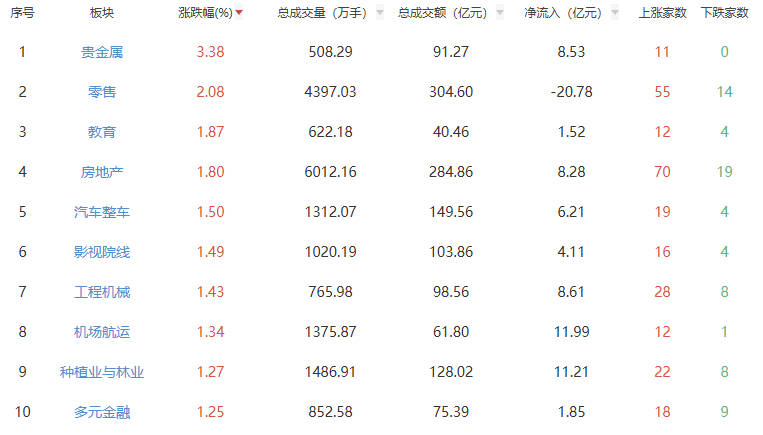
A股收评:沪指微跌0.23%险守3900点,深成指涨0.29%,海南及房地产概念股走强、零售股活跃,银行股走低
Jin Rong Jie· 2025-12-10 07:10
Market Overview - On December 10, A-shares showed mixed performance with the Shanghai Composite Index down 0.23% to 3900.50 points, while the Shenzhen Component Index rose 0.29% to 13316.42 points, and the ChiNext Index slightly fell by 0.02% to 3209.00 points [1] - The total trading volume in the Shanghai and Shenzhen markets reached 1.78 trillion, with over 2800 stocks declining [1] Sector Performance - **Retail Sector**: The retail sector continued its strong performance, with stocks like Dongbai Group and Yonghui Supermarket hitting the daily limit. The National Retail Innovation Development Conference emphasized the importance of retail in driving domestic demand and high-quality development [2] - **Hainan Sector**: The Hainan sector saw significant gains, with stocks such as Hainan Ruize and Ronow Mountain reaching the daily limit. The upcoming full island closure operation of Hainan Free Trade Port on December 18 is expected to boost the sector [3] - **Precious Metals Sector**: The precious metals sector rose, led by companies like Xiaocheng Technology. Silver prices have increased by nearly 110% this year, with significant daily gains noted [4] Institutional Insights - **China Bank Securities**: The firm anticipates an early start to the "spring excitement" market, supported by funds and policies, with expectations of a bull market continuing into next year [5] - **Cinda Securities**: The firm suggests December may serve as a window for positioning in the cross-year market, although the timing for a market rally may not be immediate due to current high valuations [6] - **CITIC Securities**: The firm notes that before any unexpected changes in domestic demand, market fluctuations and structural opportunities will be the norm, with a focus on resource and traditional manufacturing sectors [7]
广西六大领域改革释放澎湃动能
Guang Xi Ri Bao· 2025-12-10 03:11
Core Insights - The Guangxi region has made significant progress in economic reforms since the start of the 14th Five-Year Plan, leading to a GDP growth of 5.3% year-on-year in the first three quarters of 2025, which is consistently above the national average [1] Economic Reform and Development - Guangxi is focusing on economic system reforms to drive high-quality development, establishing a development path that integrates R&D from major cities with applications in ASEAN [1] - The region is enhancing the non-ferrous metal industry through a "Ten Ones" initiative, aiming for high-quality development in key metal sectors [1] - There are ongoing reforms in state-owned enterprises and measures to promote the high-quality development of the private economy [1] Open Economy and Trade - Guangxi is improving its open economy system, achieving a 30% increase in operational efficiency through the integration of rail and sea transport at the Beibu Gulf Port [2] - The region is actively constructing the Western Land-Sea New Corridor and enhancing connectivity across land, sea, air, and digital platforms [2] - The Free Trade Zone is undergoing upgrades, with three reform outcomes recognized as best practices nationally [2] Social and Cultural Development - The region is advancing reforms in democracy and the rule of law, with a focus on national unity and social stability, achieving a 98.22% public safety perception in the third quarter [2] - Cultural reforms are fostering innovation, with significant advancements in media integration and tourism branding [2] Public Welfare and Quality of Life - Guangxi is enhancing its social welfare system, with five vocational schools selected for a national high-level program and improvements in healthcare access [3] - The region is addressing rural elderly care services and has been recognized for its air and water quality [3] - Guangxi has also been successful in poverty alleviation, with 13 cases recognized globally, the highest in the country [3] Party and Governance Reforms - The region is implementing reforms in party governance, focusing on grassroots party building and community governance [3]
教育部发布《卓越工程师教育认证标准》
Zhong Guo Xin Wen Wang· 2025-12-10 02:46
Core Viewpoint - The Ministry of Education has released the "Excellence Engineer Education Certification Standards" as an industry standard, effective immediately upon publication [1][2]. Group 1 - The standard aims to implement the spirit of the 20th National Congress of the Communist Party and subsequent plenary sessions, as well as the important speeches of General Secretary Xi Jinping [2]. - The initiative is part of the broader "Education Strong Nation Construction Plan Outline (2024-2035)" to accelerate the establishment of a Chinese-style, world-class excellence engineer training system [2].