
高技术制造业

Search documents
我国经济总体产出保持稳定 10月份三大重点行业PMI继续位于扩张区间
Jing Ji Ri Bao· 2025-11-03 00:34
Core Insights - The manufacturing Purchasing Managers' Index (PMI) for October is at 49.0%, a decrease of 0.8 percentage points from the previous month, indicating a slowdown in manufacturing activity [1] - The non-manufacturing business activity index is at 50.1%, an increase of 0.1 percentage points from last month, suggesting stability in the non-manufacturing sector [2] - The comprehensive PMI output index is at 50.0%, down 0.6 percentage points from the previous month, reflecting overall economic stability [1] Manufacturing Sector - Manufacturing production and new orders indices are at 49.7% and 48.8%, respectively, down 2.2 and 0.9 percentage points from last month, indicating a decline in production and market demand [1] - High-tech manufacturing, equipment manufacturing, and consumer goods industries have PMIs of 50.5%, 50.2%, and 50.1%, respectively, all remaining in the expansion zone and significantly above the overall manufacturing level [1] Enterprise Size Analysis - The PMIs for large, medium, and small enterprises are 49.9%, 48.7%, and 47.1%, showing a decline of 1.1, 0.1, and 1.1 percentage points, respectively, indicating a decrease in economic sentiment across all sizes [2] - Large enterprises have production and new orders indices at 50.9% and 50.1%, respectively, remaining in the expansion zone for six consecutive months, indicating sustained production and demand [2] Non-Manufacturing Sector - The non-manufacturing business activity index is at 50.1%, up 0.1 percentage points, indicating continued stability in non-manufacturing operations [2] - The service sector business activity index is at 50.2%, reflecting a slight increase and improved sentiment in the service industry [2] - The construction industry business activity index is at 49.1%, down 0.2 percentage points, indicating a decline in construction activity [2] Economic Outlook - The slight increase in the business activity index for October suggests stable operations in the non-manufacturing sector, supported by holiday consumption and positive changes in investment and consumption-related activities [3] - The effectiveness of growth-stabilizing policies is expected to strengthen domestic demand in the fourth quarter, providing solid support for achieving annual economic and social development goals [3]
10月份三大重点行业PMI继续位于扩张区间—— 我国经济总体产出保持稳定
Jing Ji Ri Bao· 2025-11-03 00:10
Core Insights - The manufacturing Purchasing Managers' Index (PMI) for October is at 49.0%, a decrease of 0.8 percentage points from the previous month, indicating a slowdown in manufacturing activity [1] - The non-manufacturing business activity index is at 50.1%, an increase of 0.1 percentage points from last month, suggesting stability in the non-manufacturing sector [1] - The comprehensive PMI output index is at 50.0%, down 0.6 percentage points from the previous month, reflecting overall economic stability [1] Manufacturing Sector - Manufacturing production and new orders indices are at 49.7% and 48.8%, respectively, down 2.2 and 0.9 percentage points from last month, indicating a decline in production and market demand [1] - High-tech manufacturing, equipment manufacturing, and consumer goods industries have PMIs of 50.5%, 50.2%, and 50.1%, respectively, all remaining in the expansion zone and significantly above the overall manufacturing level [1] Enterprise Size Analysis - The PMIs for large, medium, and small enterprises are 49.9%, 48.7%, and 47.1%, showing a decline of 1.1, 0.1, and 1.1 percentage points, respectively, indicating varying levels of economic activity [2] - Large enterprises have production and new orders indices at 50.9% and 50.1%, respectively, remaining in the expansion zone for six consecutive months [2] Price Trends - The equipment manufacturing purchase price index and factory price index have risen for three consecutive months, with the factory price index reaching a new high since June 2024 [2] - High-tech manufacturing purchase and factory price indices have also increased, with the factory price index hitting a new high for the year [2] Non-Manufacturing Sector - The non-manufacturing business activity index is at 50.1%, indicating a slight increase and stability in operations [3] - The service sector business activity index is at 50.2%, reflecting a recovery in service sector activity, while the construction sector index is at 49.1%, showing a decline [2][3] Consumer Behavior - Holiday consumption has supported the stability of the non-manufacturing sector, with positive performance in travel, shopping, tourism, and dining [3] - Investment and consumption-related activities are showing positive changes, contributing to the overall economic stability [3]
陆家嘴财经早餐2025年11月3日星期一
Wind万得· 2025-11-02 23:32
Group 1 - Anshi China refutes claims from Dutch Anshi Semiconductor regarding contract payment defaults, stating that the latter owes ATGD 1 billion RMB [2] - Anshi China has sufficient finished and in-process inventory to meet customer demand until the end of the year and is actively verifying new wafer production capacity [2] Group 2 - The Chinese government is focusing on expanding bilateral investment cooperation, with plans to introduce more detailed measures to stabilize foreign investment [3] - The Minister of Commerce emphasizes the importance of maintaining stable supply chains and enhancing cooperation with South Korea and Japan [4] Group 3 - High-tech manufacturing in China saw a 9.6% year-on-year increase in value added, contributing 24.7% to overall industrial growth [4] - The automotive sector, particularly in new energy vehicles, is experiencing significant growth, with companies like BYD and Xpeng reporting substantial increases in sales [12] Group 4 - The A-share market is showing strong performance, with over 5446 listed companies reporting a total revenue of 53.46 trillion RMB and a net profit of 4.70 trillion RMB for the first three quarters [6] - Insurance institutions have increased their equity investments in A-shares, with a total market value exceeding 650 billion RMB [8] Group 5 - The government of Shanxi Province successfully issued 2.373 billion RMB in government bonds, indicating strong demand with an average bid multiple of 23.51 times [17] - New tax policies for gold transactions are expected to enhance the transparency and health of the gold market [18]



10月PMI点评:基本面对债市的定价权再次确认
Changjiang Securities· 2025-11-02 23:30
1. Report Industry Investment Rating No information provided in the given content. 2. Core Viewpoints of the Report - In October 2025, the decline of manufacturing PMI, weaker than the seasonal level and with weakening supply and demand, may indicate certain downward pressure on the Q4 economy [2][7]. - Both domestic and external demands declined, and price indicators did not continue the improvement trend of last month. The differentiated structure of "strong raw material prices and weak finished - product prices" may restrict the repair of corporate profits [2][7]. - The business climate of large enterprises fell below the boom - bust line, and the business climates of high - tech manufacturing and equipment manufacturing industries significantly declined [2][7]. - The business climate of the non - manufacturing industry is mainly driven by holiday service consumption, and the overall expansion strength is still weak [2][7]. - The trading logic of the bond market in Q4 focuses on the weakening economic fundamentals and the expectation of monetary easing, and a repair market may be welcomed. It is expected that the yield of the active 10 - year treasury bond (tax - exempt) may decline to 1.65% - 1.7%, and the yield of the taxable bond may decline to 1.7% - 1.75% [2][7]. 3. Summary by Relevant Catalogs 3.1 Event Description - In October 2025, the manufacturing PMI was 49.0%, a decrease of 0.8 pct from the previous month, lower than the Wind consensus forecast of 50.0%. The non - manufacturing business activity index slightly increased by 0.1 pct to 50.1%, slightly higher than the boom - bust line and lower than the Wind consensus forecast of 50.3%. Among them, the service industry business activity index was 50.2%, an increase of 0.1 pct, and the construction industry business activity index was 49.1%, a decrease of 0.2 pct [5]. 3.2 Event Comment - **Manufacturing PMI and economic pressure**: The manufacturing PMI in October 2025 fell back to a nearly two - year low. The production index and new order index decreased by 2.2 pct and 0.9 pct respectively to 49.7% and 48.8%. The procurement volume index decreased significantly by 2.6 pct to 49.0%, and the difference between the "finished - product inventory - on - hand orders" index widened by 0.6 pct to 3.6 pct. The weak pattern of production and demand was partly due to the pre - release of some demand before the National Day holiday and partly reflected the lack of endogenous momentum, indicating certain downward pressure on the Q4 economy [7]. - **Demand and price situation**: In October, external demand did not continue its resilience, and the new export order index significantly declined by 1.9 pct to 45.9%. The new order index for domestic demand also turned from rising to falling. The main raw material purchase price index and the ex - factory price index both decreased by 0.7 pct, recording 52.5% and 47.5% respectively. The difference between them remained at 5.0 pct, and the main raw material purchase price index was still in the expansion range. The "strong raw material prices and weak finished - product prices" structure may restrict the repair of corporate profits [7]. - **Enterprise and industry changes**: Among enterprises, the PMIs of large and small enterprises both fell by 1.1 pct to 49.9% and 47.1% respectively, and the PMI of medium - sized enterprises slightly fell by 0.1 pct to 48.7%. In terms of industries, the PMIs of high - tech manufacturing and equipment manufacturing industries were 50.5% and 50.2% respectively, a decline of 1.1 pct and 1.7 pct from the previous month. The consumer goods industry remained in the expansion range, slightly falling by 0.5 pct to 50.1%, while the PMI of the basic raw material industry further dropped to 47.3%. The overall market expectation was optimistic, with the production and business activity expectation index at 52.8%, and the expectation indexes of industries such as non - ferrous metals and transportation equipment rising to the high - level boom range above 60% [7]. - **Non - manufacturing industry situation**: In October, the non - manufacturing PMI slightly increased by 0.1 pct to 50.1%, and the service industry PMI rose to 50.2%. The on - hand order index fell by 0.8 pct while the new order index remained flat, indicating that the holiday effect was the main driver. The business activity indexes of industries such as transportation, accommodation, and culture and entertainment were all in the high - level boom range above 60%, but industries such as real estate continued to be sluggish. The construction industry business activity index turned from rising to falling, decreasing by 0.2 pct to 49.1%, possibly dragged down by the slowdown of holiday construction and the decline of post - holiday real estate sales [7]. - **Bond market outlook**: Currently, the endogenous momentum for the repair of production and demand may be limited. On the day when the PMI data was released, the yield of the 10 - year treasury bond active bond decreased by 0.95 BP. The economic fundamentals still face a pattern of weak supply and demand, the pressure on enterprises for passive inventory replenishment continues, and the ex - factory - raw material price gap still restricts the repair of corporate profits. Although 500 billion yuan of new policy - based financial instruments have been put in place and local governments have an additional 200 billion yuan of special bond quotas, the sustainability of the recovery of real estate sales and the transmission effect of policy funds on infrastructure investment still need to be observed. The trading logic of the bond market in Q4 focuses on the weakening economic fundamentals and the expectation of monetary easing, and a repair market may be welcomed. It is expected that the yield of the active 10 - year treasury bond (tax - exempt) may decline to 1.65% - 1.7%, and the yield of the taxable bond may decline to 1.7% - 1.75% [7].
我国经济总体产出保持稳定
Jing Ji Ri Bao· 2025-11-02 23:20
Group 1 - The manufacturing Purchasing Managers' Index (PMI) for October is 49.0%, a decrease of 0.8 percentage points from the previous month, indicating a slowdown in manufacturing activity [1] - The non-manufacturing business activity index is at 50.1%, an increase of 0.1 percentage points from last month, suggesting stability in the non-manufacturing sector [1] - The comprehensive PMI output index is 50.0%, down 0.6 percentage points from the previous month, reflecting overall economic stability [1] Group 2 - In October, the production index and new orders index for manufacturing are 49.7% and 48.8%, respectively, showing declines of 2.2 and 0.9 percentage points from last month, indicating reduced production and market demand [1] - Factors contributing to the slowdown include international trade uncertainties and seasonal factors related to holidays, which historically lead to a decline in production indices in October [1] - High-tech manufacturing, equipment manufacturing, and consumer goods industries have PMIs of 50.5%, 50.2%, and 50.1%, respectively, all remaining in the expansion zone and significantly above the overall manufacturing level [1] Group 3 - The PMIs for large, medium, and small enterprises are 49.9%, 48.7%, and 47.1%, respectively, with all showing declines from the previous month, indicating varying levels of economic activity [2] - Large enterprises have production and new orders indices of 50.9% and 50.1%, respectively, remaining in the expansion zone for six consecutive months, indicating sustained production and demand [2] - The equipment manufacturing purchase price index and factory price index have risen for three consecutive months, with the factory price index reaching a new high since June 2024 [2] Group 4 - The non-manufacturing business activity index has increased to 50.1%, indicating a stable operating environment, supported by holiday consumption trends [3] - The service sector business activity index is at 50.2%, reflecting a slight recovery in service sector activity [2][3] - Investment and consumption-related activities are showing positive changes, with strong performance in travel, shopping, and entertainment sectors, contributing to overall economic stability [3]
薛鹤翔:“十五五”锚定发展新航向
Sou Hu Cai Jing· 2025-11-02 11:32
Group 1 - Manufacturing PMI fell to 49.0% in October, indicating a contraction due to short-term disturbances from pre-holiday demand release and complex international environment [9][11] - The decline in PMI is not a signal of overall weakness, as large enterprises and advantageous industries continue to show resilience, while small and medium enterprises face pressure [11][12] - High-tech manufacturing, equipment manufacturing, and consumer goods industries maintain expansion in PMI, serving as core support for stabilizing manufacturing [12][31] Group 2 - The non-manufacturing business activity index slightly rose to 50.1%, driven by structural recovery in the service sector, although recovery remains uneven across industries [13][31] - The economic outlook indicates a need for more precise policy alignment with the pain points in specific sectors to support demand recovery [11][12] - The overall economic performance shows signs of stabilization, with a focus on high-quality development and structural optimization [28][31] Group 3 - The U.S. Federal Reserve lowered the benchmark interest rate by 25 basis points to 3.75%-4.00% in October, marking the second consecutive rate cut [22][24] - Despite a cooling of December rate cut expectations, there remains potential for further rate reductions based on economic and inflation conditions [22][25] - The U.S. economy is exhibiting signs of "stagflation," with nominal growth under pressure and rising unemployment, yet the likelihood of significant inflation remains low [23][25]

31省份经济三季报:广东、江苏破10万亿,西藏、甘肃、湖北增速前三
21世纪经济报道· 2025-11-01 05:03
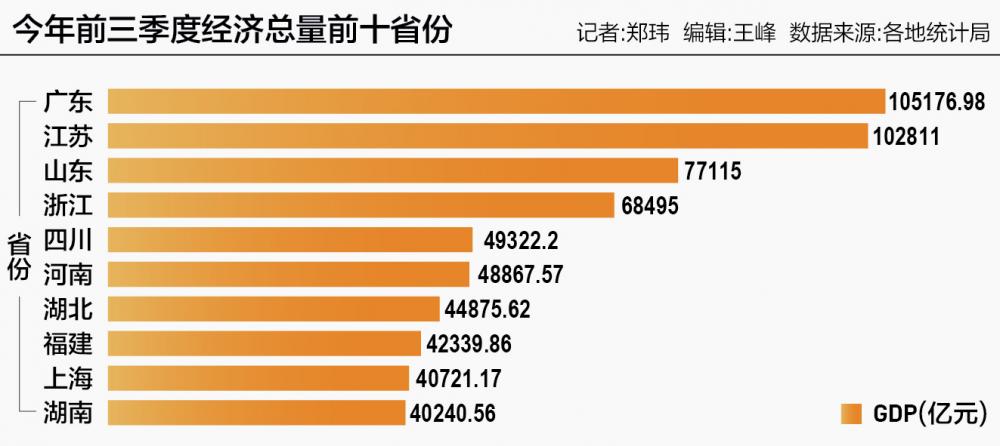
Economic Overview - As of October 31, all 31 provinces in China have released their Q3 reports for 2025, revealing new changes in the national economic landscape as the year-end approaches [1] - Guangdong, Jiangsu, and Shandong remain the top three provinces by GDP, with Guangdong leading at 105,176.98 billion yuan, followed by Jiangsu at 102,811 billion yuan, and Shandong at 77,115 billion yuan [1][6] Economic Growth - Central and western provinces, represented by Hubei and Tibet, have shown impressive GDP growth rates, with Hubei achieving 6.0% and Tibet at 7.1%, the highest in the country [1][8] - Hubei's GDP growth outpaced the national average of 5.2% by 0.4 percentage points, while Henan also exceeded the average with a growth rate of 5.6% [1][8] Industrial Development - The development of high-tech manufacturing has been a key driver for GDP growth across multiple provinces, with significant contributions to exports and industrial investment [1][11] - In Guangdong, the industrial added value increased by 3.5% year-on-year, with advanced manufacturing and high-tech manufacturing growing by 5.4% and 6.4%, respectively [6][11] Investment Initiatives - Guangdong has introduced ten measures to expand effective industrial investment, focusing on sectors like solid-state batteries and electric vertical takeoff and landing vehicles [2][14] - Sichuan has also announced policies to incentivize industrial project completion, offering up to 1,500 million yuan for project completion rewards [2][15] Export Performance - Hubei's exports reached 4,351.0 billion yuan in Q3, with a remarkable growth rate of 30.8%, driven by high-tech products such as computers and lithium-ion batteries [9][11] - Similarly, Zhejiang's exports totaled 3.16 trillion yuan, achieving an 8.3% year-on-year increase, with new high-tech products contributing significantly to this growth [12]

31省份三季报出炉:粤苏鲁三省仍稳居全国前三 高技术制造业提供关键支撑
2 1 Shi Ji Jing Ji Bao Dao· 2025-11-01 02:13
Economic Overview - As of October 31, all 31 provinces in China have released their Q3 reports for 2025, revealing significant economic changes as the year-end approaches [1][3] - Guangdong, Jiangsu, and Shandong remain the top three provinces by GDP, with Guangdong leading at 105,176.98 billion yuan, followed by Jiangsu at 102,811 billion yuan, and Shandong at 77,115 billion yuan [1][6] Economic Growth - Central and western provinces like Hubei and Tibet have shown impressive GDP growth rates, with Hubei achieving 6.0% and Tibet 7.1%, the highest in the country [1][8] - Hubei's GDP growth is supported by strong performance in consumption, investment, and exports, with a notable 30.8% increase in export value [9][10] High-tech Manufacturing - High-tech manufacturing has been a crucial driver of GDP growth across multiple provinces, significantly contributing to industrial investment and export performance [11][12] - In Guangdong, high-tech manufacturing's added value grew by 6.4%, while in Jiangsu, it accounted for 51.8% of industrial output [6][11] Policy Initiatives - Guangdong has introduced measures to expand effective industrial investment, focusing on sectors like solid-state batteries and electric vertical takeoff and landing vehicles [2][14] - Sichuan has also announced policies to incentivize industrial project completion, offering up to 1,500 million yuan in rewards [2][15] Export Performance - High-tech products have driven export growth, with Hubei's exports of electromechanical products reaching 2,191.7 billion yuan, a 19.8% increase [10][12] - Zhejiang's exports totaled 3.16 trillion yuan, with new high-tech products contributing significantly to this growth [12][13]
10月制造业PMI为49.0%经济总体产出保持稳定
Zhong Guo Zheng Quan Bao· 2025-11-01 02:09
Group 1 - The manufacturing Purchasing Managers' Index (PMI) for October is reported at 49.0%, a decrease of 0.8 percentage points from the previous month, indicating a slowdown in manufacturing activity [1] - The non-manufacturing business activity index is at 50.1%, an increase of 0.1 percentage points from last month, suggesting stability in the non-manufacturing sector [1] - The comprehensive PMI output index stands at 50.0%, down 0.6 percentage points from the previous month, reflecting overall economic stability [1] Group 2 - In October, the production index and new orders index for manufacturing are at 49.7% and 48.8%, respectively, showing declines of 2.2 and 0.9 percentage points, indicating reduced production and market demand [1] - Key industries such as food processing, automotive, and aerospace show production and new orders indices above 52.0%, indicating active supply and demand [1] - Large enterprises maintain production and new orders indices above the critical point, with values of 50.9% and 50.1%, respectively, indicating sustained expansion for six consecutive months [1] Group 3 - High-tech manufacturing, equipment manufacturing, and consumer goods industries have PMIs of 50.5%, 50.2%, and 50.1%, respectively, all remaining in the expansion zone and significantly above the overall manufacturing level [2] - The production and business activity expectation index for October is at 52.8%, indicating optimistic market expectations among manufacturing enterprises [2] - The non-manufacturing business activity index reflects a slight increase, with the service sector's index at 50.2%, indicating a recovery in service sector activity [2] Group 4 - The business activity expectation index for the service sector is at 56.1%, indicating strong confidence among service enterprises regarding industry development [2] - Overall, non-manufacturing sectors are stabilizing, with positive changes in investment and consumption-related activities, supported by effective growth policies [2] - The fourth quarter is expected to see strengthened domestic demand, providing solid support for achieving annual economic and social development goals [2]
10月制造业PMI为49.0% 经济总体产出保持稳定
Zhong Guo Zheng Quan Bao· 2025-11-01 00:16
Group 1 - In October, the manufacturing Purchasing Managers' Index (PMI) decreased to 49.0%, down 0.8 percentage points from the previous month, indicating a slowdown in manufacturing activity [1] - The production index and new orders index for manufacturing were 49.7% and 48.8%, respectively, both showing declines of 2.2 and 0.9 percentage points from last month, reflecting weakened production and market demand [1] - Large enterprises maintained production and new orders indices above the critical point, with values of 50.9% and 50.1%, respectively, indicating sustained expansion for six consecutive months [1] Group 2 - Three key sectors, namely high-tech manufacturing, equipment manufacturing, and consumer goods, reported PMIs of 50.5%, 50.2%, and 50.1%, respectively, all remaining in the expansion zone and significantly above the overall manufacturing level [2] - The production and business activity expectation index for October was 52.8%, indicating that most manufacturing companies maintain an optimistic outlook for market development [2] Group 3 - The non-manufacturing business activity index rose to 50.1%, up 0.1 percentage points from the previous month, indicating expansion in the non-manufacturing sector [3] - The service sector's business activity index continued to expand at 50.2%, reflecting a slight recovery in service sector activity levels [3] - The business activity expectation index for the service sector was 56.1%, indicating strong confidence among service enterprises regarding industry development [3]