
农林牧渔

Search documents
量化择时周报:趋势指标进入边缘位置,由重仓位到重结构
ZHONGTAI SECURITIES· 2026-02-01 13:30
Investment Rating - The industry rating is "Overweight," indicating an expected increase of over 10% relative to the benchmark index in the next 6 to 12 months [16]. Core Insights - The market is currently in an upward trend, with the core observation being whether the profit-making effect is positive. The market trend line is near 6800 points, and the profit-making effect is at the zero value edge, suggesting the potential for a halt in the upward trend [5][8]. - The short-term outlook indicates continued outflows from broad-based ETFs, particularly the CSI 300 ETF, which is exerting pressure on the index. A significant drop in non-ferrous metals has also dampened short-term risk appetite [7][8]. - The industry trend configuration model suggests waiting for reversal signals in the liquor and real estate sectors, while the TWO BETA model continues to recommend the technology sector, focusing on rebound opportunities in commercial aerospace [6][8]. Summary by Sections Market Overview - The WIND All A index is in an upward trend, with a significant distance of 6.77% between the short-term (20-day) and long-term (120-day) moving averages, indicating a continued upward trend [5][9]. - The market experienced a decline of 1.59% last week, with small-cap stocks (CSI 1000) down 2.55% and mid-cap stocks (CSI 500) down 2.56%. The CSI 300 saw a slight increase of 0.08%, while the SSE 50 rose by 1.13% [2][7]. Valuation Metrics - The PE ratio of the WIND All A index is at the 90th percentile, indicating a high valuation level, while the PB ratio is at the 50th percentile, suggesting a moderate valuation level [9][11]. Positioning Recommendations - The report recommends a 70% allocation to absolute return products based on the WIND All A index, reflecting a cautious but optimistic stance on market conditions [9][10]. - The performance trend model highlights the importance of focusing on the computing power-related industry chain and suggests waiting for significant volume reductions in high-performing cyclical sectors such as industrial non-ferrous metals and chemicals [6][14].
量化择时周报:趋势指标进入边缘位置,由重仓位到重结构-20260201
ZHONGTAI SECURITIES· 2026-02-01 11:51
证券研究报告/金融工程定期报告 2026 年 02 月 01 日 分析师:吴先兴 执业证书编号:S0740525110003 Email:wuxx02@zts.com.cn 量化择时周报:趋势指标进入边缘位置,由重仓位到重结构 分析师:王鹏飞 执业证书编号:S0740525060001 Email:wangpf@zts.com.cn 1、《量化择时周报:牛市格局仍在延 续,主题投资重回主线》2026-01-25 2、《沪深 300 增强策略本周超额收益 3.90%》2026-01-25 3、《净利润断层策略本周绝对收益 1.99%》2026-01-18 报告摘要 趋势指标进入边缘位置,由重仓位到重结构 请务必阅读正文之后的重要声明部分 相关报告 上周周报(20260125)认为:尽管 ETF 份额的持续下降,对市场有短线压力,但在 每日近 3 万亿金额的成交下,预计影响也较为有限,市场上行趋势仍将延续。最终 WIND 全 A 在 ETF 份额持续下降的影响和周五周期股大幅回调的影响下,全周下跌 1.59%。市值维度上,上周代表小市值股票的中证 1000 下跌 2.55%,中盘股中证 500 指数下跌 2.56 ...
金融工程:AI识图关注石化、化工和有色
GF SECURITIES· 2026-02-01 04:30
Quantitative Models and Construction Methods 1. Model Name: Convolutional Neural Network (CNN) for Price-Volume Data Modeling - **Model Construction Idea**: The model leverages convolutional neural networks to analyze standardized graphical representations of price-volume data, aiming to predict future price trends and map learned features to industry thematic indices[79][81] - **Model Construction Process**: - Standardize price-volume data into graphical formats for each stock within a specific time window[79] - Apply convolutional neural networks to extract features from these graphical representations[79] - Map the extracted features to thematic industry indices, such as the CSI Petrochemical Industry Index, CSI Subdivision Chemical Industry Theme Index, and others[81] - **Model Evaluation**: The model effectively identifies industry themes based on price-volume data and provides actionable insights for sector allocation[79][81] --- Model Backtesting Results 1. CNN Model - **Thematic Indices Configured**: - CSI Petrochemical Industry Index (h11057.CSI)[81] - CSI Subdivision Chemical Industry Theme Index (000813.CSI)[81] - CNI Oil & Gas Index (399439.SZ)[81] - CSI Oil & Gas Resources Index (931248.CSI)[81] - CNI Nonferrous Metals Index (399395.SZ)[81]
如何看待商品行情的大幅波动?
ZHONGTAI SECURITIES· 2026-01-31 14:47
分析师:徐驰 执业证书编号:S0740519080003 如何看待商品行情的大幅波动? 报告摘要 如何看待商品行情的大幅波动? 相关报告 本周 A 股市场整体呈现高位震荡回落格局,成交维持高位但赚钱效应明显走弱。从 指数表现看,市场结构分化显著:主要宽基指数多数下跌,其中上证指数本周下跌 0.44%,深证成指下跌 1.62%,创业板指基本持平(-0.09%)。从成交情况看,市 场交投依然活跃。本周万得全 A 日均成交额约 3.06 万亿元,较上周提升约 9.44%, 显示尽管指数承压,但增量资金并未明显撤离,市场流动性基础仍然稳固。从赚钱效 应看,本周市场情绪明显降温。全周日均上涨家数占比仅为 34.80%,较上周大幅回 落,个股层面呈现"跌多涨少"的特征。 Email:xuchi@zts.com.cn 分析师:张文宇 执业证书编号:S0740520120003 Email:zhangwy01@zts.com.cn 证券研究报告/策略定期报告 2026 年 01 月 31 日 本周 A 股大宗商品相关板块表现强势,成为周度涨幅靠前的核心主线,但内部分化 与波动显著放大。从申万一级行业周度涨幅来看,石油石化(7 ...
重大信号出现!这个板块暴跌之后,我准备卖房抄底!
Sou Hu Cai Jing· 2026-01-31 03:48
Market Overview - The A-share market showed mixed performance with the Shanghai Composite Index down by 0.96%, Shenzhen Component down by 0.66%, and the ChiNext Index up by 1.27% [1] - The total trading volume in the Shanghai, Shenzhen, and Beijing markets was 28,624 billion yuan, a decrease of 3,970 billion yuan from the previous day [1] Sector Performance - AI hardware sectors saw a broad increase, with significant gains in optical modules, optical circuit switching, optical communication, optical chips, and advanced packaging [1] - The non-ferrous metals sector experienced a collective sharp decline, with industrial metals, rare earths, gold and jewelry, and other related sectors showing significant losses [1] - Traditional sectors like liquor and real estate, referred to as "old stocks," performed poorly after a recent surge [1] Investment Sentiment - The market is experiencing a significant risk rotation, with funds flowing into underperforming technology and agriculture sectors as a form of risk aversion [1] - Despite the sharp decline in the non-ferrous metals sector, it is believed to have medium to long-term investment value, with the performance of this sector closely tied to commodity prices, particularly gold [9] - The liquidity in the market remains robust, as indicated by the reduced trading volume being attributed to investors locking in positions rather than panic selling [5] Specific Stock Insights - The liquor index showed a significant decrease in trading volume, suggesting that large funds are not exiting but rather locking in positions, indicating potential for future gains [10][11] - The "old stocks" like liquor and real estate may present opportunities for short-term trading, with potential returns of 10%-20% based on technical signals [10]

北交所日报-20260130
Yin He Zheng Quan· 2026-01-30 13:01
北交所日报 北交所日报(2026.01.30) 2026 年 01 月 30 日 核心观点 分析师 范想想 :zhangzhihao_yj@chinastock.com.cn 分析师登记编码:S0130524100001 相对沪深 300 表现图 2026-01-30 资料来源:iFinD,中国银河证券研究院 相关研究 1. 【银河北交所】2026 年度策略_ 小而美美到"小 美久到,推动北证高质量发展 2. 【银河北交所】小十五五到:北交所引领中而企业 再进阶 3. 【银河北交所】2025 年度中期策略_并购协同促 新格局,提质扩容迎新供给 :010-8092-7663 :fanxiangxiang_yj @chinastock.com.cn 分析师登记编码:S0130518090002 张智浩 www.chinastock.com.cn 证券研究报告 请务必阅读正文最后的中国银河证券股份有限公司免责声明 1 资料来源:中国银河证券研究院 ⚫ 1 月 30 日,北证 50 涨跌幅为-0.29%,收于 1,531.55 点。同日,北证 专精特新指数收于 2,571.08 点,涨跌幅为-0.29%;上证指数收于 ...
商品市场大幅波动
Tebon Securities· 2026-01-30 11:18
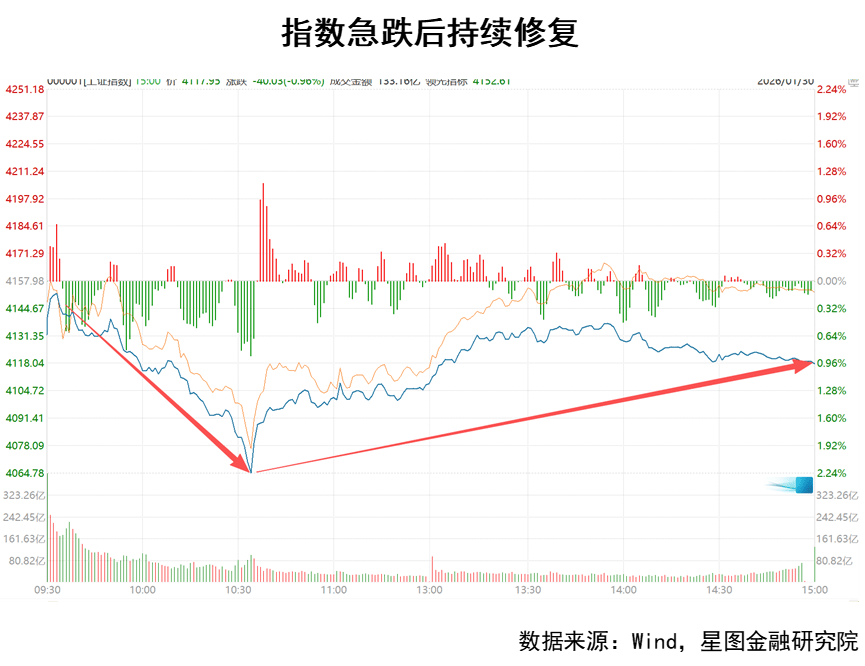
Group 1: Report Summary Investment Rating - The document does not mention the industry investment rating. Core View - On January 30, 2026, the A-share market showed a differentiated and volume - shrinking adjustment; the Treasury bond futures market had mixed performance; the commodity index had a significant adjustment, with precious metals dropping sharply and lithium carbonate hitting the daily limit down [2]. - The current market is in a structural market driven by "policy catalysis + industrial trends". It is recommended to focus on the main lines of photovoltaic, commercial aerospace, and non - ferrous metals in the medium and long term [8]. Summary by Directory Market行情 Analysis - **Stock Market**: The market showed a differentiated adjustment with a shrinking volume. The ChiNext Index rose against the trend. The Shanghai Composite Index closed at 4117.95 points, down 0.96%. The Shenzhen Component Index fell 0.66%, the ChiNext Index rose 1.27%, and the STAR 50 Index rose slightly by 0.12%. The total market turnover was 2.86 trillion yuan, a 12.2% decrease from the previous day. Resource stocks tumbled, while agriculture and technology sectors strengthened. The market rotation accelerated, and attention should be paid to pre - Spring Festival capital layout [3][6][8]. - **Bond Market**: The Treasury bond futures market had mixed performance, with medium - and short - term contracts rising and long - term contracts falling. The central bank had a net injection of 352.5 billion yuan, and short - term interest rates declined. In a moderately loose monetary policy environment, the central bank indicated that "there is still room for reserve requirement ratio cuts and interest rate cuts", which is expected to support the bond market sentiment in the future [10][11]. - **Commodity Market**: The commodity index had a significant adjustment. The Nanhua Commodity Index closed at 2858 points, down 2.48%. Precious metals and new energy materials were hit hard, while some chemicals and agricultural products rose. Lithium carbonate futures hit the daily limit down, and the price of precious metals fluctuated significantly due to the possible nomination of a new Fed chair [10][11][12]. Trading Hotspot Tracking - **Recent Popular Varieties Summary**: Popular varieties include AI applications, commercial aerospace, nuclear fusion, quantum technology, brain - computer interfaces, robots, large - scale consumption, securities firms, precious metals, and non - ferrous metals. Each variety has its own core logic and subsequent focus points [15]. - **Recent Core Ideas Summary**: The overall market turnover remains at a historical high, and it is recommended to focus on the main lines of photovoltaic, commercial aerospace, and precious metals. The bond market is expected to be supported by a moderately loose monetary policy. The commodity market may oscillate and consolidate after high - level fluctuations, and precious metals still have upward potential in the medium and long term [18].
【30日资金路线图】两市主力资金净流出超540亿元 通信等行业实现净流入
证券时报· 2026-01-30 10:57
Market Overview - On January 30, the A-share market experienced an overall decline, with the Shanghai Composite Index closing at 4117.95 points, down 0.96%, and the Shenzhen Component Index closing at 14205.89 points, down 0.66%. The ChiNext Index, however, rose by 1.27% to close at 3346.36 points. The total trading volume for both markets was 283.55 billion yuan, a decrease of 39.44 billion yuan from the previous trading day [1]. Capital Flow - The net outflow of main funds from the Shanghai and Shenzhen markets exceeded 54 billion yuan, with an opening net outflow of 24.87 billion yuan and a closing net outflow of 4.098 billion yuan, totaling 54.013 billion yuan for the day [2]. - Over the last five trading days, the main funds have consistently shown a net outflow, with the highest recorded outflow of 75.71 billion yuan on January 26 [3]. Sector Performance - The ChiNext saw a significant net outflow of 15.67 billion yuan, while the CSI 300 index experienced a net outflow of 7.919 billion yuan on the same day [4]. - In terms of sector performance, the communication sector saw a net inflow of 14.231 billion yuan, while the computer and pharmaceutical sectors faced the largest outflows, with net outflows of 15.418 billion yuan and 10.197 billion yuan, respectively [6][7]. Individual Stock Activity - The top stocks with net inflows included Xinyi Silver and Yunnan Copper, with net purchases of 539.36 million yuan and 173.80 million yuan, respectively. Conversely, stocks like Hunan Gold and Tian Di Online faced significant net outflows, with -70.3878 million yuan and -10.7999 million yuan, respectively [8][10]. - Institutional interest was noted in several stocks, with Huafang Co. receiving a "Buy" rating from UBS with a target price of 45 yuan, representing a potential upside of 56.52% from its latest closing price of 28.75 yuan [11].

解释城市|纽约市城市服务型制造对上海发展制造业有哪些参考
Xin Lang Cai Jing· 2026-01-30 10:23
Core Insights - The article discusses the economic structure and industrial layout of New York City, highlighting the distribution of major industry sectors and their impact on the regional economy [2][7]. - It emphasizes the concentration of economic activity in a few key sectors while many others contribute relatively less, illustrating a dual characteristic of concentration and dispersion in New York's economy [7][8]. Economic Structure - In 2023, New York City's total economic output was $1,285.74 billion, with a clear distinction between "core pillar industries" (over 10% contribution), "mid-tier supporting industries" (3%-10%), and "specialty supplementary industries" (below 3%) [7][8]. - The "core pillar industries" include finance and insurance, real estate, information, and professional and technical services, collectively contributing $785.84 billion, or 61.1% of the city's GDP [8]. Key Industries - The finance and insurance sector alone accounts for approximately 25% of New York City's GDP, underscoring its status as a global financial center [8]. - Real estate and rental services are significant contributors, primarily driven by transactions, property management, and related services concentrated in Manhattan [8]. - The information sector has seen rapid growth, increasing from 10% to 12.4% of GDP over the past 20 years, while professional and technical services contribute around 10% [8]. Supporting Industries - "Mid-tier supporting industries" encompass public administration, wholesale and retail trade, healthcare, and accommodation and food services, collectively making up 23.3% of the economy [9][10]. - These industries are essential for maintaining the city's operational stability and resilience against economic fluctuations, as they are less affected by short-term economic changes [10]. Specialty Industries - "Specialty supplementary industries" include agriculture, mining, utilities, construction, manufacturing, transportation, management services, education, and arts and entertainment [11]. - Although these industries have a lower economic contribution, they play a vital role in supporting core industries and enhancing the city's cultural vibrancy [11]. Manufacturing Sector - Manufacturing's share of New York City's GDP has drastically declined to only 0.8% in 2023, reflecting a broader trend of urban centers moving away from manufacturing towards service-oriented economies [14][19]. - The historical context shows that manufacturing was once a significant part of New York's economy, particularly post-World War II, but has since diminished due to the rise of the service sector [15][18]. Current Manufacturing Landscape - The remaining manufacturing in New York is characterized by "urban service-oriented manufacturing," focusing on light industries such as food and apparel, which cater directly to local consumer needs [22][23]. - The manufacturing sector is primarily composed of food manufacturing (26.9%), apparel manufacturing (15.0%), and printing (13.4%), indicating a strong alignment with urban consumption patterns [25][22].

粤开市场日报-20260130-20260130
Yuekai Securities· 2026-01-30 07:41
Market Overview - The A-share market saw a majority of indices decline today, with the Shanghai Composite Index falling by 0.96% to close at 4117.95 points, and the Shenzhen Component Index down by 0.66% at 14205.89 points. The ChiNext Index, however, increased by 1.27% to 3346.36 points [1]. - Overall, there were 2449 stocks that rose and 2892 that fell, with a total trading volume of 28355 billion yuan, which is a decrease of 3945 billion yuan compared to the previous trading day [1]. Industry Performance - Among the Shenwan first-level industries, the leading sectors included Communication, Electronics, Agriculture, Forestry, Animal Husbandry, and Fishing, with respective gains of 3.44%, 0.68%, 0.65%, 0.54%, and 0.21%. Conversely, the sectors that experienced the largest declines were Non-ferrous Metals, Steel, Food and Beverage, Real Estate, and Computers, with declines of 7.80%, 2.83%, 2.78%, 2.47%, and 1.96% respectively [1]. Concept Sectors - The top-performing concept sectors today included Optical Modules (CPO), Optical Communication, Optical Chips, Biological Breeding, Advanced Packaging, and others, while Industrial Metals, Rare Earths, and Gold Jewelry saw a pullback [2][11].