化工等

Search documents
淮安立优包装材料有限公司成立 注册资本50万人民币
Sou Hu Cai Jing· 2025-09-20 00:13
Group 1 - A new company, Huai'an Liyou Packaging Materials Co., Ltd., has been established with a registered capital of 500,000 RMB [1] - The legal representative of the company is Zhang Xuli [1] - The business scope includes sales of various products such as packaging materials, daily necessities, special labor protection products, stationery, and chemical products [1] Group 2 - The company is also involved in the sales of food detergents, rubber products, daily ceramic products, building materials, and metal materials [1] - It offers retail of computer software and hardware, fire-fighting equipment, and environmental protection specialized equipment [1] - The company engages in wholesale of kitchenware, clothing, and textiles, as well as manufacturing of paper products and molds [1]
海南盈安行能源有限公司成立 注册资本868万人民币
Sou Hu Cai Jing· 2025-09-18 11:27
Core Insights - Hainan Ying'anxing Energy Co., Ltd. has been established with a registered capital of 8.68 million RMB [1] - The company is involved in various business activities including import and export of goods and technology, as well as sales and manufacturing of non-ferrous metal alloys [1] Business Scope - The company’s licensed business activities include import and export of goods, technology, and agency services [1] - General business activities encompass sales of non-ferrous metal alloys, high-performance non-ferrous metals, and related manufacturing processes [1] - Additional services offered include new material technology research and development, energy storage technology services, and various consulting services [1]
资金跟踪系列之十一:北上活跃度回落,整体继续净卖出
SINOLINK SECURITIES· 2025-09-15 12:02
Macro Liquidity - The US dollar index continued to decline, and the degree of "inversion" in the China-US interest rate spread has narrowed [1][13] - Both nominal and real yields on 10-year US Treasuries have decreased, indicating a slight decline in inflation expectations [1][13] - Offshore dollar liquidity has become more accommodative, while the domestic interbank funding situation has remained balanced, initially tightening and then loosening [1][20] Market Trading Activity - Overall market trading activity has continued to decline, with major index volatility also decreasing [2][27] - Trading activity in sectors such as consumer services, retail, chemicals, electric power, light industry, and real estate remains above the 80th percentile [2][27] - Most industry volatility remains below the 80th percentile, with notable increases in volatility for sectors like real estate, electronics, and transportation [2][33][37] Institutional Research - Research interest is highest in sectors such as electronics, pharmaceuticals, communications, non-ferrous metals, and computers, with a rising interest in machinery, chemicals, food and beverage, light industry, and electric power [3][45] Analyst Forecasts - Analysts have continued to lower net profit forecasts for the entire A-share market for 2025/2026 [4][52] - Net profit forecasts for sectors including real estate, building materials, electric power and utilities, and banking have been raised for 2025/2026 [4][52] - The net profit forecasts for the ChiNext Index have been lowered, while those for the CSI 500, SSE 50, and CSI 300 have been adjusted up or down [4][52] Northbound Trading Activity - Northbound trading activity has decreased, continuing a trend of net selling [5][31] - In the top 10 active stocks, the buy-sell ratio for sectors like electronics, communications, and electric power has increased, while it has decreased in finance, food and beverage, and automotive sectors [5][32] - Northbound trading has shown net buying in sectors such as electronics, agriculture, forestry, animal husbandry, and construction, while net selling has occurred in computers, communications, and chemicals [5][33] Margin Financing Activity - Margin financing activity has rapidly increased, reaching the highest point since "924" [6][35] - The main net buying in margin financing has been in sectors like electronics, electric power, and non-ferrous metals, with significant increases in financing buy-in ratios for coal, home appliances, and consumer services [6][38] - Margin financing has shown net buying across various styles of stocks, including large, mid, and small-cap growth and value stocks [6][39] Active Equity Fund Positions - Active equity funds have seen a decrease in positions, while ETFs have continued to experience net subscriptions [7][45] - Active equity funds have primarily increased positions in sectors such as communications, computers, and real estate, while reducing positions in pharmaceuticals, media, and machinery [7][46] - The correlation between active equity funds and mid-cap growth/value has increased, indicating a shift in investment strategy [7][48]
今日共91只个股发生大宗交易,总成交68.89亿元
Di Yi Cai Jing· 2025-09-12 09:41
Group 1 - A total of 91 stocks in the A-share market experienced block trading today, with a total transaction value of 6.889 billion yuan [1] - The top three stocks by transaction value were Pudong Development Bank at 4.531 billion yuan, Guangqi Technology at 224 million yuan, and Hengli Petrochemical at 200 million yuan [1] - Among the stocks, 23 traded at par, 7 at a premium, and 61 at a discount; Zhejiang Meida, Luxiao Technology, and Shanying International had the highest premium rates of 9.81%, 5.06%, and 2.05% respectively [1] Group 2 - The top stocks by institutional buying were Shengyi Electronics at 76.9341 million yuan, Dameng Data at 76.6407 million yuan, and Shenghong Technology at 76.1339 million yuan [2] - Other notable institutional purchases included Juguang Technology at 67.405 million yuan and Huatu Shanding at 62.62 million yuan [2] - A total of 20 stocks were highlighted in the institutional buying rankings, indicating strong interest in these companies [2] Group 3 - The leading stock by institutional selling was Pudong Development Bank at 2.5 billion yuan, followed by Shenghong Technology at 76.1339 million yuan and Cambricon Technologies at 51.2527 million yuan [3] - Other significant sell-offs included Donghua Energy at 16.9625 million yuan and Chuanheng Co. at 9.0578 million yuan [3] - The data indicates a concentrated selling activity in a few key stocks, particularly in the financial and technology sectors [3]
临沂市12家企业获评2025年山东省“一企一技术”研发中心
Qi Lu Wan Bao Wang· 2025-09-12 07:39
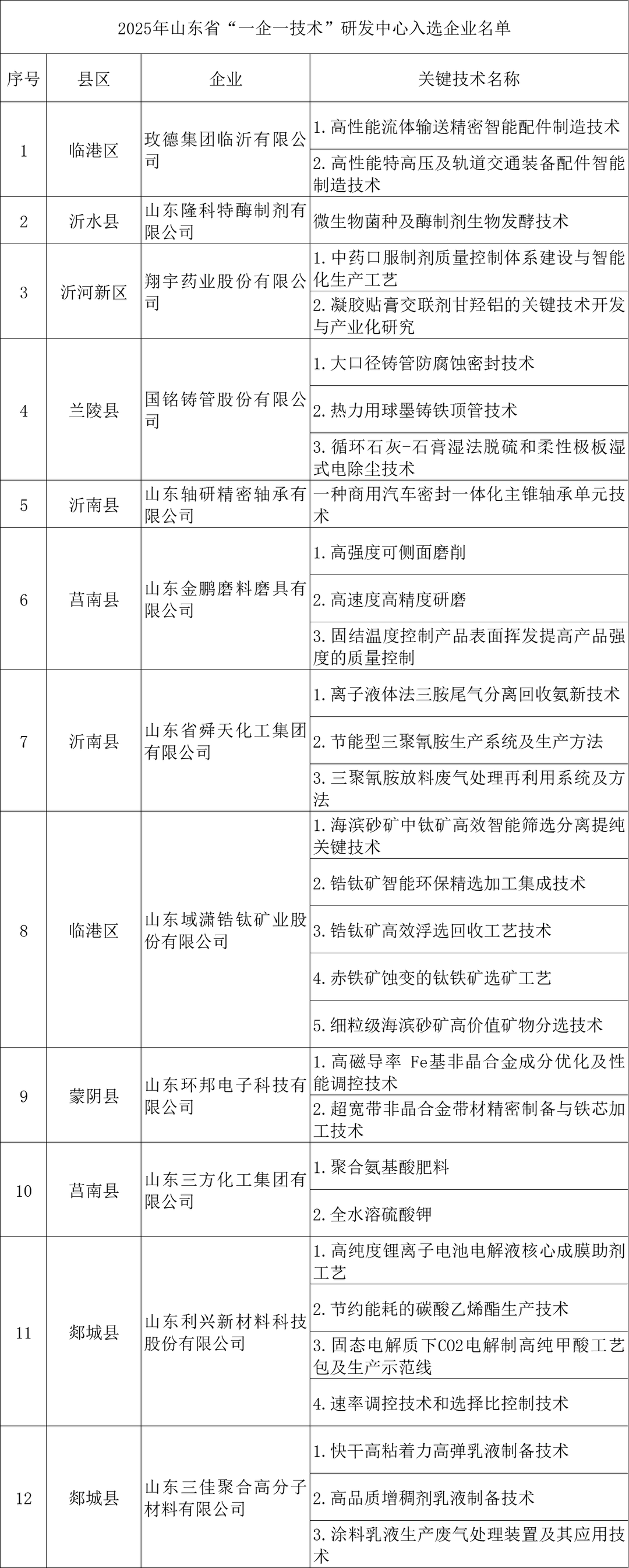
Core Insights - The Shandong Provincial Department of Industry and Information Technology announced the list of "One Enterprise, One Technology" R&D centers for 2025, with 12 companies, including Linyi Xiangyu Pharmaceutical Co., Ltd. and Shandong Longkote Enzyme Preparations Co., Ltd., successfully selected [1] Group 1: R&D Center Development - Linyi City has focused on building enterprise R&D platforms to gather industrial innovation resources, enhance R&D capabilities, and accelerate the transformation of scientific achievements [1] - A total of 243 provincial-level "One Enterprise, One Technology" R&D platforms have been cultivated in Linyi City, ranking among the top in the province [1] Group 2: Future Plans - The Municipal Bureau of Industry and Information Technology will continue to improve the technology innovation platform cultivation system throughout its lifecycle [1] - The bureau aims to leverage various scientific and technological innovation platforms for technology R&D, achievement transformation, and industry-academia-research cooperation, promoting deep integration of technological and industrial innovation [1] Group 3: Selected Companies and Technologies - The selected companies and their key technologies include: - Gaode Group Linyi Co., Ltd.: High-performance fluid transport precision intelligent component manufacturing technology [1] - Shandong Longkote Enzyme Preparations Co., Ltd.: Microbial strains and enzyme preparations bio-fermentation technology [1] - Xiangyu Pharmaceutical Co., Ltd.: Quality control system construction for traditional Chinese medicine oral preparations and key technology development for gel patch crosslinking agents [1] - Guoming Casting Co., Ltd.: Large-diameter cast pipe anti-corrosion sealing technology [1] - Shandong Axis Research Precision Bearing Co., Ltd.: Integrated main cone bearing unit technology for commercial vehicles [1] - Shandong Jinpeng Abrasives Co., Ltd.: High-speed high-precision grinding technology [1] - Shandong Shuntian Chemical Group Co., Ltd.: New technology for ammonia separation and recovery from tail gas using ionic liquid [1]

8月辽宁工业生产者出厂价格同比下降4.5%
Xin Hua Cai Jing· 2025-09-11 08:12
Core Insights - In August 2025, the Producer Price Index (PPI) in Liaoning decreased by 4.5% year-on-year, with a narrowing decline of 1.3 percentage points compared to the previous month. Month-on-month, it increased by 0.1%, a decrease in growth of 0.2 percentage points from the last month [1] - The Industrial Producer Price Index (IPI) fell by 6.1% year-on-year, with a narrowing decline of 0.7 percentage points from the previous month. Month-on-month, it shifted from a decrease of 0.2% to an increase of 0.3% [1] Price Trends - The prices of production materials decreased by 3.4% year-on-year in August, with specific declines in various sectors: mining industry down by 8.8%, raw materials industry down by 4.6%, and processing industry down by 1.5% [1] - Consumer goods prices saw a year-on-year decline of 9.6%, with durable goods down by 16.9%, food down by 3.3%, general daily necessities down by 2.4%, and clothing down by 0.3% [1] Raw Material Price Movements - In August, the prices of nine major raw materials showed a mixed trend with "two increases and seven decreases." Notable increases included non-ferrous metals and wire materials up by 2.2%, and textile raw materials up by 1.1% [1] - Other industrial raw materials and semi-finished products decreased by 1.3%, wood and pulp materials down by 1.9%, construction materials and non-metallic materials down by 3.2%, black metal materials down by 6.9%, chemical raw materials down by 8.1%, agricultural and sideline products down by 10.5%, and fuel and power down by 10.6% [1]
日度策略参考-20250905
Guo Mao Qi Huo· 2025-09-05 06:07
Report Industry Investment Ratings - No specific industry investment ratings are provided in the report. Core Views of the Report - Short - term stock index futures basis widens again, and with liquidity drive, short - term index adjustment may bring long - position layout opportunities [1]. - Short - term gold price may shift to high - level consolidation, but the long - term center of gravity still has upward space; silver may run at a high level in the short term but has the risk of increased volatility [1]. - Aluminum price fluctuates due to weak domestic downstream demand in the off - season and the expectation of the Fed's interest rate cut; zinc price has limited downside space despite inventory pressure; nickel price follows the macro trend in the short term and long - term surplus pressure remains [1]. - Stainless steel futures fluctuate weakly in the short term, and attention should be paid to the actual production of steel mills; tin price is strong in the short term; industrial silicon, polysilicon, and lithium carbonate have their own market characteristics and influencing factors [1]. - Steel products such as rebar and hot - rolled coil have neutral valuations, unclear industrial drivers, and warm macro drivers; iron ore has upward opportunities in the far - month contracts; coal and coke prices are under pressure [1]. - Palm oil and soybean oil are expected to run in a volatile manner; rapeseed oil is recommended to be observed; cotton price may range - bound in the short term; sugar supply is expected to be loose; corn has limited short - term rebound and downward space in the medium term [1]. - Crude oil, fuel oil, and other energy - related products are affected by geopolitical situations, OPEC+ policies, and the Fed's interest rate cut expectations; various chemical products such as PTA, short - fiber, and styrene have their own market trends and influencing factors [1]. - Alumina price is under pressure due to weak fundamentals; copper price is expected to rise; some products like soda ash and ethylene glycol face supply - surplus pressure [1]. Summary by Related Catalogs Macro - finance - **Treasury bonds**: No clear trend judgment provided [1]. - **Gold**: Short - term high - level consolidation, long - term upward space [1]. - **Silver**: Short - term high - level operation with increased volatility risk [1]. Non - ferrous metals - **Aluminum**: Fluctuates due to domestic demand and Fed rate - cut expectation, pay attention to far - month long - position opportunities [1]. - **Zinc**: Limited downside space, be cautious about short - selling in the short term [1]. - **Nickel**: Follows macro trend in the short term, long - term surplus pressure exists, focus on short - term trading and selling hedging opportunities [1]. - **Stainless steel**: Short - term weak fluctuations, pay attention to actual production of steel mills [1]. - **Tin**: Strong in the short term [1]. - **Industrial silicon**: Supply resumes, high hedging pressure, polysilicon production cut expected [1]. - **Polysilicon**: Capacity reduction expected in the long - term, low terminal installation willingness, good profit [1]. - **Lithium carbonate**: Frequent resource - end disturbances, large short - term downstream replenishment, limited subsequent replenishment space [1]. Ferrous metals - **Rebar and hot - rolled coil**: Neutral valuations, unclear industrial drivers, warm macro drivers [1]. - **Iron ore**: Upward opportunities in far - month contracts [1]. - **Coking coal and coke**: Prices are under pressure [1]. Agricultural products - **Palm oil and soybean oil**: Expected to run in a volatile manner, consider exiting long positions [1]. - **Rapeseed oil**: Recommended to observe [1]. - **Cotton**: Short - term range - bound [1]. - **Sugar**: Supply expected to be loose, price with upper - bound pressure [1]. - **Corn**: Limited short - term rebound, downward space in the medium term [1]. - **Pulp**: Consider 11 - 1 positive spread [1]. - **Log**: Weakly fluctuating [1]. - **Pig**: Bearish due to increased supply and lower costs [1]. Energy and chemicals - **Crude oil and fuel oil**: Affected by geopolitics, OPEC+ policies, and Fed rate - cut expectations [1]. - **PTA**: Production resumes, price difference expands, and short - term upward momentum is strong [1]. - **Short - fiber**: Factory overhauls increase, and warehouse receipts increase [1]. - **Styrene**: Bearish due to industry reform rumors and weakening market transactions [1]. - **Urea**: Limited upside space, supported by cost [1]. - **PVC**: Fluctuates weakly, with supply pressure and more near - month warehouse receipts [1]. - **LPG**: Affected by international oil prices, CP prices, and downstream profit conditions [1]. Others - **Shipping**: Supply exceeds the same - period level, and freight rates decline [1]. - **Alumina**: Weak fundamentals put pressure on prices [1]. - **Copper**: Expected to rise, consider stopping profit for spot - futures positive spread [1]. - **Soda ash**: Bearish due to supply surplus [1]. - **Ethylene glycol**: Affected by industry reform rumors and hedging pressure [1].
这4只金股,纳入富时中国A50指数
Zheng Quan Shi Bao· 2025-09-03 22:40
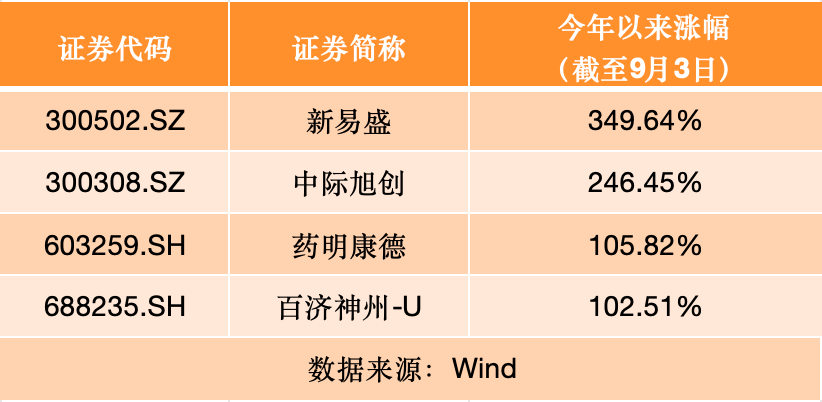
Core Insights - FTSE Russell announced quarterly review changes for several indices including FTSE China 50 Index, FTSE China A50 Index, FTSE China A150 Index, FTSE China A200 Index, and FTSE China A400 Index, effective after market close on September 19, 2025 [1] - The most notable change is the inclusion of four stocks in the FTSE China A50 Index: BeiGene Ltd (百济神州-U), Xinyisheng (新易盛), WuXi AppTec (药明康德), and Zhongji Xuchuang (中际旭创), while excluding China National Nuclear Power, China Unicom, GD Power Development, and Wanhua Chemical [1] - According to Wind statistics, the newly included stocks have all seen significant price increases, with gains exceeding 100% year-to-date as of September 3, 2023 [1][2] Stock Performance - Xinyisheng (新易盛) has increased by 349.64% year-to-date [2] - Zhongji Xuchuang (中际旭创) has increased by 246.45% year-to-date [2] - WuXi AppTec (药明康德) has increased by 105.82% year-to-date [2] - BeiGene Ltd (百济神州-U) has increased by 102.51% year-to-date [2] Backup Stocks - The backup stock list for the FTSE China A50 Index includes Minsheng Bank, Luoyang Molybdenum, Tonghuashun, SAIC Motor, and Seres [2] - These backup stocks will be considered for inclusion if any of the current constituents are removed before the next quarterly review [2]



瑞银:A股具备更大上行潜力,聚焦核心资产一键布局机会
Mei Ri Jing Ji Xin Wen· 2025-08-21 06:21
Core Viewpoint - The A-share market continues its upward trend, with the Shanghai Composite Index reaching a ten-year high, driven by retail capital inflows and increased trading volume [1] Group 1: Market Performance - The MSCI China A50 Connect Index rose over 0.6%, with leading stocks such as Muyuan Foods, Mindray Medical, and Wanhua Chemical showing significant gains [1] - A-share trading volume has increased by 80% year-on-year, indicating heightened market activity [1] Group 2: Investor Sentiment - Retail participation in the A-share market typically increases as the market strengthens, suggesting a greater potential for upward movement [1] - The financing balance has also seen a substantial rise, reflecting increased investor confidence [1] Group 3: A50 ETF Insights - The A50 ETF closely tracks the MSCI China A50 Connect Index, providing exposure to 50 leading stocks and covering core assets in the A-share market [1] - Companies classified as central state-owned enterprises account for over 50% of the index's weight, indicating a strong presence of government-backed firms [1] - The total cash dividends for 2024 are projected to exceed 990 billion yuan, with a dividend payout ratio of 40.28% and a 12-month dividend yield of 3.36%, highlighting both growth and income potential [1]
ETF资金周报(8/4-8/8)|宽基板块延续流出态势,化工ETF(159870)近20日流入超26亿、规模突破42亿
Sou Hu Cai Jing· 2025-08-12 10:30
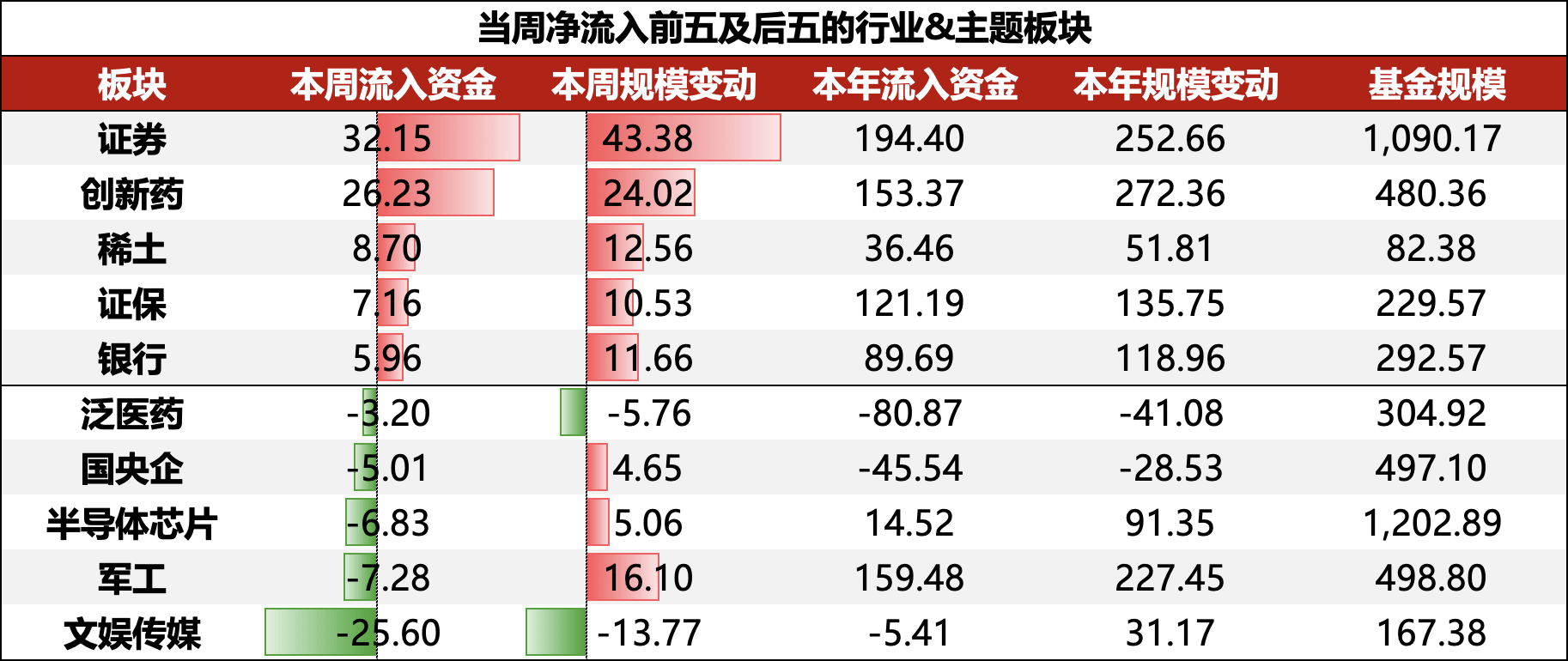
Market Overview - The total scale of equity ETFs in the market reached 39,566.74 billion yuan, with an increase of 582.16 billion yuan in total scale over the past week and a net inflow of 48.40 billion yuan [1] Fund Inflow and Outflow Directions - In the broad-based and strategy ETF segment, the top three inflow sectors were Free Cash Flow, CSI 2000, and CSI 1000, while the top three outflow sectors were CSI 300, STAR 50, and SSE 50 [2] - In the industry and thematic ETF segment, the top five inflow sectors were Securities, Innovative Drugs, Rare Earths, Insurance, and Banking, while the top five outflow sectors were Entertainment Media, Military Industry, Semiconductor Chips, State-owned Enterprises, and Pan-Medicine [2] Weekly Net Inflow and Outflow by Industry - The top five sectors with net inflows were Securities (32.15 billion yuan), Innovative Drugs (26.23 billion yuan), Rare Earths (8.70 billion yuan), Insurance (7.16 billion yuan), and Banking (5.96 billion yuan) [3] - The sectors with the largest net outflows included Entertainment Media (-25.60 billion yuan), Military Industry (-7.28 billion yuan), Semiconductor Chips (-6.83 billion yuan), State-owned Enterprises (-5.01 billion yuan), and Hanfu Pharmaceuticals (-3.20 billion yuan) [3] Chemical Industry Insights - The chemical ETF saw a net inflow of 3.53 billion yuan over the past five days, with a total inflow of 26.09 billion yuan over the past 20 days, indicating strong investor interest [3] - The chemical industry faces challenges such as overcapacity and intensified competition, leading to a decline in overall profit margins [3] - The "anti-involution" policy aims to optimize industrial layout and accelerate the elimination of inefficient capacity, which may enhance industry concentration and benefit leading companies [3] Performance of Various Indices - The CSI 500 index showed a significant increase of 10.44%, while the CSI 1000 index increased by 14.78% [5] - The Hong Kong Stock Connect sectors, particularly the Hong Kong Stock Connect Technology sector, experienced a notable increase of 40.71% [6] Sector Performance - The financial sector, particularly the banking segment, showed a positive performance with a 13.56% increase in the CSI Bank index [7] - The consumer sector, specifically the liquor segment, faced a decline of 9.76% [7]