金属

Search documents
金属暴涨加剧美国通胀隐忧!巴克莱测算:金属每涨10%,CPI涨0.3%
Hua Er Jie Jian Wen· 2026-02-04 13:12
2026年伊始,全球市场见证了一场惊人的金属狂欢,这不仅是资产价格的重估,更是一个被市场严重低 估的宏观通胀信号。巴克莱最新研报指出,通胀市场目前对金属价格暴涨的风险定价过低。 据追风交易台,1月3日,巴克莱认为,如果金属价格出现持续性的10%的上涨冲击,将在两年内推高名 义CPI约0.3个百分点,推高核心CPI约0.2个百分点。虽然直接传导效应看似温和,但在当前甚至出现白 银暴涨150%的极端行情下,这种累积效应不容忽视。 目前的市场叙事被原油价格的下跌所迷惑,导致通胀掉期和远期市场未能充分计入金属带来的上行风 险。对于投资者而言,这意味着当前的通胀对冲成本可能被低估,通胀预期的分布正在发生实质性右移 (向更高通胀偏移)。 金属狂潮:2026年的开局暴击 2026年开年至今,基本金属和贵金属市场并未如传统预期般运行,而是上演了一场全面且剧烈的反弹, 推动多个板块逼近或突破历史高点。自2025年1月1日以来,白银即便在近期大幅抛售之后,涨幅仍超过 150%;黄金上涨80%;锡上涨60%;铜上涨50%;铝上涨20%。 巴克莱指出,这种价格行为的背景极其复杂,包括外国储备管理者的偏好转移、金融条件的宽松、对美 元 ...
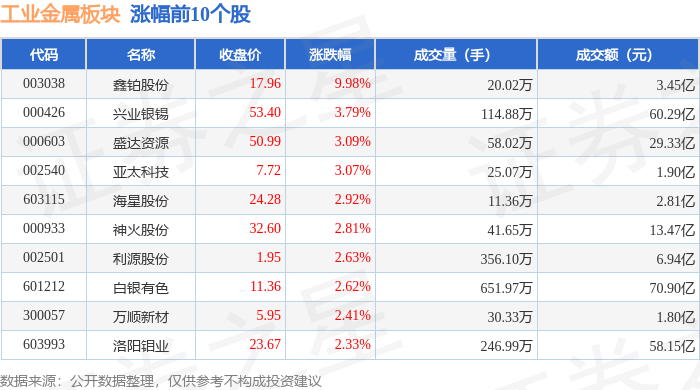
工业金属板块2月4日涨0.92%,鑫铂股份领涨,主力资金净流出40.61亿元
Zheng Xing Xing Ye Ri Bao· 2026-02-04 08:49
Core Insights - The industrial metal sector saw an increase of 0.92% on February 4, with Xinbo Co., Ltd. leading the gains [1] - The Shanghai Composite Index closed at 4102.2, up 0.85%, while the Shenzhen Component Index closed at 14156.27, up 0.21% [1] Industrial Metal Sector Performance - Notable gainers included: - Zhengpai Co., Ltd. with a closing price of 17.96, up 9.98% and a trading volume of 200,200 shares, totaling 345 million yuan [1] - Xingye Silver Tin at 53.40, up 3.79% with a volume of 1,148,800 shares, totaling 6.029 billion yuan [1] - Shengda Resources at 50.99, up 3.09% with a volume of 580,200 shares, totaling 2.933 billion yuan [1] - Other significant performers included: - Yatai Technology at 7.72, up 3.07% [1] - Haixing Co., Ltd. at 24.28, up 2.92% [1] Decliners in the Sector - Major decliners included: - Zinc Industry Co., Ltd. at 5.85, down 6.55% with a trading volume of 2,016,400 shares, totaling 1.187 billion yuan [2] - Guocheng Mining at 27.75, down 3.28% with a volume of 166,700 shares, totaling 467 million yuan [2] - Tongling Nonferrous Metals at 7.66, down 2.30% with a volume of 9,658,500 shares, totaling 7.501 billion yuan [2] Capital Flow Analysis - The industrial metal sector experienced a net outflow of 4.061 billion yuan from institutional investors, while retail investors saw a net inflow of 3.231 billion yuan [2] - Notable capital flows included: - Shenhuo Co., Ltd. with a net inflow of 102 million yuan from institutional investors [3] - Xinbo Co., Ltd. with a net inflow of 84.069 million yuan from institutional investors [3] - Zijin Mining with a net inflow of 75.083 million yuan from institutional investors [3]



金属巨震后,年前及年后策略
2026-02-04 02:27
李怡然 兴业证券金属首席: 各位投资者大家早上好,我是兴业金属首席分析师李依然。然后今天早上,借着这个时间 然后跟各位投资者分享一下,就是我们对于整个金属的年前年后的一个策略。其实从整个 上周开始,其实大家也关注到整个商品端出现了一次比较大的波动,这次波动其实各方面 的解释可能更多的聚焦在整个宏观沃什这边,那我们这次想要从另一个角度去。分享一下 我们对于微观面的一些看法。那首先,其实我们能看到,就是上周三周四的时候,其实整 个铜铝商品端,出现了一个单日比较大的一个放量上涨。 那其实这个原,这个点的这个催化,其实我们更多的是认为,其实因为整个交易所前期对 于整个这个广西所这边的监管,带来的一定的这个资金端的这个流转。那其实前期对于整 个差别品种的这个限仓以及限制出金的交易之后,其实更多的资金其实转向了整个上期所 那既然转向了一个相对来说监管比较小的品种,或者说整个资金容纳度比较大的品种,那 在整个声波交易中,其实是放大它的整个投资收益。因此,其实选择了像铜铝这样的一个 比较大的国际化的一个品种去做一个。 这个生波交易。那这个生波交易过程中,其实也能看到,其实外盘的价格其实在被动的跟 着内盘走,基本上可以确定,当 ...
未知机构:科创50139创业板指1-20260204
未知机构· 2026-02-04 02:10
现金成交额较昨日略有下降。 资金流向 买盘优于卖盘 1.14,我们正在买入,同时卖出电动汽车。 科创 50:+1.39% 创业板指:+1.86% 中证 500:+3.11% 上证综指:+1.29% 上证 50:+1.05% 沪深 300:+1.18% :2.57 万亿元人民币 当日市场动态 :中国股市今日出现重大反转,收盘上涨。 :工程机械是午后表现最佳的板块之一,其中。 当地反馈表明,市场 科创 50:+1.39% 创业板指:+1.86% 中证 500:+3.11% 上证综指:+1.29% 上证 50:+1.05% 沪深 300:+1.18% :2.57 万亿元人民币 当日市场动态 :中国股市今日出现重大反转,收盘上涨。 :工程机械是午后表现最佳的板块之一,其中。 当地反馈表明,市场对 1 月份出口销售数据的投机有所增加。 :CPO 概念股也出现强劲上涨,以反映周末发布的盈利数据,但由于整体市场疲软,首个交易日遭到抛售。 :现货期货企稳后,金属股在午后也出现强劲反弹。 :尽管市场反弹,ETF 成交量总体稳定,表明风险偏好更多是由本地机构和散户推动。 ...
特朗普宣布下调对印度关税,2026年“印度行情”能否回归
2 1 Shi Ji Jing Ji Bao Dao· 2026-02-03 13:47
Group 1 - The Indian stock market, which faced the worst performance among emerging markets in 2025, is experiencing renewed optimism following a trade agreement with the U.S. that includes a reduction in tariffs on Indian goods [1][2] - The U.S. will lower the tariff rate on Indian goods from 25% to 18%, effective immediately, while India will stop purchasing Russian oil, which is expected to stabilize the Indian rupee and attract foreign investment back into the market [1][4] - Following the announcement, the Nifty 50 index rose by 2.55% and the Sensex index increased by 2.54%, marking the strongest single-day gains since May of the previous year [1] Group 2 - Despite the high tariffs imposed by the U.S., India's economy has shown resilience, with GDP growth projected at 7.4% for the fiscal year 2025-26, up from 6.5% in the previous year [2] - The Indian rupee appreciated by 1.5% against the dollar, reaching 90.1250, indicating a potential recovery after a year of depreciation [1][3] - The trade agreement is expected to have a positive structural impact on India's economy, enhancing its strategic importance to global investors and improving market sentiment [6] Group 3 - Various sectors related to exports, including automotive, pharmaceuticals, energy, and infrastructure, saw significant gains, with increases exceeding 2% [5] - Analysts predict that 2026 could be a recovery year for the Indian stock market, with firms like Goldman Sachs and HSBC upgrading their ratings on Indian stocks due to recent government reforms [6] - However, concerns remain regarding the attractiveness of Indian equities, as the market's valuation remains high compared to other emerging markets, with a premium of 55% to 60% [7][8]
懒人财知道:2月3日商品期货复盘总结 商品巨震高风险阶段保守观望
Xin Lang Cai Jing· 2026-02-03 09:11
Group 1 - Strong sectors today include non-ferrous metals, energy chemicals (some varieties), and shipping sectors [3][16] - Weakest sectors are black metals (iron ore) and agricultural products (live pigs) [3][16] - Core long positions are in copper, PVC, and alumina, while core short positions are in live pigs and iron ore [3][16] Group 2 - The global situation shows a sharp reversal in Federal Reserve policy expectations, with Trump's nomination of Waller as Fed Chair causing market turbulence [3][16] - The core advocacy of "rate cuts + aggressive balance sheet reduction" strengthens the dollar, leading to significant market differentiation [3][16] - The market has shifted from being "financially driven" to "fundamentally priced," with increased volatility and a failure of single trend logic [3][16] Group 3 - Domestic recovery and production pace exceed expectations, supporting demand for industrial metals and some energy chemicals [3][16] - High inventory levels in black metals and persistent overcapacity in agricultural products create a foundation for long-short hedging strategies [3][16] Group 4 - Long strategy for PVC includes a low-entry position with a maximum of 6% of total equity, targeting a price range of 4780-4820 points [5][18] - Long strategy for copper involves a strong bullish stance with a maximum of 10% of total equity, targeting a price range of 101000-101800 points [6][19] - Long strategy for alumina suggests a left-side layout with a maximum of 5% of total equity, targeting a price range of 2580-2600 points [7][20] Group 5 - Short strategy for live pigs involves a rebound short with a maximum of 7% of total equity, targeting a price range of 11200-11250 points [8][21] - Short strategy for iron ore suggests a high short position with a maximum of 8% of total equity, targeting a price range of 785-790 points [9][22] Group 6 - The effectiveness of strategies shows a precise match with fundamentals, focusing on "supply-demand gaps + demand recovery" for long positions and "high inventory + supply increase" for short positions [10][23] - The overall position balance is reasonable, with long positions at 21% and short positions at 15%, allowing for hedging space [10][23] Group 7 - Macro variables such as the progress of Waller's nomination, domestic recovery data, and overseas manufacturing recovery will influence long-short logic [12][25] - Potential opportunities for long positions include lithium carbonate and European shipping line pullback, while short positions should be cautious of supply contractions in coking coal and coke [12][25]

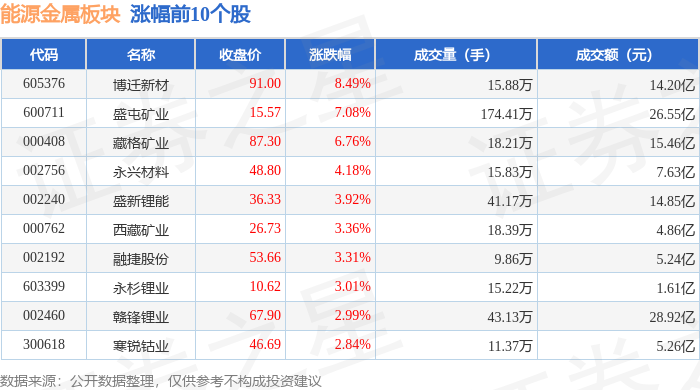
能源金属板块2月3日涨4.02%,博迁新材领涨,主力资金净流入7758.58万元
Zheng Xing Xing Ye Ri Bao· 2026-02-03 09:03
Group 1 - The energy metals sector increased by 4.02% on February 3, with Boqian New Materials leading the gains [1] - The Shanghai Composite Index closed at 4067.74, up 1.29%, while the Shenzhen Component Index closed at 14127.1, up 2.19% [1] - Key stocks in the energy metals sector showed significant price increases, with Boqian New Materials rising by 8.49% to a closing price of 91.00 [1] Group 2 - The main capital inflow in the energy metals sector was 77.59 million yuan, while retail investors saw a net inflow of 17 million yuan [1] - Boqian New Materials had a net inflow of 71.92 million yuan from main capital, with a 5.07% share of the total [2] - Retail investors showed a net outflow of 1.12 billion yuan from Shengxin Lithium Energy, despite a net inflow of 68.88 million yuan from main capital [2]


日度策略参考-20260203
Guo Mao Qi Huo· 2026-02-03 03:13
Report Summary 1. Industry Investment Ratings - **Bullish**: Biodiesel, Cottonseed Oil, Rapeseed Oil [1] - **Bearish**: Soybeans, Crude Oil, Fuel Oil, Asphalt, LPG, Container Shipping on European Routes [1] - **Neutral**: Most other industries including stocks, bonds, and various metals and agricultural products, with suggestions of short - term caution, waiting for opportunities, and controlling risks [1] 2. Core Views - **Macro - financial**: In the short term, policies will support the A - share market, but overseas liquidity tightening may cause panic. In the long run, the stock index is still expected to rise due to low - interest rates, "asset shortage" and economic bottom - building. Asset shortage and weak economy are beneficial for bond futures, but the central bank has warned of interest - rate risks [1]. - **Metals**: Macro - level risk aversion is pressuring the non - ferrous metals sector. Supply concerns in Indonesia are affecting nickel and stainless steel, while other metals like zinc, tin, etc. are facing different price trends and risks [1]. - **Agricultural products**: Different agricultural products have different market situations. For example, cotton has support but lacks a driving force; sugar has a bearish consensus but cost support; grains are expected to oscillate and decline before the holiday [1]. - **Energy and Chemicals**: The energy and chemical sector is affected by various factors such as geopolitical events, supply - demand relationships, and cost changes. Some products like PTA, ethylene glycol, and styrene are showing different price movements and trends [1]. 3. Summary by Related Catalogs **Macro - financial** - **Stocks**: Short - term caution is advised due to A - share weakness and overseas liquidity concerns. Long - term upward trend is expected due to low - interest rates and economic recovery [1]. - **Bonds**: Asset shortage and weak economy are favorable for bond futures, but short - term interest - rate risks are highlighted, and the Japanese central bank's interest - rate decision should be monitored [1]. **Metals** - **Non - ferrous metals**: Overall under pressure from risk aversion. Nickel and stainless steel are affected by Indonesian supply issues. Zinc is expected to correct, and tin's price has fluctuated but not in a trend - reversing way. Gold and silver are in short - term oscillatory or stabilizing trends. Platinum and palladium may be supported in the short term [1]. - **Industrial metals**: Alumina is expected to oscillate near the cost line. Steel products (rebar, hot - rolled coil) have limited upward space, and iron ore has a clear upper pressure [1]. **Agricultural products** - **Grains and oilseeds**: Soybeans are expected to be weak. Cotton is "supported but without a driver". Sugar has a bearish consensus but cost support. Grains are expected to decline before the holiday [1]. - **Livestock**: The pig production capacity still needs to be further released [1]. **Energy and Chemicals** - **Fossil fuels**: Crude oil and fuel oil may be affected by OPEC+ policies, geopolitical events, and market sentiment. Asphalt has high profits but is also affected by supply and demand [1]. - **Chemicals**: PX drives the chemical sector. PTA, ethylene glycol, and styrene have different supply - demand and price trends. Methanol, polyethylene, PVC, and LPG are affected by various factors such as geopolitical risks, supply - demand relationships, and cost changes [1]. **Shipping** - **Container shipping**: The freight rate on European routes has peaked and declined before the holiday. Airlines are cautious about resuming flights and plan to raise prices after the off - season in March [1].
收评:沪指跌2.48% 电网设备板块逆势活跃
Jing Ji Wang· 2026-02-02 09:16
Market Overview - The Shanghai Composite Index closed at 4015.75 points, down 2.48%, with a trading volume of 11635.33 billion yuan [1] - The Shenzhen Component Index closed at 13824.35 points, down 2.69%, with a trading volume of 14212.32 billion yuan [1] - The ChiNext Index closed at 3264.11 points, down 2.46%, with a trading volume of 6768.91 billion yuan [1] Sector Performance - The power grid equipment sector showed resilience, with Tongguang Cable hitting a 20% limit up, and companies like Senyuan Electric, Baobian Electric, and Sanbian Technology also reaching the limit up [1] - The liquor sector was active again, with Huangtai Liquor and Jinhui Liquor hitting the limit up [1] - Resource cyclical sectors, including metals, oil and gas, chemicals, coal, and steel, experienced significant declines [1] - The semiconductor sector also saw a substantial downturn [1]


贵金属转为失速暴跌:金银高位去杠杆,全球市场迎来压力测试
Xin Lang Cai Jing· 2026-02-02 07:17
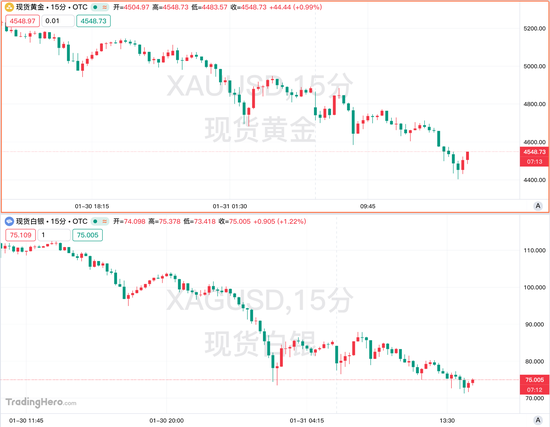
Core Viewpoint - The precious metals market is experiencing a historic crash, with gold prices nearing $4,400 per ounce and silver prices dropping below $72 per ounce, erasing significant gains made throughout the year [1][3][15]. Market Performance - On the previous Friday, gold and silver prices plummeted, with silver falling 26% in less than 20 hours, marking the largest single-day drop in history, while gold dropped 9%, the worst performance since the 1980s [3][17]. - The domestic futures market also saw a "limit down" trend, with significant declines across various sectors, including energy and precious metals, where contracts for SC crude oil and fuel oil hit their limits with declines of 7.02% and 7.01% respectively [3][17]. Regulatory Changes - CME raised margin requirements for Comex gold and silver futures in response to the volatility, increasing gold margins from 6% to 8% and silver from 11% to 15%, effective February 2 [4][18]. - The Thailand Futures Exchange expanded its price limits for gold and silver futures due to significant price drops, allowing for greater fluctuations in trading [4][18]. Analyst Perspectives - Analysts suggest that the recent declines in precious metals are driven by a deleveraging process rather than a fundamental shift in market conditions, indicating a simultaneous sell-off of precious metals and risk assets [5][19]. - CBA commodity strategist Vivek Dhar noted that the market's reaction to Kevin Walsh's nomination as Fed Chair and the strengthening dollar has pressured precious metals, but he views the current drop as an adjustment rather than a fundamental change, maintaining a bullish outlook for gold prices in Q4 [7][21]. - CMC Markets' Christopher Forbes described the situation as a typical deleveraging phase, where previously accumulated leverage is being cleared, leading to a concentrated sell-off in liquid assets [8][22]. Market Dynamics - The rapid price changes in precious metals are seen as a result of position liquidation rather than a clean macro revaluation, with potential for further declines depending on whether forced selling continues [9][23]. - Analysts from Singapore's OCBC Bank highlighted that the ongoing decline reflects a combination of technical and emotional pressures, with sensitivity to dollar movements and Fed policy uncertainty exacerbating the situation [9][23]. Institutional Role - Increased trading activity from institutions has been noted, as they seek liquidity and manage positions amid heightened volatility, which has also impacted other markets like Bitcoin and equities [13][26]. - The volatility in gold and silver has triggered liquidity pressures and margin calls among institutional investors, contributing to broader market declines [13][26].