
AI产业链

Search documents
【十大券商一周策略】持股过节,性价比较高!10月新一轮上行正在蓄势
券商中国· 2025-09-28 15:09
Group 1 - The core viewpoint emphasizes resource security, corporate globalization, and technological competition as the main structural market clues, with a focus on resource allocation in the context of new productive forces [2] - The resource sector is driven by insufficient investment in traditional resource industries under a high global interest rate environment, leading to supply constraints [2] - The corporate globalization of Chinese companies is seen as a crucial but subtle fundamental aspect of the current market, with the stability of trade environments and the reduction of internal competition being key conditions [2] Group 2 - The third quarter is expected to show improved or sustained high growth in specific sectors, particularly in mid-to-high-end manufacturing and the AI industry chain [3] - Key sectors include battery manufacturing, military electronics, and AI-related components, which are anticipated to benefit from a recovering PPI and resilient export growth [3] - Resource products such as fluorochemicals, copper, and gold are also expected to see price increases due to improved supply-demand dynamics [3] Group 3 - The market is currently experiencing short-term volatility, but the overall trend remains positive, with structural opportunities still prominent [5] - The upcoming important meetings, such as the 20th National Congress, are expected to serve as critical points for market validation and potential recovery in risk appetite [5] - The focus for investment opportunities is on themes like new productive forces, consumer sectors, and areas benefiting from the reduction of internal competition [5] Group 4 - The market is expected to maintain a strong upward trend post-National Day, with historical patterns suggesting a favorable environment for stocks after holidays [6] - The focus is shifting towards sectors with structural growth, particularly in technology, new energy, and innovative pharmaceuticals [6] - The market's liquidity is anticipated to remain favorable, supported by ongoing improvements in macroeconomic conditions [6] Group 5 - The market is likely to experience a "red October," with continued support from long-term policy layouts and technological catalysts [8] - The technology sector is expected to maintain a dominant trend, with significant opportunities arising from new catalysts and structural changes [8] - The focus on anti-involution is seen as a key factor in transitioning from a structural bull market to a more comprehensive bull market [8] Group 6 - The current bull market is characterized by a lack of clear bubble signals, with strong structural features and a focus on key indicators [9] - The market is expected to remain in a strong oscillating state around the National Day, with no significant downturn risks anticipated [9] - The transition from a technology-driven growth model to one that includes export and globalization is being highlighted as a future trend [13]


别看行情很热,但赚钱并不容易
雪球· 2025-09-22 07:58
Core Viewpoint - The current bull market in A-shares has seen significant gains, with the ChiNext Index and STAR Market Index rising by 91.65% and 98.41% respectively since the market bottom on September 24 last year, indicating that the market has been performing for a considerable time [4][5]. Market Performance - The bull market has been characterized by rapid shifts in market hotspots, making it challenging for investors to achieve satisfactory returns unless they were actively engaged during key trading days [4][5]. - As of September 8, major indices like the CSI 300 and the CSI A500 have increased by 16.1% and 18.62% respectively this year, while the ChiNext Index has seen a remarkable rise of 38.5% [6]. Investment Strategies - Investors are advised to reduce trading frequency and hold onto their positions rather than chasing market trends, as this approach may yield better returns in the long run [5]. - Maintaining a defensive position with a portion of value-style assets is recommended to navigate market volatility, with suggestions to upgrade holdings to funds that exhibit strong defensive characteristics during downturns [7]. - Selecting and patiently holding onto industry themes such as AI, innovative pharmaceuticals, robotics, semiconductors, and precious metals is encouraged, while also considering less popular sectors for potential opportunities [8]. Asset Allocation - A "core-satellite" strategy is proposed, where the core portfolio consists of stable, high-probability assets, while a smaller portion is allocated to riskier assets for potential high returns [8].

外资看好中国市场,青睐科技板块
Zhong Guo Zheng Quan Bao· 2025-09-13 05:05
Group 1 - Morgan Stanley's recent survey indicates that over 90% of participating investors are willing to increase their exposure to the Chinese market, marking the highest level since early 2021 [1][2] - Foreign capital inflow into Chinese stocks reached the largest monthly net purchase since September 2024, with a 76 basis point increase in total allocation to 6.4% in August, the highest in nearly two years [2] - Korean investors have shown significant interest, with trading volume in Chinese stocks reaching $6.5 billion and total holdings at $3.5 billion, a nearly 50% increase year-on-year [2] Group 2 - International investor interest in China is driven by four main factors: China's leadership in humanoid robots and biomedicine, recent economic stabilization measures, improved market liquidity, and a growing demand for diversification from the US market [2] - UBS analysts suggest that as the Chinese economy gradually recovers, corporate earnings are expected to improve, supported by innovation breakthroughs and a shift in market expectations due to policy changes [3] - The current foreign capital inflow is more direct, with US investors increasingly participating in onshore markets, particularly in sectors like AI, semiconductors, and new consumption [4] Group 3 - The investment logic of foreign capital in China is shifting from defensive to offensive, with a focus on high-growth technology and advanced manufacturing sectors, driven by policy and valuation factors [4] - The recent rise in the A-share market is attributed to multiple factors, including policy adjustments, improved liquidity, and enhanced economic fundamentals [5]
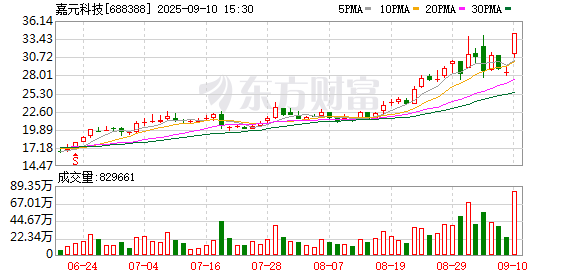
688388 20%涨停!这一概念卷土重来
Zheng Quan Shi Bao· 2025-09-10 09:13
Market Overview - A-shares experienced a rebound after a dip, with the ChiNext Index and STAR 50 Index showing strong performance, while Hong Kong stocks also strengthened, with the Hang Seng Index and Hang Seng Tech Index both rising over 1% [2] - The three major A-share indices initially fell but then recovered, with the Shanghai Composite Index closing up 0.13% at 3812.22 points, the Shenzhen Component Index up 0.38% at 12557.68 points, and the ChiNext Index up 1.27% at 2904.27 points [2] - Total trading volume in the Shanghai and Shenzhen markets reached 200.42 billion yuan, a decrease of 148.2 billion yuan from the previous day [2] Sector Performance - Resource sectors such as non-ferrous metals, coal, chemicals, and electricity collectively declined, while the oil sector saw strong gains, with Keli Co., Ltd. rising over 10% and Zhun Oil Co. hitting the daily limit [2] - The film and television sector was notably active, with Heping Blue Sea reaching a near-limit increase, and Jin Yi Film and Yue Media both hitting the daily limit [2][5] - AI-related stocks, including CPO and computing power sectors, saw a resurgence, with companies like Jiayuan Technology and Dongshan Precision hitting the daily limit [2][9] Film and Television Sector Insights - The film and television sector showed significant strength, with Heping Blue Sea rising nearly 14% and reaching a nine-year high, while Jin Yi Film and Yue Media both hit the daily limit [5] - The National Film Administration reported that the box office for the summer season from June 1 to August 31 reached 11.966 billion yuan, with a year-on-year increase of 2.76%, and total audience attendance of 321 million, up 12.75% year-on-year [6] - Upcoming films for the National Day holiday include major titles like "Assassination Novelist 2" and "Panda Project 2," which are expected to support box office performance [7] AI Industry Developments - AI-related stocks were active, with Jiayuan Technology hitting a 20% limit increase, and Shenghong Technology nearing a price of 300 yuan, marking a new high [9] - Oracle projected that cloud infrastructure sales would surge by 77% to reach $18 billion in fiscal year 2026, driven by increasing demand for AI [10] - Broadcom reported strong third-quarter earnings, with revenue of $15.95 billion, a 22% year-on-year increase, and provided a robust outlook for the fourth quarter, expecting revenue of approximately $17.4 billion, a 23.8% increase year-on-year [11] Company-Specific News - Pop Mart experienced a significant decline, dropping over 7% at one point and closing down 4.5% at 275.2 HKD per share, with a market capitalization of 369.6 billion HKD [13] - The company is facing a new wave of price drops in the secondary market, attributed to increased production capacity leading to an oversupply [14] - Morgan Stanley noted that secondary market prices may not accurately reflect true supply and demand, suggesting that Pop Mart's long-term growth prospects remain strong despite current challenges [14]

688388,20%涨停!这一概念卷土重来
证券时报· 2025-09-10 08:58
Core Viewpoint - A-shares showed a rebound after a dip, with the ChiNext and STAR 50 indices performing strongly, while Hong Kong stocks also gained momentum, with the Hang Seng Index and Hang Seng Tech Index both rising over 1% [1][2]. A-shares Market Summary - The three major A-share indices initially dipped but then rose, with the Shanghai Composite Index closing up 0.13% at 3812.22 points, the Shenzhen Component up 0.38% at 12557.68 points, and the ChiNext Index up 1.27% at 2904.27 points. The STAR 50 Index increased by 1.09% [2]. - Total trading volume in the Shanghai and Shenzhen markets was 200.42 billion yuan, a decrease of 148.2 billion yuan from the previous day [2]. - Market hotspots were diverse, with resource sectors like non-ferrous metals, coal, chemicals, and power experiencing declines, while the oil sector surged, with Keli Co. rising over 10% and Zhun Oil Co. hitting the daily limit [2]. - The film and entertainment sector was notably active, with companies like Happiness Blue Sea and Jin Yi Film both hitting the daily limit, and the newly listed Aifenda soaring 170% [2][4]. Film and Entertainment Sector - The film sector saw significant gains, with Happiness Blue Sea rising nearly 14% and reaching a nine-year high, while Jin Yi Film and Yue Media both hit the daily limit [4]. - The National Film Administration reported that from June 1 to August 31, 2025, the summer box office reached 11.966 billion yuan, with a year-on-year increase of 2.76% and attendance rising by 12.75% [5]. - Upcoming films for the National Day holiday include major titles like "Assassination Novelist 2" and "Panda Project 2," which are expected to support box office performance [5]. AI Industry Chain - Stocks in the AI industry chain, including CPO and computing power sectors, saw collective gains, with Jia Yuan Technology hitting the daily limit with a 20% increase, and Shenghong Technology nearing 300 yuan, also reaching a new high [6][7]. - Oracle projected a 77% increase in cloud infrastructure sales to $18 billion in fiscal year 2026, driven by rising AI demand, exceeding market expectations [8]. - Broadcom reported a 22% year-on-year revenue growth to $15.95 billion for its third fiscal quarter, surpassing analyst expectations and indicating strong growth in AI chip revenue [8][9]. Hong Kong Market Summary - In the Hong Kong market, stocks like Hong Teng Precision rose nearly 13%, Bilibili increased over 7%, and Lenovo Group gained nearly 5%, while Pop Mart saw a decline of over 7% [2][11]. - Pop Mart's stock has dropped approximately 18% over the past 11 trading days, attributed to a significant decline in secondary market prices for its products, despite Morgan Stanley suggesting that secondary market prices may not accurately reflect supply and demand [11].

A股,强势反弹!超4800股飘红
Zheng Quan Shi Bao· 2025-09-05 09:01
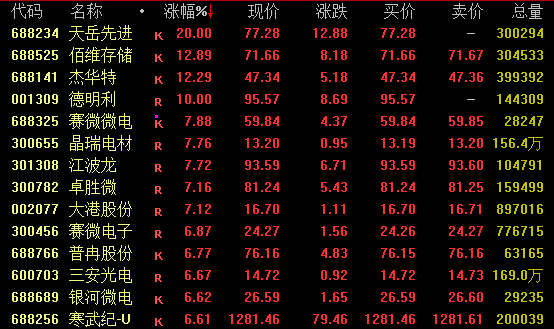
Market Overview - A-shares experienced a strong rebound on September 5, with the Shanghai Composite Index rising over 1% to return above 3800 points, and the ChiNext Index soaring over 6% [1] - The total trading volume in the Shanghai, Shenzhen, and Beijing markets reached 23,488 billion yuan, a decrease of over 2,300 billion yuan compared to the previous day [1] Semiconductor Sector - The semiconductor sector rebounded significantly, with notable stocks such as Tianyue Advanced and Bawei Storage hitting their daily limit of 20% and nearly 13% gains respectively [4][1] - Global semiconductor demand continued to improve in August, with growth in PCs, tablets, and rapid growth in TWS headphones, wearable devices, and smart home products [5][6] AI and Technology Sector - The AI industry chain stocks saw a surge, driven by the increasing demand for AI computing power and related hardware [6][10] - Companies involved in AI-related technologies, such as high-performance Ethernet switches and advanced storage products, are expected to benefit from the rising demand [6][10] New Energy Battery Sector - The solid-state battery and lithium battery concepts saw significant gains, with companies like Paiter and Tianhong Lithium Battery reaching daily limits of 30% [12][1] - The solid-state battery industry is entering a critical period of industrialization, with expected rapid growth in market size and technology advancements [14][15] Future Outlook - The solid-state battery market is projected to grow from approximately 7 GWh in 2024 to over 65 GWh by 2030, driven by policy support and technological advancements [14][15] - The electronic industry is expected to maintain steady growth, with AI continuing to be the primary driving force [10]
中欧瑞博吴伟志:投资中最困难的事 踏空后该怎么办?
Zhong Guo Zheng Quan Bao· 2025-09-03 22:49
Group 1 - The core issue of "missing out" in a rising market is more painful for investors than experiencing losses in a declining market, reflecting a typical behavior of "loss aversion" [1][2] - Professional investors often face the dilemma of either buying into a rising market, fearing to chase high prices, or staying out, fearing further market gains [1][2] - The importance of maintaining a clear mindset and emotional stability during market fluctuations is emphasized as a key trait of mature investors [1][2] Group 2 - The primary reasons for professional investors missing out on market gains include a lack of confidence in market strength and insufficient research preparation on specific stocks or sectors [3][5] - The cyclical nature of the stock market leads to a common belief that any rise is merely a rebound, causing hesitation to invest until it is too late [3][5] - Successful investors often focus on in-depth fundamental analysis of individual stocks, allowing them to remain unaffected by broader market trends [4][5] Group 3 - Understanding market adjustments requires a broader perspective beyond just significant declines in major indices; adjustments can also occur through sector rotations and varying performance among stocks [6][7] - Investors should differentiate between their interest in specific stocks or sectors versus the overall index performance, as these may not always align [7][8] - Recognizing various forms of market adjustments can prevent investors from missing opportunities in specific sectors or stocks [8] Group 4 - Current market conditions are described as healthy, with a potential for adjustments, but no signs of a market turning point are evident [9] - Strategies during strong market conditions should involve maintaining high positions and making timely adjustments rather than waiting for corrections [10][11] - The concept of "missing out" is reframed as simply not participating in leading sectors, while still having opportunities in other areas of the market [10][11]
中欧瑞博吴伟志: 投资中最困难的事,踏空后该怎么办?
Zhong Guo Zheng Quan Bao· 2025-09-03 22:44
Group 1 - The core issue of "missing out" in a rising market is more painful for investors than experiencing losses in a declining market, reflecting a typical behavior of "loss aversion" [1][2] - Professional investors often face the dilemma of whether to buy into a rising market or risk missing further gains, leading to a psychological struggle [1][2] - The experience of missing out can be particularly acute for professional investors who see others profiting while they do not [2][3] Group 2 - Two main reasons for professional investors missing out include a lack of confidence in market strength and insufficient research preparation on specific stocks or sectors [3][5] - The cyclical nature of the stock market leads investors to perceive early gains as mere rebounds, causing hesitation to participate [3][4] - Successful investors often focus on in-depth fundamental analysis of individual stocks, allowing them to remain confident and avoid missing out [4][5] Group 3 - The research team operates at full capacity regardless of market conditions, emphasizing the importance of having a solid "base" of knowledge about specific sectors and companies [4][5] - A well-prepared team can mitigate the risk of missing out by maintaining confidence and readiness to act even in uncertain market conditions [5][6] Group 4 - Investors need to have a comprehensive understanding of market adjustments, which can take various forms beyond just significant declines in broad indices [6][7] - Recognizing that adjustments can occur through sector rotations and not solely through index declines is crucial for identifying investment opportunities [7][8] Group 5 - Current market conditions are described as healthy, with a potential for adjustments, but no signs of a market turning point are evident [9][10] - Investors are encouraged to maintain high positions and adjust portfolios as necessary, rather than waiting for a market correction [9][10] Group 6 - In a strong market, it is advised to actively invest in quality stocks rather than waiting for adjustments, as this can lead to missed opportunities [10][11] - The analogy of farming illustrates that missing the right planting season can lead to lost opportunities, emphasizing the importance of timely investment actions [10][11]
投资中最困难的事,踏空后该怎么办?
Zhong Guo Zheng Quan Bao· 2025-09-03 22:42
Group 1 - The core issue of "missing out" in a rising market is more painful for investors than experiencing losses in a declining market, highlighting the psychological impact of "loss aversion" [1][2] - Professional investors often face the dilemma of whether to buy into a rising market or risk missing further gains, leading to a sense of frustration when they miss opportunities [1][2] - The lack of confidence in market strength and insufficient research preparation are primary reasons why professional investors may miss out on gains [2][3] Group 2 - The cyclical nature of the stock market, characterized by alternating strong and weak phases, contributes to investor hesitation in participating during early stages of a market upturn [2][3] - Successful investors often focus on individual stocks through in-depth fundamental analysis, allowing them to remain unaffected by broader market fluctuations [3][4] - A well-prepared research team with a strong understanding of specific sectors or companies can mitigate the risk of missing out on market opportunities [4][5] Group 3 - Investors need to broaden their understanding of market adjustments, recognizing that adjustments can take various forms beyond just significant declines in broad indices [5][6] - The current market is described as healthy, with potential for adjustments, but no signs of a market turning point are evident, suggesting a strategy of maintaining high positions [6][7] - In a strong market, it is advised to actively seek opportunities in undervalued sectors rather than waiting for adjustments, as this can lead to missed opportunities [6][7]
中欧瑞博吴伟志:投资中最困难的事,踏空后该怎么办?
Zhong Guo Zheng Quan Bao· 2025-09-03 11:52
Group 1 - The core issue of investors experiencing "踏空" (missing out on market gains) is more painful than losing money in a downturn, as it stems from "loss aversion" psychology [1][2] - Professional investors often face the challenge of missing out on gains due to a lack of confidence in market strength and insufficient research preparation [2][3] Group 2 - The first reason for missing out is a lack of confidence in market strength, leading investors to perceive initial market uptrends as mere rebounds rather than the start of a strong rally [3][4] - The second reason is the failure to conduct thorough research on individual stocks or sectors, resulting in a lack of a solid "base" for investment decisions [4][5] Group 3 - Investors need to have a comprehensive understanding of market adjustments, recognizing that adjustments can take various forms beyond just significant declines in broad indices [6][7] - The current market is healthy, with no signs of a turning point, suggesting that maintaining a high position and optimizing the portfolio is advisable [8] Group 4 - In a strong market, it is essential to actively invest in promising sectors rather than waiting for adjustments, as doing nothing can lead to missed opportunities [9][10] - Companies in undervalued sectors may present attractive investment opportunities, even if they are not the current market leaders [10]